The Race
| Next Race Date | Sunday 18 April 2027 |
|---|---|
| Course type | Loop, start and finish in Alameda Vieja |
| Registration | Open online entry, no ballot |
| Ballot opens | No ballot |
| Start | Alameda Vieja, 08:00 |
| Finish | Alameda Vieja; closes 14:30 |
| Total finishers | Not confirmed |
| Avg race-day temp | About 10 to 23°C (AEMET Jerez airport April normal) |
| Cutoff time | 6 hours 30 minutes, with a closing time at every station |
| Free race-day transport | No |
| Course certification | None; the organiser states 42.195 km on mixed road and vineyard track |
History
The Sherry Maratón began in 2017, built by the Jerez events company TerraIncognita round a simple idea: run from the centre of Jerez out into the vineyards that produce sherry and back again. The 2018 race already had its lasting shape, starting in Alameda Vieja beside the Alcázar, crossing the old town, going out into the vineyards and coming back through the bodegas. More than 800 runners took part, 20% from abroad.
A mountain-bike race grew up alongside it, now held the day before, and the running side added two shorter formats open to walkers, the Sherry Media and the Sherry Promo. One edition was lost to the pandemic, which is why 2027 is the tenth. David Cepero won the men’s race three years running from 2023, in 2:29:50 in 2025, when Dorte Dahl of Denmark won the women’s race in 3:27:15. In 2026 Cristian López won in 2:43:47 and Begoña Mula in 3:41:16. The organiser reported more than 3,600 athletes from over 50 countries across the whole weekend in 2026.
There is no certificate and no official record list, and the organiser’s own pages give the distance three ways, so times from different years are not strictly comparable. It is a full-distance run through working wine country, with tastings at some aid stations.
The course
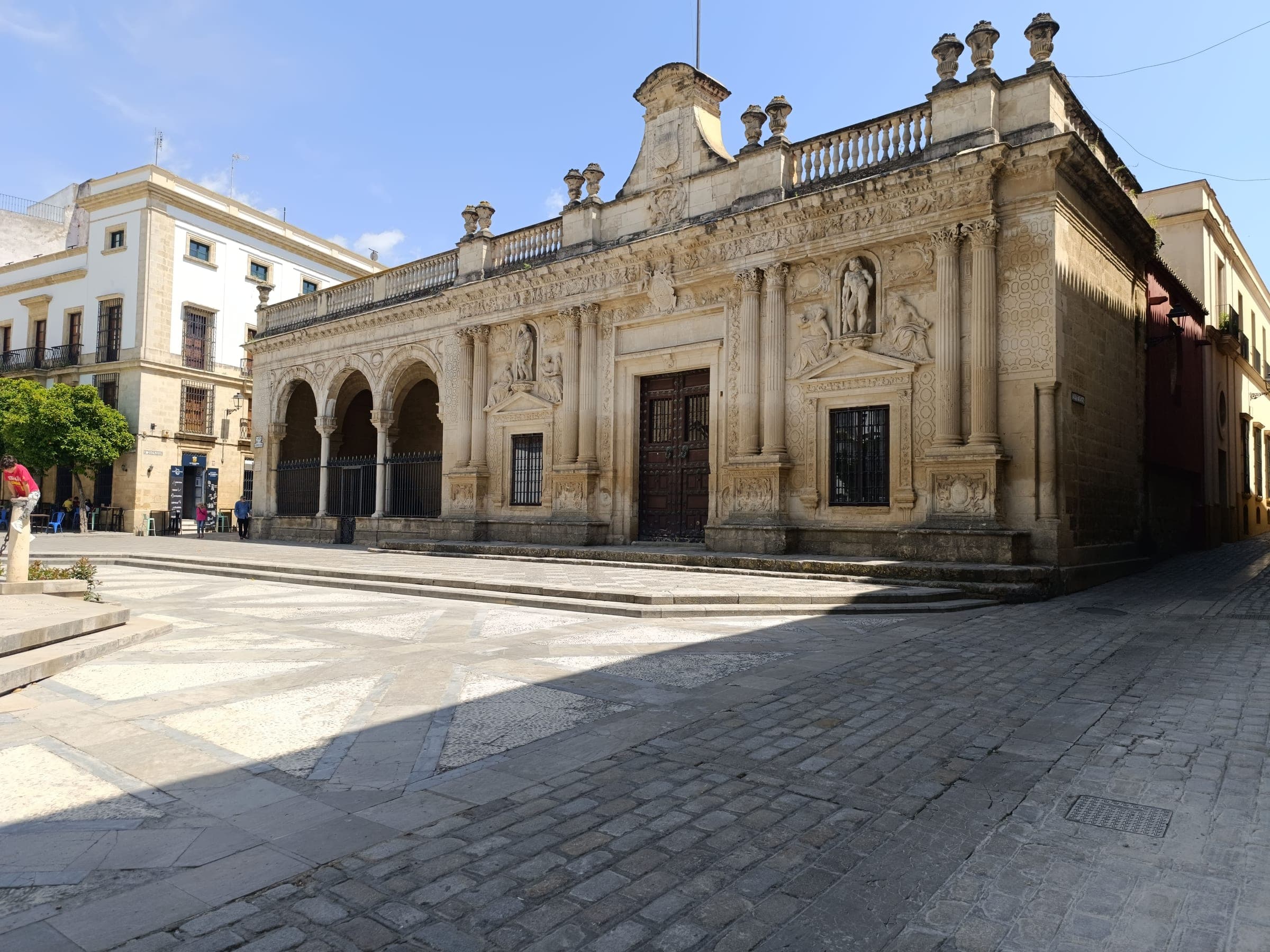
The marathon starts at 08:00 in Alameda Vieja, beside the Alcázar in the centre of Jerez, and finishes in the same place. The organiser gives the distance as 42.195 km; there is no measurement certificate. The first kilometres run west out of the city, and from about km 6 the route runs on farm roads and tracks over albariza, the white chalky soil of the sherry region.
It is not flat. The vineyards sit on low, rounded hills, and the course crosses one after another. The first climb, 55 m in 2.2 km at about 2.5 per cent, takes the route up to Añina by km 6.5. Then the rises come every few kilometres: 34 m from km 10, 76 m over 3 km from km 14.9 to km 17.9, 33 m from km 19 and 53 m in 1.8 km from km 23, each followed by a descent of similar size. The route reaches its northernmost point, 8 km from the start, at km 26.
The biggest climb is the next one: 80 m in 2.6 km, about 3 per cent, to the high point of the course, 126 m at Macharnudo Alto around km 28.5, followed by the steepest descent, 77 m in 1.8 km at over 4 per cent. The last 10 km are lower and flatter on the way back towards the city, until a final 45 m climb from km 38 brings the route back up into the centre and the finish. There is little shade, the tracks can be dusty in dry weather and sticky after rain, and support is sparse outside the stations.
Kilometre by kilometre
Km 0 to 6: Jerez and the first climb. The start enclosure in Alameda Vieja opens at 07:30. There are no published waves, so place yourself honestly: trail runners, road marathoners and people out for the experience start together. The first 3 km drop 39 m through the city, and then the course climbs 55 m to the vineyards. The first station, at Bodega Luis Pérez (5.7 km), closes at 08:45, about 7:54 per kilometre from the gun.
Km 6 to 20: into the vineyards. The surface changes from tarmac to farm roads and tracks over white albariza. Dry, it throws up dust and glare; wet, it clings and slips. The hills start in earnest, the longest 76 m over 3 km to km 18, and the field spreads out with few spectators between stations. La Trinidad (12.4 km) is the first station with wine and local produce as well as water, isotonic drink and fruit. Viña Canariera (19.7 km) closes at 10:50.
Km 20 to 31: Macharnudo. Two more climbs, 53 m from km 23 and then the biggest of the day, 80 m in 2.6 km, to Macharnudo Alto, the high point at 126 m around km 28.5, with the steepest descent of the race straight after it, 77 m in under 2 km. This is the most exposed part of the course. Shorten the stride on the rises and on rough ground, brake gently on the way down, and accept slower kilometres. The Macharnudo station closes at 11:50.
Km 31 to 42.2: back to Jerez. The last stations bring the route back towards the city, lower and flatter, and the surface returns to tarmac, which feels hard after hours of track. The final climb, 45 m from km 38, brings the course back up into the centre. The finish in Alameda Vieja closes at 14:30.
The course is marked with tape and signs, and runners must pass three to five control points; missing one means disqualification. Follow the tape, not a GPS track, and treat the organiser’s 2027 instructions as the authority.
Down through the city, then 55 m up to the vineyards. The first station closes at 08:45.
Tracks over chalky albariza and a series of hills, the longest 76 m. The first tasting stations appear.
80 m up to the 126 m high point, then 77 m straight down. Run by effort.
Lower and flatter, then a 45 m climb back into the centre.
Course Map
Out of Jerez to the west, north through the vineyard hills to Macharnudo and back into the city. Tap a marker for the start and finish, bib collection, the landmarks and the stations, and scrub the slider or press play to move the orange marker along the course with the elevation profile beneath it.
Pacers
No pace groups are listed in the rules, programme or FAQ. On mixed ground and hills they would be of limited use.
The aid stations give out no cups. Carry a soft cup or flask; the organiser recommends at least a litre of carrying capacity, a phone, sunscreen, sunglasses and spare food. Four stations serve wine and local produce alongside water, isotonic drink and fruit. Food and drink must be finished inside each station, and the white vineyard tracks between them are long and open.
Plan for sun and for surface. AEMET’s April normals for Jerez are about 10°C at night and 23°C by day, so a runner out for five or six hours finishes in noticeably warmer weather than the 08:00 start. The vineyards have almost no shade and the white albariza reflects the light.
A light running vest with soft flasks covers the organiser’s recommended kit. On dry tracks, cushioned road shoes cope; after rain, the albariza turns sticky and slippery, and trail or hybrid shoes with grip are worth wearing. A thin top for the wait can go in the bag drop; there is no clothing collection, so do not leave anything in the start area.
Entry
Entry is direct through the organiser’s registration platform, RockTheSport. There is no ballot, qualification or charity route, and no cap is published. Adults of any nationality can enter; no Spanish licence or medical certificate is asked for.
The marathon costs €45 until 5 March and €50 afterwards, plus a management fee. Entry includes aid, medical cover, timing and online tracking, transport back from designated withdrawal points, a finisher diploma and medal, a commemorative garment and a tasting glass.
The standard refund is 50% if cancelled at least 30 days before the race. Optional cancellation insurance, about €10, can only be bought when registering. A place can be put in someone else’s name for €5 up to 15 days before, while places remain. The marathon is for runners aged 18 and over.
Fast runner standards
There is no good-for-age route. The course is uncertified, so a time here cannot be used as a qualifying time elsewhere.
Official Sherry Maratón site →Race Weekend
Bib collection
Bibs and runner’s bags are collected at IFECA, the Palacio de Exposiciones "Lola Flores" on Paseo de Sementales, entrance by the Glorieta de la Yeguada Militar, in the fairground district 2 km north-east of the start. Hours are Friday 11:00 to 14:00 and 17:00 to 20:00, Saturday 17:00 to 20:00, and race morning 06:30 to 07:30 for marathon runners only.
Friday is the best day: Saturday has only an evening window, and Sunday collection leaves 30 minutes to reach the start. A friend can collect with your authorisation and a copy of your DNI or passport. Check the bib, the garment size and the tasting glass before leaving.
Getting to the start
The marathon starts at 08:00 in Alameda Vieja; the Sherry Media starts there at 09:00, and the Sherry Promo at 10:30 at Macharnudo, with organiser transport.
Getting there. Walk. From Plaza del Arenal, the cathedral or San Miguel, the start is 3 to 12 minutes on foot; from the station, 15 to 20 minutes. Jerez has no metro, and buses are diverted round the course. There is no start shuttle for marathon runners.
Bag drop. In Alameda Vieja. The race programme gives 07:15 to 07:45 for handing bags in; another page says 08:00 to 14:30, so check the final guide. Staff may ask to inspect a bag.
Withdrawing. Runners who cannot make a station closure must board the sweep vehicle or withdraw at a control point and tell the officials. An unreported withdrawal can trigger a search.
The finish. Medal, diploma, water, isotonic drink, food, local products and sherry. Bags are collected in Alameda Vieja. Showers are at the Polideportivo Vega "Veguita" sports hall. The prize ceremony is at 14:00 and the finish closes at 14:30.
Nutrition on course
The stations give out no cups: bring a soft cup or flask. Help from anyone outside the stations earns a 15-minute penalty. No gels are listed, so carry your own carbohydrate for the whole distance; the gaps are long and on a warm day a litre of capacity matters.
The wine is hospitality, not fuel. Runners racing for time will stick to water, isotonic drink and their own gels; alcohol during long exercise affects people unpredictably.
| Km | Place | What is there | Closes |
|---|---|---|---|
| 5.7 | Bodega Luis Pérez | Water, isotonic | 08:45 |
| 12.4 | La Trinidad, Covijerez | Water, isotonic, fruit, wine, local products | 09:40 |
| 19.7 | Viña Canariera, González Byass | Water, isotonic, fruit, wine, local products | 10:50 |
| 25.8 | Macharnudo | Water, isotonic, fruit | 11:50 |
| 31.4 | La Trinidad, Covijerez | Water, isotonic, fruit, wine, local products | 12:35 |
| 35.6 | Bodega Luis Pérez | Water, isotonic | 13:00 |
| 39.4 | Bodega Valdespino | Water, isotonic, fruit, wine, local products | 13:30 |
| Finish | Alameda Vieja | Water, isotonic, food, local products, sherry | 14:30 |
Spectating
The start and finish in Alameda Vieja are the only easy places to watch. Following runners by car, bicycle or motorbike is banned, and the vineyard tracks are closed to traffic. La Trinidad and Bodega Luis Pérez are each passed twice, which makes them the best places for a second sighting, but they need a taxi or car before the roads close. Online tracking updates at control points, not continuously.
- Watch the 08:00 start in Alameda Vieja
- Breakfast in Plaza del Arenal
- Walk back to Alameda Vieja for the finish
- Take a taxi out before the roads close
- Watch at 5.7 km, stay, and see the runner again at 35.6 km
- Leave only when access reopens; a finish sighting is unlikely
- Pre-arrange a drop-off at La Trinidad before the start
- Watch at 12.4 km and again at 31.4 km
- Return to the centre if roads reopen in time
Post-race food
Bar Juanito on Calle Pescadería Vieja, 8 to 10 minutes’ walk from Alameda Vieja, is a Jerez institution for artichokes in season, tortilla and stews. Albores on Calle Consistorio, near Plaza del Arenal, has a seated modern Andalusian menu, and La Cruz Blanca, on the same street, serves tapas, grilled fish and potatoes.
Book Sunday lunch; the finish and the prize-giving fill the centre. Drink water and eat first; the sherry will still be there.
Where to Stay
The start and finish are in Alameda Vieja, beside the Alcázar, so stay within a short walk of it.
Alameda Vieja and San Miguel
Alameda Vieja and San Miguel are 0 to 10 minutes from the start and finish, next to the Alcázar and the cathedral. Old buildings may lack lifts, and Saturday nights near bars can be loud.
Plaza del Arenal and the old centre
Plaza del Arenal and the old centre are 5 to 12 minutes away, the best balance for a first visit, with restaurants, hotels and taxis. Ask for an interior room.
Santiago
Santiago, the old north-west quarter known for flamenco, is 18 to 28 minutes’ walk, with cheaper guesthouses and apartments.
Avenida Álvaro Domecq and the fairground
The fairground district is 25 to 35 minutes’ walk from the start but close to IFECA for bib collection, with larger, quieter hotels and parking.
The station
The station area, 1.2 km from the finish, has cheaper rooms and trains to Seville and Cádiz.
The Feria del Caballo opens on 24 April 2027, six days after the race; anyone staying on should book early.
Recommended hotels
Inside the González Byass bodega complex beside the cathedral, a few minutes from the start and finish. Confirm room orientation for weekend noise.
A conventional hotel off the main square with a short, flat walk to Alameda Vieja. Small, so it fills early.
A quiet luxury hotel in a restored palace, 10 minutes’ walk from the start.
Close to IFECA and the Royal Andalusian School of Equestrian Art, with larger rooms and a pool. A 25-minute walk to the start.
Booking timeline
Entry is immediate and the price rises by only €5 after early March, so the date to watch is the hotel market. Book a cancellable room within 1 km of Alameda Vieja when you enter, ideally the autumn before. The Feria del Caballo starts six days after the race, and Seville’s April Fair ends on race weekend, so staying on in either city means competing for rooms.
Jerez Airport (XRY) is about 8 km from the city, with a railway station; its flights are seasonal. Seville Airport (SVQ) plus the train to Jerez, about an hour, is the main alternative. Arrive by Friday to use the long collection session.
See & Do
The finish is beside the Alcázar, and Jerez’s bodegas, cathedral and tabancos are a few minutes’ walk.
Alcázar de Jerez
The twelfth-century Almohad fortress beside the finish, with a small mosque, Arab baths, gardens and a camera obscura. Some stairs and uneven floors.
Jerez Cathedral
The Baroque cathedral above the finish. A short visit on level floors.
Bodegas González Byass (Tío Pepe)
The largest bodega in Jerez, with guided tours through the old cellars and a tasting. Book an English tour for Monday.
The tabancos
The old sherry taverns of the centre, where wine is drawn from the barrel and flamenco is sometimes played. Tabanco El Pasaje is the best known.
Royal Andalusian School of Equestrian Art
The horse show runs on set days; a seated show is an easy afternoon. Check the April calendar and book.
After the Race
April in the Sherry Triangle is warm and green, a week before the Feria del Caballo fills Jerez. The coast is 15 minutes away by train, Seville an hour, and Sanlúcar’s manzanilla bodegas half an hour by road.
Bodegas, a riverside castle and fried fish by the paper cone on the Ribera del Marisco. Flat and short.
A flat old city on a peninsula with sea walls to walk along and the Mercado Central for lunch.
Manzanilla bodegas, the Guadalquivir estuary facing Doñana and seafood at Bajo de Guía.
The cathedral, the Alcázar and the flat Parque de María Luisa, recovering from its April Fair.