The Race
| Next Race Date | 29 August 2027 |
| Course type | Point-to-point |
| Certification | World Athletics Platinum Label · Abbott World Marathon Major |
| Start | Miller Street, North Sydney |
| Finish | Sydney Opera House Forecourt, Circular Quay |
| Total finishers | ~36,300 (2026), from 40,000+ starting places and more than 140 countries |
| Avg race-day temp | 10-14°C at the start, rising to high teens-low 20s°C by late morning (late August) |
| Cutoff time | 7 hours; finish-line closure around 3:40pm on current course-page wording |
| Free race-day transport | Yes, integrated ticketing with Transport for NSW; bib must be visible when boarding |
| Course certification | Run under World Athletics rules; Platinum Label. Specific AIMS/measurement certificate body not published |
History
The race that finishes on the steps of the Sydney Opera House began as an attempt to hold onto something the city had only briefly owned. Sydney staged the marathon at the 2000 Olympic Games, and the annual public race that followed, dated from 2001, was built to keep those Olympic roads open to anyone willing to pin on a number. For close to two decades it stayed a large, well-regarded Australian race and no kind of global fixture: a strong domestic field, a loyal following among Australian marathoners, and one genuine selling point no other city could copy outright, a fully closed-road crossing of the Sydney Harbour Bridge.
That bridge did more to build the event's reputation than any marketing campaign could. For years the race sat within the wider Sydney Running Festival, its identity tied to that single dramatic set piece and to little else city-wide. The move toward Major status changed the course as much as the profile: organisers shifted the start from Circular Quay to Miller Street in North Sydney, close to the original 2000 Olympic Marathon start area, and removed the tight Darling Harbour and Pyrmont turns that had slowed the old route.
On 4 November 2024, at the New York City Marathon, the Abbott World Marathon Majors confirmed Sydney as its seventh member, the first addition to a roster that had stood at six since Tokyo joined in 2013. The first Major edition ran on 31 August 2025, with Eliud Kipchoge and Sifan Hassan headlining a field that produced new course records, among them Hailemaryam Kiros's men's mark. Applications for the 2026 ballot passed 123,000, a rise of 56 per cent on the year before.
Kiros's record lasted twelve months. On 30 August 2026, Ethiopia's Addisu Gobena won the second Major edition in 2:04:42, taking 1:24 off it, and seven men finished inside the old mark on a course with 313 m of climbing. It was the fastest men's podium ever run on Australian soil. Peres Jepchirchir won the women's race in 2:18:31. Behind them, more than 40,000 runners started and 36,296 finished, from more than 140 countries, with the organisers estimating 400,000 spectators along the route.
The course
The route described here is the 2026 course, which the organiser still shows on its course page; the 2027 course has not been formally published, though the Miller Street start and Opera House finish are confirmed. The race starts on Miller Street in North Sydney, beside North Sydney Oval and St Leonards Park, not at Circular Quay as older route descriptions suggest. The opening kilometres drop through North Sydney and Kirribilli before climbing onto the Sydney Harbour Bridge, crossed southbound toward the city in roughly the first 1 to 3 km. From the bridge the route runs through The Rocks, Barangaroo, Pyrmont and the CBD, then turns east through Hyde Park and Oxford Street toward Moore Park, Anzac Parade and Kensington. A southern turnaround near Kingsford sends the field back north through Moore Park and a loop of Centennial Park, before the course returns to the harbour via the Royal Botanic Garden and Mrs Macquarie's Chair and finishes at the Sydney Opera House Forecourt.
Official figures give 313 m of elevation gain, 396 m of loss and a net descent of 83 m. The net loss is front-loaded: the start on Miller Street at 90 m is the highest point of the day, and the first 5 km give back 73 m of that. Two climbs then do most of the work, and neither is where the race’s reputation puts them. The first is the pull off Hickson Road up into the CBD, 64 m between km 11.7 and km 13.5 with one kilometre at 4.6%. The second is the climb out of the Royal Botanic Garden onto Macquarie Street, 41 m between km 39.9 and km 41.0 at 3.7%, which is the steepest sustained kilometre on the course and arrives at km 40. Anzac Parade and Centennial Park, which get the blame, run between 30 m and 50 m throughout.
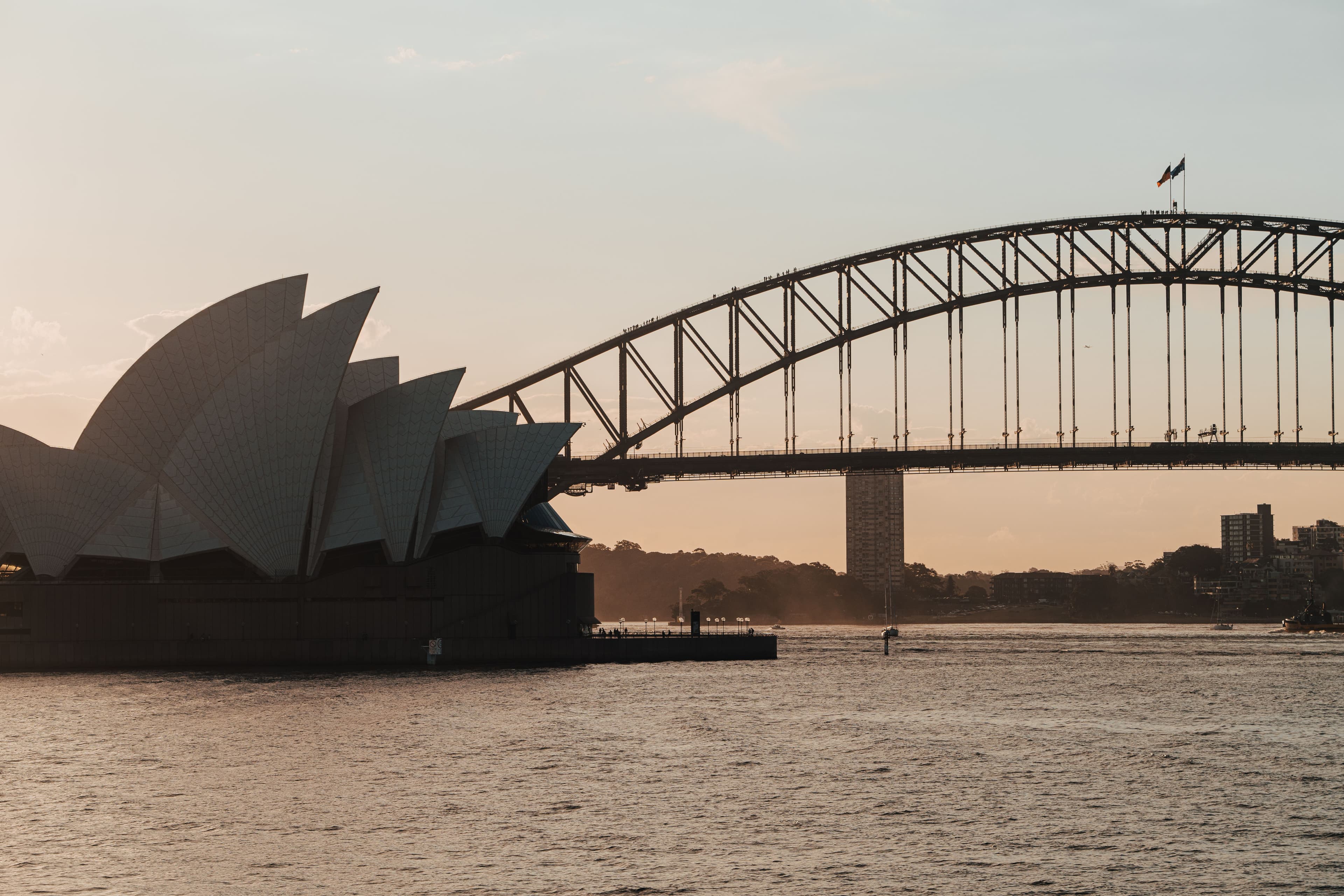
Km 0-3: North Sydney and the Bridge. The gun goes on Miller Street with the field still cool from a pre-dawn wait in the North Sydney Oval assembly areas. The road drops through North Sydney and Lavender Street toward the southern approach, and the descent feels generous enough to tempt an early surge. It should not be spent. The Sydney Harbour Bridge arrives inside the first three kilometres: a climb onto the deck, open air and cross-wind at the top, and a view across the harbour to the Opera House that most runners will only see once in a lifetime from this angle. Controlled effort on the way up, relaxed shoulders across the top, restraint on the way down. Runners who race the bridge lose time later that the bridge itself never cost them.
Km 3-13: The Rocks to Pyrmont. Off the bridge, the route threads through The Rocks and past Circular Quay before swinging into Barangaroo, the edges of Darling Harbour and Pyrmont. This is the section spectators know best, and by Major standards the crowds are strong through here, if not constant. The road bends more than the bridge crossing did, and holding rhythm takes more concentration than the scenery suggests it should. The section closes with the first real climb of the race: off Hickson Road at Dawes Point the course turns up into the CBD and gains 46 m in the single kilometre to Castlereagh Street, 4.6%, on legs that have run almost nothing but downhill since the gun. Water and Powerade Mountain Blast appear from the 5 km mark, at intervals through to the finish.
Km 13-24: Hyde Park to Oxford Street.The course cuts back through the CBD and out along Oxford Street through Darlinghurst, a stretch that is lively on any ordinary Saturday and unforgiving on a marathon morning if the late-August sun has come out. Sydney's date, close enough to spring to matter, can move from a cool harbour-side start to a warm mid-morning by the time runners reach here. Anzac Parade, wide and largely without shade, follows toward Kensington and Kingsford, before a turnaround sends the field back the way it came. This is the functional heart of the course: fewer landmarks, more discipline required.
Km 24-34: Moore Park and Centennial Park.Driver Avenue and Lang Road lead into Centennial Park, greener and more open than anything the course has offered so far, and a welcome change of scenery on tired legs. On the chart this is the gentlest part of the course: Anzac Parade and Grand Drive sit between 30 m and 50 m and the sharpest kilometre is 1.3%. Runners in 2026 described it differently. The park's run of small rises, none of them steep, came up again and again in race reports as far harder at 25 to 35 km than any single gradient suggests, and the long, exposed Anzac Parade return wore on runners mentally as much as physically.
Km 34-42.2: The Botanic Garden and the Opera House.The route turns back toward the harbour through the edges of the Royal Botanic Garden and past Mrs Macquarie's Chair, dropping to 8 m at km 38.7, the lowest running of the whole race. The road narrows here, and in 2026 the return from Mrs Macquarie's Chair and the exit from the Botanic Garden were the places runners reported the field compressing; most of the rest of the course carried the numbers without serious crowding. Then comes the sting. From km 39.9 the course climbs 41 m in a single kilometre onto Macquarie Street, 3.7%, the steepest sustained gradient of the day arriving at km 40. Runners who spent the early downhill pay for it here. The last 1.2 km give all of it back, dropping 36 m to the harbour, and the white shells of the Opera House become the backdrop for the closing few hundred metres. After the line, a controlled walk-off of roughly 600 m carries finishers toward the reunite zone; stopping immediately at the arch for photographs is discouraged because of the crowd building behind.
The tangent line matters more on this course than the total elevation figures suggest, given how many turns the middle third contains; running the shortest sensible line through The Rocks, Pyrmont and the Oxford Street bends can be worth real distance over 42.195 km. The timing mat sits at the marked finish line on the Opera House Forecourt itself, with mass-participation results calculated on net (chip) time, while the wheelchair, elite and Australian Championships fields are placed on gun time.
Course Map
The map shows the full marathon route from Miller Street to the Opera House Forecourt, the assembly-area transport stations, and the 2026 expo venue at Sydney Showground (pan west to see it, roughly 15 km from the finish). Tap a marker for details, and scrub the slider or press play to move the orange marker along the course with the elevation profile beneath it.
A downhill start leads straight onto the Sydney Harbour Bridge. The temptation is to race the descent and the crossing both. Save the effort; the bridge rewards control, not speed.
Harbour views give way to CBD turns, Oxford Street and the long, shadeless stretch of Anzac Parade. Warming temperatures and technical turns make pacing discipline more valuable here than scenery.
Green space and a change of rhythm arrive just as the course’s 313 m of accumulated climbing starts to tell on tired legs. Treat every gentle rise as real work.
The Royal Botanic Garden and Mrs Macquarie’s Chair lead into the final approach, where the Opera House reappears as the finish-line backdrop. Hold form; the crowd and the congestion both build fast in the closing kilometres.
Sydney now runs like a Major. The Harbour Bridge start, the crowds through the central city and the Opera House finish were the highlights runners named most often in 2026, and water on course was plentiful even in the most critical reports. The weak points sat around the race: start-area toilet queues of 50 to 60 minutes, an expo that took a separate trip out to Olympic Park, and pacers who were not always in the start group a runner had been given.
The net-downhill profile does not make this an easy marathon. The opening descent invites over-pacing, Anzac Parade is long and exposed, Centennial Park's small rises arrive on tired legs, and the loop around Mrs Macquarie's Chair leads straight into the steepest sustained climb of the day. Early starters can get close to ideal cool conditions; runners in the final groups may still be racing well into a much warmer late morning.
Pacers
Sydney fields a large pace team, but pacers are allocated by start group, and not every target time is represented in every group. In 2026 some runners found the flag they wanted was not in their allocated group, and changing a predicted finish time at registration changed which pacers they could run with. Check the pacer list for your own group when final race information is released, and be ready to pace yourself.
For 2027 the organiser has confirmed wheelchair racing from 6:15am and the mass field from 6:30am. Detailed start-group times and pacer allocations have not yet been published.
What to wear
Expect a cool start and a warm finish. Assembly areas around North Sydney Oval and St Leonards Park sit in the open, and late-August mornings before dawn typically sit around 10 to 14°C, cool enough to make the pre-race wait uncomfortable in shorts and a singlet alone. A cheap top or old jumper for the assembly area, discarded only where event instructions permit, solves most of that problem.
The difficulty runs the other way by mid-morning. Late August sits close enough to the Southern Hemisphere spring that temperatures can climb into the high teens or low 20s°C by the time slower waves reach Anzac Parade and Centennial Park, sections with little shade. In 2026 a runner starting around 8:20am reported running the late kilometres in the hottest part of the day, and others found the exposed southern sections noticeably harder once the sun was up. Runners starting in later groups should plan kit for the warmer half of the morning, not the cold start, and should not over-layer for the race itself. Sunscreen is worth applying before the gun for anyone expecting to be on course past mid-morning, particularly on the exposed eastern loop.
Entry
The 2027 ballot is open. Applications opened at 10:00am AEST on Tuesday 29 September 2026 and close at 10:00am AEDT on Monday 19 October 2026. It is a random draw, so applying on the first day gives no advantage: every application inside the window has the same chance. Successful and unsuccessful applicants are due to hear on Tuesday 3 November 2026, when successful applicants' nominated cards are charged automatically. If demand triggers a Race Roster waiting room, your place in that queue has no bearing on the draw.
Use a payment card that will stay valid for at least six months: Race Roster does not allow card details to be changed after an application is submitted. Submit one application only, because each application is treated individually and, if two succeed, both can be charged with no refund for the duplicate. An application can be withdrawn through the participant dashboard or in writing until 5:00pm AEDT on Friday 16 October 2026, three days before the ballot closes. Anyone who has heard nothing by 6 November should contact the organiser.
The entry fee is unchanged for 2027 at AUD $280 for Australian and New Zealand residents and AUD $330 for international applicants, excluding optional charity donations, roughly £145 to £175 or €165 to €200 at typical mid-2026 rates. Demand is far beyond supply: the organiser cites more than 123,000 applications for 2026 against 40,000+ starting positions. No single success rate is published, because places are also reserved for the High Performance Program (HPP), charity, travel-partner and Candidacy Club routes, but the scale of oversubscription puts Sydney in the same entry-difficulty bracket as the other Majors.
High Performance Program (HPP) 2027
The 2027 HPP application window ran from Monday 14 to Friday 18 September 2026 and has closed. The allocation doubled for 2027, from 600 to 1,200 places: 600 Sub-Elite places go to the fastest validated applicants overall, and 600 Good for Age places are awarded competitively within each age and gender category. Qualifying times must have been run since 1 July 2025 in a World Athletics-certified marathon with no more than 457 m of net elevation loss, and age is taken on 29 August 2027. Gun or chip times are accepted; Garmin and Strava records are not.
Applicants who do not secure one of the 1,200 places are automatically carried into the general ballot and will hear their ballot outcome on 3 November 2026. No separate ballot application is needed. Meeting the standard below was the threshold to apply and did not guarantee a place. The standards apply to the 2027 race.
| Age on 29 Aug 2027 | Men | Women | Non-binary |
|---|---|---|---|
| 18-34 | 2:45:00 | 3:18:00 | 3:18:00 |
| 35-39 | 2:47:00 | 3:20:00 | 3:20:00 |
| 40-44 | 2:51:00 | 3:27:00 | 3:27:00 |
| 45-49 | 2:55:00 | 3:35:00 | 3:35:00 |
| 50-54 | 3:00:00 | 3:43:00 | 3:43:00 |
| 55-59 | 3:06:00 | 3:51:00 | 3:51:00 |
| 60-64 | 3:17:00 | 4:13:00 | 4:13:00 |
| 65-69 | 3:41:00 | 4:24:00 | 4:24:00 |
| 70-74 | 4:07:00 | 4:35:00 | 4:35:00 |
| 75-79 | 4:43:00 | 5:30:00 | 5:30:00 |
| 80+ | 5:46:00 | 6:36:00 | 6:36:00 |
Charity entry remains available outside the ballot, led by Running for Premature Babies and We Run Foundation among the official charity partners, with fundraising minimums that vary by charity and should be checked directly. International runners can also enter through one of more than 100 official travel partners, led by Marathon Tours & Travel, which typically bundle guaranteed entry with accommodation and on-the-ground support. The organiser lists the ballot, charity places and travel partners as the three main routes into the 2027 race. Runners unsuccessful in the ballot can apply directly to a charity for a guaranteed place, and each charity selects its own runners, so charity applications become relevant once results are released on 3 November.
The Candidacy Club covers runners who completed the Sydney Marathon in 2022, 2023 or 2024, each of whom was given one Candidacy Club entry opportunity to use across 2025, 2026 and 2027. The 2027 race is the last chance to use it; any entitlement still unused expires after that.
Some athletes and groups enter outside the ballot. Non-elite racing wheelchair athletes (sub-2:45 marathon, achieved since 1 December 2025) and Duo teams apply separately, with applications opening on 1 December 2026. Non-motorised day wheelchairs start in the mass field, subject to equipment rules. Eligible runners with a physical, intellectual or visual impairment can request one or two complimentary guide entries; the organiser says it will contact them in the first quarter of 2027, with guide registration information due by 19 July 2027. Runners with ten or more Sydney Marathon finishes can register interest in the Bridge Club for 2027 until 11:59pm AEDT on 12 October 2026. The minimum age is 18 on race day.
Deferrals are tightly restricted. General deferrals, transfers and downgrades are not permitted under any circumstances; the only recognised exceptions are the pregnancy and postpartum policy for expectant parents and a specific provision for active Australian Defence Force personnel.
Race Weekend
Expo and number collection
The venue and hours for the 2027 Running Show have not been published; the organiser's Running Show page still shows 2026 information. In 2026 the TCS Sydney Marathon Running Show presented by ASICS moved from Darling Harbour to Sydney Showground, 1 Showground Road, Sydney Olympic Park, about 15 km west of the finish, and ran from Thursday 27 to Saturday 29 August. The organiser framed the move as space for a growing Major. For runners staying in the CBD it turned bib collection into a dedicated trip, where the old Darling Harbour venue had been a walk from most central hotels.
Every marathon entrant had to collect their own bib in person, showing ID matching their registration, and bibs could not normally be collected on race morning. Waits varied with the hour: some early arrivals walked almost straight in, while others queued for around 45 minutes as the day built. If Sydney Olympic Park is used again, treat the Running Show as a half-day logistics job and go early in the opening days, not in a gap between CBD sightseeing.
In 2026 transport to the show was included for registered participants and volunteers via a dedicated travel pass covering all public transport modes, and a Marathon Express train ran between Central and Olympic Park Station every 30 minutes during opening hours, the most direct route from central Sydney.
The bib pack includes the race bib and timing tag; the finisher medal and shirt are issued as part of the finish process.
Getting to the start
For 2027 the organiser has confirmed wheelchair racing from 6:15am and the mass field from 6:30am. Detailed start-group times will be published closer to the race.
In 2026 assembly ran across four colour-coded areas, High Performance, Purple, Green and Orange, around Miller Street, North Sydney Oval and St Leonards Park, with runners told to arrive in an assigned window. Bib colour set both the assembly area and the best station to use. The 2027 arrangement has not been published; the 2026 pattern below is the best current guide.
- For North Sydney Station, Purple and Orange assembly runners can expect about 1 km and 18 minutes on foot via Walker Street.
- Victoria Cross Metro is generally the better option for the same two areas, at roughly 750 m and 12 minutes via Denison Street and Walker Street.
- Green assembly runners are directed to Crows Nest Metro, about 1 km and 18 minutes via Willoughby Road and Falcon Street.
- From the CBD, Metro connections at Central, Gadigal, Martin Place or Barangaroo run every four minutes on race morning and are the fastest way across the harbour to North Sydney; buses are affected heavily by road closures, and driving is actively discouraged.
Accessible drop-off is available at North Sydney Boys High School car park on Falcon Street, accessed from the westbound lane only. Public transport is included for every registered participant under an integrated ticketing arrangement with Transport for NSW; keep the race bib visible when boarding, since that is what staff check, and there is no separate ticket.
Toilets were the biggest complaint of 2026.Runners in several assembly areas, Purple and High Performance among them, reported queues of 50 to 60 minutes, with little signage, loosely marshalled lines and unclear announcements about when the start chutes were opening. Use a toilet before leaving the hotel or station if at all possible, and allow far more time than the organiser's walking estimate alone suggests.
Bag drop
There was no race-morning bag drop at the start in 2026. Bags for the finish had to be handed in before race day, and runners arrived in North Sydney with only what they could discard. The 2027 process has not been confirmed, so check the participant information when it is released instead of assuming it will be identical. Dress for the wait, not the race: a throwaway top left only where discard is permitted covers the cold pre-dawn hours at North Sydney. Headphone policy for the mass field has not been confirmed.
Nutrition on course
Sydney runs water and Powerade Mountain Blast electrolyte drink at roughly 5 km intervals from the 5 km mark to the finish, a fairly conventional aid-station pattern for a Major, and in 2026 even critical race reports described the water supply as plentiful. GU Energy Gels appear at 20 km and 30 km, but they are limited and not guaranteed at every station, so build a personal-gel contingency around them. No personal bottle service was confirmed for mass participants; the only explicit statement found applies to High Performance Program athletes, for whom personal drinks on course are not permitted.
| Km marker | Water | Sports drink | Gel | Other |
|---|---|---|---|---|
| 5 | Yes | Powerade Mountain Blast | No | Portable toilets nearby |
| 10 | Yes | Powerade Mountain Blast | No | Portable toilets nearby |
| 15 | Yes | Powerade Mountain Blast | No | Portable toilets nearby |
| 20 | Yes | Powerade Mountain Blast | GU Energy Gel (limited) | Portable toilets nearby |
| 25 | Yes | Powerade Mountain Blast | No | Portable toilets nearby |
| 30 | Yes | Powerade Mountain Blast | GU Energy Gel (limited) | Portable toilets nearby |
| 35 | Yes | Powerade Mountain Blast | No | Portable toilets nearby |
| 40 | Yes | Powerade Mountain Blast | No | Portable toilets nearby |
| Finish | Nu-Pure water | Powerade | No | Fruit, Carman’s muesli bar, Recovery Village |
Runners used to gel-heavy European Majors should treat Sydney's on-course fuelling as lighter than Berlin's or London's, and pack accordingly; a gel will not be available at every marked interval.
The finish and Recovery Village
After the finish at the Opera House Forecourt, a controlled walk-off of roughly 600 m carries runners toward the reunite zone; stopping at the arch itself for photographs is actively discouraged because of the congestion it creates behind. About 100 m past the line, finishers collect a medal and a recovery bag containing Nu-Pure water, Powerade, fruit and a Carman's muesli bar. The Recovery Village beyond that includes food and drink stands, sponsor sampling and the ASICS Massage and Recovery Zone; changing rooms and shower provision have not been published.
The finish sits inside Sydney's most tourist-dense dining precinct, and Circular Quay, The Rocks and the Royal Botanic Garden edge all have food options within a short walk of the reunite zone, from harbour-view cafes to pubs with outdoor seating suited to a slow, seated recovery with no queue. Runners finishing mid-morning will find breakfast and brunch service more readily available near the finish than a full lunch menu, and The Rocks' weekend market food stalls, when running on race Sunday, offer a lower-effort option than sitting down in a full-service restaurant. Coffee quality across central Sydney is consistently strong by international standards.
For spectators
Sydney rewards spectators who commit to public transport and give up on driving entirely; road closures on race morning are extensive enough that trains, Metro and ferries are the only realistic way to move between viewing points. The single most dramatic image, the Harbour Bridge crossing, is also the hardest to watch from close range, since normal pedestrian access to the bridge deck is restricted on race morning. The better plan is to watch the bridge's effect, not the bridge itself, from The Rocks or Circular Quay as runners descend on the city side.
A genuine two- or three-sighting day is possible for supporters prepared to move quickly: first, catch the field early around The Rocks or Barangaroo as it comes off the bridge; second, cross to Hyde Park or Oxford Street for the mid-race city-east section, where cafes and easy transport make waiting comfortable; third, return to Circular Quay for the finish. Faster fields make this tight; for anyone expecting a finish time past four hours, it is comfortably achievable. For supporters who would rather guarantee one good view than risk missing the finish chasing three, the Opera House and Circular Quay area is the single best spot on the course.
Whichever plan is used, the meeting point after the race should not be the finish arch. Runners are moved through a 600 m walk-off to a reunite zone, and stopping for photographs immediately after the line is discouraged because of the crowd building behind. Agree a specific landmark beyond the reunite zone, at Circular Quay, the Royal Botanic Garden edge or a nearby hotel lobby. "The finish line" is not a plan.
- Circular Quay or Wynyard for the early field off the Harbour Bridge, around km 3
- Walk to Hyde Park or a short Metro hop to Museum Station for Oxford Street, around km 15-18
- Return to Circular Quay by Metro for the finish
- The Rocks for the bridge descent, around km 3
- Metro from Barangaroo or Wynyard to Central, then walk or bus toward Moore Park for Anzac Parade, around km 24
- Metro back to Circular Quay in good time for the finish
- Arrive at Circular Quay or the Royal Botanic Garden edge before the first finishers are due
- Stay in place through the finish window and skip chasing multiple sightings
- Use the event app for live tracking; guessing timing from the road does not work
Sydney's course carries a direct line back to the 2000 Olympic Games. The start on Miller Street, beside North Sydney Oval, sits close to the historic start area used for the Sydney 2000 Olympic Marathon, a connection the organisers made explicit as they rebuilt the route for Major status. Runners crossing the Sydney Harbour Bridge in the opening kilometres are, in a small way, retracing a piece of Olympic road that most visitors to the city will never otherwise walk, let alone run, closed to traffic for the length of a marathon field.
Where to Stay
Stay near the finish, not the start. Sydney's race finishes at the Opera House Forecourt and starts across the harbour in North Sydney, and race-morning public transport is built to carry runners out to North Sydney, not the other way round. A finish-side base removes far more friction than it costs. The same logic applies to the expo: in 2026 it was at Sydney Olympic Park, 15 km west, and a hotel chosen for the Running Show is a poor trade for one near the finish.
CBD and Circular Quay is the most practical choice for most first-time Sydney marathoners. It sits close to the Opera House finish and reunite zone, with ferries, restaurants and the Metro and rail network all within easy reach, and Metro connections at Martin Place, Barangaroo or Central provide a direct route to North Sydney on race morning. Prices run high on marathon weekend and Saturday-night noise varies street by street, quieter around the business core, busier near the harbour bars, but the convenience is close to unmatched.
The Rocks is the most characterful harbour-side option, all heritage lanes, pubs and bridge views, with quick access to Circular Quay for both race morning and the finish. Rooms are limited and expensive, and moderate pub noise is part of the deal, but many of the better properties manage it well.
Darling Harbour and Pyrmont offer more room stock and a slightly better chance at value while staying broadly central, at the cost of a 25 to 40 minute walk back to the Opera House after finishing, or a short Metro or light rail hop once roads reopen. Surry Hills suits runners who care more about food than finish-line proximity, with a 30 to 45 minute walk back from the finish. Newtown sits further out again, with better value and a stronger independent food identity, at a real cost in race-morning convenience.
Manlyis the outlier: a genuinely appealing base for a broader Sydney holiday, reached from Circular Quay by ferry, but a logistically riskier choice for race weekend specifically. Relying on an early ferry on race morning adds a dependency that a CBD hotel simply doesn't carry.
Book as early as the entry situation allows. Results of the 2027 ballot are due on Tuesday 3 November 2026, ten months before the race, and central hotel stock, particularly around Circular Quay and The Rocks, moves quickly once a Major-sized field starts confirming travel plans. A fully refundable rate held from the moment of ballot, charity or travel-partner confirmation is the safer approach while other logistics are still settling.
One of the few genuinely budget options inside The Rocks, close enough to Circular Quay and the finish to make the marathon-weekend price premium bearable, and a rare central choice for runners travelling on a tighter budget.
Close enough to Circular Quay to walk back after finishing without joining the post-race transport queue, and a mid-tier alternative to the luxury harbour hotels a few streets over.
A budget base at 88 Liverpool Street, opposite World Square, a short walk from Museum Station and the Metro at Gadigal for the run across to North Sydney on race morning. No harbour views, and the walk back from the Opera House is the longest of the hotels listed here, but the marathon-weekend rate is usually lower.
A business-hotel location close to Martin Place transport, walkable to the Opera House finish but quieter on Saturday night than a room directly on the harbour front.
About as close to the finish line as a hotel gets without being inside the reunite zone itself, and the premium choice for runners prioritising a short walk over everything else on marathon morning.
See & Do
The finish at the Opera House Forecourt puts you at the harbour's edge in central Sydney. What follows covers the territory within reasonable post-marathon reach of the finish and the hotels above.
Sydney Opera House
0 km (0 miles) from the finish. The finish line sits at the Opera House Forecourt, which makes the building itself the natural first stop of the trip, never an add-on. A guided tour or an evening performance is better booked for the Monday or Tuesday after the race than squeezed in on legs that have just run a marathon.
Royal Botanic Garden Sydney and Mrs Macquarie's Chair
0.5-1.5 km (0.3-0.9 miles) from the finish. The course itself passes through the edge of this harbourside green space in the closing kilometres, and it doubles as one of the gentlest possible post-race walks: flat paths, harbour views and none of the effort a full sightseeing day would demand.
The Rocks
1 km (0.6 miles) from the finish. Historic lanes, a weekend market and direct bridge views make this a low-energy sightseeing base for the day or two after the race, conveniently placed between the bridge, Circular Quay and the finish itself.
Manly by ferry
About 30 minutes each way from Circular Quay. A harbour crossing followed by a beach promenade and a run of cafes makes Manly the easiest full-day excursion from the finish area, better suited to the day after the race than the day before it.
Bondi to Coogee coastal walk
Reached by bus or taxi from the CBD. One of Sydney's best walks on any ordinary day, but the stairs and undulations along the clifftop path make it a poor choice immediately post-marathon. A short Bondi-only visit works better in the first day or two, with the full walk saved for later in the trip.
Read Before you Run
Cloudstreet
Tim Winton
Two working-class families sharing a house in postwar Perth across twenty years - Winton's most celebrated novel, and one of the great books about the texture of Australian life. It is set on the other side of the continent, in Perth, and suits a reader wanting the country before the city.
Buy on Amazon ↗In a Sunburned Country
Bill Bryson
Bryson's outsider account of Australia is not written around Sydney specifically, but it sets a tone, wry, curious, faintly bewildered, that suits anyone using this marathon as a first proper trip to the country, well beyond a quick city stopover.
The Fatal Shore
Robert Hughes
A serious, heavyweight history of Australia's convict founding, closely tied to the harbour, The Rocks and the colonial core the marathon route runs directly through. Better suited to readers wanting depth than to anyone after light pre-race inspiration.
After the Race
The TCS Sydney Marathon falls in late August, close enough to the Southern Hemisphere spring for the days after the race to offer everything from a flat harbour ferry ride to a genuine holiday extension up the coast. The excursions below are ordered by how much they ask of legs that ran a marathon.
A harbour crossing followed by a flat beach promenade and a run of cafes, this is the most recovery-friendly excursion the race city offers. Keep it to the promenade and the ferry ride, and skip the long coastal walk on the same legs that ran the marathon.
Late-August timing sits close enough to spring for crisp mountain air, but many of the classic walking tracks involve steep stairs. Stick to the Three Sisters lookouts, Leura village and Scenic World, and leave the full bushwalk alone on the first day after finishing.
Vineyards, long lunches and spa hotels make this the better choice for real post-marathon decompression over hard sightseeing. Spring weekends fill quickly, so this is one to book early, not on arrival.
Byron supplies beaches, cafes and easy recovery swims; Nimbin adds a hinterland day trip with a very different character. This works best as a full holiday extension, never a quick add-on, and the early days should stay gentle, particularly for anyone flying soon after the race.
Frequently asked questions
Should I stay near the start or the finish?
Near the finish. The race starts in North Sydney and finishes at the Opera House Forecourt, and race-morning public transport is built to carry runners out to North Sydney, not the other way round. A hotel in Circular Quay, The Rocks or the CBD keeps the walk home short and avoids fighting the crowds heading the opposite direction before the gun.
How far in advance should I book a hotel?
As soon as an entry route is confirmed. Sydney's Major status pushed applications past 123,000 for 40,000+ starting positions in 2026, and central hotel stock around Circular Quay, The Rocks and the CBD fills quickly once ballot results land. For 2027 that is Tuesday 3 November 2026. A fully refundable rate held early is the safer option while other travel plans settle.
Is there free transport to the start?
Yes. Public transport is included for every registered participant under an integrated ticketing arrangement with Transport for NSW; keep the bib visible when boarding; there is no separate ticket to find. The same travel pass covers transport to the Running Show for registered participants and volunteers, though airport station fees are not included.
What is the best area to stay?
CBD, Circular Quay or The Rocks, for most runners. All three keep the finish, transport and restaurants within easy walking distance and offer a straightforward Metro connection to the North Sydney start on race morning. Surry Hills works as a food-focused alternative, and Darling Harbour or Pyrmont suit anyone prioritising room size over harbour views.
When does the expo open?
The 2027 dates and venue have not been published. In 2026 the Running Show ran Thursday to Saturday at Sydney Showground, Sydney Olympic Park, about 15 km west of the finish, and every entrant collected their own bib in person with matching ID. Bibs could not normally be collected on race morning. If Olympic Park is used again, set aside half a day for the trip; queues reached around 45 minutes at busy times in 2026.
What is the weather typically like?
Expect a cool start and a warmer finish. Late-August mornings at North Sydney typically sit around 10 to 14 degrees C, cool enough to justify a throwaway layer, while conditions can climb into the high teens or low 20s degrees C by the time later waves reach Anzac Parade and Centennial Park. Always check the race-week forecast; historical averages alone will not do.
How do I get from the airport to the city centre?
By train. Sydney Airport connects directly to the city rail network, with services running to Central and onward connections to Town Hall, Wynyard, Circular Quay and the Metro. Airport station access fees apply and are specifically excluded from the marathon's included transport, so budget for that leg separately. Taxis and rideshare are straightforward alternatives, though pricier during busy arrival windows.
Is there a bag drop?
Not at the start. In 2026 there was no race-morning bag drop in North Sydney; bags for the finish had to be handed in before race day. The 2027 process has not been confirmed, so check the participant information when it is released, and arrive at the start carrying only what can be discarded.
Should I bring a throwaway layer?
Yes. North Sydney's assembly areas sit in the open, and the pre-dawn wait can feel genuinely cold even though the race itself warms up fast. An old top or light layer, discarded only where event instructions allow, covers the wait without weighing anything down once running. Avoid over-dressing for the race itself, since the second half can turn warm.
How do I get back to my hotel after finishing?
On foot, if staying in Circular Quay, The Rocks or the CBD. Finishers move through a controlled walk-off of roughly 600 m to the reunite zone, so agree a meeting point beyond that, away from the finish arch itself. Runners based in Darling Harbour, Surry Hills, Newtown or Manly should plan for public transport and allow extra time around road closures and post-race crowds.