| Next Race Date | Sunday 31 October 2027 |
|---|---|
| Course Type | Loop: single lap, start and finish on the Malieveld |
| Registration | Open online entry, first come first served |
| Ballot Opens | Not applicable (no ballot) |
| Total Finishers | Not published (about 9,500 starters in the inaugural edition) |
| Average Race Day Temperature | About 7 to 13°C in late October; the inaugural edition ran at 12 to 13°C |
| Cutoff Time | 5 hours 30 minutes |
| Free Race Day Transport | None announced |
| Course Certification | Measured under World Athletics and AIMS rules, certificate NED 2026-001; no World Athletics label |
Plan your pace for the Hague Marathon for you and your supporters
Turn a goal time into grade-adjusted splits, and see when your supporters should be where.
Build your pace planBefore you go
Entry, accommodation and travel: what to sort out before you book.
Entry
Entry is by direct online registration. There is no ballot and no qualifying time. Registration for the first edition opened in late May and the marathon sold out within days, then reopened briefly as entries were returned. The date for the next edition, Sunday 31 October 2027, is confirmed, and an interest list is open on the organiser’s site. The opening date for entries has not been announced; join the list and register in the first days after it opens.
The first edition used three price tiers: €90 for the first 1,500 entries, €99 up to 2,000 and €105 after that. Entry covered a personalised bib for those who registered early, a finisher medal, changing facilities, official timing by ChronoRace, a Limited Edition ASICS running shirt and nutrition on the course and after the finish. Extras were medal engraving, a locker, a charity donation and cancellation cover.
Waves are set by the finish time given at registration, editable until the late-September deadline. Edits after that put a runner in the final wave. Moving to an earlier wave is not possible, but starting in a later one is allowed. The fastest runners can be placed in a fast pen, using a MyLaps-timed result or proof of time sent to the organiser. This affects pen placement only.
Cancellation is possible only with the cancellation cover bought at registration, and the request deadline in the first edition was in the third week of September. Bibs can be transferred through the personal dashboard until the day before the event. The new participant pays a €12 administration fee. Deferral to a later year is not offered.
Two charity routes gave free entry: KWF Kankerbestrijding and Fonds Gehandicaptensport, the latter with a minimum of €325 for the marathon. The KWF fundraising target is not stated here because it has been published inconsistently; confirm it with KWF.
Fast Runner / GFA Standards
There is no qualifying entry route and no guaranteed-entry standard. Fast runners can request a place in the fast pen at registration using a MyLaps-timed result or proof of time.
Where to Stay
Start and finish are on the same field, which removes the usual dilemma. Choose by distance to the finish: anywhere within a short walk or a single tram stop of Den Haag Centraal puts you back at your room soon after the line. The only real decision is whether to stay near the finish or by the sea.
Centrum
Centrum, the commercial heart around Grote Marktstraat, the Buitenhof and the Plein, is five to ten minutes on foot from the Malieveld, with Centraal station on the doorstep. The streets are busy with shops and restaurants but are not a nightlife district, so Saturday noise is moderate. Demand is highest here and rooms go first. Choose it for the shortest race-morning walk and a short shuffle back afterwards. It has the least character of the central options.
Hofkwartier
Hofkwartier, the quarter around Noordeinde and the Plein with its royal palace, galleries and good restaurants, is 10 to 15 minutes from the Malieveld. It is quiet at night and pricier than most central areas. Choose it for the most attractive version of The Hague that remains within an easy walk of the start.
Zeeheldenkwartier
Zeeheldenkwartier is a 19th-century residential quarter north of the centre, with independent cafes and bakeries along its streets. It is 20 to 25 minutes on foot from the Malieveld or about ten minutes by tram to Centraal. Saturday night is quiet and prices are middling. Choose it for a good breakfast before the race and a walk back through the centre afterwards. Skip it if you want to step out of the door and into a pen.
Bezuidenhout
Bezuidenhout, the quarter behind Centraal, is mostly offices and practical hotels, 8 to 12 minutes from the Malieveld via the station. It is quiet after dark and often cheaper than the centre. Choose it for convenience and price. It has the least charm.
Scheveningen
Scheveningen, the seaside resort, sits on the final stretch of the course at km 35 to 38. The finish is about 30 minutes away by tram or bus, so a coastal stay trades a short pre-race walk for a long ride back. Saturday night noise is moderate and localised around the boulevard. Prices are middling and apartments are plentiful. Choose it to watch the race pass your door and to walk the seafront on the day after.
Statenkwartier
Statenkwartier is a leafy, upmarket residential area behind Scheveningen. The tram or bus to Centraal takes about 25 minutes. It is calm at night and prices run from mid-range to premium. Choose it for a quiet room.
Book early. The first edition sold out in days and the weekend draws about 21,000 participants across all distances into a city that is mostly business hotels.
Recommended hotels
The official partner hotel, with a marathon offer of the best available rate including breakfast. The rate is not discounted, so the benefit is availability. It sits on the Spui, about 15 minutes on foot from the Malieveld.
A small boutique hotel at Bleijenburg 1, among the closest independent options to the Malieveld. Small hotels sell out first, so book as soon as the entry is confirmed.
A modern chain hotel at Lange Houtstraat 5, beside the Buitenhof. Functional and well placed, the safe mid-range choice for race logistics.
A design-led budget hotel at Wijnhaven 6 with compact rooms and a busy lobby. Light sleepers should ask for a quiet room on the Saturday night.
Beside Den Haag Centraal at Bezuidenhoutseweg 53, with a gym, bar and restaurant. A convenient base for runners arriving by train, and quiet after hours.
Booking timeline
There is no ballot, so the timeline starts when entry opens. The first edition’s registration opened in late May and sold out within days. Book a hotel as soon as the entry is confirmed, ideally within a week or two, because the centre has few rooms for a weekend that brings about 21,000 participants across all distances.
The official partner hotel, TRIBE Hotel Den Haag Centraal, offered participants its best available rate with breakfast. That is not a discount, so the benefit is availability, and it makes sense to look there first. No room block or tour-operator allocation is known.
Both Amsterdam Schiphol and Rotterdam The Hague Airport serve the city. Choose the airport by where you plan to spend the days after the race. A Sunday race means Monday departures are full of runners going the same way.
Race weekend
The expo, number collection and the days either side of the start.
Race Weekend
The marathon is one event in a weekend of several. An Urban Walk runs on the Saturday. On the Sunday, the inclusive NN 4ALL (1 km) starts at 09:30, the marathon at 10:00, the ASICS x PassaRunning 5K at 11:00 and the NN The Hague 10K in the afternoon at 15:45, with Kids Runs at the Malieveld and in Honselersdijk. The 5K, 10K and 4ALL start and finish on the Malieveld, so the field stays busy all day. NN 4ALL is open to participants with disabilities, and it is the first place to look for an inclusive route into the event.
Expo and Race Pack Collection
There is no separate expo. Race numbers are collected at the Malieveld, the same field as the start and finish, beside Den Haag Centraal. Centraal is a walk of five to ten minutes from the field, and the organiser suggests planning for the longer estimate.
In the first edition collection ran from 12:00 to 17:00 on the Saturday and from 08:00 to 16:00 on race day. The programme table listed the Saturday opening at 11:00, so check the current hours before travelling. In 2027 the Saturday is 30 October. Collecting on the Saturday avoids a race-morning queue with the full field and gives a chance to walk the final approach to the finish.
Runners who registered by mid-October had their bibs posted and did not need to collect them, with the exception of NN 4ALL and Westland participants. Runners registering later collect at the Malieveld. Anyone travelling from abroad should confirm with the organiser whether posting covers their country, and plan to collect in person if it does not.
Names are printed on bibs only for those who registered before the late-September deadline. The pack includes the Limited Edition ASICS shirt, which is collected at the Malieveld.
There is no general bag drop. Lockers on the terrain were bookable in advance for €6.50 (medium, 25 x 22 x 50 cm) or €7.50 (large, 25 x 36 x 50 cm), could be opened all day and could be shared by two runners. Backpacks are not allowed in the start areas.
The organiser publishes a Runners Guide in the weeks before the race with the full practical detail. Read it once the next edition’s version appears.
Getting to the Start
The marathon starts at 10:00, a late start by marathon standards, and the whole race happens within sight of Den Haag Centraal. Pens on the Koningskade open at 09:35 and runners are asked to be in their wave 15 to 30 minutes before the gun. The clocks in the Netherlands go back at 03:00 that Sunday, so runners gain an hour in bed and the 10:00 start is unaffected.
| Wave | Start | Target finish times |
|---|---|---|
| Wave 1 | 10:00 | Fastest runners and up to the 3:20 pace group |
| Wave 2 | 10:08 | 3:30 to 3:50 pace groups |
| Wave 3 | 10:16 | 4:00 to 5:00 pace groups and later |
The start is rolling, so crossing the line can happen several minutes after your wave time. Gun time is the official time. The pen colour is printed on the bib, and the pen follows the finish time given at registration.
Getting there. The Malieveld sits beside Den Haag Centraal, which is the main option for trains from Rotterdam, Amsterdam, Utrecht and the airports. From the station, allow ten minutes on foot. From a central hotel it is a walk of 10 to 25 minutes. HTM trams and buses run toward the Malieveld all weekend with changed timetables, and RET line E runs to Den Haag Centraal. Check the HTM journey planner on the morning. Cycling is recommended, with bike racks along the Malieveld; do not lock a bike to event fencing, which is removed. Driving is discouraged: the start and finish area is closed to traffic from 05:00 to 22:00, and Q-Park Malieveld cannot be reached during the event.
On the field. Changing rooms, lockers and toilets are on the Malieveld. Changing rooms are for participants and need the bib for access, both before the start and after the finish. Toilets are also along the course and at every aid station. Expect queues in the 30 minutes before each wave. There is no bag drop, so travel light and use a locker. Items left unattended are removed.
What to wear to the pen. Wear an old top or bin liner and discard it before the gun. An open field at that time of year can sit well below the temperature you will run in.
A sensible timeline. Arrive at Centraal by about 08:45 for a late wave and a little earlier for the first wave. Collect nothing on the morning if you can help it. Use the toilets once on arrival and once more near the pens. Enter the pen 15 to 30 minutes before your wave.
Finish. Finishers receive the medal and nutrition after the line, and engraving of name and time is available as a paid extra. The changing rooms and lockers are on the field. The field is large, so agree a meeting spot with supporters in advance. Finishing after the 5:30 limit means no official result and no medal.
What to wear
Late October in The Hague runs from about 7°C to 13°C, and the Malieveld is an open field. The inaugural edition, on 1 November, ran at 12 to 13°C, dry, with little wind. That is the good end of the range; a damp day at 7°C with a coastal wind is just as likely.
Heat is not a concern. Wind is. The long glasshouse straights between Wateringen and Monster have almost no shelter, and the seafront between Scheveningen harbour and the Kurhaus is open to the North Sea. Sleeves you can push up and down, gloves that fit in a pocket and a thin windproof layer suit the day better than a single heavy top.
Wear an old top or bin liner to the pen and drop it before the gun. Unattended items on the terrain are removed and discarded, so hand anything you want back to a supporter or put it in a locker. Backpacks are not allowed in the pens, although hydration packs are.
Sponges are offered at km 27.5, 32.5 and 37.5, which help more in a warm year than a cold one. Hot tea at km 25 does more for the cold. Bring a dry top for the finish, because the changing facilities are on the Malieveld and wet kit chills quickly once you stop. Choose shoes that grip on damp asphalt and painted road markings in the villages.
Race day
The course, the clock, getting to the start and what to carry.
The Race
The course
The course is a single loop from the Malieveld, the grass field beside Den Haag Centraal, and the start and finish are on the same field. It heads south-west out of the centre along the Hogewal and Waldeck Pyrmontkade, drops through Segbroek to Escamp and leaves the city at about km 9 for the Westland greenhouse district.
Wateringen (km 10), Kwintsheul (km 12 to 13), Honselersdijk (km 14 to 16) and Poeldijk (km 19 to 20) follow on straight roads between glasshouses. The course reaches its southern point near km 17 and its western end at Monster around km 22, then re-enters the city at Loosduinen after km 25. Ockenburgh comes at km 26 and Kijkduin at km 29. Inland streets through Segbroek lead to Scheveningen harbour at km 35, the Strandweg runs up the seafront to the Kurhaus at km 38, and Badhuisweg returns past Madurodam at km 40 to the Malieveld.
The surface is asphalt throughout and the whole course sits between about 1 m below and 13 m above sea level. The low point is in the Westland polders at km 17. The high point is on the Scheveningen seafront at km 38, and the last four kilometres fall gently to the finish.
Km 0-9: The city. The pens on the Koningskade open at 09:35 and the field leaves in three waves at 10:00, 10:08 and 10:16. The wave comes from the finish time given at registration, so an honest figure matters. Gun time is the official time and the start is rolling, so a runner in the last wave who crosses the line several minutes after the gun gives that time away. Expect to weave for the first two or three kilometres as the field strings out along the Hogewal and Waldeck Pyrmontkade. The route then turns south through Segbroek and Escamp, with the Zuiderpark close by around km 5, and the city ends at about km 9.
Km 9-24: Westland. Wateringen is the first of the greenhouse villages and the race changes character at once: village streets, garden chairs on the pavement, handwritten signs. Kwintsheul comes at km 12 to 13, with DJs and dense support. Honselersdijk follows, the course touches its southern point at km 17, and Poeldijk comes at km 19 to 20. Monster, at km 21 to 24, is the western end of the loop. Between the villages the roads are wide, straight and exposed, cut through open horticultural land with almost no shelter, and the profile sits between about 1 m below and 3 m above sea level, its lowest reading at km 17. This is where the race goes quiet. On a windy day the glasshouse straights are the main pacing problem, and rhythm matters more than anything else on the course.
Km 24-35: Back to the coast. After Monster the route bends back towards the sea and re-enters the city at Loosduinen, with Ockenburgh at km 26. Hot tea is served at km 25 and sponges at km 27.5. Kijkduin at km 29 brings strong crowds and the only bump on the profile before the seafront, a rise of about 6 m to the dune edge. The route then turns inland through Segbroek on Laan van Poot and Nieboerweg, km 31 to 33, and reaches Scheveningen harbour at km 35.
Km 35-42.195: Seafront and run-in. The harbour and the Strandweg give the race its biggest lift with 7 km to run, and the seafront is also the most exposed stretch of the day. A headwind here costs minutes. The course climbs about 6 m from km 35 to km 37 and reaches the 13 m high point at km 38, small on paper but arriving when it is least welcome; the Upfront gel point is at km 36. The turn inland comes at the Kurhaus at km 38. Badhuisweg runs past Madurodam at km 40, and Raamweg leads on to the Malieveld, falling about 8 m from the seafront to the finish. The last kilometre is flat and lined, and the finish is easy to find on the open field.
No shortest-route line has been published for the village sections, which twist more than the map suggests, and a 42.195 km measurement follows the shortest legal path.
Three waves leave the Koningskade eight minutes apart, and the first two or three kilometres are crowded. Run the early kilometres on feel and let the long straight roads through Segbroek and Escamp settle the pace.
Five greenhouse villages with warm support, separated by wide, exposed roads at or just below sea level. Hold a steady rhythm on the straights and save the lift from the crowds for the villages.
The route returns through Loosduinen, Ockenburgh and Kijkduin, then turns inland through Segbroek to the harbour at km 35. Take the tea at km 25 and keep something back for the seafront.
A rise of about 6 m to the high point at the Kurhaus, km 38, then Madurodam at km 40 and a gently falling run to the finish. Fuel at km 36 and shelter behind other runners where you can.
Course highlights
From the city to the greenhouses. After Escamp the route crosses the city boundary into Westland, the greenhouse district that supplies much of the vegetable and flower trade of northern Europe. The glasshouses run for kilometres, and the villages inside them turn out in force. Kwintsheul has DJs, children watch from ladders in Honselersdijk, and the crowds fill the pavements in Monster.
Kijkduin and the dunes. At km 29 the route reaches Kijkduin, where the city runs out against the dunes. The course turns inland again through Segbroek and next reaches the coast at Scheveningen harbour, km 35.
Scheveningen and the Kurhaus. The harbour and boulevard arrive with 7 km to run. The turn inland at the Kurhaus, km 38, takes the race away from the sea along Badhuisweg, past Madurodam and through to the Malieveld.
Course Map
The map shows the 2026 loop from the Malieveld through the Westland villages to Monster, back through Loosduinen and Kijkduin, along the Scheveningen seafront and home along Badhuisweg, with Den Haag Centraal marked. Tap a marker for details, and scrub the slider or press play to move the orange marker along the course with the elevation profile beneath it.
MarathonPassport
Pace plan and spectator planner for the The Hague Marathon
Enter a start time and goal finish, then tap the course map. Each point you pick shows the window of time your runner is expected to pass it.
Pacers
The NN Pacing Team, run by the Dutch Pacing Team, provides pacers. They wear a white NN outfit showing the target time and carry flags, each group has at least three pacers, pacing is free, and a pacer can drop out at short notice. Pace per kilometre runs from 4:16 for 3:00 to 7:07 for 5:00.
| Wave | Start time | Corrals | Pacers available |
|---|---|---|---|
| Wave 1 | 10:00 | Pen colour printed on the bib | 3:00 · 3:10 · 3:20 |
| Wave 2 | 10:08 | Pen colour printed on the bib | 3:30 · 3:40 · 3:50 |
| Wave 3 | 10:16 | Pen colour printed on the bib | 4:00 · 4:10 · 4:20 · 4:30 · 4:40 · 4:50 · 5:00 |
Build a grade-adjusted pace plan for this course
Nutrition on Course
Each marathon aid station has a toilet. Sports drink comes from AA Drink and the gel point is from Upfront.
| Km | What is offered |
|---|---|
| 5 | Water, AA Drink |
| 10 | Water, AA Drink |
| 15 | Water, AA Drink |
| 20 | Water, AA Drink, bananas |
| 25 | Water, AA Drink, hot tea |
| 27.5 | Sponges |
| 30 | Water, AA Drink |
| 32.5 | Sponges |
| 35 | Water, AA Drink |
| 36 | Upfront gel |
| 37.5 | Sponges |
| 40 | Water, AA Drink |
Stations are five kilometres apart for most of the race. The hot tea at km 25 is the unusual item and worth taking on a cool day, because it arrives at the point where the wind off the Westland fields starts to chill a tiring runner. The bananas at km 20 are the only solid food on the course.
The gel point at km 36 is a single product from a single brand. Runners who rely on a different gel or on caffeine should carry their own. No personal bottle service is listed, so assume there is none and carry what you need.
A practical split: practise with AA Drink in training if you plan to use it, take the gel at km 36 only if you have tried it before, and use the sponges for the head and neck if the day is warm. Fluid needs are lower in late October than in a spring marathon, and the main danger is going out under-fuelled and meeting the seafront wind with nothing left. The Red Cross provides medical cover on the course.
Spectating
The Malieveld gives a spectator the start and the finish in one place, and it is the only point that does. Everything else on the course needs a decision about which side of The Hague to stand on. Road closures run for hours, trams are on changed timetables and cross-town journeys are slow, so pick one side and stay there.
Indicative passage times are published for the Westland villages. The first runners reach Wateringen at about 10:30 and the last at around 12:00 to 12:15. In Honselersdijk the first runners pass between 10:43 and 10:52 and the last between 12:33 and 12:56. Poeldijk sees the first runners at about 11:00 and the last at 13:25. Monster sees the first runners at 11:05 to 11:09 and the last at 13:31 to 13:39. Those windows are wide enough to catch a friend running anywhere from 3 hours to the cut-off with a short walk between points in the same village.
For the biggest crowds with the least effort, the Scheveningen seafront near the Kurhaus is the best single point. It sits at km 38, with cafes close by and a long view up the coast. Kijkduin at km 29 has strong crowds too, but access between the dune sections is limited.
The official NN Marathon The Hague app offers live tracking of participants, the programme and the course map.
Itinerary A, start and finish only. Stay on the Malieveld for the 10:00, 10:08 and 10:16 wave starts and watch finishers arrive from late morning, with the elite finishers around 12:10. No transport is needed.
Itinerary B, Westland. Start at Den Haag Centraal, take a local bus towards Wateringen or Honselersdijk and check the HTM planner for the service on the day. Stand in Honselersdijk, where the first runners pass between 10:43 and 10:52, then return towards Centraal once roads reopen.
Itinerary C, the coast. Start at Den Haag Centraal, take a tram towards Scheveningen and get off near the harbour or the Kurhaus for km 35 to 38. Walk or take a short tram ride back towards the centre and reach the Malieveld for the finish.
After the race
Where to eat, what to see and how to spend the days after the finish.
See & Do
Everything below sits within a flat walk of the finish and the central hotels, apart from the seafront. Distances are straight-line from the Malieveld finish.
Post-Race Food
Post-finish nutrition is included in the entry and handed out on the Malieveld. For a sit-down meal, the centre is five to ten minutes on foot from the finish.
El Mamma BBQ at Grote Marktstraat 15 is a grill house about 1.3 km from the finish. The Hangout Vietnamese & More at Korte Houtstraat 14C is about 0.8 km away and serves noodle soups and rice dishes, which suit a runner who wants something warm, salty and easy to eat sitting down. Rozey at Turfhaven 356 is a vegetarian and vegan restaurant about 0.9 km from the finish for anyone who cannot face a plate of meat after 42 km.
A tram ride to Scheveningen puts the seafront cafes within reach of the finish, although the sea wind makes the indoor tables the better option.
Mauritshuis
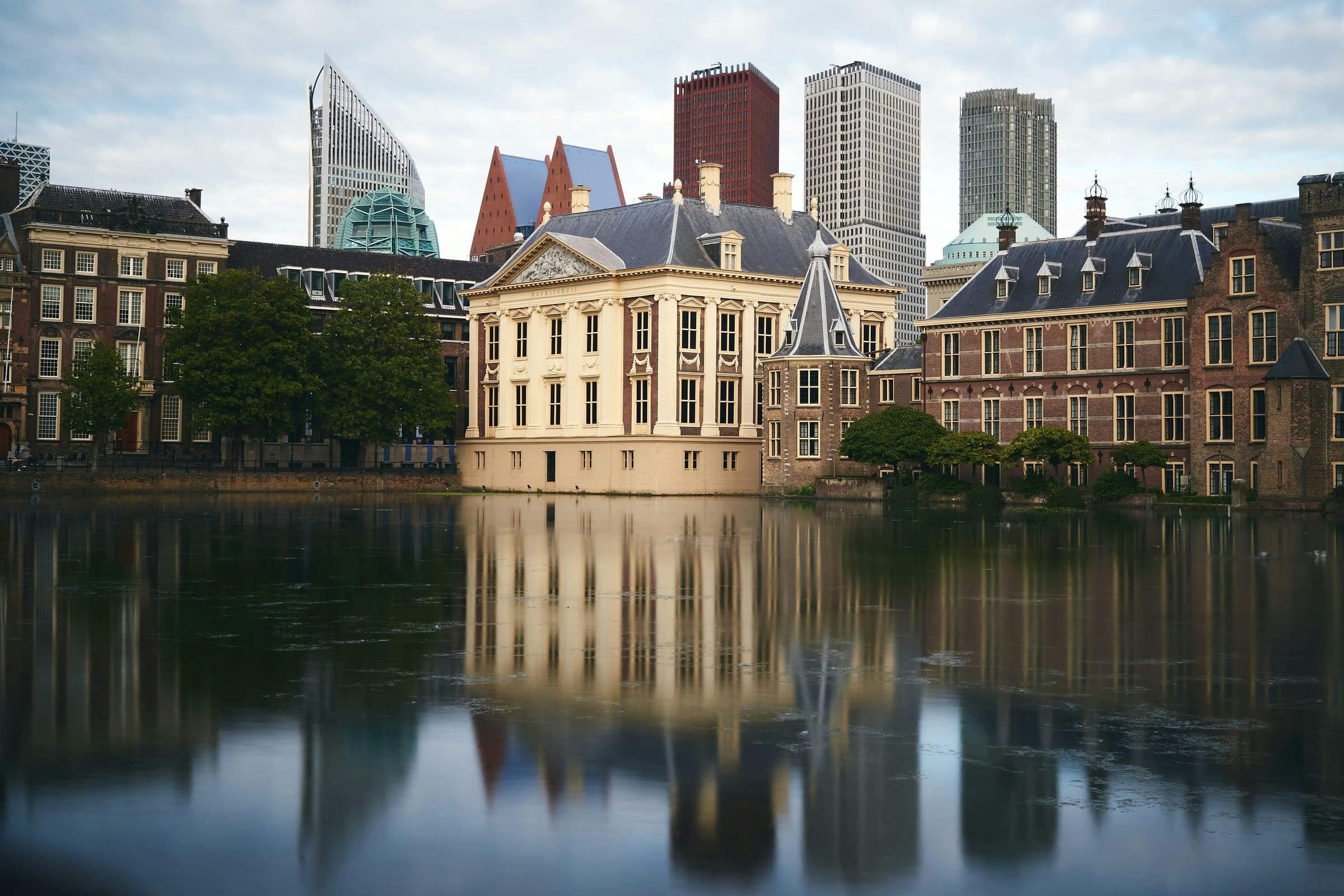
0.7 km (0.4 miles) from the finish. The royal picture gallery holds Vermeer’s Girl with a Pearl Earring, Fabritius’s The Goldfinch and several Rembrandts in a small building with seating in most rooms, which suits tired legs. It opens on Monday afternoons (13:00 to 18:00), the day after the race, and a timed ticket costs about €15.50.
Binnenhof and Ridderzaal
0.9 km (0.5 miles) from the finish. The 13th-century centre of Dutch government is flat and compact, and the inner court is easy to wander. Parts of the complex have been under long-term restoration, so check what is open before going.
Escher in Het Paleis
0.4 km (0.2 miles) from the finish. A former royal palace on the Lange Voorhout holds a museum of M.C. Escher’s prints. It is a low-effort rainy-day visit. Check the current opening hours and book ahead.
Panorama Mesdag
1.0 km (0.6 miles) from the finish. Hendrik Willem Mesdag’s 1881 cylindrical painting of Scheveningen shows the coast you ran along at the end of the race. It is open Tuesday to Sunday, 10:00 to 17:00, and closed on Mondays, so go before the race or save it for a later trip.
Scheveningen seafront and the Kurhaus
3.9 km (2.4 miles) from the finish, at km 38 of the course. The seafront and harbour you ran along are flat, free and at their quietest in late autumn. Walk it the day after the race; the sea wind is the only demand it makes. A tram from Centraal is easier than walking back.
Read Before you Run
Two Hours: The Quest to Run the Impossible Marathon
Ed Caesar
Caesar follows the runners and coaches chasing a sub-two-hour marathon, with much of the book set in Kenya’s training camps and on fast, flat courses. Good reading before a race where a Kenyan debutant won the first edition in 2:09:03.
After the Race
The marathon falls on Sunday 31 October 2027, so the first free day is Monday 1 November. Delft, Leiden, Amsterdam and Rotterdam are all reachable by direct train from Den Haag Centraal in 11 to 50 minutes, on flat ground and with indoor stops, which suits legs that have just run 42 km. Keukenhof is closed in November, so none of these plans depend on the tulip season.
Canals, two churches and the oldest Delftware factory in the Netherlands, all within a flat walk of the station. The churches are indoors, which suits a cold morning after the race.
Rembrandt’s birthplace, a canal-ringed university town and a 12th-century hill fort that is free to climb. Flat and compact apart from one short staircase.
A Rijksmuseum visit on a timed ticket, a flat walk through the Vondelpark and a night in a museum-quarter hotel. Trains run on to Schiphol for the flight home.
A city rebuilt after 1940, with the Markthal, the Cube Houses and the waterfront. Kinderdijk’s windmills are a Friday to Sunday option in winter, so they sit outside a Monday plan.
Background
History
The Hague spent decades as a half-marathon city. The City-Pier-City Loop, run since 1975, gave it a spring classic over 21.1 km, and the full distance never found a permanent home. A one-off marathon in 1998 marked the jubilee of a supermarket chain. Between 2013 and 2015 a small foundation staged the Den Haag Marathon, also called the Vredesmarathon or Peace Marathon, on a course that used beach and woodland. It was the first Dutch marathon held in autumn. Only 145 runners finished the last edition in 2015, and the event ended there.
The idea returned as Dutch running boomed. After questions in the city council and a feasibility study, The Hague’s executive committed to a flagship autumn marathon and approved a municipal subsidy of €150,000 for Golazo Athletics, the Belgian organiser that already runs the City-Pier-City Loop. Nationale-Nederlanden signed as title sponsor. The neighbouring Westland municipality joined as a partner, and the Olympic sailing champion Marit Bouwmeester, who is based in Westland, became the event’s ambassador.
Registration opened at 13:00 on a Thursday in late May and more than 2,000 places went on the first day. The marathon sold out within days, then reopened briefly at the top price as entries were returned. The first edition ran on Sunday 1 November 2026 from the Malieveld, and the second moves to the last Sunday of October. About 9,500 starters were announced and final registration reached 9,864, which the organiser billed as the third largest marathon in the Netherlands behind Rotterdam and Amsterdam.
Elijah Saurey Kibet of Kenya, running his first marathon, broke clear of the favourite Joshua Kipsang Kemboi in the closing kilometres and won in 2:09:03. Kemboi finished 13 seconds behind, and Alex Mutai of Uganda was third in about 2:10. Doreen Chesang of Uganda won the women’s race in 2:24, a personal best. Björn Koreman, the fastest Dutchman, was fifth in 2:18:22. With no earlier editions of this event, those times are the course records.
Frequently asked questions
Should I stay near the start or the finish?
Both are the same place. The start and finish are on the Malieveld, beside Den Haag Centraal, so any hotel within a 15-minute walk of the station puts you at the pens. The real choice is a central stay or Scheveningen, which means a tram ride of about 30 minutes back from the finish.
How far in advance should I book a hotel?
Book as soon as your entry is confirmed, ideally within a week or two. The first edition sold out in days and the weekend brings about 21,000 participants into a city of business hotels. The partner hotel, TRIBE Hotel Den Haag Centraal, offered its best available rate with breakfast.
Is there free transport to the start on race day?
No free race-day transport has been announced. HTM trams and buses run toward the Malieveld on changed timetables, and Den Haag Centraal is a walk of five to ten minutes from the field. Driving is discouraged: the start and finish area is closed to traffic from 05:00 to 22:00.
What is the best area to stay?
The centre around Den Haag Centraal gives the shortest walk to the start. Zeeheldenkwartier is 20 to 25 minutes away on foot and has the best breakfast cafes. Hofkwartier is quieter, Bezuidenhout is practical and cheaper, and Scheveningen suits runners who want to watch the race pass.
When does the expo open?
There is no separate expo. Race numbers are collected on the Malieveld. In the first edition collection ran from 12:00 to 17:00 on the Saturday and from 08:00 to 16:00 on race day. Bring your registration confirmation. Early registrants had bibs posted to them.
What is the weather typically like on race day?
Late October runs from about 7°C to 13°C, often damp and breezy. The first edition, on 1 November, ran at 12 to 13°C with little wind. Heat is not a risk. Wind is, on the open Westland farmland between km 9 and 24 and along the Scheveningen seafront.
How do I get from the airport?
From Amsterdam Schiphol, direct trains reach Den Haag Centraal in about 30 to 47 minutes. From Rotterdam The Hague Airport, take bus 33 to Meijersplein metro station and RET line E to Den Haag Centraal, about 30 minutes on the metro leg. Schiphol has the wider network of flights.
Is there a bag drop?
There is no general bag drop and no other bag storage on site. Lockers on the Malieveld could be booked in advance for €6.50 or €7.50 and opened all day. Backpacks are not allowed in the start areas, but hydration packs are.
Should I bring a throwaway layer?
Yes. An open field on a late-October morning can be well below the temperature at the finish. Wear an old top or bin liner to the pen and drop it before the gun. Unattended items on the terrain are removed, so hand anything you want back to a supporter or use a locker.
How do I get back to my hotel after finishing?
From a central hotel, walk. Den Haag Centraal is a short walk from the finish, and the changing rooms and lockers are on the field. From Scheveningen or Statenkwartier, trams run from Centraal, but expect crowds and slower services. The 10K starts mid-afternoon, so the area stays busy into the evening.