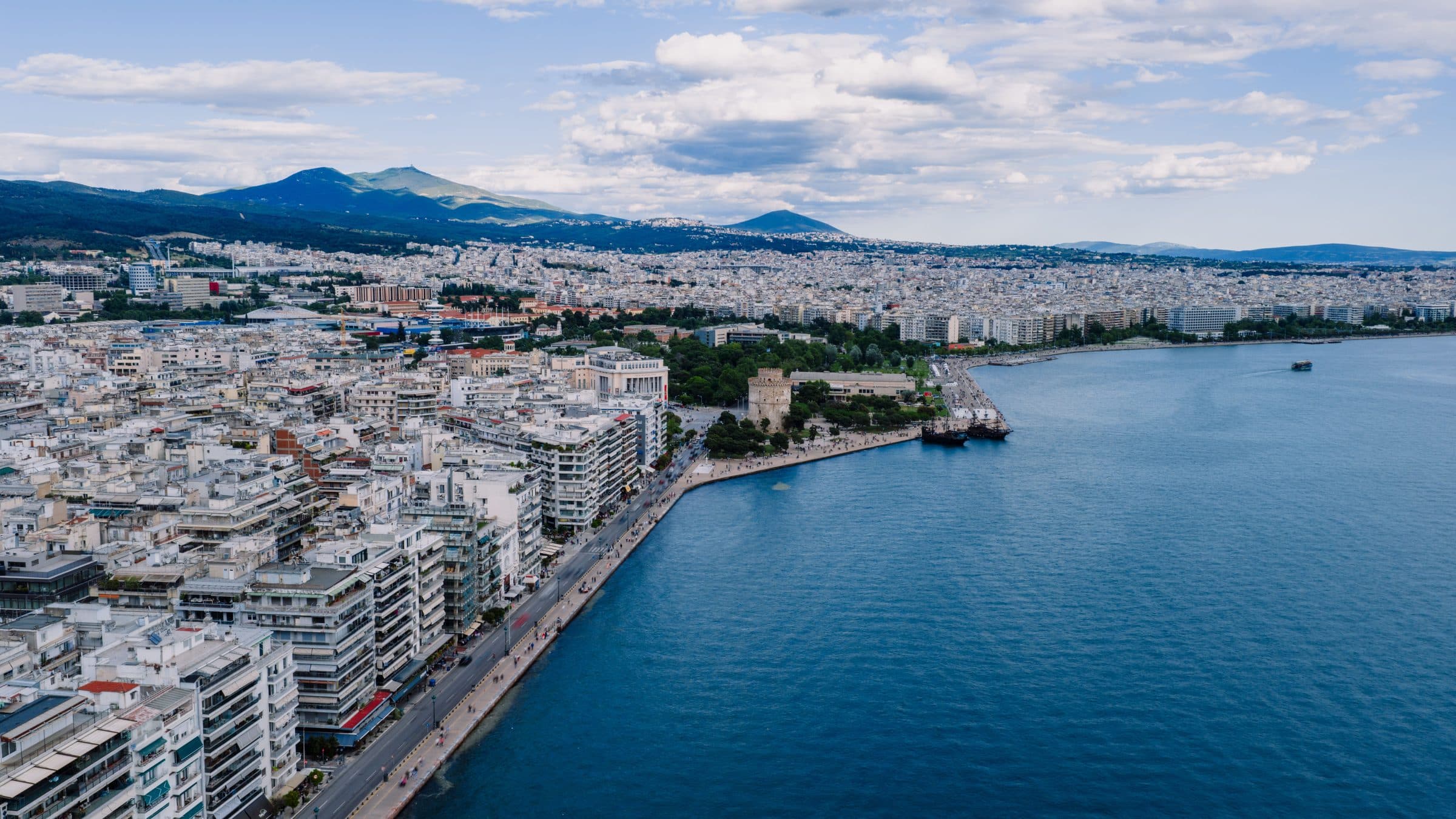
The Race
| Next Race Date | Sunday 4 April 2027 |
|---|---|
| Course type | Point-to-point road course, Pella to Thessaloniki |
| Registration | Open online entry, no ballot |
| Ballot opens | Not applicable |
| Start | Beside the Alexander statue, Pella, 07:30 |
| Finish | Beside the Alexander statue, Megalou Alexandrou Avenue, Thessaloniki waterfront |
| Total finishers | Not published |
| Avg race-day temp | 9 to 19°C (April daily low to high) |
| Cutoff time | 6 hours |
| Free race-day transport | Organiser coaches from Thessaloniki to the start are included; public transport is not free |
| Course certification | Organiser states certified courses; certificate not published |
History
The marathon began in 2006 and has always linked Pella, the ancient capital of Macedonia, with Thessaloniki. Pella Municipality dates the first race to 16 April 2006 and names M.E.A.S. TRITON Thessaloniki as the organiser. The race is named after Alexander the Great, who was born at Pella, and joins the old capital to the regional capital on the waterfront.
Edition numbers do not match the calendar. The 2026 race, held on 26 April, was the twentieth, and the 2027 race on 4 April is the twenty-first. The organiser's news archive recorded repeated postponement decisions around 2020, but a postponement notice does not show that a race ran on the proposed date, so a full chronology needs checking against completed results.
The organiser's 2026 marathon results page lists 1,441 records, with Dimitrios Linardos of Greece at the top in 2:26:14. That is a winning time and not a course record; the prize bonuses in the proclamation are incentives and not records. The results archive keeps the marathon, 10 km and 5 km separate, so festival participation is not the marathon field. The organiser is a full AIMS member; no World Athletics Label has been found.
The course
The race starts beside the Alexander statue in the central square of Pella, 45 m above sea level, and finishes beside the Alexander statue on Megalou Alexandrou Avenue on the Thessaloniki waterfront, 38.8 km away in a straight line. The organiser describes a low-undulation, mainly eastbound road course with long straight roads and few inhabited areas before about 30 km.
The course leaves Pella on the old Thessaloniki to Edessa road at km 1, passes Chalkidona from km 6 to 10, follows the Thessaloniki to Veria road and then the Florina to Thessaloniki road through Valtochori at km 11 and 12, crosses the Axios at about km 13 to 14 and runs through Gefyra at km 15 to 17. The Agios Athanasios area comes at km 18, the Anchialos area from km 19 to 26 and Nea Magnisia from km 27 to 30. Diavata is at km 31 to 33, Kordelio at km 34 and 35, Evosmos at km 36 and Menemeni at km 37. In the city the course passes Dafnis at km 38, Palaiou Stathmou at km 39, Navarchou Koundouriotou and the Courthouse at km 40 and Aristotelous Square at km 41, then finishes on the waterfront.
The profile runs from 47 m at the start to a low of 3 m near Dafnis at km 38.9. The first 3.3 km fall 35 m, an average of 1.1% and 2.7% over the first kilometre. Three climbs follow: 20 m over 1.2 km (1.6%) at km 6.4 to 7.6, 27 m over 3.0 km (0.9%) at km 16.5 to 19.5, topping out near 31 m at km 20, and 23 m over 1.7 km (1.3%) at km 25.5 to 27.2. Each gives way to a long descent: 20 m over 8.9 km, 26 m over 6.0 km and 23 m over 8.9 km to km 36. The last six kilometres are level at 4 to 12 m. The organiser publishes no total climb.
Kilometre by kilometre
Km 0 to 10: Pella to Chalkidona. The race starts at 07:30 in a rural setting, and runners have usually been on a coach since before 06:30. The road drops 27 m in the first kilometre, 2.7%, and 35 m by km 3.3, which makes a target pace feel easier than it is. A 20 m climb at km 6.4 to 7.6 comes through Chalkidona, with a small drop to 8 to 10 m by km 9. The road is straight and exposed, so settle early and keep to the plan.
Km 10 to 20: the Axios crossing and Gefyra. The road is level at 8 to 10 m through Valtochori and across the Axios at about km 13 to 14, then through Gefyra. The longest climb begins at km 16.5, 27 m over 3.0 km to about 31 m at km 20. Timing checks are at 10 km and at halfway, 21.1 km, and the organiser says missing a check can invalidate the result.
Km 20 to 30: the long straights. The course falls 26 m to 10 m by km 23, runs level through the Anchialos area to km 26, then climbs 23 m over 1.7 km to Nea Magnisia at km 27 (30 m) and falls to 17 m by km 30. Few inhabited areas appear before about 30 km, so a runner who relies on crowds will notice. The proclamation announces 15 support stations, the first at 5 km, with toilets and medical support.
Km 30 to 40: into the city. Diavata at km 31 to 33, Kordelio at km 34 and 35, Evosmos at km 36 and Menemeni at km 37 bring the first sustained urban running, all at 8 to 16 m. Dafnis is at km 38, the low point of the course (3 m) is at km 38.9, and the 30 and 40 km timing checks fall either side. The Courthouse is at km 40. The 30 to 35 km stretch is the place to reassess breathing and pace before the city.
Km 40 to 42.2: the waterfront. The course passes Navarchou Koundouriotou at km 40 and Aristotelous Square at km 41, then reaches the waterfront and the Alexander statue. The proclamation directs marathon runners to the right lane near the end, where several events share the finish approach, so follow the lane and do not cut across. An eastbound course does not guarantee a tailwind, and no wind data exists for race morning.
A 35 m drop in the first 3.3 km, then a 20 m climb at km 6.4 to 7.6. A target pace feels easier than it is.
The Axios crossing, a 27 m climb to km 20 and a 23 m climb to km 27. Few inhabited areas, thinner support and full exposure to wind and sun.
Diavata, Kordelio, Evosmos and Menemeni, then Dafnis and the Courthouse at km 40. Timing checks at 30 and 40 km.
Aristotelous Square at km 41, then the waterfront to the Alexander statue. Keep to the marathon lane.
Course Map
A point-to-point line from Pella to the Thessaloniki waterfront, with the halfway check and the two coach pick-up points in the city. Tap a marker for details, and scrub the slider or press play to move the orange marker along the course with the elevation profile beneath it.
Pacers
The organiser's 2026 post-race account lists six pacing targets, and an organiser-hosted interview confirms banner identification. The 2027 roster, pens and identification have not been published. The same interview shows a 4-hour pacer finishing in 4:14:55, so a pacer is support and not a guarantee.
| Start | 2026 pacing targets |
|---|---|
| 07:30, single start | 3:00, 3:15, 3:30, 3:45, 4:00, 4:15 |
Runners sleep in Thessaloniki and travel to the start by organiser coach. Two pick-up points are used, Kaftanzoglio Stadium (yellow ticket) and the Thessaloniki Courthouse (blue ticket), with departures between 05:15 and 05:45 and arrival in Pella by 06:30. The proclamation requires the matching ticket and bib to board. Confirm times and points in the 2027 collection notice.
April at Thessaloniki airport averages a low near 9°C, a high near 19°C and a mean near 14°C, from a 1992 to 2021 record. Those are airport figures and not a reading at 07:30 in Pella, which is inland and rural.
A runner spends a long time standing before the start. Coaches leave the city between 05:15 and 05:45, the start is at 07:30 and no shelter or heating at the start has been verified, so a cheap removable layer is sensible if the forecast is cool. No clothing-donation scheme has been verified, so do not assume a discarded garment will be collected.
The second half is likely to be warmer than the start, particularly on the exposed straights, so carry sunscreen and a cap. Wind and rain are both possible. Keep dry clothes for the finish in the race bag, particularly if rain is forecast.
Entry
Entry is open and online through the organiser's registration pages, with no ballot, no Good For Age route and no qualifying time for ordinary entrants. Complete both the application and the payment, and keep the confirmation. The 10 km and 5 km races register through the same site, so check that the form names the marathon and 42.195 km before paying.
The group page describes a reduction of €10 per participant on the marathon, which gives the €35 group figure. A group leader coordinates the submission, and a club group has an earlier deadline than an individual. Sterling figures use the ECB rate of €1 = £0.85033 on 2 October 2026 and exclude card and conversion charges.
The cancellation page gives a written-request deadline of 4 March 2027 and allows a bank-transaction deduction where required, while the 2027 proclamation states a €2 operational deduction. The sources agree on the deadline but describe the deduction differently, so confirm the terms before paying. Transfer, deferral and insurance terms have not been published.
A charity and social programme lets runners join teams of participating institutions. It is not a charity-place route round a ballot, and the active institutions and fundraising obligations need checking each year. The organiser's cooperating-agency page names World's Marathons for travel packages, so check what a package includes before booking. The prize standards in the proclamation are competition incentives and not entry qualifications.
| Route | Fee |
|---|---|
| General entry (individual deadline 10 March 2027) | €45 (about £38) |
| Discounted entry (students up to age 30, with ID) | €35 (about £30) |
| Group of ten or more (group deadline 5 March 2027) | €35 (about £30) per participant |
Fast runner standards
There are no Good For Age or fast-runner standards for this race.
Register on the organiser's site →Race Weekend
Number collection
The 2027 proclamation leaves the number-collection venue and dates to be announced. The 2026 technical instructions place the registration centre in the Event Hall on the third floor of the National Kaftanzoglio Stadium, while a third-party 2026 listing named HELEXPO Pavilion 2, so the two sources disagree and neither can be assumed for early April 2027.
Plan to collect before race morning: the coaches leave before dawn and nothing suggests collection is possible in Pella. A Friday arrival leaves Saturday for any problem while the registration centre is open. Take photo identification or a passport, the registration confirmation and any evidence for a discounted entry, and keep offline copies. The race kit includes a technical shirt and timing equipment.
The coach tickets, yellow for Kaftanzoglio Stadium and blue for the Courthouse, are expected with the race materials, so check which ticket you receive and where it boards before leaving the centre. The collection layout, a separate shirt pick-up and the treatment of uncollected bibs have not been published.
Getting to the start
The marathon starts at 07:30 in Pella, about 40 km from the finish. Runners sleep in Thessaloniki and travel by organiser coach from Kaftanzoglio Stadium (yellow ticket) or the Thessaloniki Courthouse (blue ticket). Coaches leave between 05:15 and 05:45, the proclamation asks runners to be in Pella by 06:30 and it requires the matching ticket and bib to board.
Choose a hotel and a boarding point together. A finish-side hotel may need a long early walk west to the Courthouse, and a hotel to the east may suit the stadium better. Do not assume a coach will accept the other ticket colour. Work out the walk the day before, and arrange any taxi in advance because road closures and early availability are not verified. A hotel's advertised breakfast hour is unlikely to start before the coaches leave, so ask for an early or packed breakfast and carry familiar food.
The proclamation describes a dedicated race bag with a bib-number label and transport of belongings from the start to the finish. The 2026 instructions asked runners to hand in belongings 30 minutes before the start at vehicles near the starting points and to collect them on showing the bib. Keep passports, medicine and valuables out of the bag, and leave time to hand it over before finding the start. No pen letters, wave schedule, security checks, toilet queues or warm-up space have been published.
After finishing, move through the runner area and collect the bag before booking lunch or checking out. Agree a meeting point away from the flow with companions and give a time window and not an exact minute. A central hotel allows a walk back once you leave the finish area, but road closures can turn a short taxi ride into a long one. No airport transfer is part of the entry.
Nutrition on course
The 2027 proclamation announces 15 support stations, the first at 5 km, with toilets and medical support, but gives no product list for each station. The registration page lists water, isotonic drinks, juice, gel, bars and bananas in the package, which does not show what is at each station or separate finish refreshments from on-course supply.
The 2026 technical instructions list timing and aid controls at the start, 10 km, halfway, 30 km, 40 km and the finish, chemical toilets at the start, at all support stations and at the finish, and offerings that included bottled water, isotonic drinks, gels, bananas, salted snacks, alcohol-free beer, juice and halva. Those are 2026 provisions. Brands, serving format, personal-bottle service, sponges, ice and massage have not been published, so carry any product you cannot do without.
| Provision | Where |
|---|---|
| Support stations with toilets and medical help | 15 stations, first at 5 km |
| Timing checks | Start, 10 km, halfway, 30 km, 40 km and finish |
Spectating
A point-to-point course gives no repeat sightings, and driving between points on closed roads is unattractive, so the best plan is a late-race one. The proclamation and route page give no spectator barriers, grandstand, tickets or live-tracking app. No bus or metro line is named here because none could be verified for race morning. A supporter should not plan to follow the coach to Pella: spectator eligibility has not been confirmed and the early rural sighting creates a separate return problem.
Agree a meeting point reachable from the runner exit and not merely visible from the finish arch, and use a phone message after the finish as a fallback where tracking is unavailable.
- Watch the late run near Aristotelous Square, where the course passes at about km 41.
- Walk to the statue area, about 1.2 km in a straight line. The walk may miss the finish while you move.
- Suits a supporter who wants to see the last kilometres.
- Take a position near the Courthouse at about km 40, then walk to the waterfront for a meeting point, about 1.9 km in a straight line.
- Depends on runner pace and crossings, and there is no guaranteed second sighting.
- Stay near the final approach and do not move. This is the simplest plan for children or reduced mobility, though access boundaries are not yet published.
Post-race food
The finish area is understood to offer refreshments, but the proclamation does not say what, so plan a meal in town. Rouga, at Karypi 28, serves cooked Greek food, meat and seafood, and its own website lists opening from 12:30 to 00:30 daily. A late-morning finisher will need a snack first, so book a flexible lunch window and do not expect instant service.
Full tou Meze, at Katouni 3 in the Ladadika district, serves shared plates that suit a group with different appetites; check Sunday opening hours. Orizontes, the all-day restaurant at the Electra Palace on Aristotelous Square, is advertised for non-residents at breakfast, lunch and dinner, so reserve and check the kitchen times. Carry a small familiar snack so lunch does not depend on being seated immediately, and mention vegetarian, vegan or allergy needs when booking.
Where to Stay
The race is point-to-point, so the choice of base balances the walk after the finish against the walk or ride to a coach before dawn. Staying at the finish side normally beats staying in Pella, and that is a recommendation and not an organiser rule.
White Tower and the eastern historic centre
The strongest choice for a short return after finishing: the White Tower is about 0.3 km from the finish in a straight line. The Courthouse coach point is farther west and the stadium point may mean an inland walk or taxi, so check the route. Waterfront rooms may be noisy, so ask for a quiet room and early breakfast.
Aristotelous Square and the central waterfront
A balance of sightseeing, food and a finish walk of about 1.2 km in a straight line. Convenient for companions and lively, so a quiet interior room may suit better than a square-facing one.
Ladadika and the western centre
Favours the Courthouse boarding point and post-race restaurants. The return from the statue is longer, about 1.9 km to the Courthouse in a straight line and further on sore legs. Ask which way the room faces, as evening entertainment can run late.
The eastern waterfront near Makedonia Palace
A direct promenade return of about 0.8 km. The practical problem is reaching the coach point before dawn, particularly the inland stadium.
Railway station, Vardaris and Monastiriou
A value option that shortens the approach to the western boarding point but may mean a long return from the finish. A lower rate can disappear in taxi fares.
Ano Poli
A distinctive upper-town base, but the hills add a recovery cost and a pre-dawn taxi may be hard to find. Better as a quiet extension after the race.
Weigh the finish-to-hotel journey and the hotel-to-coach journey separately, and ask each hotel about noise, lifts, luggage storage and breakfast. A map distance can understate a route once closures are in place.
Recommended hotels
A waterfront base on the finish side. Check early breakfast and room noise from the seafront.
A central hotel for companions and meals, with the Orizontes restaurant. Busy square and no advertised hotel parking.
A promenade return after finishing and a historical supporter of the race. No race rate or shuttle has been confirmed, and the coach point needs a booked taxi or a checked walk.
A central, practical alternative. Room outlook and noise vary.
A western base that suits the Courthouse boarding point. The return from the finish is long, so budget for transport.
Booking timeline
There is no ballot, so there is no results date to wait for. The organiser and AIMS both support the date, so a refundable room can be held once the budget suits. Keep the individual and group deadlines distinct: a club booking may need its organiser to collect names and payment before 5 March 2027, and an individual has until 10 March. The cancellation deadline is 4 March 2027. Leave time to correct a registration problem before booking non-refundable travel.
A Friday arrival and Monday departure give a buffer for collection and recovery. Compare the combined cost of the room, early transport, luggage storage and the airport transfer, because a cheaper outer hotel can lose its saving in taxis. No hotel sell-out pattern, premium or flight deadline was found. Ask for early breakfast and Sunday checkout in writing, and review the choice when the final coach and collection notices appear.
See & Do
The finish is on the waterfront near the White Tower, so the main sights are short walks. Distances are straight-line from the finish.
White Tower
The tower is on the waterfront. The outside is the lowest-effort option, because a visit involves stairs and vertical circulation. The Ministry directory and the museum site give different closing hours, so check the race-weekend schedule and any timed access.
Museum of Byzantine Culture
At Stratou 2, with eleven permanent galleries. A short visit suits sore legs better than all the rooms. Check the April opening hours.
Archaeological Museum of Thessaloniki
A collection that links the race's Pella theme to regional history. Check admission and access information and allow breaks.
The waterfront and the statue
A short promenade walk that can be shortened in wind or rain. Race closures mean the finish area is not open to the public all Sunday.
After the Race
Early April in northern Greece is cool and changeable, which suits sites with covered galleries. The four itineraries run from a day at Pella, where the race starts, to three nights across Edessa and the thermal baths at Pozar. Journey times are planning estimates; check KTEL timetables for April.
The ancient Macedonian capital where the race starts, with a museum and an excavated site. A short, sedentary visit suits Monday legs.
A town built beside a waterfall park, with a small overnight bag and a gentle riverside walk.
The royal tombs of Aigai, the first capital of Macedonia, with a regional stay and one major site a day.
Edessa first, then the thermal baths at Pozar in the hills, with transfers arranged in place of a sequence of bus changes.