The Race
| Next Race Date | 7 March 2027 |
| Course Type | Point-to-point, net downhill |
| Start | Tokyo Metropolitan Government Building, Shinjuku |
| Finish | Gyoko-dori Avenue, Marunouchi (adj. Tokyo Station) |
| Registration | General ballot (~10%) · Charity · Semi-elite · Tour operator |
| World Major | Abbott World Marathon Major |
| IAAF Label | Platinum |
| Total Finishers | ~38,000 |
| Avg Race Day Temp | 4–12°C |
| Cutoff Time | 7 hours from gun (not chip time) - 9 intermediate checkpoints |
| Free Race Day Transport | No - Suica/Pasmo IC card required |
| Course Certification | JAAF certified, IAAF measured |
Tokyo was the last of the original six Abbott World Marathon Majors to join the series and already has the longest rulebook. The race was established in 2007, absorbing two older Tokyo events: the Tokyo International Marathon and the Tokyo-New York Friendship International Marathon. Since then it has been run with the operational precision of a train network. Wave starts run to the minute. Bag drop logistics are managed with a specificity that borders on the forensic. The race joined the World Marathon Majors in 2013, and its reputation has grown steadily: not because the course is the most scenic, nor because entry is easy, but because Tokyo delivers what it promises.
Tokyo is a point-to-point course running 42.195km from the Tokyo Metropolitan Government Building in Shinjuku to Gyoko-dori Avenue, the broad ceremonial boulevard in front of Tokyo Station. The net elevation is slightly downhill, and the first five kilometres confirm it: there is a steady, measurable descent out of Shinjuku that makes the opening miles feel unnaturally easy. That ease is a trap. Runners who use the early gradient as licence to overcook their pace tend to encounter the course's true character in the final 10km, when Tokyo's flat roads reveal their neutrality: they offer no help, no descent to lean into, and no crowd-narrowing that forces you to ease off.
The course does not have a single brutal hill. It does have long out-and-back stretches, multiple 180-degree hairpin turns that break rhythm, and no marked blue line to guide tangent efficiency. The last 3km along Gyoko-dori feel longer than they are. The finish near Tokyo Station is wide and unencumbered; the final 200 metres arrive before most runners expect them.
Elevation profile
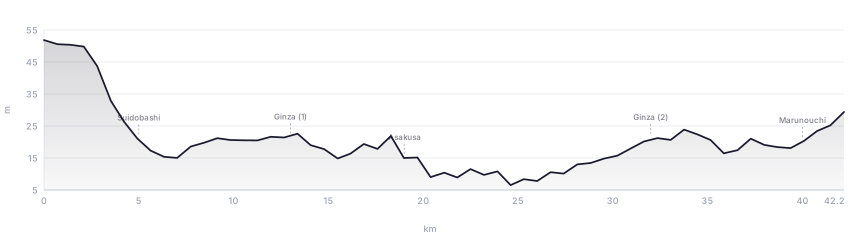
Elevation from GPS data. The course descends ~50m from the Shinjuku start; the middle sections are essentially flat. Annotations show key course landmarks.
Course highlights
km 0–5: The Shinjuku descent. The course drops out of the Metropolitan Government Building district and into the city at a gradient that feels like a gift. It is not. The received wisdom from runners who have run Tokyo more than once is consistent: treat the early descent as energy to bank, not time to spend. The quad damage from the first five kilometres accumulates silently and announces itself somewhere around km 25.
km 8–13: Suidobashi and into the city. The route drops towards Suidobashi and the Imperial Palace moat. By km 13 the course enters Ginza for the first of two passes. The roads narrow, the crowd stacks deeper, and the noise concentrates. This is where the city feels most compressed.
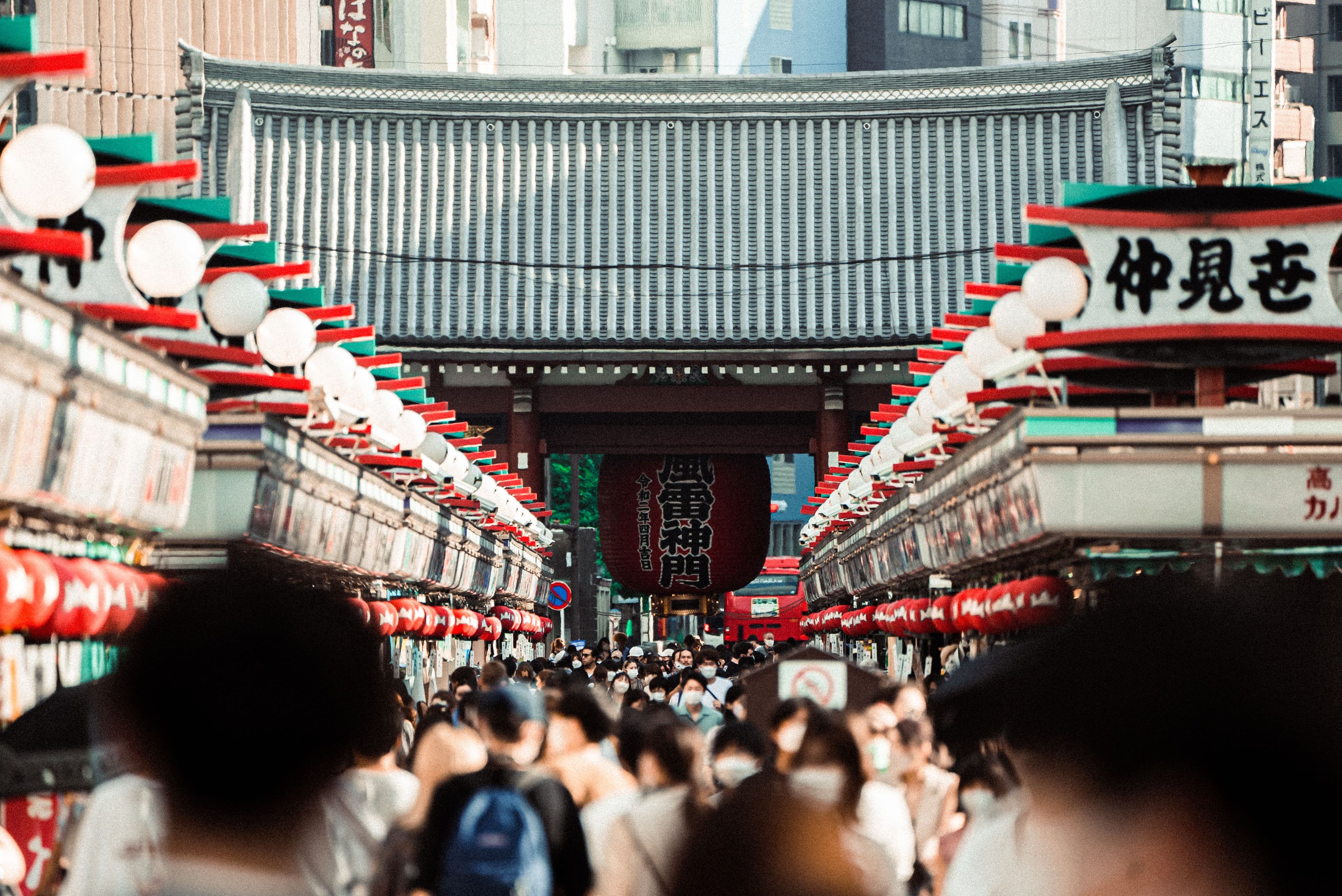
km 19: Asakusa. The stretch through Asakusa takes runners past the approach to Senso-ji Temple, where spectators tend to stack three or four deep. Ryogoku, the sumo district, comes shortly after at km 21, identifiable by the Kokugikan arena. Both are the sections where the course changes character most clearly - from commercial corridor to neighbourhood.
km 32: Ginza again. The second Ginza pass is where the race frequently becomes honest. Runners who went out conservatively look like a different race from runners who did not. After the second Ginza crossing, the route turns towards the Imperial Palace and back south to Marunouchi.
km 39–42: Marunouchi and the finish. The city opens out as the course enters the formal business district. Gyoko-dori Avenue is a broad, tree-lined ceremonial boulevard running west from Tokyo Station. The finish line arrives with less fanfare than a London or New York finish - wider roads, a quieter crowd - but the cotton finisher towel placed around your shoulders at the end is, by consistent runner accounts, more memorable than a foil blanket anywhere else.
Entry
Getting into Tokyo is a multi-route problem. The ballot has a roughly 10% success rate from 300,000 applicants. The charity route requires a significant upfront donation. The semi-elite qualification field is 50 people globally. Most runners spend almost as long studying the entry system as they spend training for the race. The application window opens months before the race, and it closes whether you are ready or not.
2027 entry timetable
General ballot
The ballot opens in mid-August and stays open for approximately two weeks. Applications are not first-come-first-served - submitting on day one provides no advantage over submitting on the last day. The entry fee, payable only if selected, is $230 USD for international runners. Results are announced in mid-September. Runners who have been unsuccessful in the ballot for three consecutive years receive priority weighting in a separate draw.
ONE TOKYO Global Membership
The organiser's paid membership programme costs approximately ¥30,000 per year for international runners. It provides access to a priority draw held before the general ballot opens. Unsuccessful applicants in the priority draw roll automatically into the general ballot pool, so membership functions as a second chance rather than a guaranteed path.
RUN as ONE - semi-elite qualification
Tokyo's performance qualification route, but the international field is capped at 25 men and 25 women in total. The minimum qualifying standards are sub-2:22 for men and sub-2:50 for women, run on a World Athletics Label course and verified by gun time rather than chip time. Meeting the minimum does not guarantee a place: the field is filled by fastest time from the applicant pool. In recent years, men have typically needed a time closer to 2:20 or faster to secure one of the 25 spots.
| Event | Men | Women |
|---|---|---|
| Marathon | Sub-2:22:00 | Sub-2:50:00 |
| Half Marathon | Sub-1:05:00 | Sub-1:26:00 |
Gun time only. Qualifying race must hold a World Athletics Label. Meeting the minimum standard does not guarantee a place - only the 25 fastest qualifying men and women from the applicant pool are selected.
Charity entry - RUN with HEART
Approximately 5,000 places are allocated across around 40 partnering charities. The application window opens in late June, before the general ballot. This is not fundraising in the Western sense: you declare in advance exactly how much you are willing to donate to your chosen charity, and places are awarded primarily to the highest bidders. The donation must be paid entirely from your own funds; third-party crowdfunding contributions do not count toward your bid.
Minimum bids vary by charity, ranging from ¥100,000 to ¥375,000 depending on the organisation. Bidding the minimum will not succeed at any of the more established charities. Based on publicly available data from recent cycles, runners who secured places at mid-tier charities were typically bidding in the range of ¥150,000 to ¥250,000; the most competitive charities saw average winning bids above ¥300,000. If two bids are identical, the tiebreaker at most charities is submission time or a short essay on your connection to the charity's mission.
Charity entry rules - read before applying:
- You may apply to only one charity. Applying to multiple charities results in disqualification.
- Some charities accept applications only from residents of Japan. Check each charity's terms before the window opens.
- The charity donation is non-refundable in all circumstances, including injury, illness, or inability to enter Japan.
- If accepted, you must also pay the $230 race entry fee separately by the deadline. Missing either payment forfeits the place.
- Allow time between charity notification and the payment deadline for international bank transfers.
- Entries cannot be deferred to another year except for pregnancy.
Tour operator packages
Approved international tour operators receive guaranteed bib allocations bundled with hotel accommodation. Entry certainty comes at a significant premium: the package cost typically far exceeds what a self-organised trip would cost. This is the right option for runners who cannot afford a failed ballot attempt in a specific year and have the budget.
Race Weekend
Tokyo race rules: what you need to know
Tokyo enforces rules that other major marathons do not. These are not suggestions. Read them before race day.
There are nine intermediate checkpoints along the course, each with its own closing time calculated from the official gun - not your chip crossing. If you miss a checkpoint by a single second, volunteers drop a cordon and you are placed on a sweep bus. This is enforced without exception.
Runners starting in the rear corrals may cross the start line 20–25 minutes after the gun. That time does not come back. You must be inside the start area by 08:45. Entry after that time is refused.
Empty soft flasks and hydration bladders may pass through security; fill them from water available inside the corrals. Factory-sealed, unopened bottles up to 250ml per container are permitted. Anything larger is confiscated.
Gel supply is unrestricted, but every wrapper must be carried to the next designated bin. Dropping a gel wrapper on the road is a potential disqualification.
- Discard throwaway layers onto the road, bushes, or over barriers - they must go to a designated clothing collection point at the start.
- Change clothing outside a designated area.
- Wear face-covering costumes, or anything extending significantly beyond shoulder width.
- Carry political, religious, or unapproved commercial messaging.
Aid stations use a bib number system: take from the table matching the last digit of your bib. At every major toilet block, a volunteer holds a sign showing the distance to the next facilities. The Pocari Sweat electrolyte drink at aid stations has a mild grapefruit-salt taste - buy a bottle in the days before the race and try it.
You receive a cotton finisher towel rather than a foil blanket. It is thick, full-sized, and in many accounts lasts considerably longer than the race memory itself.
Expo and bib collection
Bib collection and the race expo are at Tokyo Big Sight South Exhibition Halls in Ariake, on the eastern waterfront in Koto-ku. The venue is a major convention centre, not a race tent, and the scale reflects this: organised queues, thorough signage, and a large official merchandise area operated by ASICS.
The ASICS merchandise section is the one place where Tokyo's customary calm temporarily fails. Forum reports from multiple editions describe the store on the first morning as overwhelmed within the first hour or two, with queue times extending to 90 minutes or longer if you arrive later in the day. If official race kit matters to you, go on Thursday as early as possible. Bib collection itself is efficient once you clear the merchandise section. Allow 20–30 minutes for the bib process. The Ariake waterfront is worth half a day if you want to explore Odaiba, but stay overnight closer to the course.
Bib collection closes at the end of the final pre-race day. There is no collection on race day. Check the current year's official schedule for exact hours.
Race morning
The race starts at the Tokyo Metropolitan Government Building in Nishi-Shinjuku. Most runners staying near the finish in Marunouchi or Nihonbashi take the Chuo Line from Tokyo Station to Shinjuku: approximately 15 minutes, and the westbound direction on race morning is uncrowded.
- Leave your hotel by 07:00 for the 09:10 start. Allow more time if staying further from Tokyo Station.
- Take the Chuo Line westbound from Tokyo Station to Shinjuku (approximately 15 minutes). Buy a Suica or Pasmo IC card at the airport on arrival - it works on all Tokyo rail and metro lines without needing to understand fare zones.
- Follow race signage from the station exit assigned in your runner guidebook. Shinjuku Station is the largest interchange in the world - allow 15–20 minutes from the platform to your designated security gate.
- Pass through security with your bib visible. Empty soft flasks through security; fill them from water available inside the corrals. Factory-sealed bottles 250ml or under are permitted; larger containers are confiscated.
- You must be inside the start area by 08:45. Entry after that time is refused, regardless of circumstances.
- Bag drop is managed at the start using only the official bag. Discard throwaway layers at designated clothing collection points inside the start area, not onto the road.
Course and logistics map
Click any pin for details. Use the view buttons to jump between the start, finish, and expo areas.
Spectating
Spectating at Tokyo requires planning because the course is point-to-point and most of the route runs through areas with controlled spectator access. The two most accessible and rewarding positions are Asakusa (around km 19, accessible via the Ginza Line from Asakusa Station) and Ginza (around km 13 and again at km 32, accessible from Ginza Station on the Ginza or Hibiya lines).
A supporter who moves efficiently between Asakusa and Ginza can see their runner at both points, though the second Ginza pass requires good timing and knowledge of the runner's expected pace. The finish area on Gyoko-dori has dedicated spectator zones with limited capacity; access is controlled and entry is not guaranteed if zones reach capacity. Arrive early and approach from the Marunouchi side rather than the station concourse.
Japanese spectators do not behave like those at London or New York. The crowd is consistently large, sometimes silent in residential stretches. What takes the place of volume is depth of attention: spectators will applaud with measured, concentrated encouragement. Many set up unofficial tables offering salted pickled plums, individual strawberries, and on cold years, hot tea.
Where to Stay
Stay near the finish. The race starts in Shinjuku and ends at Gyoko-dori Avenue, Marunouchi, and for most runners the post-race walk back to a hotel matters more than the race-morning commute. From any hotel in the recommended areas, the Chuo Line from Tokyo Station reaches Shinjuku in 15 minutes - the whole of the race-morning transport problem solved.
Marunouchi and Nihonbashi
The best bases. Marunouchi puts you walking distance from the finish on Gyoko-dori; Nihonbashi, slightly to the east, offers better value and the same practical access. After the race, you exit the finish compound and walk to your room.
Ginza
A strong alternative. Ginza sits between the finish and Nihonbashi, the course passes through it twice on race day, and supporters can watch from the hotel area at both points. The trade-off is cost: Ginza hotel rates are among the highest in central Tokyo, and Saturday night in the district is busier than Nihonbashi.
Kanda and Akihabara
One stop east of Tokyo Station on the Chuo Line. Noticeably better value than Marunouchi without adding meaningful travel time. The finish is 2km on foot or a single train stop away, and the area is quieter on race weekend than the hotel districts around the station.
Shinjuku
Suits runners whose priority is a short walk to the start, or those who want to be based in one of Tokyo's most self-contained hotel and restaurant districts. The race-morning logistics are genuinely simple from here. The trade-off is the post-race return: Shinjuku Station is the busiest interchange in the world by daily passenger count, and navigating it on race-day legs is an experience that generates consistent commentary in runner forums. Manageable; not the easiest end to the day.
Booking window: Book within the first two weeks after ballot results in September. Hotels in Marunouchi, Nihonbashi, and Ginza that typically cost ¥25,000–¥40,000 per night can reach ¥60,000–¥100,000 or more during race weekend. Runners who book speculatively before results arrive generally pay less than those who wait for confirmation. Hotels remaining in February are either significantly more expensive or significantly further from the finish.
See & Do
The Tokyo Marathon finishes in Marunouchi, the formal business district running west from Tokyo Station along Gyoko-dori. It is not the Tokyo of film and travel photography. There are no neon towers here, no Shibuya crossing. What there is instead is order, scale, and the Imperial Palace East Garden less than 10 minutes' walk from most recommended hotels.
Imperial Palace East Garden (Kokyo Higashi Gyoen) is the former site of Edo Castle, open from 09:00 most mornings and free to enter. The grounds cover roughly 210,000 square metres of flat gravel paths, lawn sections, and stone foundations. 15 minutes' walk (1.0km / 0.6 miles) from Tokyo Station, no admission charge, no requirement to stand for long periods. The most recovery-friendly major attraction in central Tokyo.
Nihonbashi bridge, a short walk east from the station, was the historic starting point for all of Japan's major highway routes during the Edo period. The current bridge dates from 1911. The area around it is dense with high-end department store food halls (depachika) - practical sources of pre-race meals at consistent quality. Mitsukoshi and Takashimaya department stores both have ground-floor food halls within 800m (0.5 miles) of most Nihonbashi hotels.
Ginza, approximately 1.2km (0.75 miles) south-west of Tokyo Station, is a 10-minute walk from the finish area. The main Chuo-dori shopping street is pedestrianised on Sunday afternoons. Galleries, cafes, and a high concentration of coffee shops with seating make it a reasonable destination for the morning after, when covering distance matters less than having somewhere to sit.
Running in Tokyo before the race: The 5km loop around the Imperial Palace moat in Chiyoda is the city's most-used running circuit, typically populated from early morning until dusk. Runners who want a longer route use the Sumida River path, accessible from Asakusa and Ryogoku - both landmarks on the race course.
Airport and transport: Tokyo is served by Narita International (NRT), approximately 60km east, and Haneda (HND), approximately 20km south. The Narita Express (N'EX) runs to Tokyo Station in approximately 53 minutes, around ¥3,070, covering onward JR travel on the day of arrival. The Tokyo Monorail connects Haneda to Hamamatsucho in 20 minutes (¥510); from Hamamatsucho, the Yamanote Line reaches Tokyo Station in 3 minutes. A taxi from Haneda costs approximately ¥6,000–¥9,000.
Cash: Carry yen from the day you arrive. Smaller restaurants, some convenience store transactions, and several of the unofficial spectator food stalls along the course operate on cash only. Foreign cards are not accepted everywhere.
Read Before you Run
What I Talk About When I Talk About Running
Haruki Murakami
Murakami's memoir of running and writing, built around his training for the 2005 New York Marathon. Much of it is set in Tokyo, where he runs the streets before dawn. Quietly obsessive, occasionally funny, and recognisable to anyone who has ever committed too seriously to a race.
Buy on Amazon ↗Butter
Asako Yuzuki
A darkly comic Tokyo novel about a food critic investigating a convicted murderer who seduced men through cooking. Yuzuki uses the city's restaurants, apartments, and social rituals to build a portrait of appetite that stays with you long after the race.
Buy on Amazon ↗After the Race
Tokyo's rail network connects the city to the surrounding region without requiring a car. Yokohama is 25 minutes from Shinjuku. Kawagoe is 45 minutes. Kamakura and Enoshima are 60 minutes by the Shonan-Shinjuku Line. All are accessible directly from the hotel areas recommended for marathon weekend. Many runners extend the trip further into Japan after recovering for a day or two in the city.
Japan's second city is 25 minutes from Shinjuku. The Minato Mirai waterfront, Yamashita Park, the Cup Noodles Museum, and Chinatown for post-marathon ramen.
The warehouse district of Kawagoe is the best-preserved Edo-period merchant street within reach of Tokyo. The candy lane, the bell tower, and the sweet potato desserts.
The Great Buddha at Kotoku-in, the Dankazura avenue approaching the Tsurugaoka Hachimangu shrine, the Enoden tram along the coast to Enoshima, and the cave shrines.