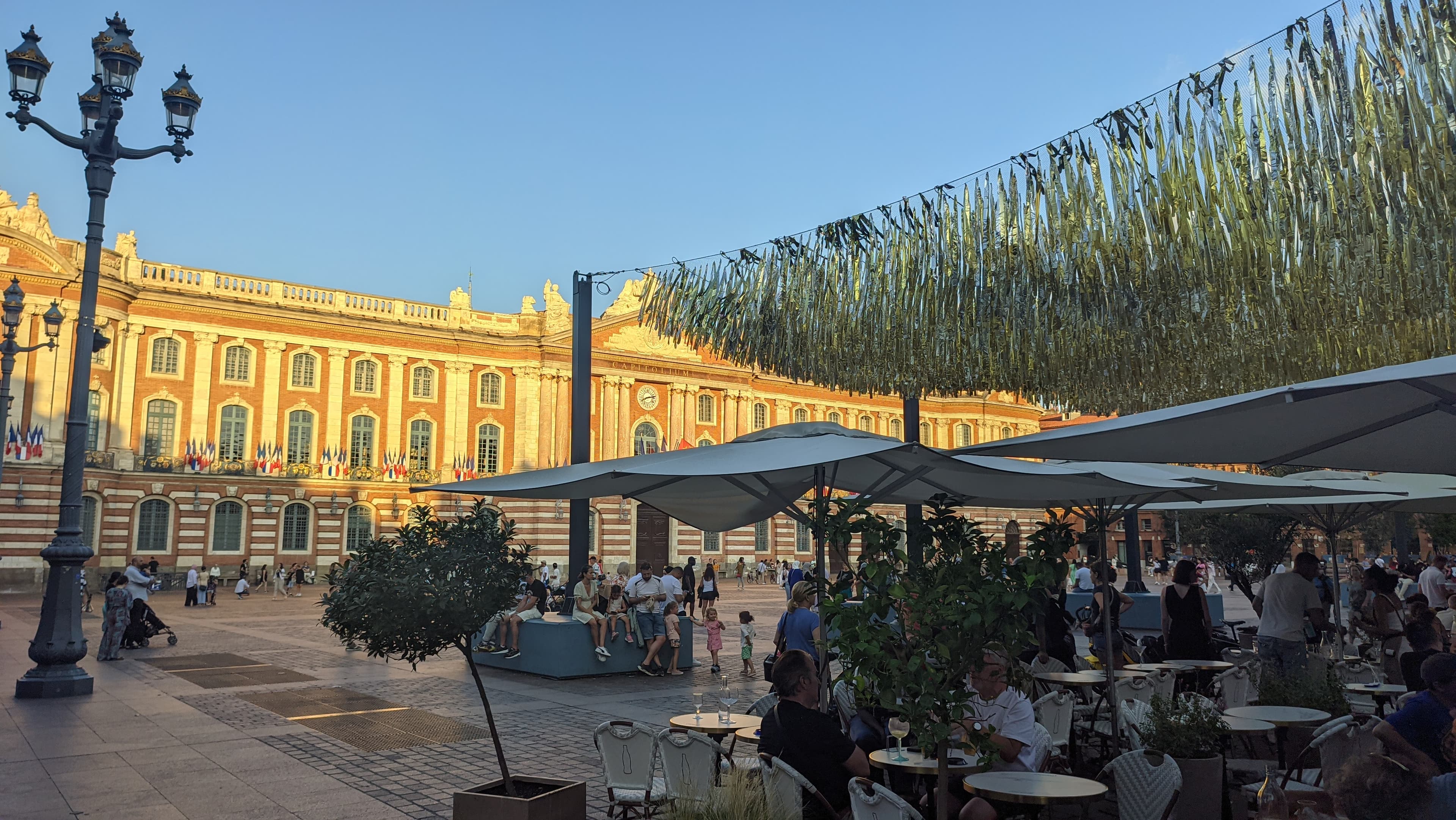
The Race
| Next Race Date | 1 November 2026 |
|---|---|
| Course Type | Urban loop, start and finish 1.4 km apart |
| Registration | Open, direct entry, capped at 7,500 |
| Ballot Opens | No ballot |
| Total Finishers | 5,700+ (2024 relaunch edition) |
| Average Race Day Temperature | 6 to 14°C in November; the 08:00 start is the coldest point |
| Cutoff Time | 6 hours |
| Free Race Day Transport | Not confirmed; the organiser partners with the transit network but publishes no runner fare |
| Course Certification | FFA measurement certificate OCC031/07249/2024/A |
History
Toulouse’s city marathon began in 2007 as the Marathon du Grand Toulouse, drawing more than 3,700 runners across the marathon and relay at its first outing. Benjamin Bitok won that inaugural race and became the event’s defining figure for the following decade, lowering the course benchmark to 2:14:12 by the third edition in 2009 and eventually setting a 2:10:54 mark. The course was reworked in its second year to take in the riverbanks and the city centre, and the finish settled at Place du Capitole.
Through the 2010s it grew into the Marathon International Toulouse Métropole, hosted the French Marathon Championships in 2013, and drew around 13,000 participants across all its races by its 12th edition in 2018. The last edition under that format ran on 20 October 2019, won by Zablon Chumba in 2:10:38 with Chaltu Dida first woman in 2:34:49. Then the marathon disappeared for five years, an interruption that began with the pandemic and continued well past it.
Toulouse Métropole announced a relaunch in November 2023, handing the event to a new organiser, Playground, under a new identity. The first relaunched edition ran in November 2024, measured under FFA certificate OCC031/07249/2024/A, with more than 5,700 marathon finishers, well beyond the old event’s typical marathon scale even at its peak. Nicolas Navarro won in 2:22:08 and Floriane Hot in 2:44:15. The 2025 edition expanded again to more than 37,000 entrants across five formats and 1,200 volunteers, with Adrien Latestère and Salomé Lecoq taking the marathon titles. For 2026 the race carries a naming partner, Harmonie Mutuelle, and a new marathon identity: the Marathon des Géants, tying the route to the city’s aerospace heritage through the Piste des Géants and the Cité de l’Espace.
The course
The race starts on Boulevard d’Arcole north-east of the old town, with corral access through Boulevard Lazare Carnot, and finishes on Lazare Carnot itself, 1.4 km away. The organiser gives 217 m of elevation gain over a single continuous loop that is entirely paved urban road with no trail sector.
It is a flat marathon with one exception. Only 40 m separate the lowest and highest points of the whole course, and the first 34 km barely move: the route runs south through Place du Capitole inside the first three kilometres, crosses the Garonne at Empalot and swings west to the Oncopole at km 10, the furthest point from the start. It returns through Croix de Pierre and Saint-Cyprien, recrosses the river, and heads east through Montaudran to the Piste des Géants at km 27, the aerospace sector that names the race. From there it follows the Hers greenway north. Then, with under eight kilometres to run, the course climbs 38 m at an average of 1.9 per cent through Faubourg Bonnefoy between km 34.7 and the day’s high point at km 36.9, and drops 24 m at 2.7 per cent immediately afterwards. The last five kilometres run back past Port Saint-Sauveur to the finish.
A note on these kilometres. The organiser had not published its own route when this page was written. The kilometre positions above follow a course that starts on Boulevard d’Arcole and finishes on Boulevard Lazare Carnot, and passes every landmark the organiser names. Treat the exact positions as provisional until the official route is released.
Kilometre by kilometre
Km 0 to 5: Boulevard d’Arcole and Place du Capitole. The field leaves in seven staggered corrals, with Elite, 3:00 and 3:15 released at 08:00 and the slowest going at 08:20. That stagger takes a lot of the sting out of 7,500 runners funnelling onto city streets, so settle into your own corral instead of fighting to overtake in the first kilometre. The course runs south into the historic core, reaching Place du Capitole at about km 3 and Place du Parlement at km 4. There is a 17 m rise between km 1.5 and km 3 and a 19 m drop straight after it, the two largest movements of the first thirty kilometres, and neither is anything to worry about.
Km 5 to 15: across the Garonne to the Oncopole. The route crosses the river at Empalot around km 6 and works south-west along the Route d’Espagne into the Oncopole and Saint-Simon district, reaching its furthest point from the start, 6.3 km away, at km 9.9. This is the quietest stretch of the race and the flattest: the profile sits between 143 and 151 m for the whole of it. It comes back through the Moulins de la Garonne and Croix de Pierre, touching Cours Dillon in Saint-Cyprien at km 15.
Km 15 to 27: the river, the Canal du Midi and the Piste des Géants. The course recrosses the Garonne and swings back east through Saint-Michel and Rangueil, past the university district and along toward Montaudran. Bridges are the one place on an otherwise level course where wind matters: a headwind on an exposed span costs more rhythm than the gradient ever will, and central streets feel sheltered by comparison, so do not force a bridge split back onto pace on the next block. The Piste des Géants arrives at km 27, the old Latécoère airfield that gives the race its name.
Km 27 to 35: the Hers greenway. The Voie verte de la Vallée de l’Hers carries the race north through Soupetard and Jolimont on a long, shallow descent, 15 m across six kilometres to the lowest point of the day, 135 m at km 34.8. Crowd noise thins out noticeably here compared with the centre, which matters more mentally than physically at this stage. Aid stays at every 5 km with toilets at each station.
Km 35 to 42.195: the hill, and the run back to Lazare Carnot. This is the part of the course that decides the race. From km 34.7 the road climbs 38 m over two kilometres through Faubourg Bonnefoy, averaging 1.9 per cent, and tops out at 175 m at km 36.9. It is the only real climb on the course and it arrives with under six kilometres to run, on a day that has given no warning of it. A 24 m descent at 2.7 per cent follows immediately, which is steep enough to hurt quadriceps that have just climbed. The last five kilometres run flat past Port Saint-Sauveur and Boulevard Griffoul-Dorval back to Boulevard Lazare Carnot, among the metro lines and restaurants of Jean-Jaurès and Wilson.
Follow the blue tangent line where it is marked: over 42.195 km the shortest legal line through this many bridges and directional changes measurably shortens the distance you actually run. Chip timing starts and finishes at the mats and not at any landmark, and the 2026 mat placement relative to the visible finish arch has not been confirmed, so allow a short buffer between crossing the line and your time registering.
Course Map
South through the Capitole, west to the Oncopole, east to the Piste des Géants, then north and up. Tap a marker for the start, the finish, the race village, the aerospace sector and the late climb, and scrub the slider or press play to move the orange marker along the course with the elevation profile beneath it.
Pacers
Seven corrals release in waves: Elite, 3:00 and 3:15 at 08:00, then 3:30 at 08:03, 3:45 at 08:06, 4:00 at 08:12, 4:15 at 08:18 and 4:30 at 08:20. The organiser confirms a pacer in each of the seven target corrals but has not published a named roster or a flag-colour system.
What to wear
November mornings in Toulouse sit close to 6°C at the coolest and warm to a maximum around 13 or 14°C by afternoon on the 1991 to 2020 average, so the 08:00 start is the coldest point of the day. Rain falls on roughly ten days in a typical November, worth planning for without a specific forecast. Frost is possible and not the norm, and the regional Autan wind can add a real edge on exposed sections such as the river bridges.
A throwaway or packable layer for the corrals is the sensible default, and it matters more the slower you are: a runner in the 4:30 corral stands exposed for twenty minutes longer than one at the front before their wave goes. No clothing-donation scheme has been confirmed for 2026, so discard kit only where the organiser explicitly permits it near the start. Heat is not the risk here, but a sunny late-autumn afternoon can still warm the second half meaningfully for slower finishers, which makes light adjustable layers more reliable than a single heavy top.
Entry
Entry is direct registration with no ballot, capped at 7,500 marathon places and priced in bands that rise as places fill instead of by calendar date: €59 for the first 1,000 entries, €69 for the next 2,800, €79 for the next 2,400 and €90 for whatever remains, with platform fees on top. Secondary calendars list 30 or 31 October as a final cutoff, but the organiser frames entry as closing on capacity, so check the live site rather than counting on a date.
Runners without an eligible competition licence need the Pass Prévention Santé, currently €5 and valid for a year; licensed runners need a valid 2026 to 2027 licence. There is no Good For Age or guaranteed-entry route: elite placement happens through corral seeding and not through a separate entry mechanism. An €8 postal bib-delivery option runs while capacity for it lasts, with the runner’s file needing to be complete by 15 September. Proxy collection is allowed with the runner’s collection card, QR code and a copy of their identification. No charity-bib allocation or international tour-operator route has been published.
Fast Runner / GFA Standards
There is no Good For Age route and no fast-runner qualifying standard. Every place comes through the open bands above, and a declared time affects only which of the seven corrals you start in.
Race Weekend
Expo
Bib collection is at the race village on Place du Capitole, the most central location possible and served directly by Metro A. The 2026 hours are Thursday 29 October from 14:00 to 18:00, Friday 30 October from 10:00 to 19:00 and Saturday 31 October from 10:00 to 18:00. There is no Sunday collection for any of the weekend’s events, the marathon included, so plan collection into Thursday through Saturday and do not assume race-morning pickup is possible.
Bring photo identification and the collection card or QR code sent by email, plus evidence of PPS purchase if your entry file is incomplete. A proxy can collect on your behalf with that same card and a copy of your identification. The optional €8 postal bib service does not include merchandise, which has to be collected separately either way. Because the village sits on the Capitole, anyone staying around Jean-Jaurès, Wilson or Carmes can reach it on foot or in one metro stop, and the square itself is worth the time while you are there.
Getting to the Start
The first corrals go at 08:00 from Boulevard d’Arcole, with access through Boulevard Lazare Carnot. The full schedule runs Elite, 3:00 and 3:15 at 08:00, 3:30 at 08:03, 3:45 at 08:06, 4:00 at 08:12, 4:15 at 08:18 and 4:30 at 08:20. The organiser recommends different bag-drop arrival windows by corral, starting around 06:45 for the fastest runners, so check the time advised for your own corral instead of assuming one blanket window.
Bag drop operates around Boulevard de Strasbourg and takes one closed bag of up to 20 litres per runner, with no loose items, closing at 16:00. Toilets are available in the start corrals themselves, which solves one of the most common practical frustrations of a mass start before the gun even goes.
The start district is best reached on foot or by metro. The organiser actively discourages driving and has a stated transit partnership, though no free race-day fare has been confirmed, and exact 2026 road closures and station-level diversions were not published when this page was written. The finish brings runners back to Boulevard Lazare Carnot, near Jean-Jaurès and Wilson and directly onto the central metro network. Note that the FFA’s certificate record still shows Place du Capitole as the finish; the organiser’s current page and the route both say Lazare Carnot, and this page follows them.
Nutrition on Course
Solid and liquid aid appears every 5 km and at the finish, with toilets at every aid station, which is a notably generous provision for a mass-participation road marathon. The organiser draws water directly from Toulouse’s public supply instead of single-use plastic bottles and serves it in reusable cups, and runners can refill a flask, bottle or hydration vest at any station. Solid aid draws on local suppliers and, as part of the event’s anti-waste programme, on surplus food that would otherwise be thrown away.
The 2026 sports-drink brand, gel availability and finish-line menu had not been published when this page was written, so nothing specific is promised here. Anyone who relies on a particular gel or drink should carry their own. It is also worth building in a small margin of self-sufficiency if you start in a later corral: the organiser has redesigned its aid points for 2026 partly in response to feedback that later waves in 2025 found stations less well stocked.
Spectating
The course returns towards the centre repeatedly before its eastern detour, so supporters get several realistic viewing windows without needing a car. The start and finish are 1.4 km apart, which makes the simplest plan also a good one.
Itinerary A, the walking option. Watch the start on Boulevard d’Arcole, walk five minutes to Place du Capitole for a second sighting at about km 3, then take a position on Boulevard Lazare Carnot for the finish. Three sightings, no transport, all inside one square kilometre.
Itinerary B, the aerospace option. Take public transport out to Montaudran and the Piste des Géants for the sector that names the race, at about km 27, then return to Jean-Jaurès in good time for the finish. This is the most distinctive part of the course and the least crowded.
Itinerary C, the river option. Position near Pont Neuf, Pont des Catalans or Île du Ramier for a crossing, then use the metro or tram back towards the finish. Agree a specific meeting point away from the post-finish crowd: a 2024 race report described the finish area as very dense, with marathon and half-marathon runners mixing.
Live app-based tracking beyond official chip results was not confirmed for 2026.
Post-Race Food
Hôtel Le Cousture on Boulevard Lazare Carnot sits on the finish boulevard itself, which makes it the lowest-effort option for anyone who cannot face a walk after 42.195 km; confirm Sunday lunch service ahead of race day. Mercure Toulouse Centre Wilson Capitole, just around Place Wilson, advertises a Sunday brunch and suits anyone who would rather sit down in a hotel than queue at a small restaurant. FirstName Toulouse on Allées Jean Jaurès, a few blocks east, also runs Sunday brunch and works well if it doubles as your accommodation.
Given the scale of the weekend, tens of thousands of participants across five events, reserve ahead instead of hoping for spontaneous Sunday seating, particularly for a group.
Where to Stay
Stay near the finish, which here is easy advice: the start on Boulevard d’Arcole and the finish on Boulevard Lazare Carnot are 1.4 km apart in the same central district, so a single base close to either solves both ends of race day.
Jean-Jaurès and Wilson
Jean-Jaurès is the default recommendation. Both metro lines meet here, the airport shuttle and Matabiau station are close, and the area holds the largest concentration of restaurants and hotels convenient to both the start and the finish. It is a lively district on a Saturday night, which is worth weighing against an 08:00 start.
Capitole
Capitole puts you in the middle of the event: the race village and bib collection are on the square, and the course passes at about km 3. It stays within easy reach of the start and finish, though race morning needs a short walk or a stop on Metro A.
Matabiau and the Ramblas
Matabiau suits rail travellers, with hotels along Allées Jean Jaurès sitting between the station and the race district. It is operationally strong and less characterful than the old town, which is a fair trade if you are arriving on a Saturday evening train.
Carmes and Esquirol
Carmes is the pick for a genuine historic-quarter stay, with the strongest restaurants, the old pink-brick streets and easy access to the Garonne and Pont Neuf. It sits further from the 08:00 start than Wilson or Jean-Jaurès, though a metro stop or an early walk covers it.
Saint-Cyprien
Saint-Cyprien on the west bank suits runners who want the Garonne on their doorstep, and the course passes through it at about km 15. Race-morning road closures make the metro the reliable way to reach the start from here rather than walking across a bridge that may be shut.
Montaudran
Montaudran, near the Piste des Géants, appeals if the aviation and space theming is what drew you to this race, and it is quieter. It is also the weakest choice for race morning given how central the start is, so only take it with a public-transport plan already worked out.
Recommended hotels
The lowest-effort option on this list: no walk at all after 42.195 km, and close enough to Jean-Jaurès metro to handle race morning too. Expect noise and temporary closures immediately outside on race day.
Very central, on Place Wilson, with an advertised Sunday brunch that solves the post-race meal without a search. Expect premium pricing on a weekend this size.
Sits between both metro lines with an in-house restaurant and Sunday brunch, which is useful for a group that would rather not go out again after the race.
Central and straightforward for both the 08:00 start and the finish. Rates move a lot across the weekend, so book early.
A smaller, better-value choice close to both the metro and Matabiau station. Inventory is limited and it sells out early in race week.
Booking timeline
There is no ballot, so the sequence is simple: enter while the lower price bands are still open, then book accommodation immediately. The marathon is capped at 7,500, but the combined weekend, marathon, half marathon, 10 km, relay and children’s races, drew more than 37,000 entrants in 2025, and that scale drives hotel demand across the whole city centre. The half marathon reached capacity well before race week in 2026.
November falls outside Toulouse’s peak tourism season, so city-wide rates are not at their annual high, but race weekend creates a sharp local spike around Jean-Jaurès, Wilson and Capitole specifically. A refundable booking made as soon as your place is confirmed handles that. Rail fares through Matabiau, for connections via Paris or Bordeaux, are worth comparing as soon as your entry is secure, since they rise towards the date the same way flights do.
See & Do
Everything below is within walking distance of the finish on Boulevard Lazare Carnot or of the Jean-Jaurès and Capitole hotel districts, apart from the Cité de l’Espace, which earns its place by being the reason the race is called what it is.
Place du Capitole
About 0.7 km (0.4 miles) from the finish, and the course at km 3. The eighteenth-century Capitole is still the city hall, and the square in front of it holds the race village all weekend. Free, always open, and a two-minute detour from bib collection.
Basilique Saint-Sernin
About 1 km (0.6 miles) from the finish, and a few hundred metres from the start line. The largest surviving Romanesque church in Europe, begun around 1080 as a stop on the pilgrim route to Santiago, built from the pink brick the whole city is made of. Free to enter.
Pont Neuf and the Garonne
About 1.3 km (0.8 miles) from the finish, and on the course. Finished in 1632 after nearly a century of building, and the oldest bridge in the city despite the name. The quays either side are flat and make the easiest recovery walk in Toulouse.
Couvent des Jacobins
About 1.2 km (0.7 miles) from the finish, in the Carmes quarter. A fourteenth-century Dominican church whose single column fans into twenty-two ribs across the vault, the palm tree, and it holds the relics of Thomas Aquinas. Indoor, seated, and short, which is the right combination for the day after.
Cité de l’Espace
About 7 km (4.3 miles) east of the finish, reachable by bus or tram in around half an hour. A full-scale Ariane 5 outside and a Mir station module you can walk through inside. It is the other half of the aerospace story the Piste des Géants tells on the course, and it needs a half day on legs that will not thank you, so save it for the Monday.
After the Race
Toulouse sits on direct regional rail to most of the south-west, which makes the day after unusually easy to plan: nearly everything below is a train ride with no car involved. Early November is out of season across the whole region, so the citadels and the cathedral towns are quiet and cool, and the light is short. The Albi day trip is the gentlest of these; Carcassonne and the Ariège both involve real climbing and are better on day two or three.
A cathedral city built from the same pink brick as Toulouse, with the Toulouse-Lautrec museum in the bishop’s palace beside it. Compact, flat and slow-paced, which is what the day after a marathon needs.
The fortified citadel is the obvious Languedoc day out, but the cobbles and the climb into the walls are punishing on fresh marathon legs. Save it for the second day.
A quieter foothills extension built around a hilltop castle and the caves of the Ariège. Worth attempting only once the legs have had a day, since the terrain here is genuinely steep.
An easy larger-city extension for food, wine and museums without the terrain. Flat, walkable and well connected onward, which makes it the softest landing of these five.
A genuine city break rather than a recovery trip: it rewards long walking days, so plan it for the end of the week and not the morning after the race.
Frequently asked questions
Should I stay near the start or the finish?
Both sit in the same central district, 1.4 km apart: the start on Boulevard d’Arcole, the finish on Boulevard Lazare Carnot. Jean-Jaurès and Wilson cover both, with the two metro lines meeting at Jean-Jaurès and Matabiau station close by.
How far in advance should I book a hotel?
As soon as your entry is confirmed. There is no ballot, and the combined weekend drew more than 37,000 entrants across five events in 2025, which drives demand across the whole city centre and not just among marathon runners.
Is there free transport to the start on race day?
No free fare has been confirmed. The organiser partners with Toulouse public transport and discourages driving, but no runner entitlement is published. Metro A serves the start district; 2026 closures and diversions were not published when this page was written.
What is the best area to stay?
Jean-Jaurès or Wilson for logistics. Capitole if you want the race village and bib collection on the doorstep. Matabiau for rail arrivals, and Carmes or Esquirol for a historic-quarter stay at the cost of a slightly longer race morning.
When does the expo open?
The race village is on Place du Capitole: Thursday 29 October 14:00 to 18:00, Friday 30 October 10:00 to 19:00, Saturday 31 October 10:00 to 18:00. There is no Sunday collection for any event in the weekend, so race-morning pickup is not an option.
What is the weather typically like on race day?
November mornings sit near 6°C at the coolest and reach 13 to 14°C by afternoon. The 08:00 start is the coldest point of the day, rain falls on about ten days in a typical November, and the Autan wind can bite on the river bridges.
Is the course flat?
Almost. Only 40 m separate the lowest and highest points and the first 34 km barely move, but there is one real climb and it is late: 38 m at 1.9 per cent from km 34.7 to the high point at km 36.9, then a sharp 24 m drop.
Is there a bag drop?
Yes, around Boulevard de Strasbourg, one closed bag up to 20 litres, closing at 16:00. Arrival windows differ by corral from about 06:45, so check the time advised for yours. There are toilets in the start corrals themselves.
Should I bring a throwaway layer?
Yes. 08:00 will feel much colder than the afternoon, and the 4:15 and 4:30 corrals stand around twenty minutes longer before going. No clothing-donation scheme is confirmed for 2026, so discard kit only where permitted.
How do I get back to my hotel after finishing?
The finish is on the central metro network near Jean-Jaurès and Wilson, so almost anywhere central is a short walk or one stop. Agree a meeting point away from the finish chute: a 2024 report described the post-finish area as very dense.