The Volcano Marathon no longer runs in San Pedro de Atacama. The organiser held its first editions in the Atacama Desert, moved one edition to Pucón and has run the race on Easter Island since 2024. This page covers the current Easter Island race.
| Next Race Date | 27 June 2027 |
|---|---|
| Course type | Point-to-point, Anakena Beach to Hanga Roa |
| Registration | Open entry, sold only as a four-night package; first come, first served |
| Ballot opens | Not applicable |
| Start | Anakena Beach; start time not published |
| Finish | Nayara Hangaroa hotel, Hanga Roa |
| Total finishers | 20 (marathon, latest edition) |
| Average race day temperature | 17 to 22°C (June) |
| Cutoff time | 8 hours |
| Free race-day transport | Yes, the bus from the hotel to the start is part of the package |
| Course certification | AIMS member race; no measurement certificate has been published |
Before you go
Entry, accommodation and travel: what to sort out before you book.
Entry
Entry is by package only. There is no standalone race bib. Registration runs through the organiser's website, with a form, acceptance of terms and full payment. The field is limited and allotted first come, first served. There is no ballot, qualifying time, charity or guaranteed-entry route.
By bank transfer the packages cost USD 3,300 for a runner in a shared twin room, USD 4,300 for a single room and USD 5,900 for a runner and a non-running companion in a double room, which the terms split as USD 3,300 for the runner and USD 2,600 for the companion. Card payment adds about 3 per cent. At 1.3341 dollars to the pound, a 16 October 2026 rate used for illustration, the bank-transfer prices are about £2,474, £3,223 and £4,422.
The price includes race entry, four nights at the Nayara Hangaroa or a similar establishment, airport transfers, the island tour, a pre-race dinner and pasta party, a post-race party, a finisher medal, race photographs for personal use, breakfast, aid stations and a race T-shirt. It excludes flights to and from Mataveri Airport, travel insurance and personal expenses. The national park ticket (USD 100 for adult foreign visitors from October 2025) is not stated as part of the island tour, so budget for it separately until the organiser confirms.
Cancellation terms are strict. Cancel more than 180 days before travel and 25 per cent is charged. Between 180 and 90 days, 50 per cent. Inside 90 days, the full amount. Card chargebacks that conflict with the policy are not accepted. If the organiser cancels the race it will tell entrants by 30 March of race year, refund the money received and offer the same trip at the next opportunity, with no added cost for late cancellations.
The organiser requires entrants to be in excellent health and able to complete a regular marathon comfortably, and advises seeing a doctor first. Officials can stop athletes showing severe conditions. Cut-offs are 8 hours for the marathon and 4 hours for the half, and they apply even though slower runners are not excluded from entry.
| Package | Bank transfer (USD) | About (GBP) | Card (USD) |
|---|---|---|---|
| Runner, shared twin room | 3,300 | £2,474 | 3,399 |
| Runner, single room | 4,300 | £3,223 | 4,429 |
| Runner and companion, double room | 5,900 | £4,422 | 6,077 |
Fast runner standards
No guaranteed-entry or fast-runner category exists.
See the official Volcano Marathon site →Where to Stay
Hanga Roa is the only town on Rapa Nui, so the stay-near-the-finish question has a short answer: stay at the finish. The race ends at the Nayara Hangaroa hotel and the package puts every runner there. Distances below are straight-line from the finish.
Nayara Hangaroa
The hotel sits on a cliff above the Pacific and is a five-minute walk from the town. It has 75 rooms, two restaurants, a spa, an outdoor pool and a bar. It is the package base and the finish venue. The package says 'or a similar establishment', so the exact hotel is not guaranteed.
Central Hanga Roa
Several guesthouses and small hotels sit within 0.5 to 1.0 km of the finish, including Hare Nua, Taura'a Hotel, Hotel Taha Tai and Matariki Sunset Apart Hotel. They suit companions on extra nights or runners who extend the trip, and they sit outside the package.
Tahai
About 2.8 km north of the finish, past the cemetery, Tahai has the island's best-known sunset spot, with three ahu holding 1, 1 and 5 moai. The Father Sebastian Englert Anthropological Museum is in the same sector, at the north end of Hanga Roa.
The package is the booking. Extra nights before or after it need a separate reservation, because pick-up is on 25 June and drop-off on 29 June.
Recommended hotels
The package hotel and the finish venue. It has 75 rooms with terraces, two restaurants (Poerava and Kaloa), a spa, a pool and a bar, and sits a five-minute walk from town. Confirm the hotel with the organiser.
A small boutique property with a 4.9 guest rating, a fit for a companion or for extra nights after the package ends.
Rated 4.5 by guests and described as quiet.
The closest independent option to the finish, rated 4.0 by guests.
Apartment-style rooms, rated 4.9 by guests from a small number of reviews.
Booking timeline
Booking is one transaction: the package. The field is limited and first come, first served, and no cap or sell-out history has been published, so nothing shows how quickly it fills.
Two cancellation dates apply. The charge moves from 25 to 50 per cent at 180 days before travel (about 27 December before a 25 June arrival) and to non-refundable at 90 days (about 27 March). The organiser will tell entrants about a race cancellation by 30 March.
Flights are not included. LATAM operates the only nonstop route, daily from Santiago to Mataveri Airport, taking about 5.5 hours out and 4.5 hours back. A UK traveller needs a long-haul connection to Santiago first. Book flights once the package is secured, to arrive on 25 June, and check the baggage allowance for trail kit.
Airport pick-up is on 25 June and drop-off on 29 June. Anyone who wants extra island nights books them separately.
Race weekend
The expo, number collection and the days either side of the start.
Race Weekend
Number collection
There is no expo. The organiser's itinerary lists a pasta party and pre-race briefing on the evening before the race, the day after arrival, and nothing else that resembles race-pack collection. The venue, the time and the kit-collection method are not stated.
Treat the briefing as the point at which numbers and instructions are handed out, and ask the organiser at info@runbuk.com to confirm.
The day before the race is already full. Day 2 of the package is a tour of Orongo, Rano Raraku and Ahu Tongariki, followed by the evening dinner and briefing, so do not plan extra walking that day.
Getting to the start
Race morning begins with an early breakfast at the hotel, then a bus to Anakena Beach. The transfer is part of the package. The bus time, the journey length and the start time are not published. Anakena is 14.4 km from the finish in a straight line and the road journey will be longer, so ask the organiser for the exact schedule.
The race finishes at the hotel where the runners are staying. That means no return journey after the finish, no bag collection from a distant point and a shower within walking distance of the finish line. The organiser describes a finish line set up at the hotel.
Pack a trail-shoe plan and a small amount of food. A 2026 finisher reported no toilets between the start and the finish, so use the hotel and the start-area facilities.
The organiser gives a June range of 17 to 22°C and advises layers and a readiness for occasional rain. A 2026 finisher reported 17 to 21°C, partly cloudy skies, a moderate easterly wind and high humidity.
The temperature is not the problem. The surface is. The organiser's FAQ says trail shoes are the best choice, and a 2026 finisher reported that several runners slipped in road shoes on the volcanic section after halfway.
Wear shorts and a light top. Carry a thin windproof layer in the start bag if bags are allowed. Sun protection helps on the exposed ground between km 10 and km 28, and a hat is worth carrying. Gloves are not needed.
Race day
The course, the clock, getting to the start and what to carry.
The Race
The course
The course runs point to point from Anakena Beach, on the north coast of Rapa Nui, to the Nayara Hangaroa hotel on the western edge of Hanga Roa, 14.2 km apart in a straight line. The organiser advertises 42.195 km, and a finisher's GPS track of the 2026 race measured 42.26 km.
The first 28 km stay low, between 3 and 98 m. A rise of 48 m (1.3%) from km 4.1 to 7.9 reaches 51 m near the eastern end of the island at km 6 to 8, and the road then falls 47 m to 4 m by km 10, where the course passes within about 150 m of Ahu Tongariki. It turns south-west along the south coast between 4 and 33 m, climbs 33 m to 45 m at km 24 and a further 63 m (1.9%) from km 25 to 98 m at km 28, passing the Ahu Vinapu road at km 27 and the Mataveri airport at km 28 to 29.
The climb to the Rano Kau crater rim starts after a dip to 61 m at km 30. It gains 248 m in 5 km (5.0%), with the first three kilometres at 6.4 to 7.9%, and tops out at 311 m at about km 35, on the road to Orongo. The descent loses 294 m over 7.3 km (4.0%), with the three kilometres from km 37 to 40 falling 6.9 to 7.7%, to 46 m at km 40 and the finish at 17 m. The organiser's total ascent is about 610 m.
The organiser describes the surface as predominantly natural and unpaved: dirt trails, grassy patches and volcanic rock, especially near Rano Kau, and recommends trail shoes. A finisher in 2026 reported paved road for the first 21 km, so choose shoes for both.
The 2027 route has not been published, so treat every kilometre as the 2026 course.
Kilometre by kilometre
Km 0 to 10: Anakena to Ahu Tongariki. The race starts on Anakena Beach and follows the Vaihu to Anakena road. The track stays between 3 and 51 m, with a 24 m rise at km 0.4 to 2 and a 48 m rise to 51 m at km 4 to 8 near the eastern end of the island. It falls to 4 m at km 10, where Ahu Tongariki, the long row of restored moai, lies about 150 m from the course. A 2026 finisher reported horses on the verge. Keep the pace easy, because most of the day's work is still to come.
Km 10 to 24: the south coast. From Tongariki the course heads south-west across low ground between 4 and 33 m, the quietest part of the day. This is the exposed stretch where a shortfall in fuel hurts, because the Rano Kau climb follows it directly. The road begins to rise at km 22, reaching 45 m at km 24.
Km 24 to 29: towards Hanga Roa. The track climbs 63 m at 1.9% from km 25 to 98 m at km 28, passing the Ahu Vinapu road at km 27. The Mataveri airport is beside the course at km 28 to 29, the last flat ground before the climb. Aid-station positions are not published, so carry enough to be self-sufficient between stations. A 2026 finisher reported no toilets between the start and the finish.
Km 29 to 35: Rano Kau. After a dip to 61 m at km 30 the road climbs 248 m in 5 km, at 7.9% in the first kilometre and 6.4 to 7.0% for the next two, on volcanic rock and unfinished road, to the 311 m high point at about km 35 on the road to Orongo. A 2026 finisher called it the hardest part of the race and found it too steep to walk comfortably in road shoes.
Km 35 to 42.2: down to the hotel. The descent loses 294 m over 7.3 km. The steepest section is km 37 to 40, at 6.9 to 7.7%, down to 46 m at km 40, then the road follows Hotu Matu'a at km 41 and Policarpo Toro at km 42 into Hanga Roa. One 2026 finisher found the last 2 km very hard because the road was broken up, so do not assume an easy downhill finish. The finish is at the Nayara Hangaroa hotel.
The route file. The organiser describes the route as well marked and easy to follow and offers GPS-watch files for download. Download the file. The 2026 track measured 42.26 km, so expect a watch to read slightly long on a winding trail course.
Anakena to Ahu Tongariki on low ground, between 10 and 52 m. Easy running past the first moai. Hold back.
Low, quiet and exposed, with a gentle rise to 98 m at km 28. Eat and drink on schedule, because the next stage does not allow it.
248 m of climbing in 5 km on rock and unfinished road, at up to 7.9%. Walk the steep parts.
294 m down from the crater rim to Hanga Roa, at up to 7.7%. The surface is rough in places, so keep the quads in reserve.
Course Map
The 2026 course from Anakena Beach on the north coast, round the eastern end of the island past Ahu Tongariki, along the south coast and up the Rano Kau crater road to the finish in Hanga Roa. Tap a marker for details, and scrub the slider or press play to move the orange marker along the course with the elevation profile beneath it.
Pacers
The organiser's event page, FAQ and itinerary do not mention them, and with about 20 marathon finishers there is no sign of pace groups.
The package price includes race entry (marathon or half marathon), four nights at the Nayara Hangaroa hotel or a similar establishment, airport transfers, the island tour, a pre-race dinner and pasta party, a post-race party, a finisher medal, race photographs for personal use, breakfast, aid stations and a race T-shirt. It excludes flights to and from Mataveri Airport, travel insurance and personal expenses. Cancellation costs 25 per cent more than 180 days before travel, 50 per cent from 180 to 90 days and the full amount inside 90 days.
The route used for this page is the 2026 course and the 2027 course has not been published. Treat landmarks and distances as the last known route, and download the organiser's route file when it is issued.
Nutrition on course
Aid stations are part of the package, but their number, spacing and contents are not published. No sports-drink brand, gel supply, cup type or personal-bottle procedure is stated.
A first-time Indian finisher in 2026 said he was told to use energy gels, and that is the only on-course nutrition detail available. Plan to carry what you need. The exposed ground between km 10 and km 28 is where a shortfall hurts, because the Rano Kau climb follows it directly. Ask the organiser how many stations there will be and where they stand.
Spectating
Spectating here is not a multi-sighting game. Rapa Nui has one town, and the course covers roughly the whole island: Anakena in the north, Tongariki in the east, the airport and Rano Kau in the south-west. The package includes a non-running companion option, so some runners will have a supporter.
The finish is the realistic place to watch. It is at the Nayara Hangaroa hotel, about a five-minute walk from the town. A companion who wants to see more could hire a vehicle, though whether road closures affect access is not stated.
For timing, the 2026 women's winner took 5:02:41 and another finisher took 5:05:08, so a supporter should plan for finishers arriving across a wide window up to the 8-hour cut-off.
After the race
Where to eat, what to see and how to spend the days after the finish.
See & Do
Distances are from the finish, in a straight line, kilometres first.
Orongo and the Rano Kau crater
The Rano Kau rim is the high point of the race, and Orongo is the ceremonial village beside it. Both are on the organiser's Day 2 tour before the race, so many runners will have seen them already. The Rapa Nui National Park ticket costs USD 100 for adult foreign visitors (from October 2025), is valid for 10 consecutive days and allows one entry each to Orongo and Rano Raraku.
Ahu Tongariki and Rano Raraku
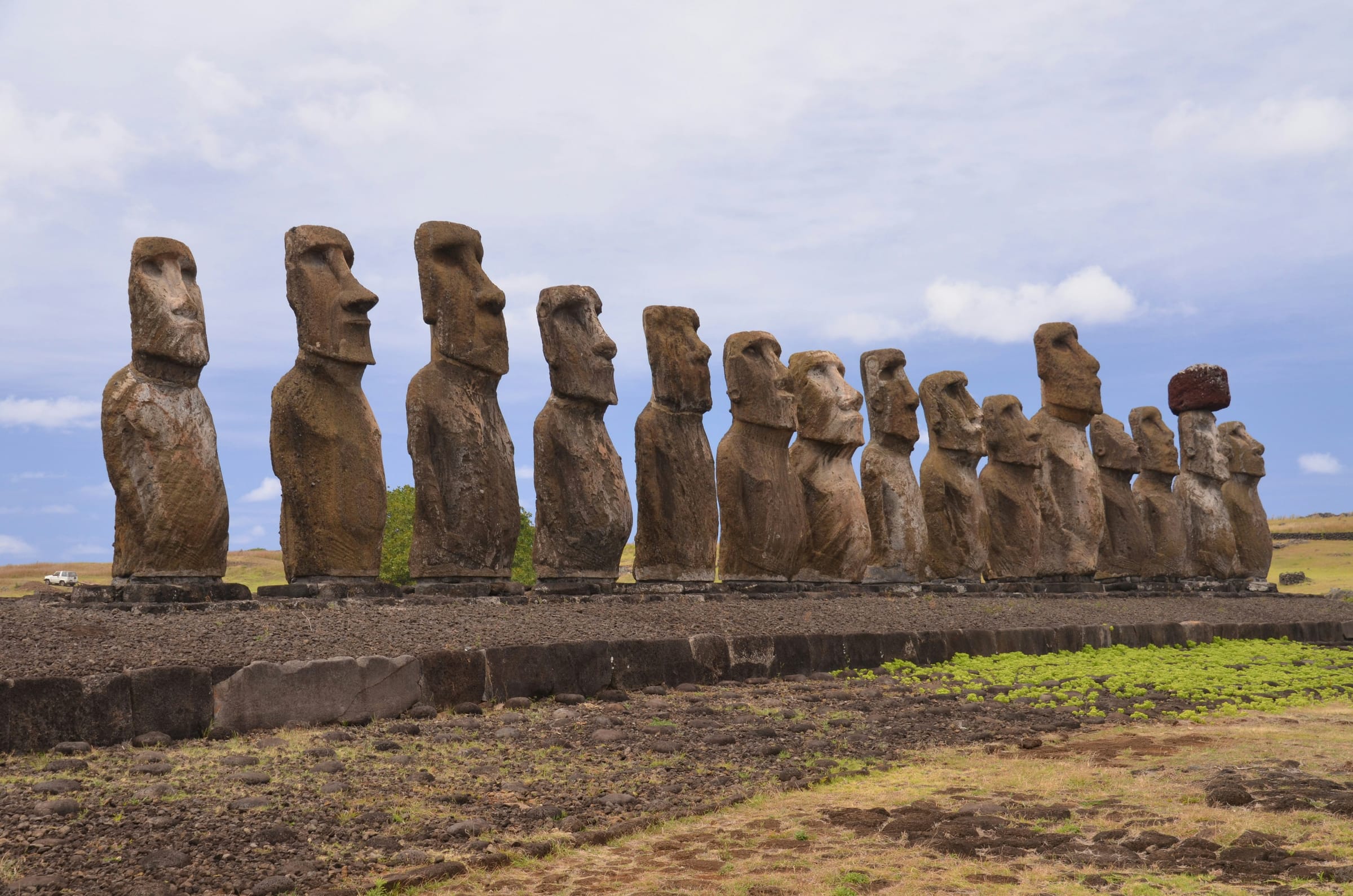
Ahu Tongariki is the long row of restored moai that the course passes at about km 10. Rano Raraku is the quarry where the statues were carved. Both are on the Day 2 tour, and going back on the free Day 4 needs a vehicle or tour.
Tahai
A short coastal walk north of Hanga Roa's centre, past the cemetery, with three ahu holding 1, 1 and 5 moai, including the only moai with restored eyes. Sunset is the usual time to go, and it is a reasonable first outing on tired legs.
Father Sebastian Englert Anthropological Museum
Obsidian tools, fish hooks and a moai face with a coral eye. Listed hours are Tuesday to Friday 09:30 to 17:30 and weekends 09:30 to 12:30, so it is probably shut on the Monday after the race. Entry is about CLP 1,000, and the hours need checking.
Anakena Beach
The start line. The organiser's Day 4 suggests horseback riding, snorkelling, diving and stargazing as optional activities.
Post-race food
The package includes a post-race dinner with the other runners on the evening of the race, and a post-race party. The itinerary places the dinner at the hotel.
The Nayara Hangaroa has two restaurants, Poerava and Kaloa. Cuisine, opening hours and menus for each are not published, so check with the hotel directly. The next morning is a free day, with breakfast included.
After the Race
The race is on a Sunday and the package ends on 29 June, two days later, so the first free day is the Monday. Orongo and Rano Kau and Anakena are half-day trips by vehicle from Hanga Roa. Two more nights on the island fit in the days after the package. Every route home runs through Santiago, so a night there turns a connection into a short stay. Timetables and fares are indicative, so confirm them when you book.
The crater rim the race climbed, seen from a vehicle instead of on foot, with the ceremonial village at Orongo beside it. Entry needs the national park ticket.
The race start beach, the moai above it and the afternoon swim the cold months allow. A half day by vehicle or tour.
The days after the package ends, with the museum, Tahai, horse riding and the sights the race passed.
Every route home runs through Santiago, so a night in the capital turns a connection into a short stay.
Background
History
The Volcano Marathon began as a desert race. Its organiser, Runbuk, which also stages the North Pole Marathon and the Antarctic Ice Marathon, lists race years from 2013, and the first editions ran in the Atacama Desert in northern Chile. A further edition was held at Pucón, in the Chilean lake district, before the race moved to Rapa Nui.
The tenth edition, on 28 June 2024, was the first on Easter Island. Six runners finished the marathon that day. Jon Herrick of Great Britain won the men's race in 3:35:29, and Becca Pizzi of the United States won the women's in 3:21:15. The half marathon had six finishers of its own.
The 2026 race was bigger. Twenty runners finished the marathon, 12 men and 8 women, and 14 finished the half. Patricio Andrés Osses Soto of Chile won the men's marathon in 3:25:10 and Christine Thomlinson of Canada won the women's in 5:02:41. Runners came from Asia, Europe, North America, South America and Oceania, and one became the first Indian to complete the course.
That is the scale of the event. It is not a mass-participation race and does not try to be one. Entry is sold as a package that includes four hotel nights, so the field is made up of people who chose Rapa Nui first and the marathon second. The organiser describes the event as run with the local community on the island.
The course is a point-to-point route from Anakena Beach to Hanga Roa, and the organiser describes the same shape across the Easter Island editions.