| Next Race Date | Sunday 26 September 2027 |
|---|---|
| Course type | Point-to-point: Emmersdorf to Krems, with an early out-and-back to Weitenegg |
| Registration | Open online entry; EUR 100 at the opening price rising in stages to EUR 130 for late entry (2026 bands), plus a EUR 8.90 processing charge |
| Ballot opens | Not applicable |
| Start | B3 beside the Freizeitzentrum, Emmersdorf an der Donau; 10:00 on the 2026 baseline |
| Finish | Stadtpark, Krems an der Donau |
| Total finishers | Not published |
| Average race day temperature | 10 to 20°C (September daily low and high at Krems) |
| Cutoff time | To be Confirmed |
| Free race-day transport | Yes: the organiser's transfer from Krems to Emmersdorf is included with entry and must be booked at registration |
| Course certification | AIMS member race; certificate details not confirmed |
Before you go
Entry, accommodation and travel: what to sort out before you book.
Entry
Entry is open and online. No ballot, qualifying time, charity allocation or elite standard was found. The date for 2027 is confirmed, but the organiser's fee pages still show the completed edition, so check the year on the form before paying.
On the 2026 baseline the marathon was EUR 100 at the start of sales, EUR 110 from January, EUR 120 in July and August and EUR 130 for late entry, plus a separate processing charge of EUR 8.90 shown on the marathon page. The fee and inclusions pages display the extra charge differently, so check the total at checkout.
The entry fee includes the booked Krems to Emmersdorf transfer, the timing chip, a pasta-party voucher for the Saturday, the starter pack, bag transport, a finisher medal, changing and shower access at the Badearena Krems and medical cover with a finish massage. Each item needs 2027 confirmation.
The insurance page treats personal cancellation and event cancellation differently. For 2026 it excluded ordinary personal refunds without a valid policy and did not carry entry into the following year; an optional policy is offered through the timing company. Event-cancellation cover for force majeure excluded epidemics, with the processing charge deducted. Read the 2027 wording before buying flights.
| Registration period (2026 baseline) | Marathon fee |
|---|---|
| Opening price | EUR 100 |
| From January | EUR 110 |
| July and August | EUR 120 |
| Late entry | EUR 130 |
| All bands | Plus a EUR 8.90 processing charge |
Fast runner standards
There is no good-for-age or fast-runner entry route. Age groups exist for awards and are not entry standards.
Register on the organiser's site →Where to Stay
The choice of base depends on the finish and the way back. Krems is the finish town, and the organiser's start transfers leave from the station there. Emmersdorf is the start but not where you want to be at 15:00 with sore legs.
Krems centre and station area
The best-supported default. The booked transfer leaves from the station on the 2026 baseline, 0.6 km from the finish, and a hotel here makes the return easy. Hotel Unter den Linden stands 0.2 km from the line. Check the walking route against finish road closures.
Krems-Stein and the arts district
Close to the Kunstmeile museums and the restaurants above, 0.7 to 1.1 km from the finish. arte Hotel Krems and the Steigenberger are here, and some hillside hotels need a hill on the way back, so check the route before booking one.
Melk and Emmersdorf
Near the start but 26 km from the finish, so a hotel here needs a return plan. A shuttle from Melk station ran in 2026, and no hotel is known to arrange it.
Dürnstein and the valley villages
A longer-stay choice, 6.3 km from the finish. The organiser's accommodation page sells Gartenhotel Pfeffel through a half-marathon package, so its transport does not apply to a marathon entrant. Do not assume you can drive on race morning.
Vienna
A base for a wider trip. The 2026 offer included a reserved marathon train via Melk, and its capacity needs checking. Align bib collection with the transfer before choosing it.
Plan the hotel around the return, checkout and luggage. A runner leaving that evening should confirm storage and a place to change.
Recommended hotels
A central Krems option beside the finish end of the course. Confirm the walk to the station and early breakfast before relying on it.
A central Krems hotel with its entrance on Hohensteinstraße 5. Check room types, breakfast and cancellation terms directly with the hotel.
Close to the campus and arts district. Check the walk to the station and finish.
A spa hotel suited to a longer stay. Check the return route if the hotel is on a hill.
The organiser's accommodation page connects this hotel to a half-marathon package. A marathon entrant needs a separate plan for the start and finish transfers.
Booking timeline
The date is confirmed, but the transport, collection and fee pages still describe the completed edition. Choose a hotel that is cancellable until the 2027 operations are published, and read the actual cancellation and prepayment terms.
Fees rise in stages, so entering early is cheaper on the 2026 pattern. No sell-out history, room-release window or marathon cap was found, so do not assume hotels sell out by a given month. Entry insurance does not cover flights or hotels, and last year's event-cancellation cover does not automatically apply. Recheck the date, transfer reservation, collection schedule and return plan before anything becomes non-refundable.
Race weekend
The expo, number collection and the days either side of the start.
Race Weekend
Bib collection
On the 2026 baseline bibs could be collected in two places. The first was Raiffeisen Forum Wien, Friedrich-Wilhelm-Raiffeisen-Platz 2, Vienna, on the Wednesday from 15:00 to 20:00. The second was the WACHAUmarathonEXPO, Utzstraße 12, Krems, on the Saturday. The marathon page gives 11:00 to 18:00 for the Saturday and the FAQ gives 17:00 to 18:00 for the same collection, so the two do not agree.
The FAQ allows an exceptional collection in Krems on the Sunday from 06:30 to 08:00, without new registration, with the timing company's entry confirmation. That is an exception and a poor plan for a marathoner, because the transfer to Emmersdorf has to be caught and the first bus in 2026 left Krems station at 08:20. The expo is open to the public on the Sunday after the collection window ends, which is not permission to collect a bib.
The goodie bag is the official clothes bag: collect it with the bib and put the bib sticker on it. Pasta-party vouchers are included in the entry fee for the Saturday. Required ID, proxy rules and late-arrival arrangements have not been published, so settle collection before buying a late Saturday flight.
Getting to the start
The finish is in Krems but the start is in Emmersdorf, so the day is a journey before it is a race. On the 2026 baseline the start was at 10:00 on the B3 beside the Freizeitzentrum. The bus left Krems station at 08:20, arriving about 09:10, and a special train left at 08:00 with a walk of about ten minutes from Emmersdorf station. Bags were dropped from 60 minutes to 10 minutes before the start.
A Vienna Westbahnhof train via Melk and a shuttle from Melk station were also offered in 2026. The transfer mode and departure are chosen at registration and printed on the bib. A standard ticket is not a seat on a reserved race service, and a bib is not a free pass on every train in Austria. The B3 closes to traffic from 08:00, so driving is not a fallback.
On the 2026 baseline the time limits were 11:30 at Grimsing, 13:00 at Spitz and 14:30 at Dürnstein, with the finish closing at 15:00 or 15:30. After you finish, follow the one-way runner food area. Access is bib-controlled and you cannot re-enter once you leave, so eat and drink before going out to meet supporters. Showers and changing are at the Badearena Krems, 0.3 km from the finish.
The post-race page mixes 2025 and 2026 content and its return-transport table contains times that do not make sense, so do not rely on it for return departures.
September in Krems averages a daily high of about 20°C and a low of about 10°C, with roughly 45 mm of rain across the month. The race starts at 10:00 on the 2026 baseline, so the early kilometres are mild and the last hours can be sunny with little shade. Wear a cap and sunglasses, and put sun cream on before the transfer.
The start is remote: you leave Krems on a booked bus or train, wait at Emmersdorf and are then separated from your hotel for the day. Carry a throwaway layer for the wait if you are cold-prone. No clothing-disposal scheme has been found, so check the 2027 rules before leaving anything at the start.
The only baggage service is the official numbered bag, which doubles as the goodie bag. It takes the bib sticker, goes by organiser transport to Krems and is collected from labelled buses by the finish. Leave no valuables in it and use nothing larger.
Race day
The course, the clock, getting to the start and what to carry.
The Race
The course
The Wachau Marathon starts on the B3 beside the Freizeitzentrum in Emmersdorf, on the left bank of the Danube opposite Melk, and finishes in the Stadtpark in Krems an der Donau, 26 km away in a straight line. It is a point-to-point road course and not a loop.
The race turns upstream first: it runs west on the B3 through Hain and Sankt Georgen to a turn at Weitenegg at km 4.0, comes back past the start area at km 7.3 and then follows the Danube downstream through Aggsbach Markt at km 14.8, Schwallenbach, Spitz at km 23.0, Wösendorf, Weißenkirchen at km 30.0, Oberloiben and Dürnstein at km 34.1. It runs through Unterloiben and the edge of Krems and finishes in the Stadtpark at 42.195 km. The half marathon does not run the Weitenegg loop.
The valley floor is flat, and the organiser calls the route flat without publishing an ascent figure. The chart reads an 18 m band, from 199 m at km 40.4 to 217 m at km 21.7, with the road at 208 to 216 m for the first 34 km and falling 12 m over the last 6 km. The urban approach to Krems changed in 2025.
Kilometre by kilometre
Km 0 to 7.3: the upstream loop. The race starts on the B3 beside the Freizeitzentrum at 10:00 on the 2026 baseline and turns upstream first through Hain and Sankt Georgen at 211 to 218 m. It turns at Weitenegg at km 4.0 and is back at the start area at km 7.3. The first aid station is at 4.5 km on the return leg. Runners who have not seen the course sometimes read the turn as a mistake; it is part of the full distance and the half marathon does not do it.
Km 7.3 to 20: downstream along the river. After the loop the race heads north-east on the B3 with the Danube beside it, through Schallemmersdorf and Aggsbach Markt at km 14.8 to Groisbach and Schwallenbach at 205 to 221 m. The organiser lists aid stations at 7.5, 11.7, 15.4 and 20.0 km. The first time limit is at Grimsing, where the 2026 baseline closes at 11:30, 90 minutes after the start.
Km 20 to 32.5: through the wine villages. The route reaches Spitz at km 23.0, where the 2026 limit is 13:00, then runs through Wösendorf and Weißenkirchen at km 30.0 at 198 to 214 m. Aid stations come at 23.1, 25.1, 28.7 and 32.5 km. This is the part of the valley the wine is known for and the part with the least shade in a sunny September; a 2023 runner report describes strong sun late in the race.
Km 32.5 to 42.2: Dürnstein and the run in to Krems. The route passes Oberloiben and reaches Dürnstein at km 34.1, where the 14:30 limit stands at the Kuenringer Bad car park. The last aid stations are at 35.0, 36.9 and 39.4 km, and personal bottles are not accepted at 36.9. It runs through Unterloiben at 195 to 198 m, enters Krems at km 39 and finishes in the Stadtpark. The urban approach changed in 2025, so older descriptions of the last kilometres may be wrong.
West on the B3 to the Weitenegg turn at km 4.0, then back past the start. Only the marathon does this.
The Danube beside the B3 through Aggsbach Markt, with aid at 7.5, 11.7, 15.4 and 20.0 km. The first time limit is at Grimsing.
Spitz at km 23.0, Wösendorf and Weißenkirchen at km 30.0. The longest unshaded stretch, with the Spitz limit at 13:00 on the 2026 baseline.
Dürnstein at km 34.1 with its 14:30 limit, then Unterloiben and Krems to the Stadtpark, a finish that changed in 2025.
Course Map
A short upstream loop to Weitenegg, then the B3 downstream along the Danube through Spitz, Weißenkirchen and Dürnstein to Krems. Tap a marker for details, and scrub the slider or press play to move the orange marker along the course with the elevation profile beneath it.
The 2026 FAQ asks for a finish by 15:00 in one place and gives 15:30 as the official close in another. Plan for the earlier time until the organiser clarifies. The intermediate limits sit at 14:30 in Dürnstein, 8.1 km from the line: 15:30 would allow 7:24/km from there, and 15:00 would need 3:42/km, so the checkpoint times fit the later close.
The organiser's FAQ describes TopTimes pacers and coloured blocks for the half marathon, and those groups do not apply to the full distance.
Nutrition on course
The 2026 baseline lists twelve aid stations at 4.5, 7.5, 11.7, 15.4, 20.0, 23.1, 25.1, 28.7, 32.5, 35.0, 36.9 and 39.4 km. They are not on an even five-kilometre grid, so write your fuelling plan from the real positions. Older material lists thirteen stations, so do not reuse that inventory.
Personal bottles are accepted at all stations except 4.5 and 36.9 km. The rules ask for no glass, a label with name, bib number and station, and personal supplies set out first. Bottle drop-off was Saturday 11:00 to 18:00 on the marathon page and 17:00 to 18:00 in the FAQ, plus a window on the Sunday from 09:00 to 09:30 at the start. What each station serves, gels, sponges and toilets were not published. Finish refreshments are mineral water, drinks, bars, fruit cake and fruit.
| Station km | Personal bottles |
|---|---|
| 4.5 | Not accepted |
| 7.5, 11.7, 15.4, 20.0, 23.1, 25.1, 28.7, 32.5, 35.0, 39.4 | Accepted |
| 36.9 | Not accepted |
Spectating
The most dependable plan is to watch the finish in Krems. Agree a reunion point outside the runner food area, because it is one-way and re-entry is not allowed. A four-hour runner starting at 10:00 would finish at around 14:00, which is arithmetic and not a tracking promise.
A single sighting in one of the villages is possible but needs a current map and a timetable. Spitz is at km 23.0, Weißenkirchen at km 30.0 and Dürnstein at km 34.1, 8 km from the finish. The organiser's FAQ suggests ferries from the south bank, and ferry queues do not guarantee a second sighting at the finish. It also mentions the Treppelweg cycle path as a spectator option, with delays where it crosses the course road, and that is not permission to accompany or supply a runner. Because the course is point-to-point, repeated sightings are a transport problem and not a walk to the next corner.
- Stay in Krems and watch the runner off the transfer bus or train.
- Spend the morning at the Kunstmeile museums.
- Be at the finish in the Stadtpark by early afternoon.
- Take the seasonal rail or a bus to one village, if the 2027 timetable allows.
- Watch from a public spot, without relying on a ferry crossing.
- Return to Krems for the finish.
- Cycle a permitted path as an independent rider.
- Expect delays at crossings.
- Finish in Krems and meet outside the food area.
After the race
Where to eat, what to see and how to spend the days after the finish.
See & Do
The race is on a Sunday, so the day after is a Monday, which decides museum opening days. Distances are straight-line from the Stadtpark.
Landesgalerie Niederösterreich
Museumsplatz 1. The operator's listed hours are Tuesday to Sunday and holiday Mondays, 10:00 to 17:00, so an ordinary Monday is closed. Check the 2027 schedule.
Karikaturmuseum Krems
Museumsplatz 3. Listed as open daily from 10:00 to 17:00, which makes it the Monday option on the same square as the Landesgalerie.
Stift Melk
The operator's 2027 season runs from 20 March to 1 November. An adult ticket was EUR 16.00 on the page checked. German tours run hourly from 10:00 to 16:00, with English tours at 10:55, 13:55 and 14:55. Confirm September 2027 times.
Stift Dürnstein
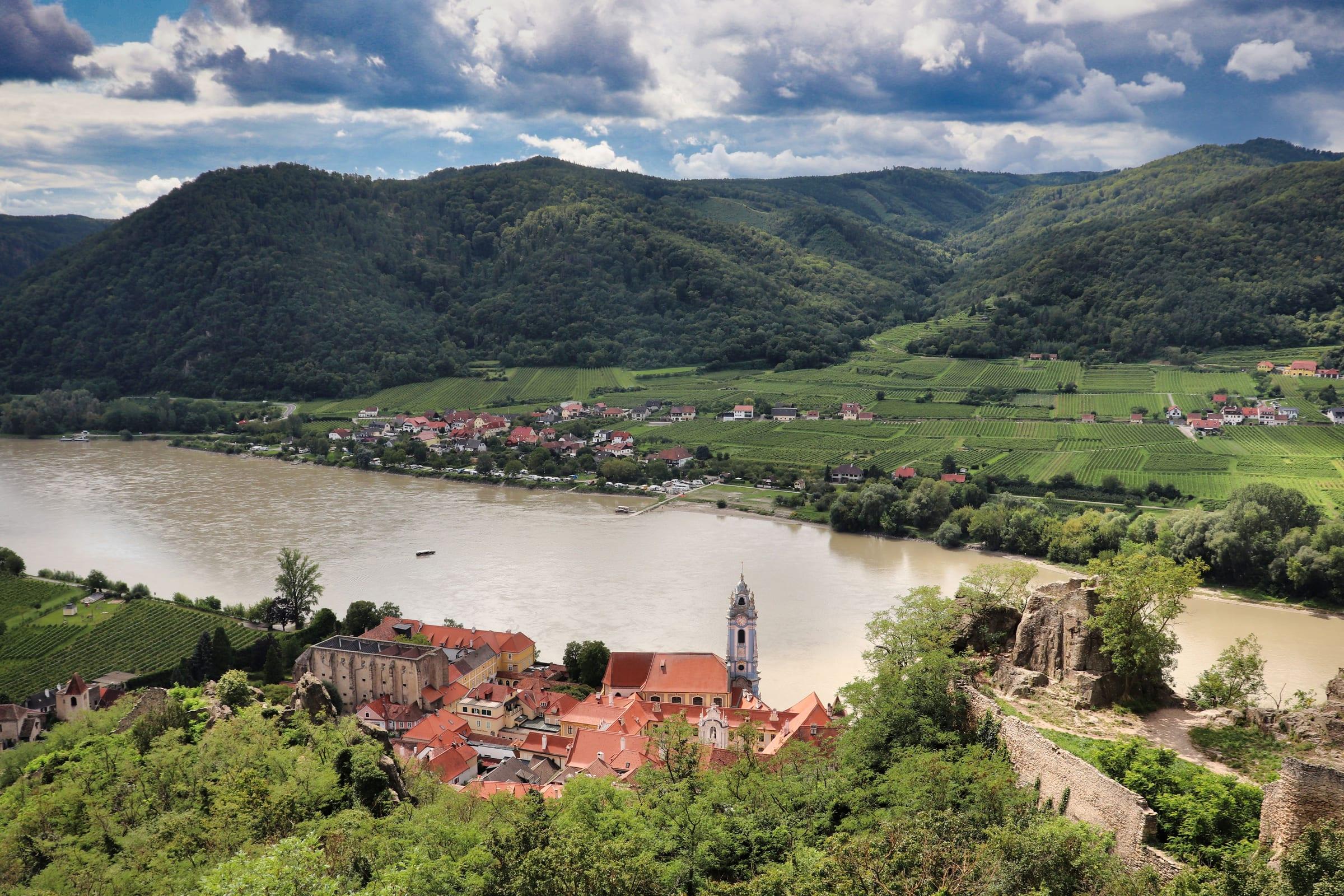
The blue abbey tower in the photograph at the top of this page. The operator's page did not load, so verify hours and step access before planning a visit.
Post-race food
The runner-only finish area serves mineral water, drinks, bars, fruit cake and fruit. Eat before you leave, because you cannot return.
Two seated options were verified from operator sites. 2STEIN, in Campus West, serves burgers and steaks and lists Sunday opening from 09:00 to 22:00 with hot food throughout. Poldi Fitzka, at the Landesgalerie, lists Sunday opening from 08:00 to 18:00, and its kitchen hours should be checked separately before planning a late meal. Both are about 0.7 to 0.9 km from the finish, and after a large event a table is not guaranteed, so book where you can.
After the Race
The race is on a Sunday in late September, so the Monday is the first free day. Several museums close on an ordinary Monday, the grape harvest is under way in the valley, and tired legs make short rail and bus hops easier than anything with steps. Each excursion keeps walking short.
A flat walk to the Kunstmeile, with a museum that opens on a Monday and a coffee at the gallery. No transport.
A walled wine village beneath a ruined castle, with a blue abbey tower, a short flat lane and no obligation to climb.
The abbey at Melk, a night there and a second night back in Dürnstein, with the boat as the slow option.
A city base before the flight home, with the airport on the same rail network.
Background
History
The event dates to 1998 and was reorganised in 2008 under WACHAUmarathon GmbH, led by Michael Buchleitner, who had run in the first edition. The first full-marathon field and the early routes are not documented.
The weekend is a multi-distance festival. An international elite half marathon and the full distance start on the same morning. James Price of Great Britain won the 2026 marathon in 2:45:30 and Katrin Zauner of Austria the women's race in 3:05:29. Neither is a course record.
The race has had two interruptions. It returned in 2022 after two years without one. Separately, the 2024 edition was cancelled amid heavy rain and flooding warnings, and the anniversary edition followed the next year. The Krems end of the course was altered for the anniversary edition and the course was remeasured with an adjusted certificate, so a time on an earlier finish may not map to the current course.