The Race
| Next Race Date | 23 May 2027 |
|---|---|
| Course Type | Loop: two identical 21.1 km laps, starting and finishing on Kranenkai beside the Congress Centrum Würzburg |
| Registration | Open, online, no ballot. Prices rise in tiers toward race week |
| Ballot Opens | Not applicable: open registration |
| Total Finishers | 888 (2026, marathon distance) |
| Average Race Day Temperature | About 10°C to 21°C, late May (overnight low to afternoon high) |
| Cutoff Time | 5 hours 30 minutes. The finish closes at 15:00 |
| Free Race Day Transport | Yes. The race bib is a free ticket on WVV and NVM public transport on race Sunday |
| Course Certification | DLV-measured road course. No World Athletics or AIMS label confirmed |
The halfway decision
The marathon’s first lap is the half-marathon course, and it ends a few metres from where it began. At 21.1 km every marathon runner passes the start line again and chooses: go out for the second lap, or stop. That exit is worth planning for on a hot day, after a bad week of sleep, or when the first half has gone out too fast. How a deliberate stop is scored is less clear. The organiser’s current wording says a runner who does not complete the marathon receives no marathon placing and is listed separately as a non-finisher with their splits recorded; whether a planned stop at halfway can instead count as a half-marathon result is not spelled out. Check the 2027 participant information before counting on a half-marathon time.
History
Paul Sichermann won the first Würzburg city marathon in 2001 in 2:30:01, and Uschi Wolf won the women’s race in 2:56:48. The race is organised by the Stadtmarathon Würzburg association and run on a large volunteer operation rather than by a commercial promoter. The city’s utilities and transport company, Würzburger Versorgungs- und Verkehrs-GmbH, known as WVV, has backed it since the first edition and became title sponsor in 2023, which is why the event now carries its name. The 2027 race is the 25th.
What began as a single marathon is now a weekend programme: a half marathon, a six-person relay, the MetaComp 10 km FunRun, and children’s and youth races. The half is by far the biggest event. In 2026 the weekend took around 7,000 registrations and more than 6,000 starters, of whom 888 finished the marathon, around 3,800 the half, around 300 ran in relay teams and around 900 ran the 10 km. The organiser called those 888 the strongest marathon total since 2010.
The race was once considerably faster at the front. The fastest times in the organiser’s own winner list are Titus Kipchumba Kosgei’s 2:14:10 in 2011 and Abiyot Deme’s 2:34:07 in 2015, fastest-listed results rather than formally ratified course records. Recent winning times are slower: Florian Koch won in 2:38:30 and Mona Grewe in 2:46:18 in 2025, and in the hot 2026 edition Alexander Bier won in 2:32:47 while Nina Hauck ran 2:59:20, her first time under three hours.
No World Athletics label has been confirmed for the event. Its standing rests on DLV course measurement, and the organiser states that a result here is valid for Boston Marathon qualification. That concerns what a Würzburg time can be used for elsewhere; it is not a route into the Würzburg field. For 2026 the organiser lengthened the riverside sections of the lap and reported that runners liked the change.
The course
Two identical laps of 21.1 km, both starting and ending on Kranenkai between the Congress Centrum Würzburg and the river. Each lap crosses the Main twice: west on the Brücke der Deutschen Einheit before km 1, and back east on the Konrad-Adenauer-Brücke at the southern end of the lap, around km 12. In between it zigzags through the residential grid of Zellerau, runs the left-bank quays past Marienberg Fortress, and heads south through Steinbachtal. After the second crossing it comes north along the right-bank quays and finishes each lap with nearly six kilometres of old-town streets, past the Residence at about km 17, the Juliusspital at km 18.6 and the Cathedral at km 19.2.
The surface is asphalt throughout and the course is flat: the whole route sits inside a band of about 24 m on the elevation chart below, and less than that on the road itself. What makes it harder than the profile suggests is heat and turning. The riverside sections have little shade, and the old-town part of each lap is a dense run of short streets and corners. The course never crosses the Alte Mainbrücke itself; it passes its western end on Saalgasse at about km 8.7 and its eastern end on the Mainkai at about km 20.2. Kilometre points are from the 2026 course, which may shift slightly for 2027.
Km 0 to 5: across the river and into Zellerau. The four start blocks leave five minutes apart from 09:10, sharing the road with the half-marathon and relay fields, so the first kilometres are crowded whichever block you start in. The course runs north on Röntgenring and Veitshöchheimer Straße and crosses the Main on the Brücke der Deutschen Einheit at about km 0.8. Zellerau follows: a working residential district, not a postcard, and the route zigzags through it on Mainaustraße, Weißenburgstraße, Sedanstraße, Wredestraße and Franz-Horn-Straße to a turn on Frankfurter Straße just before km 5. This is the time to settle into pace, not to chase road position.
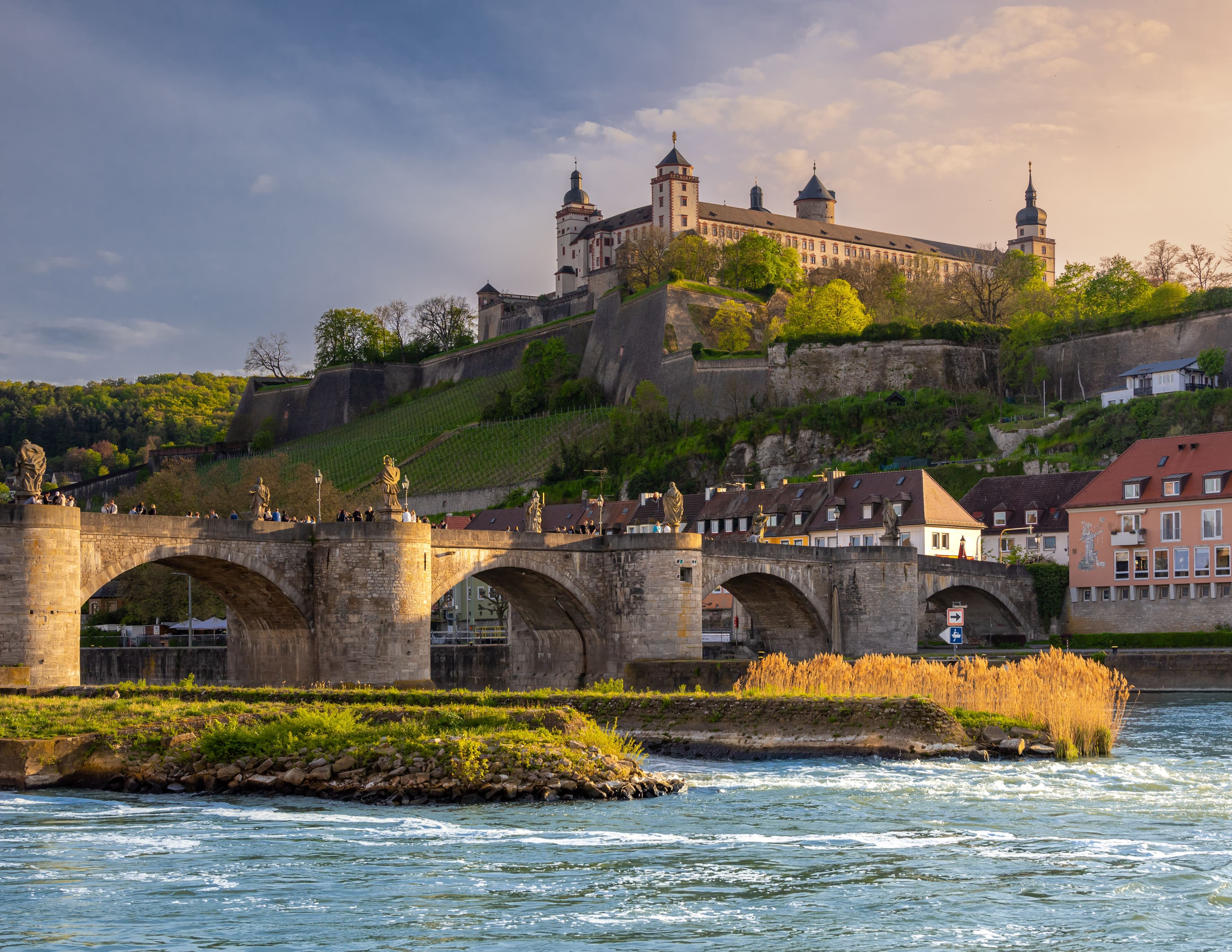
Km 5 to 9: the left bank and the Mainviertel. The route comes back east along Mainaustraße, the first stretch that runs right beside the water, then turns south along Dreikronenstraße on the left-bank quay. At about km 8.7 it passes the western end of the Alte Mainbrücke on Saalgasse, with the Mainviertel’s old houses on one side and Marienberg Fortress directly above. That is the scene in the photograph at the top of this page, and one of the better places on the course for supporters.
Km 9 to 12.5: south to the Konrad-Adenauer-Brücke. Mergentheimer Straße and the Maria-Theresia-Promenade carry the course south through Steinbachtal. This is the quietest stretch of the lap for crowds. At the southern end the route crosses the Main on the Konrad-Adenauer-Brücke around km 12, with a short loop around the bridge approaches on the Heidingsfeld side, then turns back north.
Km 12.5 to 15.5: the right-bank quays. Three kilometres north along the river on Kurt-Schumacher-Promenade, Theodor-Heuss-Damm, Ludwigkai and Willy-Brandt-Kai, with a brief detour onto Platenstraße at about km 14. It is flat, open and exposed, with the fortress across the water. On a warm morning this is where shade runs out. Full aid stations come roughly every 5 km, with water-only points between them; use them here.
Km 15.5 to 21.1: the old town. The course leaves the river at Reibeltgasse and spends its last six kilometres of the lap in the Altstadt. It picks its way along Neubaustraße, Münzstraße and the Sanderring, then runs up the Balthasar-Neumann-Promenade beside the Residence at about km 17. Theaterstraße and Semmelstraße take it north to the Kaiserplatz near the Hauptbahnhof at about km 18.3, and it turns back along the Juliuspromenade past the Juliusspital at km 18.6. It then passes the Cathedral on Schönbornstraße and the Domerschulstraße between km 19 and 19.4, drops to the Oberer Mainkai beside the Rathaus at km 20 and crosses the Marktplatz at km 20.5 before returning along Kranenkai past the Alter Kranen. This is where most of the crowd is, and where the bands concentrate. It is also a long sequence of corners, so run the tangents.
Km 21.1 to 42.195: the second lap. The same route again, 21.1 km later: the Brücke der Deutschen Einheit at about km 21.9, Saalgasse at km 29.8, the southern crossing around km 33, the Residence at km 38.1, the Cathedral near km 40.3 and the Marktplatz at km 41.6. Familiarity helps: you know where the turns and the aid stations are, and where the shade stops. What changes is the company. The much larger half-marathon field has finished, the roads are emptier, and the support along the river thins out; it stays loud in the old town and at the finish. Placings are decided on gross time rather than chip time. No blue tangent line or full timing-mat list has been published beyond the half-marathon split.
Course Map
One lap of the course, run twice: across the Main to Zellerau, south on the left bank, back over the Konrad-Adenauer-Brücke and north through the old town to Kranenkai. Tap a marker for details, and scrub the slider or press play to move the orange marker along the course with the elevation profile beneath it.
Start blocks and pacers
The marathon and half marathon start together in four blocks five minutes apart, seeded by predicted finish time. The relay uses the same start structure.
| Block | Start | Marathon prediction | Half prediction |
|---|---|---|---|
| A | 09:10 | Under 3:20 | Under 1:40 |
| B | 09:15 | 3:20 to 3:50 | 1:40 to 1:55 |
| C | 09:20 | 3:50 to 4:20 | 1:55 to 2:10 |
| D | 09:25 | 4:20 and slower | 2:10 and slower |
Official CEP pacers run both distances, identified by CEP compression socks and a small flag worn on the back. The marathon targets are:
And the half-marathon targets:
The organiser does not say which block each pacer starts from. The obvious fit follows the time bands, so the 2:59 and 3:29 groups should be in block A and the 4:29 and 4:59 groups in block D, but look for the flags in your own block rather than assuming. Because half-marathon pacers share the first lap, make sure the group you follow is running your distance.
What to wear
The 2026 race was hot. The organiser named sunshine and early-summer warmth as the day’s defining challenge, and finishers said the same. The long-run average for 23 May in Würzburg is a roughly 10°C overnight low and a 21°C afternoon high. The 09:10 to 09:25 starts sit near the cool end of that range, but a four-hour runner is on the second lap until after 13:00, and the right-bank quays and the Mainaustraße stretch have almost no shade. Dress for the forecast, not for the idea of a spring marathon.
Sunscreen matters more here than the calendar suggests, especially for runners in blocks C and D. A light throwaway layer is only worth it on a cool or wet morning, and since bag drop is metres from the start you can keep a layer in your bag until late. No clothing-donation scheme has been announced, so do not assume anything left at the start will be collected. Toilets are roughly every 2.5 km along the course, at aid points and relay exchanges, and full aid stations every 5 km or so, which makes carrying a hydration vest unnecessary for most runners.
Entry
Entry is open: no ballot, no qualifying time. Registration for the 2027 race opened in July 2026 and the price rises in tiers, currently €74 until 31 December 2026 and €89 for late online entry in race week, roughly £64 and £76 at September 2026 exchange rates. An optional finisher shirt can be preordered for €27. International runners enter on exactly the same basis as German ones.
Start blocks are assigned by predicted finish time: A for under 3:20, B for 3:20 to 3:50, C for 3:50 to 4:20 and D for 4:20 or slower, with matching half-marathon bands. No proof of a previous time has been required. There is no charity-entry programme, no tour-operator allocation and no Good for Age route, and cancellation, transfer and deferral terms are those of the registration platform at the time of booking, so read them before paying. The one piece of built-in flexibility is on the course: the option to stop at 21.1 km, covered above.
The weekend is growing quickly, from around 6,000 registrations in 2025 to around 7,000 in 2026. No marathon sell-out has been recorded, but the tiered pricing already rewards deciding early, and so does the hotel supply near the Congress Centrum.
Fast Runner / GFA Standards
Not applicable. There is no qualifying-standard or Good for Age entry. The Boston Marathon qualification the organiser mentions applies to the finishing time you run here, not to getting in.
Race Weekend
Expo
Bib collection and the expo are both at the Congress Centrum Würzburg, beside the start and finish. On Saturday 22 May 2027 collection runs from 10:00 to 19:00, alongside the expo, the pasta party and the children’s and youth races. On race morning it reopens from 06:30 to 08:30, with the expo open from 06:30. The organiser recommends Saturday: Sunday queues can run long, and with a 09:10 start there is little slack.
A confirmation email with a barcode goes out on the Wednesday before the race. If it does not arrive, photo ID plus your start number from the online entry list will do. Someone else can collect for you with the confirmation or QR code and a signed authorisation. The start pack includes the official race bag, which is the only bag the bag drop will accept on Sunday. Anyone staying on Pleichertorstraße can collect on Saturday, drop everything in their room and be back at the start on foot in a couple of minutes the next morning.
Getting to the Start
Everything happens in one place. The Congress Centrum and Kranenkai hold number collection, bag drop, changing, the start and the finish, so race morning involves no transfer and no shuttle. Number collection reopens at 06:30, bag drop opens at 07:30 and the start-area programme begins at 09:00.
- Walk to the Congress Centrum. It is about 900 m from Würzburg Hauptbahnhof and within 15 minutes on foot of anywhere in the northern Altstadt. The bib is also a free ticket on WVV and NVM buses and trams on race Sunday, and the Congress Centrum tram stop is beside the start, though race-day closures divert some routes.
- Drop your bag from 07:30. Bag drop and changing are in the Congress Centrum basement, and only the official race bag from your start pack is accepted. Fixed toilets are in the basement too, with more around the start area.
- Go to your block on Kranenkai. A starts at 09:10, B at 09:15, C at 09:20 and D at 09:25.
- After the finish, collect your medal and the finish-area food and drink, then your bag from the same basement, open until 14:30.
The course closes at 15:00 and the cutoff is 5 hours 30 minutes. Runners still going after closure can continue on the pavement, but without road closures, aid or timing support, which is worth weighing at the halfway decision if the first lap has been slow. No headphone rule, pushchair or wheelchair policy, or outside-assistance rule has been published.
The finish area hands out medals, drinks, fruit, bakery goods and alcohol-free Kauzen beer. Physiotherapy students give free massages in return for a voluntary donation, and hot showers are in a shower truck on the WVV car park opposite the Congress Centrum. With the bag, the showers and most hotels a few minutes apart, the post-race exit is about as easy as a city marathon gets.
Nutrition on Course
Full aid stations come roughly every 5 km, with water-only points between them. The full stations serve RESIDENZ QUELLE mineral water, an apple spritzer, a cola mix, Iso-Sport isotonic drink and bananas. With the laps repeating, every station comes round twice, so the second lap’s drinking can be planned from what you saw on the first.
No gel brand, personal-bottle service or sponge station has been announced, so carry your own gels. On a warm day, drink at every station on the Mainaustraße and right-bank sections of both laps; running between stations on a hot late morning is where this race goes wrong. Toilets are roughly every 2.5 km. At the finish there is water, other soft drinks, alcohol-free Kauzen-Bräu, fruit and bakery goods.
Spectating
Two laps make this an easy race to watch: any one spot on the course sees each runner twice, and the old town is compact enough to see them three or four times without a tram. Support in 2026 was heaviest in the city centre, beside the river in town and at the start and finish, with bands along the route. The quieter stretches are Zellerau and Steinbachtal, away from the centre. No ticket is needed for ordinary finish-area spectating, and no live-tracking app has been announced for 2027.
The bridge plan. Watch the start on Kranenkai, then walk about 600 m south to the Alte Mainbrücke and cross it to Saalgasse on the far side, under the fortress. Runners pass there at about km 8.7, around 50 minutes after their block starts for a four-hour runner. Cross back into the old town by about 10:15, before the leaders reach the Mainkai, and wait on the Marktplatz, which the course crosses at km 20.5, then again at km 41.6 before the finish on Kranenkai. It is all on foot, and it fits the view in the photograph above.
The old-town plan. Skip the crowded start and base yourself between the Residence and the Cathedral. The course passes the Residence at about km 17, the Juliusspital at km 18.6 and the Cathedral at km 19.2, all within a short walk of each other, so a supporter can move ahead of a runner between those points and repeat it all on the second lap before walking to the finish.
The one-spot plan. Stand on Kranenkai near the Alter Kranen. You see the start, the halfway pass at km 21.1 and the finish without moving, with food and a beer garden behind you.
Post-Race Food
The finish area covers the first hour. For a proper meal, the Alter Kranen at Kranenkai 1 is the closest option, about 250 m from the finish with a beer garden on the quay, serving Franconian food in portions sized for people who have just run. Wirtshaus am Dom, on the Paradeplatz beside the Cathedral, is the old-town choice for dumplings, potatoes and roasts once you have showered. For a slower celebratory meal, the Bürgerspital-Weinstuben on Theaterstraße, a street the course itself uses at about km 17.3, pairs Franconian cooking with wine from its own estate. Eat and rehydrate before the wine. Check Sunday opening hours for all three, and book the latter two if you can.
Where to Stay
The usual advice, stay near the finish, is easy to follow here because the finish and the start are the same line on Kranenkai. Every district below is judged on its walk to the Congress Centrum. The one complication is the river: the course crosses it and uses both banks, so a hotel on the far side can mean crossing a live course on the way back.
Pleich and the Congress Centrum
Pleich, the district around the Congress Centrum and Pleichertorstraße, is the logistics choice. The official race hotel and a smaller independent one are both about 100 m from the start, so number collection, bag drop, the start and the post-race shower are all a couple of minutes from your room. It is a conference-centre quarter rather than a pretty one, and prices on race weekend reflect the location.
The Altstadt
The Altstadt, around the Marktplatz and the Cathedral, is the best all-round base. Most of the city’s restaurants and sights are here, and nowhere in the old town is more than about 15 minutes on foot from the start. Some hotels sit directly on the course, which is useful for supporters. Saturday night is louder than in Pleich.
The Hauptbahnhof area
The Hauptbahnhof area, on the northern edge of the centre, suits anyone arriving by train from Frankfurt Airport. The start is about 900 m from the station, so luggage and race morning are both simple. The streets immediately around the station are less appealing than the old town.
The Mainviertel
The Mainviertel, across the Alte Mainbrücke under the fortress, has the river and fortress views that suit a trip with family. The course runs through it on Dreikronenstraße and Saalgasse at about km 8 to 9 and again at km 29 to 30, which is good for supporters. For a runner, reaching the start is easy since nobody is on the course yet, but the walk back after finishing may mean waiting for a marshalled crossing while second-lap runners come through.
Sanderau and Grombühl
Sanderau, the residential district south of the old town, is quieter on Saturday night and has more apartments. It adds a tram ride or a 20 to 30 minute walk to the start, and the course runs along its riverside at km 13 to 15. Grombühl, beside the university hospital and behind the station, is mainly useful for extra rooms once the central hotels are full.
Recommended hotels
The official race hotel, next to the Congress Centrum, with a marathon-weekend offer booked under the keyword “Würzburg Marathon” that has included late checkout to 15:30 on the Sunday. That checkout time is the practical draw: finish, shower in your own room and leave for the train without a bag-drop queue.
As close to the start as the Maritim for less money, a few doors along the same street. It is a small property, so it goes early; book it when you enter if the price suits.
On the northern edge of the old town, halfway between the Congress Centrum and the Hauptbahnhof, which makes it the easiest hotel on this list for a rail arrival. Barbarossaplatz is a busy junction, so ask for a room away from the street.
Directly across the river from the Congress Centrum, with fortress views. The course runs past the front door at about km 8.3 and again at km 29.4, which suits supporters, but on the walk back after finishing you may need to cross the course while slower runners are still coming through.
An old-town hotel on Neubaustraße, which is itself on the course at about km 15.7 and km 19.6, so anyone staying here can step outside to watch both laps. The furthest of the five from the start, but still a flat 15-minute walk.
Booking timeline
There is no ballot, so the trigger for booking is simply deciding to go. Registration opens around ten months before race day; for 2027 it opened in July 2026. The marathon field is under 1,000, but the whole weekend drew around 7,000 registrations in 2026, and the half-marathon crowd wants the same few hotels beside the Congress Centrum. The official race hotel, the Maritim, has offered a marathon-weekend rate under the booking keyword “Würzburg Marathon”; check early rather than assuming the arrangement carries over. For UK runners, Frankfurt Airport is the gateway, with direct ICE trains to Würzburg Hauptbahnhof in about 1 hour 24 minutes to 1 hour 33 minutes, so there is no need for a hire car on a weekend spent in the city. Book the hotel first and the flight second.
See & Do
All of these are within walking distance of the finish on Kranenkai and the central hotels. Distances are on foot from the finish.
The Alte Mainbrücke
About 600 m (0.4 miles) from the finish. The old stone bridge with its baroque saints is free, pedestrian and short, and the view from it takes in the river, the old town and the fortress without committing to anything more. On a fine evening it fills with people standing along the parapet with a glass of Franconian wine, which counts as recovery. The city’s guided walks restart in May, so the tour programme is running on race weekend.
The Altstadt, the Cathedral and the Marktplatz
The Marktplatz is about 500 m (0.3 miles) from the finish and the Cathedral about 800 m (0.5 miles). Most of the old town was destroyed in the air raid of 16 March 1945 and rebuilt afterwards, and the course covers much of it twice. Cafés every few metres make it easy on sore legs: a short self-guided loop between the Cathedral, the Neumünster and the Marienkapelle on the Marktplatz is kinder than a fixed 90-minute tour.
The Würzburg Residence
About 1.4 km (0.9 miles) from the finish, and passed by the course at km 17 and km 38. The prince-bishops’ palace is a UNESCO World Heritage Site, open daily 09:00 to 18:00 from April to October with last admission at 17:15. The grand staircase and the run of state rooms mean a good hour on your feet, so it suits the Monday more than race afternoon. The Court Garden behind it is free.
Marienberg Fortress
About 2 km (1.2 miles) from the finish, across the Alte Mainbrücke and up through the vineyards. The fortress dominates every view of the city, but the walk up is a proper climb, so it is a second-day outing unless your legs are unusually fresh. The terraces give the best overview of the course you ran: the old town spread below, the river and the long quays on both banks.
Franconian wine at the Bürgerspital
About 800 m (0.5 miles) from the finish, on Theaterstraße. Würzburg is the centre of Franconian wine, and two of its historic estates, the Bürgerspital and the Juliusspital, sit on the course itself. The tourist office runs wine walks and tastings from May, but the vineyard walks involve real slopes; a seated tasting or a table at the Bürgerspital-Weinstuben is the better choice the day after the race.
After the Race
Late May is a good month to be in Franconia: long evenings, open beer gardens, and the Romantic Road towns before the summer coach tours arrive. Würzburg Hauptbahnhof is a rail hub, so everything below is reachable without a car, and the day trips are short enough for Monday legs. Leave the cobbled walled towns for the second day after the race.
A UNESCO-listed old town built across river islands, small enough to cover in an unhurried afternoon on tired legs. Late May means the beer gardens and riverside seating are open without the summer crowds.
The walled medieval town at the heart of the Romantic Road. The change of train and the cobbles make it a better fit for the second day after the race than the first.
Frequent direct trains make this an easy extension: an afternoon and evening in the old city, then a slow second morning before flying home or continuing through Germany.
The practical choice for anyone flying out of Frankfurt Airport. Two nights puts a full recovery day beside the Main between the race and the flight.
Rothenburg and one or two smaller Franconian towns on a slower wine-country circuit. Collect the hire car after race weekend, once the only luggage problem is your own legs.
Frequently asked questions
Should I stay near the start or the finish?
They are the same place: Kranenkai, beside the Congress Centrum, which also holds the expo and bag drop. Two hotels sit about 100 m away. The Altstadt is within 15 minutes on foot.
How far in advance should I book a hotel?
As soon as travel is decided. There is no ballot to wait for, and the whole weekend drew around 7,000 registrations in 2026, all competing for the few hotels near the Congress Centrum.
Is there free transport to the start on race day?
Yes. Your bib is a free ticket on WVV and NVM public transport on race Sunday. Most central hotels are within walking distance anyway, and race-day closures divert some routes.
What is the best area to stay?
Pleich, around the Congress Centrum, for logistics. The Altstadt for restaurants and sightseeing with an easy walk to the start. The Hauptbahnhof area for rail arrivals from Frankfurt Airport.
When does the expo open?
Saturday 22 May, 10:00 to 19:00, and race morning 06:30 to 08:30, both at the Congress Centrum. Collect on Saturday: Sunday queues can run long.
What is the weather typically like on race day?
Roughly 10°C overnight and 21°C in the afternoon in late May. The 2026 race ran hot, so plan for a warm second lap even after a cool 09:10 start.
How do I get from the airport?
Fly to Frankfurt. Direct ICE trains reach Würzburg Hauptbahnhof in about 1 hour 24 to 1 hour 33 minutes, and the start is about 900 m on foot from the station.
Is there a bag drop?
Yes, in the Congress Centrum basement beside the start and finish, 07:30 to 14:30 on race day. Only the official race bag from your start pack is accepted.
Should I bring a throwaway layer?
Only on a cool or wet morning. Bag drop is metres from the start, so a layer can go in your bag late. No clothing-donation scheme has been announced.
How do I get back to my hotel after finishing?
Walk: the finish is where you started, beside your bag and the showers. Staying in the Mainviertel means crossing the course on Dreikronenstraße while second-lap runners pass.