The Reykjavík Marathon finishes in the compact grid of the capital in late August, timed to coincide with Reykjavík Culture Night, and by the following morning most runners are stiff-legged, sunburnt round the edges and not remotely interested in another 42km on foot. August in Iceland's southern uplands is about as forgiving as the country gets: the worst of the wind has usually eased off from spring, days still run long, and none of the three main stops on this route demand more walking than a car park allows. Þingvellir is the exception, and even there the paths are level gravel rather than anything technical.
The loop from Reykjavik covers Routes 36, 365, 37 and 35, roughly 230-250km depending on which detours are taken, and needs about three and a half hours of driving without stops. Most people spend six to eight, and there is no shame in leaving the second half of that day for sitting down. A standard 2WD hire car manages every metre of this route in summer; nothing here requires 4x4. Runners who would rather not drive the day after a marathon can book a seat on one of the daily coach tours that leave from central Reykjavik, run by operators including Reykjavik Excursions, which cost more than self-driving but ask nothing of tired legs beyond getting on and off a bus.
Þingvellir and the Rift
Þingvellir sits about 45km northeast of Reykjavik on Route 36, inside a national park that is also a UNESCO World Heritage Site. Iceland's national parliament, the Alþingi, met here from 930AD, at a rock outcrop still known as the Lögberg, the Law Rock. The more immediate draw for most visitors is geological rather than historical: this is one of the few places on Earth where the boundary between two tectonic plates, North American and Eurasian, is walkable on foot, via the Almannagjá gorge. The main path through it is flat, wide gravel, easily managed on legs that are still complaining about Saturday. Parking costs around 750 ISK (about £4.50). Allow an hour if the legs want to sit somewhere afterwards, two if they don't.
Geysir and Gullfoss
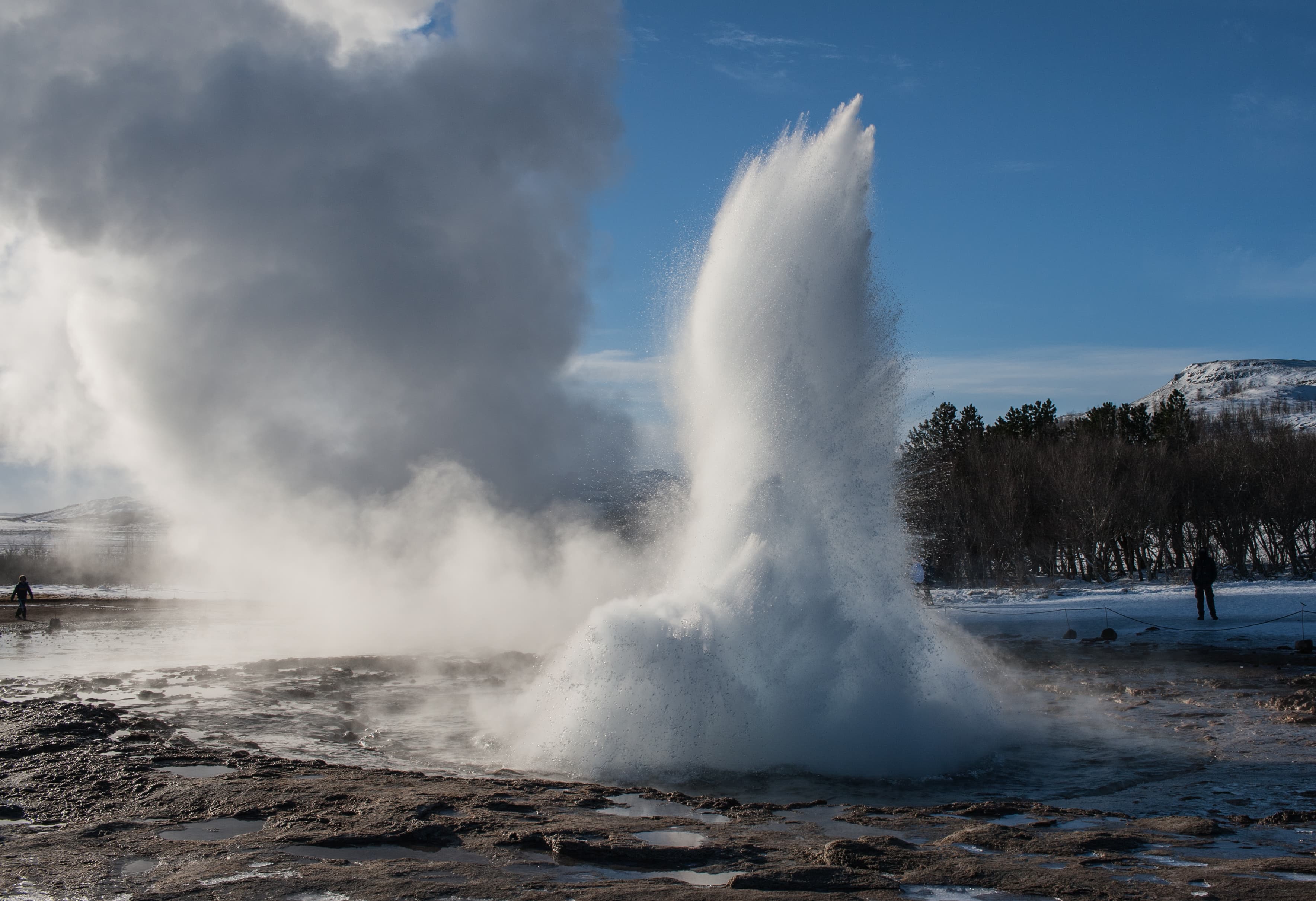
From Þingvellir, Routes 365 and 37 lead southeast through Laugarvatn to the Geysir geothermal field, about 50 minutes further on. The Great Geysir itself, the one that gave English the word, has been mostly dormant since the early twentieth century, but its neighbour Strokkur erupts every five to ten minutes, throwing water 20 to 40 metres into the air with no warning beyond a bulge in the pool. The car park sits close enough that no real walking is involved. Ten minutes north on Route 35, Gullfoss drops the Hvítá river 32 metres in two stages into a gorge that catches spray on a sunny day into something close to a permanent rainbow. There are two viewing platforms; the lower one involves a short flight of steps, the upper one none at all. Both are free.
Those with an appetite for one more stop before turning back can detour to Kerið, a 3,000-year-old volcanic crater near Selfoss with a small aquamarine lake at its base and red-orange scoria walls, entry roughly 400 ISK (about £2.40). The rim walk is fifteen minutes and mostly flat.
Return south on Route 35 to Route 1 through Selfoss, about ninety minutes back into Reykjavik. Fuel stations sit at Laugarvatn, Flúðir and Selfoss, so there is no need to plan around running dry on the way.