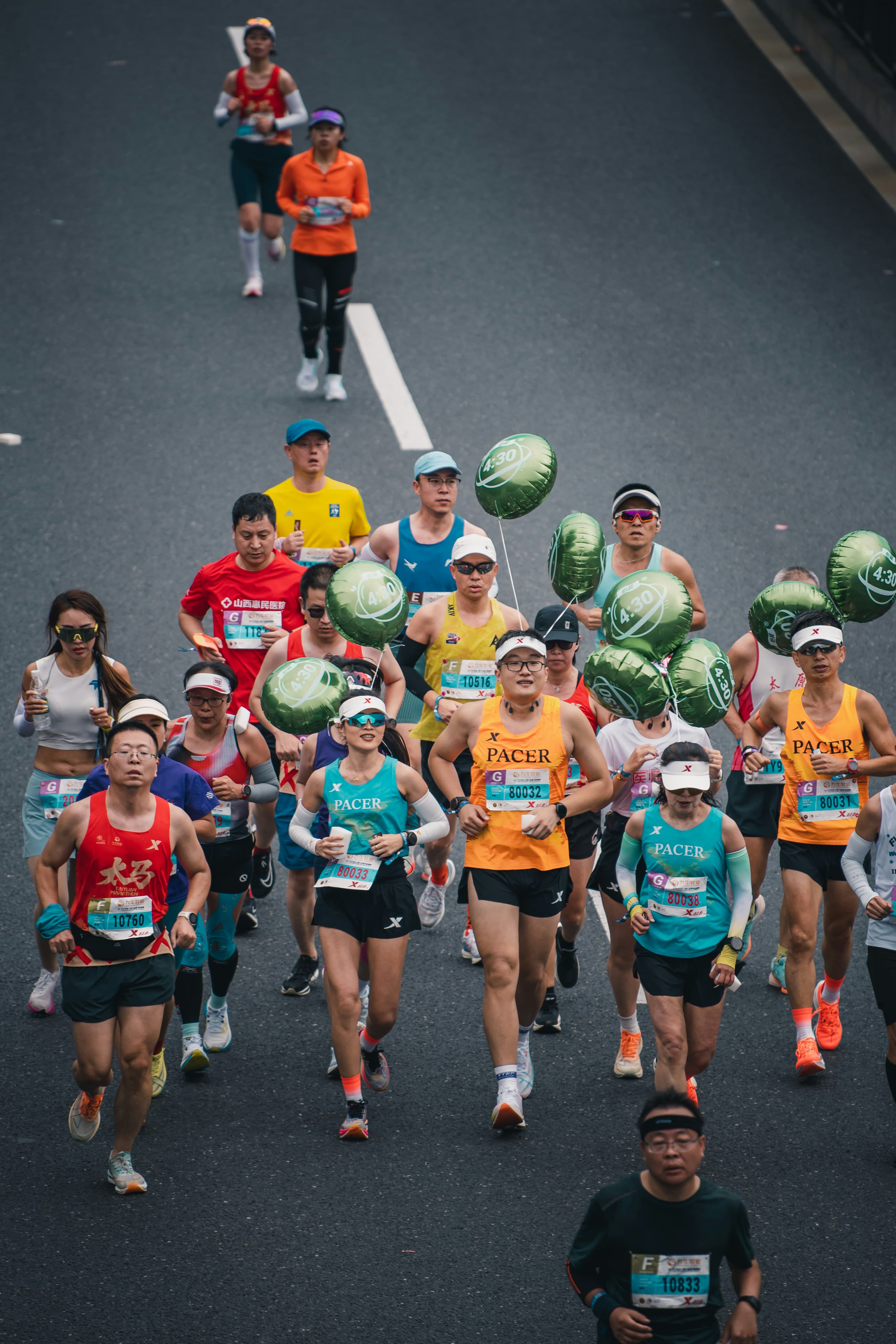
The obvious job is the time. A pacer running a 3:30 group commits to crossing the line within a few seconds of that target, neither too fast nor too slow, regardless of conditions. But the interesting work happens long before the finish.
The Short Cut
- Official marathon pacers commit to crossing the line within a few seconds of their target time regardless of conditions, running either even splits or a mild negative split.
- The visible balloon or flag serves as a moving reference point for runners, reducing cognitive load over four-plus hours of racing.
- Race directors use pace groups as an active crowd-management tool: steady groups distribute runners across course infrastructure and prevent congestion at bottlenecks.
- Becoming a pacer requires consistent finishes at least 20 to 30 minutes faster than your target group, verified through timing databases.
What pacers actually do
Human physiology is highly sensitive to early pace surges. Starting a marathon even a few seconds per kilometre faster than your lactate threshold pace burns through glycogen stores quickly and accelerates neuromuscular fatigue, which is usually what is behind the wall that arrives somewhere around kilometre 32. Official pacers bypass this by running either evenly distributed pace or a mild negative split, where the second half runs slightly faster than the first. They are also watching GPS and accounting for course topography, which most runners in their group are too tired to do themselves.
The high-visibility flag or balloon matters more than it looks. In a field of tens of thousands, a pacer serves as a visible reference point. Runners lock onto that flag rather than a watch face, and that shift in attention reduces cognitive load significantly over four-plus hours.
The operational logic
Race directors use pacers as an active crowd-management tool, not just a service for runners. By holding a steady tempo, a pace group naturally distributes the field across the course infrastructure. Runners self-sort into predictable bands, which prevents dangerous congestion at bottlenecks: narrow turns, bridge approaches, and water stations in particular. When pace groups are well spread, aid station volunteers can set up cups ahead of time rather than scrambling to react.
Experienced pacers operating well within their physical limits also have the cognitive clarity to notice when someone in their group is struggling. Pacers are trained to spot early signs of heat exhaustion or hyponatremia and to flag course marshals or alert medical staff at the next station. They are effectively the race's distributed safety network in the middle of the field.
The psychological side
Following a pacer removes a surprising amount of mental load from a long race. Managing split calculations, tracking distance markers, and converting current pace into projected finish time requires continuous background processing that compounds fatigue. Outsourcing that to a pacer lets runners focus on breathing, form, and managing discomfort.
The group dynamic matters too. A pack has its own momentum. The social reinforcement of running alongside others, combined with a pacer's encouragement and periodic landmark callouts, helps suppress the brain's tendency to slow things down as discomfort increases. Runners in a pace group regularly report finishing faster than they would have managed alone.
How to become one
Becoming an official pacer requires a strong racing pedigree and, more importantly, excellent pacing consistency. Race directors are not looking for fast runners, they are looking for precise ones.
Most major marathons ask applicants for verified timing data showing multiple finishes at least 20 to 30 minutes faster than the target group they want to lead. Aiming to pace a 3:45 group means demonstrating comfortable, repeatable finishes under 3:15. Applications typically open six to nine months before race day and are assessed through timing databases for historical split consistency. Selected candidates are often tested at tune-up events, where they must cross within 15 seconds of a target time.
The compensation is practical rather than financial. Entry fees are covered, kit is provided, and for destination races there is usually travel support and accommodation. The less tangible return, watching a runner hit a long-chased time because you ran the first 30 kilometres steadily enough to give them the legs for the last twelve, is the reason most pacers keep coming back.
Pacing profiles, application timelines, and qualification standards vary by race. Runners following a pace group should ensure their training genuinely aligns with the target time; a pacer can manage the splits, but cannot make up for a training block that is not there.
For more on race-day strategy, How to Race Without Paying the Entry Fee covers the pacer route as one path to a free bib. The London Marathon and Berlin Marathon race pages include details on their official pacer programmes.