The Race
| Next Race Date | 26 September 2027 |
|---|---|
| Course type | Near-flat loop. 55m total elevation gain. |
| Certification | IAAF Platinum Label · Abbott World Marathon Major |
| Start | Straße des 17. Juni at Großer Stern, Tiergarten |
| Finish | Straße des 17. Juni, beyond the Brandenburg Gate |
| Total finishers | ~50,100 (2026) |
| Avg race-day temp | 12 to 18°C (late September) |
| Cutoff time | 6 hours 15 minutes |
| Free race-day transport | Yes - 4-day VBB ABC zone ticket included with entry (valid to 3am Monday; covers BER Airport via S9) |
| Course certification | AIMS / World Athletics certified |
| Sleeper Train | Accessible |
History
The Berlin Marathon is the world record course. Not once, not twice - the open marathon world record has been broken here more times than on any other course. Eliud Kipchoge ran 1:59:40 under the Ineos 1:59 Challenge here in 2019, then set the official open world record of 2:01:09 in 2022. The circuit has attracted record attempts and record falls so consistently that its flat profile and September weather have become synonymous with the outer limit of what human marathon running can do. Carbon-plate shoes have amplified the effect; why flat courses amplify the benefit is worth reading before deciding on footwear.
The 2026 race, on Sunday 27 September, produced a men's winning time of 2:02:50 from Guye Adola, ahead of Gemechu Dida (2:03:19) and Gabriel Geay (2:03:59), with eight men under 2:06. Tigst Assefa won the women's race in 2:11:04, a new Berlin course record that beat her own 2:11:53 from 2023, ahead of Bedatu Hirpa (2:16:53) and Dera Dida (2:16:55). Race organiser SCC describes the combined winning time of 4:13:54 as the second-fastest combined winning performance in marathon history. Assefa was tracking about 2:09:36 with 5 km to go before a leg problem around 40 km.
The race began in 1974 as a small event run through the Tiergarten park. It moved to the streets in 1981 and has since grown to about 50,100 finishers in 2026, from more than 56,000 entrants representing 162 countries, making it the largest of the six Abbott World Marathon Majors by field size. The course is certified at IAAF Platinum Label - the highest classification a road race can receive. The start and finish are approximately 300 metres apart on the same street, making the race functionally a loop through the centre of the city.
The course
The course is a single loop. It starts and finishes on the same stretch of Straße des 17. Juni in the Tiergarten, meaning you will run within sight of the Brandenburg Gate before the first kilometre is done, then not see it again until the final turn.
The first five kilometres pass along the wide, tree-lined boulevards of the western Tiergarten, around the Victory Column, and down toward the Charlottenburg Gate. Broad roads, clear air, the noise of 54,000 people still compressed and optimistic. This is the most dangerous section of the race. The pace here feels effortless in the way that only a pace you cannot sustain for forty kilometres feels effortless. Run by a GPS watch, not by feel, and treat the effort level as a warning indicator if it seems easy.
By kilometre seven the Reichstag appears on the left, its glass dome catching the morning light over the river. The route then runs east through Mitte along Torstraße, loops through Friedrichshain at Strausberger Platz, and turns south into Kreuzberg between kilometres fifteen and twenty, where the neighbourhood generates the loudest crowd noise on the course. This is the section to bank good feelings.
From Yorckstraße at kilometre twenty the course heads west through Schöneberg and Friedenau to Wilmersdorf and Schmargendorf, and this is where the race frequently comes undone for runners who went out too fast. The streets are long, straight and residential, Rheinstraße and the Südwestkorso among them, and the crowds thin compared with Kreuzberg or the finish. This is the section where internal arithmetic replaces external distraction.
The same stretch carries the only climb on the course, and it is barely one: about 14 metres between kilometre twenty-one in Schöneberg and the high point of 53 metres at kilometre twenty-eight in Schmargendorf, a gradient of 0.2 per cent. After twenty flat kilometres it is still felt. The Maurten gel station at kilometre 27.5 sits just before the top. Take it.
From kilometre twenty-eight the course drops gently along the Hohenzollerndamm through Wilmersdorf, turns onto the Kurfürstendamm at about kilometre thirty-four and passes the Kaiser Wilhelm Memorial Church around kilometre thirty-five as the crowd begins to build again. Potsdamer Straße brings it back through Schöneberg to Potsdamer Platz at kilometre thirty-eight, then Leipziger Straße and the Gendarmenmarkt streets lead to Unter den Linden.
The finish line catches runners out. At kilometre forty-two, the Brandenburg Gate appears ahead. Enormous, lit by the morning sun, with the crowd pressed against the barriers on both sides. But the race does not end at the Gate. Runners come through Pariser Platz and the arch heading west, and the timing mats are a further three hundred metres down Straße des 17. Juni. Do not sprint at the Gate. Save it.
Blue tangent line:A three-stripe blue line runs along the official measured route throughout the course, marking the precise 42.195 km if followed exactly. On Berlin's wide roads the temptation to drift is constant, and on a crowded early race it is easy to add three hundred to five hundred metres by weaving and taking wide corners. Follow the line where you can, especially through Kreuzberg where the streets tighten.
Course Map
The single loop from the Tiergarten west to Charlottenburg, east through Mitte, south through Kreuzberg, west to Schmargendorf and back along the Kurfürstendamm to the Brandenburg Gate, with the start village, the Tempelhof expo and the nearest stations. Tap a marker for details, and scrub the slider or press play to move the orange marker along the course with the elevation profile beneath it.
A 22 m range across the whole course: the lowest point beside the Spree in the government quarter at km 6.6, and a gentle rise from Kreuzberg to the highest point, 53 m in Schmargendorf at km 28. Chart-only data, not a published statistic.
Elevation approximate. Total gain ~55m. The rise from Kreuzberg to Schmargendorf (km 21-28) is the only sustained climb on the course; the gel station at km 27.5 sits just before its top.
Straße des 17. Juni and the Tiergarten avenues. Wide roads, loud crowd, effortless pace. The most dangerous section of the course. Run by GPS watch, not by feel. If the effort seems easy, treat it as a warning sign.
The loudest neighbourhood on the course. Crowd noise is genuine here, not polite. Bank the good feelings - the western leg from km 20 through Friedenau and Wilmersdorf is substantially quieter.
The only climb on the course, about 14 metres over seven kilometres to the 53m high point at km 28 - modest on paper, noticeable to tired legs. Maurten gel station at km 27.5 sits just before the top.
The Brandenburg Gate at km 42 is not the finish. Through the arch and out the other side, the timing mats are 300 metres further down Straße des 17. Juni. Do not sprint at the Gate.
Elevation profile: Start and finish both at approximately 35m above sea level. No significant hills. Total gain approximately 55 metres - less than any other Abbott World Marathon Major. The world record has been broken here eight times. The combination of flat roads, wide Berlin streets, and September temperatures is the reason every record attempt of the last decade has targeted this course.
Pacers
Pacers run from 3:00 to 5:00, but the allocation differs by wave. A runner targeting 4:00 who is seeded into Wave 2 will not have a 4:00 pacer available from their wave. Check your wave assignment against the table before planning your race.
| Wave | Start | Pacers available |
|---|---|---|
| Wave 1 (corrals A–D) | 9:15am | 3:00, 3:15, 3:30 |
| Wave 2 (corrals E–F) | 9:45am | 3:00, 3:15, 3:30, 3:45 |
| Wave 3 (corrals G–J) | 10:10am | 3:30, 3:45, 4:00, 4:15 |
| Wave 4 (corral K) | 10:40am | 3:45, 4:00, 4:15, 4:30, 4:45, 5:00 |
What to wear
Late September in Berlin runs 12 to 18°C at race start in most years, with low humidity and typically dry conditions. Dress for 14°C. The start area on Straße des 17. Juni is exposed; morning temperatures before the city warms can be 8 to 12°C, particularly for later wave starts. Bring a throwaway layer. The organisation donates discarded clothing to charity.
Warm outliers are not rare. September 2023 reached 24°C at race start; 2025 reached 27.6°C. Check the forecast during race week and adjust accordingly. Sun on the second half of the course, on a warm year, compounds fatigue in ways that are easy to underestimate at the start. The 2026 race was far cooler than 2025 and still sunny: several recreational runners found it noticeably warm later on, one reporting that the heat became hard from around 25 km and another dropping a planned time target because of it. Late September is not automatically PB weather.
Entry
| Registration type | Ballot (general draw) |
|---|---|
| Lottery window | Opens 1 October 2026; closing date not yet confirmed; results expected late November or early December |
| Fast runner entry | Available - 2027 qualifying standards not yet confirmed |
| Charity entry | Available through official partners |
| Tour operator entry | Available - removes lottery uncertainty |
The 53rd Berlin Marathon is on Sunday 26 September 2027, and SCC has announced that the 2027 lottery opens on Thursday 1 October 2026. The closing date is not yet confirmed, and the official page gives results as late November or the beginning of December. For comparison, the 2026 window ran from 25 September to 6 November 2025, with results on 27 November. A first rejection email is not necessarily the last word. Berlin draws in multiple rounds, and runners who were passed over in the initial ballot have received acceptance emails weeks later. Check your spam folder. Sit on it for a while before assuming the answer is no.
The published acceptance rate is roughly one in five. That makes Berlin more accessible than Tokyo (where the rate is closer to one in ten), but a field of more than 56,000 entrants in 2026 means demand is fierce. Entry costs around €205, which includes race timing, the bib, on-course support, and a four-day public transport ticket covering Berlin's entire ABC zone network from Thursday to Sunday.
Fast runner entry
Fast runner entry offers a guaranteed place to those who meet the age-graded standards below, providing they can supply a verified result from an AIMS-certified, AbbottWMM Age Group World Rankings, or USATF-listed event from the preceding two calendar years. Full road marathon times only. Half marathon splits, virtual races, and other distances are not counted. Times are verified in late November; invalid or unverifiable proof falls back into the general draw. Upload the official results certificate or a direct link to the official results page. A screenshot of a personal device will not be accepted. The standards and qualifying window below are those published for the 2026 draw; SCC is still updating its site for 2027, so treat the 2027 standards as unconfirmed until they appear.
| Category | Standard |
|---|---|
| Men under 45 | Sub-2:45 |
| Men 45–59 | Sub-2:55 |
| Men 60+ | Sub-3:25 |
| Women under 45 | Sub-3:10 |
| Women 45–59 | Sub-3:30 |
| Women 60+ | Sub-4:20 |
Other entry routes
Charity entry is available through official partners listed on the race website, each with a minimum fundraising commitment. Tour operator packages from accredited international agencies guarantee a bib but bundle it with accommodation and logistics at a significant premium. One runner estimated around €2,200 all-in through a British sports travel company for the 2024 edition. The certainty is real and the price reflects it. Team entry, for teams of up to three, functions as a unit draw: the group enters as one, is drawn as one, and either all get in or none do. It does not improve individual odds.
Waves are assigned by previous marathon time. Runners with no previous marathon result are placed in Wave K regardless of expected finish time. The expo wave-change stand is the only route to changing this assignment before race day.
Race Weekend
Every entered runner receives a 4-day VBB public transport ticket valid across zones ABC, included with race registration. This covers the entire Berlin S-Bahn and U-Bahn network including BER Airport (zone C, S9 line). The ticket is valid until 03:00 on Monday; runners flying home on Sunday are fully covered, but anyone travelling to the airport on Monday will need to buy a ticket (and they do check). If you ordered a finisher's t-shirt, it is collected at the expo alongside your bib.
Expo and Number Collection
The race expo is at Tempelhof Airport, Platz der Luftbrücke 5, in 2026, a move from the previous Messe Berlin venue. It ran Thursday 24 September (15:00 to 20:00), Friday 25 September (10:00 to 20:00), and Saturday 26 September (09:00 to 19:00), with free entry. The 2027 venue and hours are not yet announced, so verify them on the official race website before travelling. Number collection is at the expo only - there is no race-day collection. Allow 60 to 90 minutes for the visit, including bag collection and merchandise queues.
Collect on Thursday if you arrive in time. Saturday queues are the longest. Book a reserved time slot if one is offered: on busy periods runners in 2026 found the slot queue much shorter, while at quiet times it made little difference, and it does not clear the merchandise queue. Bib collection requires your registration confirmation and photographic ID, and is in person only - there are no exceptions. Your pack includes your bib, timing chip, and the information on your bag drop or poncho option - read this carefully before race morning, because the two options have different race morning procedures.
There is no on-site parking. The U6 to Platz der Luftbrücke is the reliable route, a step-free station followed by a ten-minute walk; the M43 or 248 bus both stop close by as an alternative. Runners arriving by car should follow signage to GAT on Werner Loebermann Weg, where reserved spaces require a permit. The lifts inside the venue take wheelchairs only, not handbikes; race packets for runners requiring assistance are issued at the Inclusion counter in Hangar 5.
The maximum bag permitted inside the expo hall is 55 x 40 x 25cm. Larger bags can be stored at the venue for a fee of around 7 euros per item.
Berlin Marathon merchandise is available at the expo but queues at the merchandise stand can be long, particularly on Saturday, and in 2026 they could outlast bib collection. Adidas stores across Berlin city centre typically stock Berlin Marathon merchandise throughout race week and are a practical alternative. Race jackets tend to be discounted on the Adidas website in the weeks after the event; runners who are not set on a specific colourway or size can save money by waiting and ordering online after the race.
Saturday: Inline Skating Marathon
On the Saturday before the marathon, Berlin hosts the largest inline skating marathon in the world. Around five thousand skaters complete a multi-lap course of five circuits around a 7-kilometre loop centred on the Victory Column, finishing on the same Brandenburg Gate final straight that runners will cover twenty-four hours later. The first wave starts at approximately 12:20pm. Elite speed skaters, tucked into aerodynamic pacelines and averaging over 42 km/h, finish in under an hour. Leisure skaters roll through in waves throughout the afternoon. Helmets are mandatory.
Watching on Saturday afternoon serves two purposes. The first is entertainment in its own right: the sound of speed skates on smooth Berlin asphalt at full race pace is not something video prepares you for. The second is practical. Standing near the Brandenburg Gate puts you at the finish line without spending your legs. You can observe the exact geometry of the final turn through the Gate, locate where the timing mats sit, and start your race on Sunday with that last kilometre already visualised. For a race where many runners mistake the Gate itself for the finish line and ease off too early, this is a meaningful advantage. The skating event and the running marathon are separate competitions with separate registrations; completing the Saturday event provides no entry to Sunday's race.
Getting to the Start
Berlin has four waves. Wave 1 starts at 9:15am (corrals A, B, C, D); Wave 2 at 9:45am (corrals E, F); Wave 3 at 10:10am (corrals G, H, J); Wave 4 at 10:40am (corral K). Waves are assigned by previous marathon time. If Berlin is your first marathon, you are placed in Wave K automatically, regardless of expected finish time. There is a stand at the expo where runners can request a wave reassignment with proof of another race result (a half marathon or longer), but a change is not guaranteed.
Density on the road is part of the deal even in the right corral: in 2026 a first-time runner with the four-hour pacers found the first 5 km congested before space opened up, and another guide describes constant weaving around the 3:30 group. A flat profile does not guarantee an uninterrupted racing line. The start corrals are chaotic and very busy. Runners who feel anxious in crowded spaces should enter their corral either early, before the rush builds, or right as the wave is about to start, not during the busy middle period.
Your bib functions as a public transport ticket for the entire duration of race week - ABC zones, covering all S-Bahn, U-Bahn, tram, and bus routes including the connection to BER Airport, from Thursday through to 3am on the Monday morning after the race. Berlin's network runs with a frequency and coverage that makes hotel location largely irrelevant for race morning logistics. The advice from runners who have done it repeatedly is consistent: do not pay a premium to stay close to the Brandenburg Gate. Stay where you want to stay. The S-Bahn will handle the rest.
S-Bahn lines S3, S5, S7, and S9 run to Berlin Hauptbahnhof, a ten-minute walk from the start village entrance at Platz der Republik. U-Bahn Bundestag (U55) is five minutes from the same entrance. On race morning, services run frequently from early, and the platforms will be full of runners in club vests and throwaway layers.
The single entrance for all runners is at Platz der Republik, directly in front of the Reichstag. Your start block letter is printed on your bib; signs inside use the same system. Allow at least seventy-five minutes from departure to being in your corral. The start village is on the Reichstag lawns and the toilet queues absorb most of that buffer. In 2024, queues at the start area ran to seventy minutes in places - bring your own tissue, use hotel facilities before leaving, and budget the time.
Warm throwaway layers are worth packing. September mornings in Berlin average around 12 degrees, and the wait in the start village between arrival and your wave can exceed two hours for later corrals. Discarded clothing is collected for the Berliner Stadtmission charity.
One decision made at registration cannot be reversed on race morning: the bag drop versus poncho choice. If you selected bag drop, you receive a clear plastic bag at the start to fill with post-race gear, handed to a numbered truck and collected at the finish. If you chose the poncho option, no bag check is available - you collect a heavy, reusable fleece poncho at the finish instead. The choice is binding and cannot be changed at the expo or on race day. Both options work, but runners who need dry clothes or medication accessible immediately at the finish, or who are meeting family quickly after, should have selected bag drop at registration.
Only open-ear headphones are permitted on course. Noise-isolating earbuds and over-ear headphones are not allowed.
Pregnancy deferral: runners can defer entry for up to three years with a medical certificate. No other deferrals are available.
Nutrition on Course
There are fifteen aid stations on course. Water is available at kilometres 5, 12, 17.5, 22.5, 27.5, 32.5, 34.5, 38, and 40. Full stations offering water, fruit, warm tea, and Maurten Drink Mix 160 are at kilometres 9, 15, 20, 25, 30, and 36. Maurten Gel 100 appears once, at kilometre 27.5, just before the course's highest point in Schmargendorf.
All drinks are served in stiff plastic cups, not soft cups or bottles. If you have never practised drinking from a rigid cup at race pace without losing half of it, do that in training. Berlin is a poor venue for learning this skill for the first time.
The Maurten Drink Mix 160 contains no electrolytes, and Maurten advises against supplementing with them alongside their products. Electrolytes attract alginate molecules in the stomach, creating competition that reduces cross-links with hydrogen ions and weakens the hydrogel. If you want to use electrolytes, Maurten recommends taking them in recovery rather than in immediate conjunction with their drink mix or gels. Plan your nutrition strategy around this before race day, not at the aid stations.
The personal bottle service is unique among the World Marathon Majors. During registration, runners can nominate personal drinks bottles (no glass) to be placed at any staffed refreshment point at kilometres 9, 15, 20, 25, 30, and 36. On race morning, bottles must be labelled with your name, bib number, and intended station, and delivered to the Eigenverpflegung stand on Annemarie-Renger-Straße by 7:45am. The service cannot be arranged at the expo or on race morning without prior registration.
BRITA refill stations sit at every aid point, marked with a sign at the last table. If you are carrying a soft flask or hydration vest, you can top up at each stop without joining the main cup queue. In 2026 some refill stations were slow or short-staffed and water stops bottlenecked, so a runner relying on refills should expect a short wait. One note on the warm tea: served throughout the race, darker and sweeter than most sports drinks, it is more useful at kilometre thirty-five than it sounds in the abstract. It is not the same as the reddish sports drink, which has a heavy beetroot base and a flavour strong enough to derail the remaining seven kilometres if you are not expecting it.
Spectating
The central loop means a pair of legs and an S-Bahn card can put a supporter in front of the same runner four or five times across the morning. From the start on Straße des 17. Juni, the most useful early move is east to Oranienburger Tor (around km 8) or south to Moritzplatz in Kreuzberg (around km 14), where the neighbourhood brings drums and real crowd noise.
Schöneberg is the most underused spectator spot on the course. Runners pass through twice: southbound around kilometres 25 to 27 via Martin-Luther-Strasse, and returning north along Kleiststrasse and Potsdamer Strasse around kilometres 33 to 35. Spectators who position themselves on or near Potsdamer Strasse can see their runner at both points without moving more than a few hundred metres. These are also the kilometres where crowd noise is thinnest - the Kreuzberg noise has faded and the Potsdamer Platz surge has not yet begun. If your runner is chasing a time, this is where you shout.
Then get to Unter den Linden for the final kilometre and the Brandenburg Gate finish. The post-race meeting point for supporters is Paul-Löbe-Haus, beside the Bundestag U-Bahn station, with letter boards A–Z. Agree a letter with your runner before they start; the finish area is runners-only. The official race app shows live tracking.
Free grandstands are available at the finish line. They are popular and fill up well before the lead runners arrive; supporters who want a seat should arrive early.
Three multi-sighting itineraries for supporters following a specific runner:
Route A: Rosa-Luxemburg-Platz for around 10 km, then U2 to Bülowstrasse for around 21 km, then walk to the 36 to 37 km point.
Route B: Oranienburger Tor for the 8 km mark, then U6 to Mehringdamm for 19 to 20 km, then walk 2 km north to reach the 39 to 40 km stretch.
Route C: Rosenthaler Platz for around 9 km, then U8 to Hermannplatz for 16 to 17 km (allow 15 minutes; this route does not work well if following elite runners), then one stop back on U8 and change to U1 or U3 to Wittenbergplatz for 35 to 36 km.
After finishing, all runners exit to the north side of the Tiergarten. Supporters travelling by public transport to meet their runner should head to Hauptbahnhof or Bundestag rather than approaching from the Brandenburg Gate side, which remains crowded and partially closed after the race.
MarathonPassport
Get an exact time window for each spot above
Enter your runner's start time and goal finish, then tap Schöneberg, Kreuzberg or any point on the course to see the predicted arrival window instead of a generic km range.
The Finish at the Brandenburg Gate
The finish runs through Pariser Platz and under the Brandenburg Gate heading west. The timing mats are approximately 300 metres beyond the Gate, on Straße des 17. Juni - do not decelerate when the Gate arch appears overhead. The bag collection zones (if you selected bag drop) are organised by bib number band in the post-race area. Most Mitte and Tiergarten hotels are within walking distance; the post-race area on Straße des 17. Juni disperses quickly.
At the finish, all runners receive water, tea, isotonic drink, alcohol-free beer, fruit, and salty pretzels, plus a finisher bag. Runners who selected bag drop collect their bag from the numbered trucks here; runners who selected the poncho option collect their poncho here. Changing rooms and hot showers are available at the finish.
On-course massage is available at kilometre 25 and every 5 km from there (30, 35, 40). A free massage service is also available at the finish on a first-come-first-served basis.
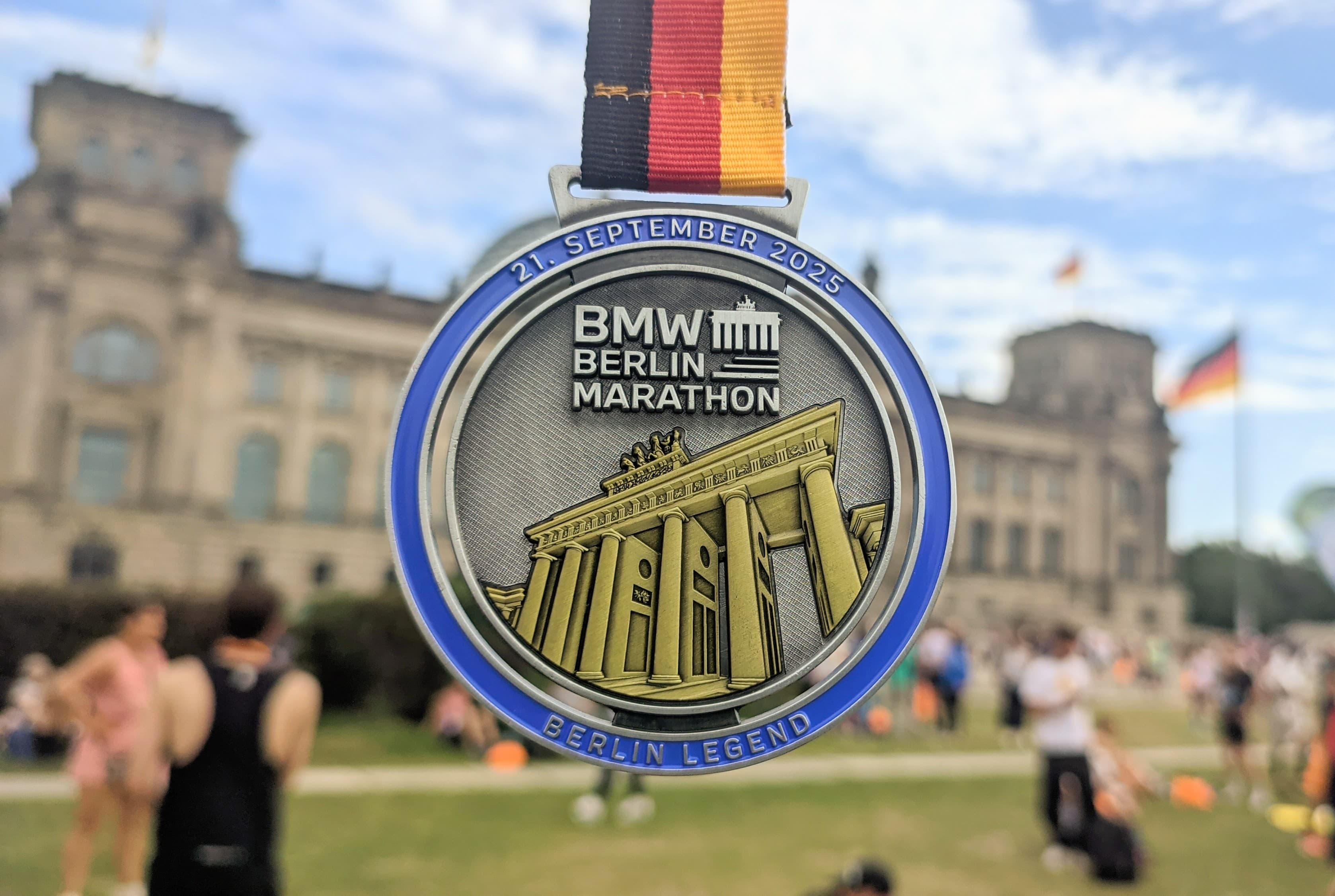
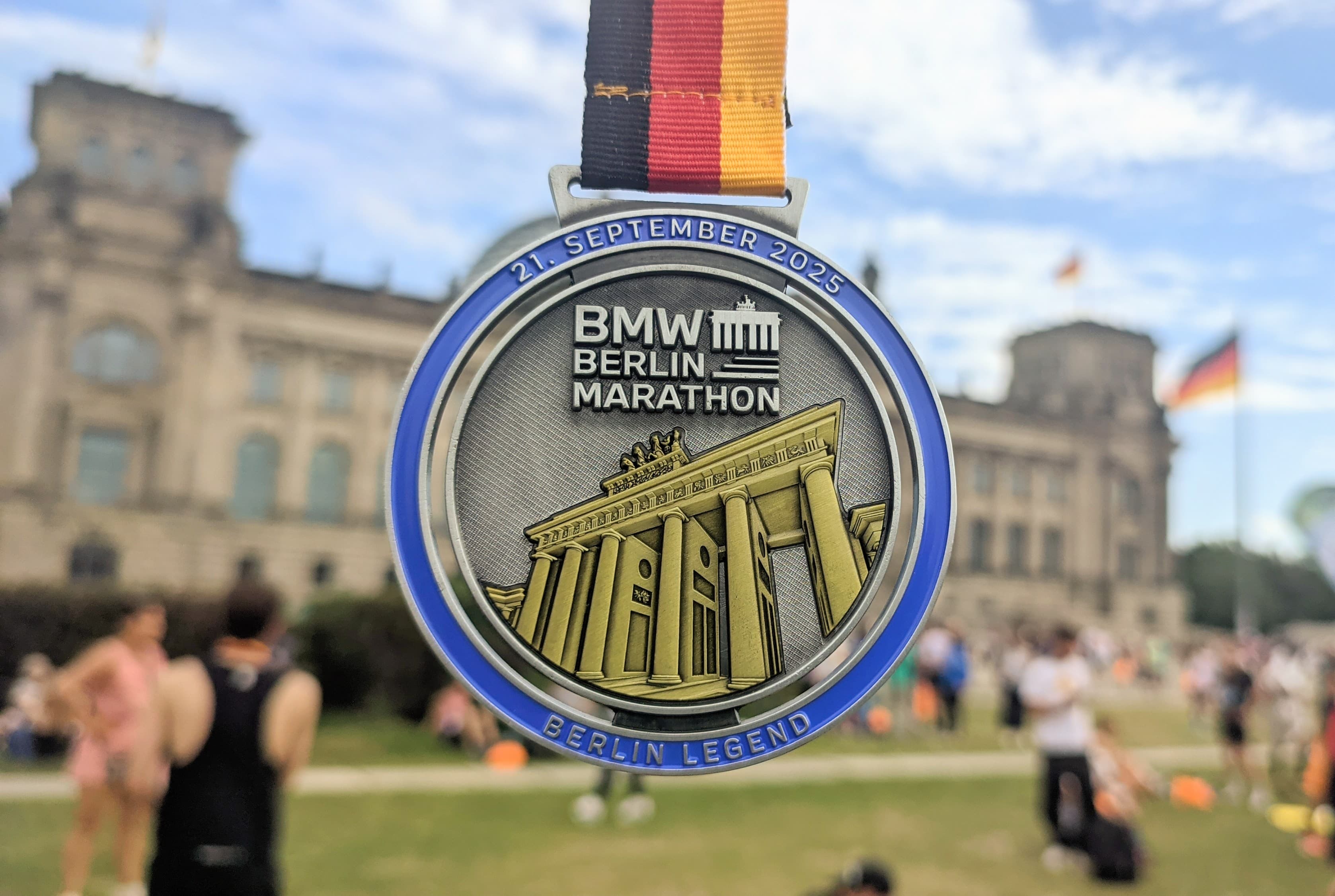
The 2025 finisher medal in front of the Reichstag.
Where to Stay
Stay near the finish, not the start. Both are on Straße des 17. Juni, so the choice largely resolves itself, but the area around the Brandenburg Gate and Mitte is where you want to be based. The more important principle is this: Berlin's public transport is so frequent and well-connected that location is far less critical than in Boston or Tokyo. Book where you want to stay, buy a hotel you will enjoy, and let the S-Bahn do its job.
Mitte (Brandenburg Gate to Friedrichstrasse)
The most convenient and the most expensive. Hotels here sit within ten to fifteen minutes' walk of the finish line, and runners who want to walk to the start on race morning can do so in around thirty-five minutes. Prices on marathon weekend run 80 to 150% above standard rates. Book immediately when ballot results arrive in late November. One noise caveat: Oranienburger Strasse is a significant late-night bar strip. If your hotel is within two streets of it, request a rear-facing room.
Potsdamer Platz
The pragmatic choice. The Ritz-Carlton and InterContinental both sit here, roughly ten minutes' walk from the start and finish. Both run marathon-specific packages in September - pasta dinners, early breakfast on race morning, discounted post-race spa treatments - and it is worth calling ahead to ask even if the packages are not listed on the website. The area is well-connected and quieter than Mitte after 10pm.
Charlottenburg
Where most repeat runners end up, and for good reason. Hotel options are wider, rooms tend to be larger, and the streets around Savignyplatz and Kurfürstendamm have enough Italian and Japanese restaurants for the carbohydrate loading ritual without booking weeks ahead. The U2 runs direct to the city centre in around twelve minutes. Prices are noticeably lower than Mitte for equivalent quality. If you are travelling with someone who is not running and wants good restaurants and a neighbourhood that feels like Berlin rather than a tourist corridor, this is the answer.
Prenzlauer Berg
Suits runners who want independent cafés, leafy squares, and the kind of streets where it feels appropriate to be seen carrying a foam roller. The S-Bahn connects to Hauptbahnhof in under fifteen minutes, from where the start village is a ten-minute walk. Kollwitzplatz has several pasta restaurants within a square kilometre. The area is quiet on Saturday nights. One warning: avoid anything close to the RAW area in Friedrichshain or Kottbusser Tor in Kreuzberg if you need to sleep before midnight.
Schöneberg (Potsdamer Strasse corridor)
Underrated and worth attention. The neighbourhood sits directly on the course twice: runners come through on the southbound leg around kilometres 25 to 27 via Martin-Luther-Strasse, and return north along Kleiststrasse and Potsdamer Strasse around kilometres 33 to 35. For spectators, that means two sightings without moving - at exactly the moments the race is hardest and a familiar face does most good. The Garner Hotel on Potsdamer Strasse 129 is a practical mid-range option: U-Bahn Bülowstrasse (U2/U4) is 400 metres from the door, putting the start village at around fifteen minutes on race morning. Goltzstrasse, five minutes' walk away, has enough independent restaurants for the Saturday carb dinner without requiring a reservation made months in advance. Sits at a price point noticeably below Mitte hotels with equivalent transport access.
Neukölln
Worth considering if you are happy with a longer S-Bahn journey and want to spend the surrounding days in one of the most interesting parts of the city. The food along Sonnenallee and Karl-Marx-Strasse is significantly better value than Mitte for the Saturday carb dinner, and the area around Rixdorf still runs on Berliner routine rather than anything built for visitors. The tradeoff is the journey: twenty to twenty-five minutes on the S-Bahn to Hauptbahnhof, and some streets close to Hermannplatz can be unpredictable for noise on weekend nights.
Recommended hotels
The finish runs past its front door. Opened in 1907 and rebuilt after the war; Marlene Dietrich and Michael Jackson both stayed here. Unbeatable for marathon weekend.
On the Gendarmenmarkt, a formal 18th-century square flanked by two identical cathedrals. Quiet rooms, strong spa, correct for post-race recovery.
Near the start in Charlottenburg. Large rooms by Berlin standards. Good for runners who want proximity to the start corrals.
Converted Dresdner Bank HQ on Bebelplatz. The vault is now a pool. Walking distance from the Brandenburg Gate, with a direct U6 connection to Tempelhof Airport for the expo.
Reliable budget option in Mitte. Well-priced by Berlin standards. Book immediately after ballot results - marathon weekend fills this category fastest.
See & Do
The finish at the Brandenburg Gate leaves you at the intersection of Unter den Linden and the Tiergarten. The historic centre of Berlin - Reichstag, Museum Island, the Gendarmenmarkt - is within a 1.5km radius. The Tiergarten park is directly behind the finish for slow recovery walking.
Museum Island
1.5km (0.9 miles) from the finish, across the Spree. Five museums on a UNESCO World Heritage island: the Pergamon holds the 2nd-century BC Pergamon Altar and the Ishtar Gate; the Neues Museum holds the bust of Nefertiti. Book timed entry for both; walk-up access on a post-marathon weekend is unreliable. Closed Mondays.
Gendarmenmarkt
0.6km (0.4 miles) from the finish - the course runs directly past it. Berlin's most formally symmetrical square: the identical French Cathedral and German Cathedral flanking the Konzerthaus, built between 1702 and 1821. The French Cathedral tower has the best elevated view of central Berlin without the queues of the Reichstag dome.
Tiergarten
Directly behind the finish. 210 hectares of forest and lakes in the centre of the city. The Siegessäule (Victory Column) is at the centre - this is where the race starts. The surrounding parkland is entirely flat. The post-race walk from the Brandenburg Gate through the Tiergarten to the Victory Column and back takes 45 to 60 minutes at recovery pace.
East Side Gallery
3.0km (1.9 miles) from the finish via S-Bahn or U-Bahn. 1.3km of original Berlin Wall in Friedrichshain, painted by 105 international artists in 1990 - the longest remaining section in the world. Completely flat; the murals take 20 to 30 minutes to walk end to end. The adjacent Oberbaum Bridge is one of the better river photographs in the city.
Read Before you Run
Stasiland
Anna Funder
Funder spent years tracking down people whose lives were shaped by the East German secret police - both the watched and the watchers. The Berlin Marathon passes through a city still visibly marked by that division, and Stasiland makes the architecture mean something.
Buy on Amazon ↗After the Race
The Berlin Marathon runs in late September. The city at the end of September has the summer crowds gone, the harvest markets starting, and direct rail connections to Potsdam and the Brandenburg countryside within 25 minutes. All excursions below depart from central Berlin stations and are planned for post-marathon leg tolerance.
Sanssouci Park, eight palaces on flat gravel paths, and the Dutch Quarter. Late September is the exact right time: harvests on the vineyard hill, summer crowds gone.
A fairytale palace on its own island in a lake. The lakeside circuit is 4.5 km of flat path with constantly changing views of copper-green domes reflected in the Burgsee.
A UNESCO Biosphere Reserve of 300 waterways threading through alder forest. You travel by traditional wooden punt boat. The ferryman does all the work.
Two nights in Potsdam's palace gardens, then north by Intercity to the Baltic coast. Finish at Warnemünde's seafront promenade and fly home from Rostock without returning to Berlin.
Frequently asked questions
Should I stay near the start or the finish?
Near the finish at the Brandenburg Gate. The Mitte and Tiergarten hotel areas are within walking distance of both the start near the Großer Stern and the finish on Straße des 17. Juni beyond the Brandenburg Gate.
How far in advance should I book a hotel?
Six to twelve months in advance for the best options. The Berlin Marathon falls in late September, one of the city's busiest weekends. Hotels in Mitte and near the Brandenburg Gate fill quickly once ballot results are announced.
Is there free transport to the start?
Yes. Every entered runner receives a 4-day VBB public transport ticket valid across zones ABC, included with race registration. Zone ABC covers the entire S-Bahn and U-Bahn network including BER Airport (zone C, S9 line). The ticket is valid until 3am on Monday morning - runners flying home on Sunday are fully covered.
What is the best area to stay?
Mitte, around Unter den Linden and the Brandenburg Gate, puts you closest to the finish. Tiergarten is equally convenient. Charlottenburg is near the start. Avoid areas east of Alexanderplatz.
When does the expo open?
The Marathon Expo is at Tempelhof Airport, Platz der Luftbrücke 5, in 2026, moved from Messe Berlin. It opened Thursday 24 September 15:00 to 20:00, Friday 25 September 10:00 to 20:00, and Saturday 26 September 09:00 to 19:00, with free entry; 2027 details are not yet announced. You must collect your number in person, with photo ID and your start card; there is no race-day collection. There is no on-site parking - take the U6 to Platz der Luftbrücke, a step-free station, then walk ten minutes, or the M43 or 248 bus. Allow 60 to 90 minutes.
What is the weather typically like?
Late September in Berlin: 12 to 18°C at race start, usually dry. Historically ideal conditions for fast times - the world record has been set here repeatedly. Occasional warm outliers occur; check the forecast in race week.
How do I get from the airport?
Berlin Brandenburg Airport (BER): FEX Airport Express to Berlin Hauptbahnhof (approximately 30 minutes). S-Bahn S9 takes 45 minutes. Both covered by the VBB ABC zone ticket included with race registration.
Is there a bag drop?
Bag drop is one option chosen at registration - the other is a poncho. The bag drop provides a clear plastic bag for gear collected at the finish. The poncho option gives no bag on race morning; a heavy fleece is handed to you after finishing. The choice cannot be changed at the expo.
Should I bring a throwaway layer?
Yes. Late September Berlin mornings can be 8 to 12°C and the start area on Straße des 17. Juni is exposed. Bring a disposable layer; the organisation donates discarded clothing to charity.
How do I get back to my hotel after finishing?
The Brandenburg Gate finish is central. Most Mitte and Tiergarten hotels are within walking distance. S-Bahn and U-Bahn connections are immediate. The post-race area on Straße des 17. Juni disperses quickly.