Over the past decade, runners have been breaking records at a pace the sport has never seen before. Eliud Kipchoge ran a sub-two-hour marathon. Amateur runners are posting personal bests by margins that used to require years of additional training. The footwear on their feet is a significant part of why.
Carbon-plated shoes with thick, highly resilient foam midsoles have changed marathon running in a measurable way. What is less often discussed is that the benefit is not uniform. These shoes work very well for some runners, are roughly neutral for others, and can actively cause problems for a third group.
The Short Cut
- Modern super shoes use energy-returning foam alongside a stiff carbon plate to improve running economy and delay late-race muscle fatigue.
- Runners who gain most are efficient, higher-speed runners who strike on the midfoot or forefoot. The shoe amplifies an existing mechanical efficiency.
- Slower runners, heavy heel-strikers, and those with unstable strides may see no measurable benefit, or find that the instability of a high stack causes additional fatigue and injury risk.
How the Technology Works
There are two components to a modern super shoe: the carbon plate and the foam.
The plate is often misunderstood. It does not act as a spring that actively propels the runner forward. Its function is as a stiffening lever. It keeps the toes straight through the foot strike, reducing the energy lost at the ball of the foot as the toe joints flex. That energy saving compounds over 26 miles.
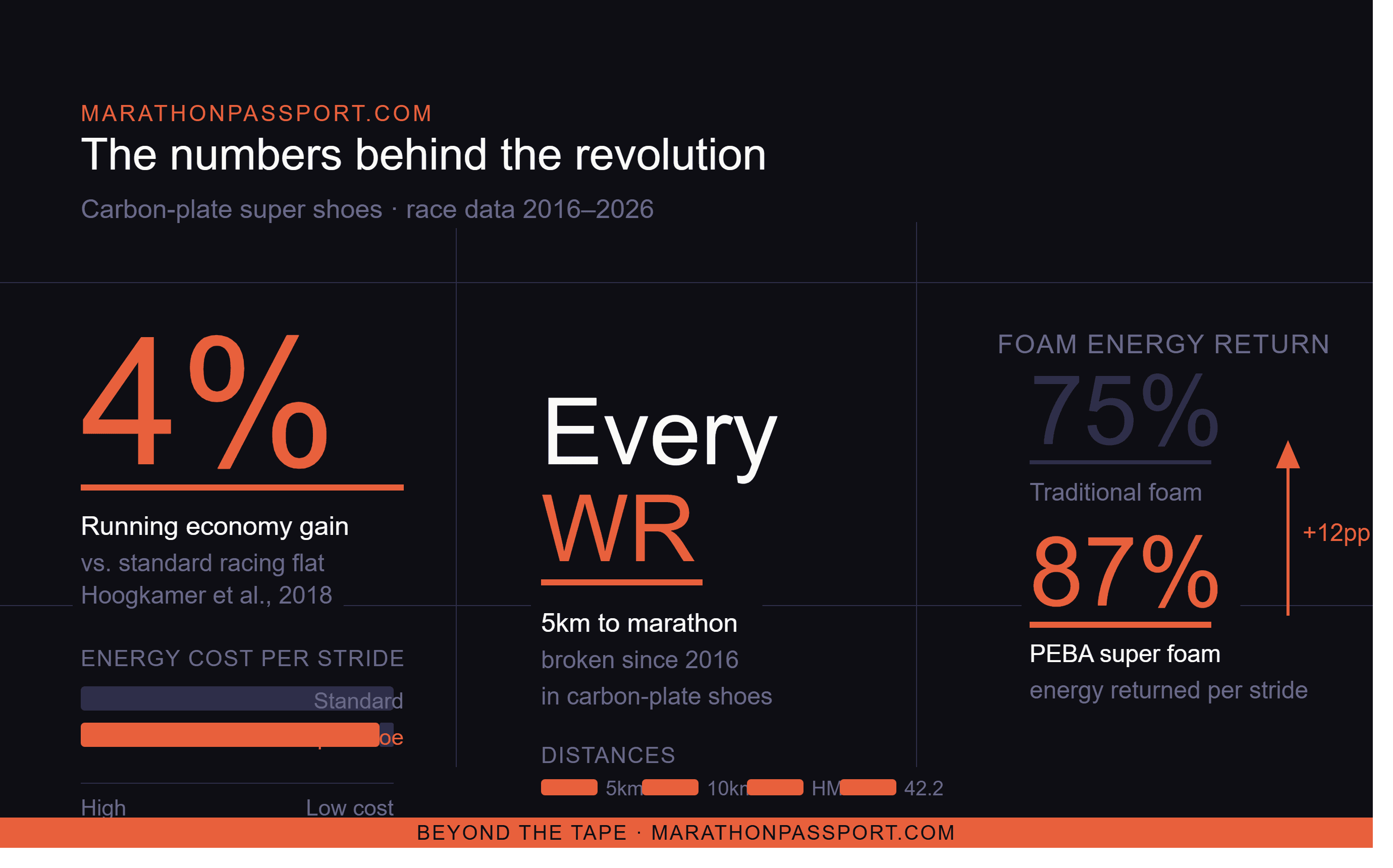
The foam does most of the work. Traditional running shoe foam absorbs impact and dissipates much of it as heat. Modern racing foams, of which Polyether Block Amide (PEBA) is the most common, compress under weight and return up to 85% of that energy back into the stride. Combined with a large stack height, this gives runners what feels like running on something that pushes back.
Who Gets the Most Out of Them
When carbon-plated shoes first appeared, researchers at the University of Colorado found an average improvement in running economy of around 4%. That average conceals a wide spread.
To compress a stiff carbon plate and a deep foam stack sufficiently to store and return energy, a runner needs to apply real force. High-speed runners, midfoot and forefoot strikers, and those with a high, efficient cadence get the most back. The shoe amplifies what is already there. Runners who are slower, or whose mechanics do not generate enough force to compress the plate effectively, do not get the same return.
Where They Can Cause Problems
At slower paces. A study by Joubert and Jones (2022) found that at paces equivalent to a four to four-and-a-half hour marathon, the metabolic benefit of the carbon plate drops significantly. Slower runners do not strike the ground with enough force to engage the plate as intended. Instead of a spring, it becomes a rigid layer that prevents the natural flexing of the foot, which tends to produce early calf fatigue and arch discomfort.
For heavy heel-strikers. When a heel-striker lands in a high-stack shoe, the foot travels a longer path from heel to toe before leaving the ground. Because the carbon plate does not bend through that transition, it can shift mechanical load away from the foot and calf and distribute it into the knee, hip, and lower back. For some runners this is inconsequential; for others it accelerates injury.
For anyone with poor stability. PEBA foam is soft and compliant. Combined with a high stack, this creates an unstable platform. Runners who overpronate, or who have weak ankle and hip stabilisers, may find the instability works against them, with the lower leg and Achilles tendon working harder just to keep the body balanced.
Matching Shoe to Runner
| Runner profile | Suitable shoe | Effect |
|---|---|---|
| High speed, forefoot or midfoot striker, strong stability | Deep stack, rigid carbon plate | Maximises energy return, improves running economy, delays late-race fatigue |
| Moderate speed, midfoot striker, neutral stride | Mid-stack with flexible nylon or partial plate | Balance of cushioning and propulsion without overloading the calves |
| Slower pace, heavy heel-striker, overpronator | Standard stack, traditional supportive foam | Protects joints from lateral instability, allows natural foot flexion, reduces injury risk |
The shoe can only return the energy your legs put into it. Technology assists; it does not replace the training that generates the force in the first place.
Related reading: This article covers who benefits from the technology. Super Shoes Are Rewriting the Marathon Record Book covers the broader performance data and what the records show. For how altitude and hilly terrain affect the carbon plate advantage, Super Shoes at Altitude covers the research in full. The courses where the technology is most likely to deliver for all runner profiles are flat and fast: the Berlin Marathon and Valencia Marathon race pages include course profile data and elevation charts.
The Extra Mile
- Hoogkamer, W., Kipp, S., et al. (2017). A comparison of the energetic cost of running in three prototype running shoes. Sports Medicine, 47(11), 2303–2312.
- Joubert, D. P., & Jones, G. P. (2022). A comparison of running economy across seven carbon-plated racing shoes. International Journal of Sports Physiology and Performance, 17(9), 1394–1401.
- Whiting, C. S., Hoogkamer, W., & Kram, R. (2022). Metabolic cost of running in shoes with carbon fibre plates of different stiffness. Journal of Sport and Health Science, 11(3), 301–308.
- Muniz-Pardos, B., et al. (2021). Recent footwear technological advancements in marathon running: implications for competitive balances. Sports Medicine, 51(3), 371–378.
The information in this article is for educational purposes only and does not constitute medical advice. Always consult a qualified healthcare professional before changing your training protocols.