The Race
| Next Race Date | Sunday 19 September 2027 (provisional; the organiser has not yet published the 2027 date) |
|---|---|
| Course Type | Loop: start on Hermann-Veit-Straße, finish on the track inside Carl-Kaufmann-Stadion, 200 m apart in the same complex |
| Registration | Open entry, no ballot and no qualifying time. Start block assigned by predicted finish |
| Ballot Opens | No ballot |
| Total Finishers | Not confirmed for a recent edition. More than 30,000 have finished the marathon since 1983 |
| Average Race Day Temperature | About 16°C, with a typical high near 21°C. Heat and sun are a real factor on the unshaded southern loop |
| Cutoff Time | The finish closes at 15:20. Roads reopen on a rolling basis behind an approximate 8:30 min/km limit |
| Free Race Day Transport | No. Marathon and half-marathon bibs are not valid as KVV tickets |
| Course Certification | DLV measured and approved, eligible for German ranking lists. A World Athletics label is claimed by the organiser but is not shown on the race’s calendar entry |
History
Karlsruhe has staged a city marathon since 18 September 1983, which the organiser, Marathon Karlsruhe e.V., describes as Germany’s third-oldest after Berlin and Frankfurt. A 25th-anniversary publication noted that the race began a year before the women’s marathon became an Olympic event, and that more than 30,000 runners had covered the full distance here in its first quarter-century. The results database now holds every edition since 1983, more than 60,000 participant records. Only the pandemic broke the sequence: 2020 did not take place and 2021 ran as a scaled-back special event, with normal participation resuming from 2022.
The event grew from a single road race into a weekend programme with a half marathon, team formats, children’s races and inclusion runs, but the marathon has stayed the anchor and the Baden-Marathon identity has outlasted every sponsor name attached to it. The club now organises the race from premises next to the start and finish complex on Hermann-Veit-Straße.
One feature has outlasted the sponsors too. The Marathonengel system lets a runner expecting to finish slower than 3:45 register up to three companions to join them for the closing stretch. It started more than a decade ago as an informal gesture and has since been written into the event’s own rules with a fixed per-companion fee, an exception to the no-outside-pacing norm most marathons apply.
The course has been redrawn more than once. The current route shares its first 20.5 km with the half marathon through the centre, Durlach and the palace grounds, before marathon runners peel away into a quieter southern loop through Bulach, Weiherfeld, Rüppurr and the Oberwald, then rejoin the earlier corridor for a second pass through the centre and a finish on the stadium track.
The course
The race starts on Hermann-Veit-Straße in Beiertheim, beside Europahalle and Carl-Kaufmann-Stadion, and finishes on the stadium track 200 metres away. It is flat, DLV measured and approved, and closed to traffic for its full length within the published time limits. A blue line marks the shortest legal route for the whole distance, which is the reliable way to run 42.195 km and not a longer GPS figure, and it matters most through the two central passes where the road narrows at the Marktplatz.
The organiser’s course carries its own kilometre markers, and they line up: the finish sits 9 metres from the stadium, the Marktplatz pyramid comes at km 14.8 and again at km 35.9, and Karlsruhe Palace at km 15.7 and again at km 36.7. From about km 37 the course repeats the km 16 to 20 stretch exactly, which is the clearest way to think about the closing kilometres: you have already run them.
No elevation-gain figure is published, and the organiser describes the course simply as flat and fast. The chart agrees: the whole course sits between 110 m and 127 m, with no climb anywhere longer than a few hundred metres.
Km 0 to 4: Beiertheim onto Kriegsstraße. Three waves go off a few minutes apart from 09:00, A1 and A2 first. The opening kilometres run out of the sports complex onto Kriegsstraße, one of the city’s main east-west arteries, passing Schloss Gottesaue at about km 4. Aid is thin here, water only at km 4, so this is a stretch for finding rhythm.
Km 4 to 10: out to Durlach. The course runs east to its furthest point from the start, turning in the Durlach area around km 9 to 10. Durlach is one of Karlsruhe’s oldest districts and the only part of the route that feels like a separate town.
Km 10 to 16: back through the centre, the loud part. West through Citypark into central Karlsruhe, reaching the Marktplatz and its sandstone pyramid, the grave of the city’s founder, at km 14.8, then Karlsruhe Palace at km 15.7. The half marathon shares every metre of this, so it is the most crowded and best-supported section of the whole race, and the easiest place to spend more than you meant to.
Km 16 to 20.5: south, past the finish, to the split. The route turns back south toward Beiertheim and passes within a few hundred metres of the stadium at about km 19.8, which is a peculiar thing to do at half distance. Just after that comes the split. Marathon runners who no longer want the full distance can simply follow the half-marathon signage instead and be reclassified as a half finisher automatically, with no paperwork on the day.
Km 20.5 to 33: the southern loop. This is where the race changes character entirely. Marathon runners head south alone into Bulach and Weiherfeld, reach Rüppurr at about km 28, and run the Oberwald, a wooded section and the quietest ground of the course, to around km 31. The highest point of the whole course is here, and it is all of 127 m, about 10 m above the start. The crowd energy that carried the first half is gone, aid stations become the structure of the race, and this is where it tends to be decided. It is also the most exposed part of the route on a warm September morning.
Km 33 to 42.195: back to the crowds, and the track. Shortly before km 33 the route rejoins the first-half corridor. Citypark reappears, the Marktplatz comes round again at km 35.9 and the palace at km 36.7, the second passage being a useful marker that the finish is close. The final kilometres retrace km 16 to 20 exactly, back through Beiertheim to a finish on the track inside Carl-Kaufmann-Stadion. Timing is net, from the mat, which matters with staggered waves.
Course Map
East to Durlach, back through the centre, a quiet southern loop through the Oberwald that only marathon runners see, then a second pass through the centre to the stadium. Tap a marker for details, and scrub the slider or press play to move the orange marker along the course with the elevation profile beneath it.
Flat streets onto Kriegsstraße, past Schloss Gottesaue at about km 4, east to the turn around Durlach. Water only at km 4, so this is a stretch for rhythm.
Back through Citypark to the Marktplatz at km 14.8 and the palace at km 15.7, all shared with the half marathon. Best support of the day, and the easiest place to overspend.
Bulach, Weiherfeld, Rüppurr at km 28 and the Oberwald to about km 31. Marathon runners only, little crowd, long unshaded stretches. Where the race is decided.
Marktplatz again at km 35.9, the palace at km 36.7, then a retread of km 16 to 20 back through Beiertheim to a finish on the stadium track. Course closes 15:20.
Runners expecting to finish slower than 3:45 can register up to three companions, marathon angels, to join them for roughly the last four kilometres. There is a fixed fee per companion and it has to be arranged in advance, not improvised on the day. Most marathons treat an outsider joining the course as grounds for disqualification; here it is written into the rules, and it has been part of the race for more than a decade.
Pacers
Eight pace groups, all run by the Karlsruhe club memler.de, each carrying a large yellow balloon that is visible from a long way back in the field. Your pacer’s block is fixed by the same predicted-finish system that assigns your own, so check the pairing below before choosing a block: a 3:45 target sits in B, not A2.
| Target | Start block |
|---|---|
| 3:00 | A2 |
| 3:15 | A2 |
| 3:30 | A2 |
| 3:45 | B |
| 4:00 | B |
| 4:15 | C |
| 4:30 | C |
| 5:00 | C |
What to wear
September in Karlsruhe averages around 16°C with a typical high near 21°C and a low near 11°C, so the swing between a 09:00 start and an early-afternoon finish is the thing to dress for. Humidity runs around 76%, and the southern loop through Bulach, Weiherfeld and the Oberwald has long stretches with no shade at all. A cool start here does not rule out a warm finish.
Dress for the warmer half of the range, not the start-line temperature. Sunscreen and a cap are worth carrying even under an overcast morning, given how much of the second half runs uncovered. Monthly rainfall averages only around 44 mm, so persistent rain is possible but not the likelier scenario; check the actual forecast before travelling.
A throwaway layer for the wait is still worth having, and here you have somewhere to put a real one instead: bag drop at Europahalle opens at 06:30 with a separate valuables desk, and showers and changing facilities are in the same building afterwards. That makes a proper warm layer to the start and a dry change for the walk out both easy to arrange.
Entry
Open entry: no ballot, no qualifying time. What registration does ask for is a predicted finish, which fixes your start block. A1 is the elite field, A2 covers a predicted 3:30 or faster, B covers up to 4:00, and C takes everything slower, with power walkers at the back of C. Getting that prediction roughly right matters more here than at a race with chip-allocated corrals.
The live entry fee is not reliably visible on the registration page. A cost-comparison source puts it at roughly €67, with resale listings for transferred places clustering around €70, but neither figure is an official price and both should be checked on the live registration form before you budget around them. A bib-delivery charge of €3.50 applies on top, and students and school pupils up to 30 get around €10 off with proof of status. There is no Good for Age route and no qualifying-time pathway of any kind.
The transfer terms are unusually generous. Entries move to another person free of charge right up to race day through a personal change link, with the caveat that the name printed on a posted bib cannot change once it has gone to print, only the underlying registration. A runner who cannot start for medical reasons can submit a certificate within two weeks of the event and, after a €10 processing fee, get the entry fee back as a voucher toward the following year. It is a voucher, not a refund and not transferable, and extras booked alongside the entry do not carry over.
There is no UK-style guaranteed-entry charity programme. Two side programmes, Laufen mit Herz and an inclusion run, sit alongside the main event; neither is an alternative way in.
Fast Runner / GFA Standards
Not applicable. No Good for Age or time-qualification route exists for this race; predicted finish time affects only which block you start in.
Race Weekend
Expo
There is no expo, and that changes how to plan the weekend. Runners with a German address have their bib posted by the end of August; there is no Saturday pickup to attend at all.
Runners with an international or otherwise undeliverable address collect at a service point inside Europahalle, open 06:30 to 09:00 on race morning itself. Bring the participation confirmation, on a phone or printed. A proxy collecting for someone else needs that plus a photo of the runner’s identification.
The practical upshot is that flying in on the Saturday works here in a way it does not at a marathon built around a mandatory Friday-to-Saturday expo hall. The constraint moves to Sunday morning instead: you have to be at that desk before 09:00, which in practice means staying close enough to Beiertheim to make a 06:30 to 09:00 window comfortable. If you are also handing in personal nutrition for the course, that deadline is earlier still, 07:45 at the Europahalle information desk.
Getting to the Start
Everything on race morning happens inside one compact part of Beiertheim. Europahalle, the start on Hermann-Veit-Straße, Lina-Radke-Halle and Carl-Kaufmann-Stadion all sit in the same sports complex, which removes most of the pre-race transport stress that larger city marathons create.
Transport is the one thing to plan and pay for properly: neither the marathon nor the half-marathon bib works as a KVV ticket for this race, which differs from the arrangement on some of the shorter events the same weekend. The Europahalle/Europabad stop is served by local rail and tram, but the KVV network carries construction diversions that vary from year to year, so check the current pattern. The organiser runs its own interactive route and arrival planner, which is a better source than memory.
Bag storage opens at Europahalle from 06:30. Bags need the tear-off tag from your bib attached before drop-off, valuables go to a separate desk, and both are collectible until 16:00. If you need to collect an international bib as well, it is the same building in the same window, so arrive at the earlier end of it.
The race goes in three waves a few minutes apart: A1 and A2 at 09:00, then B, then C. Toilets are on Hermann-Veit-Straße itself, inside Europahalle and at the stadium, with more at the aid stations on course.
After finishing, runners have Runners Heaven, a runners-only recovery area with food and drink, plus showers and changing back at Europahalle. A free massage service has run in the Europahalle warm-up hall from mid-morning into the afternoon for runners who have already showered, though the hours are worth checking against the current programme.
Nutrition on Course
Aid gets progressively more complete as the race goes on, so it is worth learning the shape of it beforehand. The single most important line in the table below: bananas do not appear until km 24.5. Anyone relying on solid fuel earlier than that has to carry it.
| Km | Available |
|---|---|
| 4.0 | Water |
| 9.0 | Water, isotonic, personal nutrition |
| 12.5 | Water |
| 15.0 | Water, isotonic, apple spritzer |
| 17.0 | Water, personal nutrition |
| 19.5 | Water, isotonic, apple spritzer |
| 21.5 | Water, personal nutrition |
| 24.5 | Water, isotonic, apple spritzer, banana |
| 28.0 | Water, personal nutrition |
| 30.5 | Water, isotonic, apple spritzer, banana |
| 33.5 | Water, personal nutrition |
| 36.0 | Water, isotonic, apple spritzer, banana |
| 38.0 | Water, personal nutrition |
| 40.5 | Water, isotonic |
Personal nutrition is only available at the alternating stations marked above, and only for runners who deposited labelled bottles or food at the Europahalle information desk by 07:45 on race morning. Each item has to be labelled with the kilometre it is meant for, and there is no way to add a personal station on the day. No glass is permitted anywhere in the aid or finish system.
At the finish, Runners Heaven offers alcohol-free Hoepfner beer, flavoured and still Karlsruhe water, Paulaner Spezi, bars, bananas, regional apples, Maultaschen, bakery products and bread with pesto. It is runners-only, so supporters wait outside it.
Spectating
The course does the work for you here. Because it passes the same central landmarks twice, outbound around km 14.8 to 15.7 and inbound around km 35.9 to 36.7, one position in the centre produces two sightings roughly two hours apart with no travel in between. Not every city marathon course allows that.
Plan A: the central double. Take up a position between the Marktplatz and Karlsruhe Palace and stay there for both passes, then make the short trip out to Carl-Kaufmann-Stadion for the finish. Lowest travel of the three, and it works without a car.
Plan B: start, palace, finish. Watch the waves go off on Hermann-Veit-Straße, take the KVV into the centre once the field has cleared, catch the runner at the palace around km 15.7, then head back to Beiertheim for the stadium finish. This trades one central sighting for seeing your runner actually start.
Plan C: the southern loop. Skip the crowded early kilometres and go to the Rüppurr and Oberwald stretch around km 28 to 32. By then the half-marathon field has long finished and this is marathon-only ground, the quietest part of the course and the part where a familiar face counts for most. Come back to the centre or the stadium afterwards, checking KVV diversions on the way.
Whichever plan, check the organiser’s interactive route tool before settling on a corner: it reflects the current year’s closures. Expect additional closures and crowding around the centre later in the day beyond the marathon route itself, since other events share the date.
Post-Race Food
Runners Heaven covers the first hour, but for a proper meal the two areas worth heading for are Südstadt and the centre around the Marktplatz and Kaiserstraße, both a short tram or taxi from the Europahalle showers.
Karlsruhe sits on the edge of Baden and Swabian cooking, which makes the regional order the easy one: Maultaschen, the large stuffed pasta parcels, Spätzle, or Flammkuchen, the thin cream-and-onion flatbread. All three are widely available in the centre and Südstadt without hunting for anywhere unusual. A sequence that works: collect the bag and shower at Europahalle, tram into the centre, and book for 17:00 or 18:00, which is realistic given most finishers are through by early afternoon.
Where to Stay
Start and finish sit 200 metres apart in the same Beiertheim complex, so this is decided by the finish and the start at once: a base near Carl-Kaufmann-Stadion and Europahalle solves race morning, bag drop, the international bib desk and the post-race shower in one choice. Whether it is where you want to spend a Saturday evening is the real question.
Beiertheim and Europahalle
Beiertheim is the logistics answer by a clear margin: walking distance to the start, the finish, bag drop and, for international entrants, race-morning bib collection. It is not where anyone would choose to spend an evening in Karlsruhe, so it suits a performance-focused trip.
Südweststadt
Südweststadt sits between Europahalle and the centre and is the strongest all-round choice. Much of it is walkable to the race complex while still putting the Marktplatz and the ZKM within easy reach, and it is quieter than Karlsruhe’s nightlife districts. If you want one recommendation for a runner, this is it.
Hauptbahnhof and Bahnhofplatz
The station area suits rail arrivals, with the race complex about two kilometres away by tram and a broader hotel choice than the smaller districts nearer the start. Practical, not picturesque, which is the usual trade for stepping off a platform close to your room. It is also the best base for the onward trips in After the Race.
Innenstadt-West and Europaplatz
Innenstadt-West is central, with shops, restaurants and the palace nearby and a short tram out to the race. Saturday-night street noise varies by exact address, so it is worth reading the room description as well as the district name. Good for a first visit that wants city life without a genuinely remote race morning.
Marktplatz and Innenstadt-Ost
The Marktplatz area is the best base for sightseeing and for spectating, since the marathon runs through it twice. The trade is that race morning needs transport out to Beiertheim and race-day closures can disrupt the usual tram and bus routes through the centre. Better for companions than for the runner.
Durlach
Durlach is historic and the race genuinely runs through it, but it sits east of the centre while the start and finish are south-west, which makes it the least convenient choice for race morning. Worth it only if the accommodation itself is the reason for going there.
Recommended hotels
The best compromise on this list: close enough to walk to bag drop and the start, close enough to the Marktplatz to eat properly the night before.
Central for sightseeing and food, and the marathon runs past this part of town twice. Race morning is a tram ride.
A predictable full-service base in the centre, which matters when breakfast has to happen at a fixed hour before a 09:00 start.
For rail arrivals, and well placed for the onward trips in After the Race. Practical, not scenic.
The budget version of the same rail-convenience argument. Fine for a weekend built around the race.
Booking timeline
This race does not need year-ahead planning. There is no ballot to create a sudden entry spike, and Karlsruhe has enough hotel stock that a refundable room three to six months out should give good choice, particularly in Südweststadt or near Europahalle.
The one thing worth checking independently is the Messe Karlsruhe trade-fair calendar. A September date can land on unrelated trade-fair demand that has nothing to do with the marathon and still fills hotels and lifts prices, so look at that schedule alongside the race date before assuming normal availability. For international travellers, Karlsruhe/Baden-Baden Airport has a thin route network; Frankfurt and Stuttgart are the more useful gateways, both with direct rail in. And because there is no mandatory expo, a Saturday arrival works, provided you can reach the Europahalle desk before 09:00 on Sunday if you need a bib there.
See & Do
Distances below are approximate straight-line distances from the Carl-Kaufmann-Stadion finish, not measured walking routes. Note the season: this race falls in mid-to-late September, when warm days are still common here, so treat it as late summer.
Karlsruhe Palace and the Badisches Landesmuseum
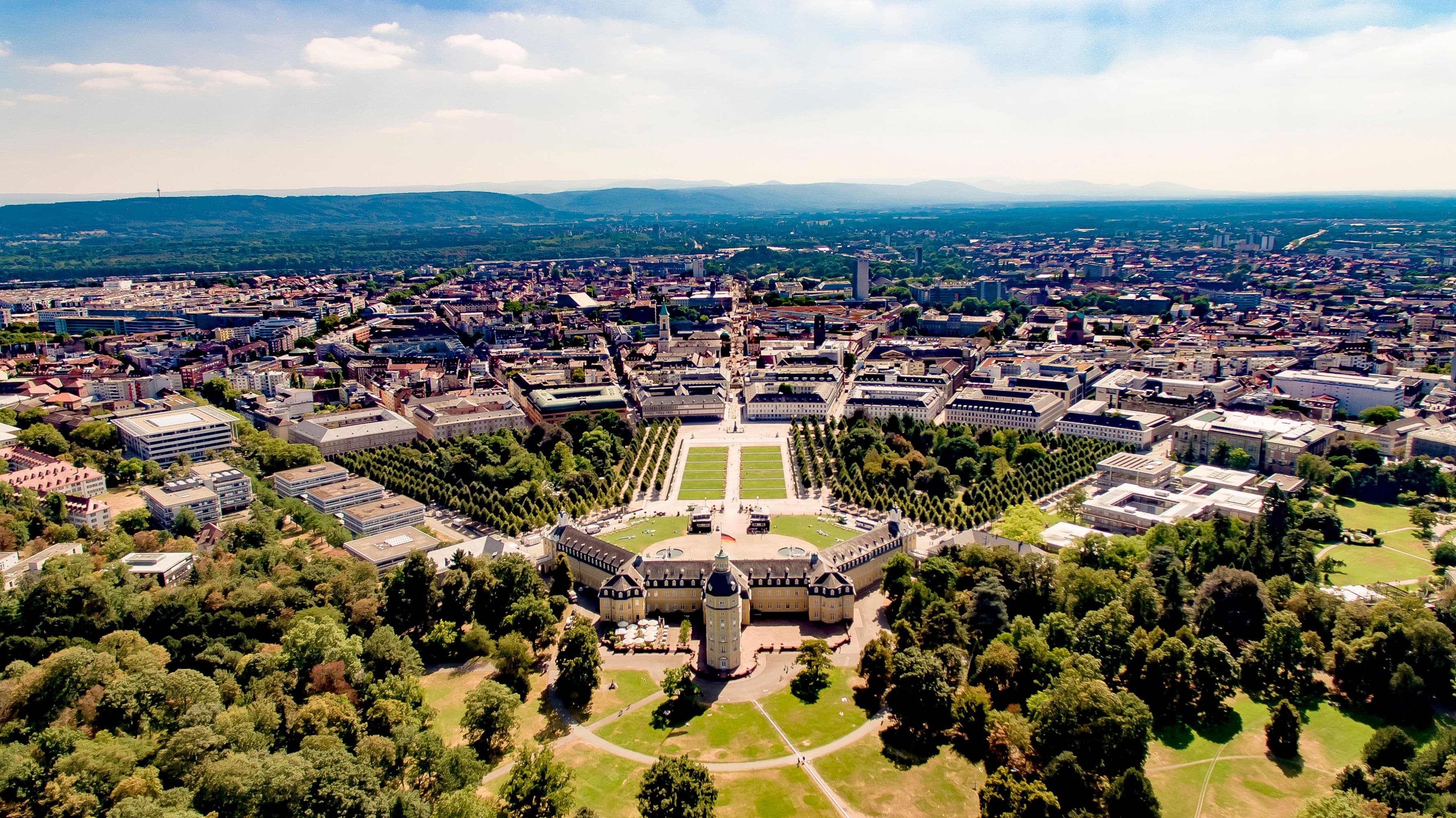
About 2.5 km (1.6 miles) from the finish, and the reason the city looks the way it does: the streets radiate from it in a fan, which is visible from the palace tower and from the air. You will have run past it twice, at km 15.7 and km 36.7, before you get to look at it properly. The Landesmuseum is inside. Check opening hours directly before going.
Schlossgarten
About 2.5 km (1.6 miles) from the finish, free, and directly behind the palace. English-landscape layout, flat easy paths, and the right ambition for the day after a marathon when a museum is too much and a hotel room is too little.
ZKM Center for Art and Media
About 2 km (1.2 miles) from the finish, closer to the south-west side of the city than the palace is, which makes it the easier trip on tired legs. It is one of the more ambitious media-art institutions in Germany and works equally well as a wet-weather option or a pre-race afternoon.
Durlach and the Turmberg
About 7 km (4.3 miles) east of the finish. Durlach’s old town is low-effort and you will already have run through it around km 9 to 10. The Turmberg climb above it is the opposite: real ascent, better taken before the race or once the legs have properly recovered than on the Monday.
After the Race
Karlsruhe’s real argument as a race base is what sits within an hour of it by rail: the Rhine, the Black Forest, Alsace and two of Germany’s better-known towns, none needing a car. September still holds enough daylight and warmth to use properly, which is not true of the October races further north. The excursions below are ordered by how much walking they ask of legs that have just covered a flat 42 km with a lonely southern loop in the middle.
A short hop into one of Germany’s classic spa towns, built around the Lichtentaler Allee promenade and the thermal baths. The one excursion here that actively helps a marathon recovery.
The castle and the Altstadt are the draw. The castle approach is a climb, so it works better on the second day than the first.
Flat, walkable and genuinely different in feel from Karlsruhe, reached without flying anywhere. Two nights is enough for the cathedral, the Petite France quarter and a slow morning.
Forest trails and river-valley towns still inside hiking season in September. Pick the valley routes over the ridges if the race went long.
Museum-led sightseeing that keeps walking distances short, which is the right shape for the two days after a marathon.
Frequently asked questions
When is the race held?
Annually in September, starting on Hermann-Veit-Straße in Beiertheim and finishing on the track inside Carl-Kaufmann-Stadion. The date moves year to year, so check the current one.
Is the course certified?
DLV measured and approved, and eligible for German ranking lists. The organiser also claims a World Athletics label, but the race’s own World Athletics calendar entry does not display one. Treat that as unconfirmed.
Where does the race start and finish?
Both are in the same Beiertheim complex, 200 m apart: the start on Hermann-Veit-Straße, the finish on the stadium track. Three waves from 09:00, by predicted finish time.
Is there free transport to the start on race day?
No. Marathon and half bibs are not KVV tickets, unlike some shorter events the same weekend. Budget for travel both ways, and check current KVV diversions.
Is there a race expo?
Not really. German addresses get the bib posted by late August. International entrants collect at Europahalle, 06:30 to 09:00 on race morning, with the participation confirmation.
What is the cutoff time?
The finish closes at 15:20, with roads reopening on a rolling basis behind an approximate 8:30 min/km limit. Fall behind it and you are moved onto the pavement.
What is the Marathonengel system?
Registered companions, up to three, who join you for roughly the last four kilometres. Open to anyone expecting to finish slower than 3:45, for a fixed per-companion fee.
Can I drop down to the half marathon during the race?
Yes. At the km 20.5 split, follow the half-marathon markings instead and the organiser reclassifies you as a half finisher automatically. No paperwork on the day.
What is the weather typically like on race day?
About 16°C on average, high near 21°C, humidity around 76%. The unshaded southern loop means heat deserves as much planning as rain at a 09:00 start.
Can I transfer or defer my entry?
Transfers to another person are free up to race day via a change link, though a printed bib name cannot change. Medical withdrawal gets a voucher for next year after a processing fee, not a refund.