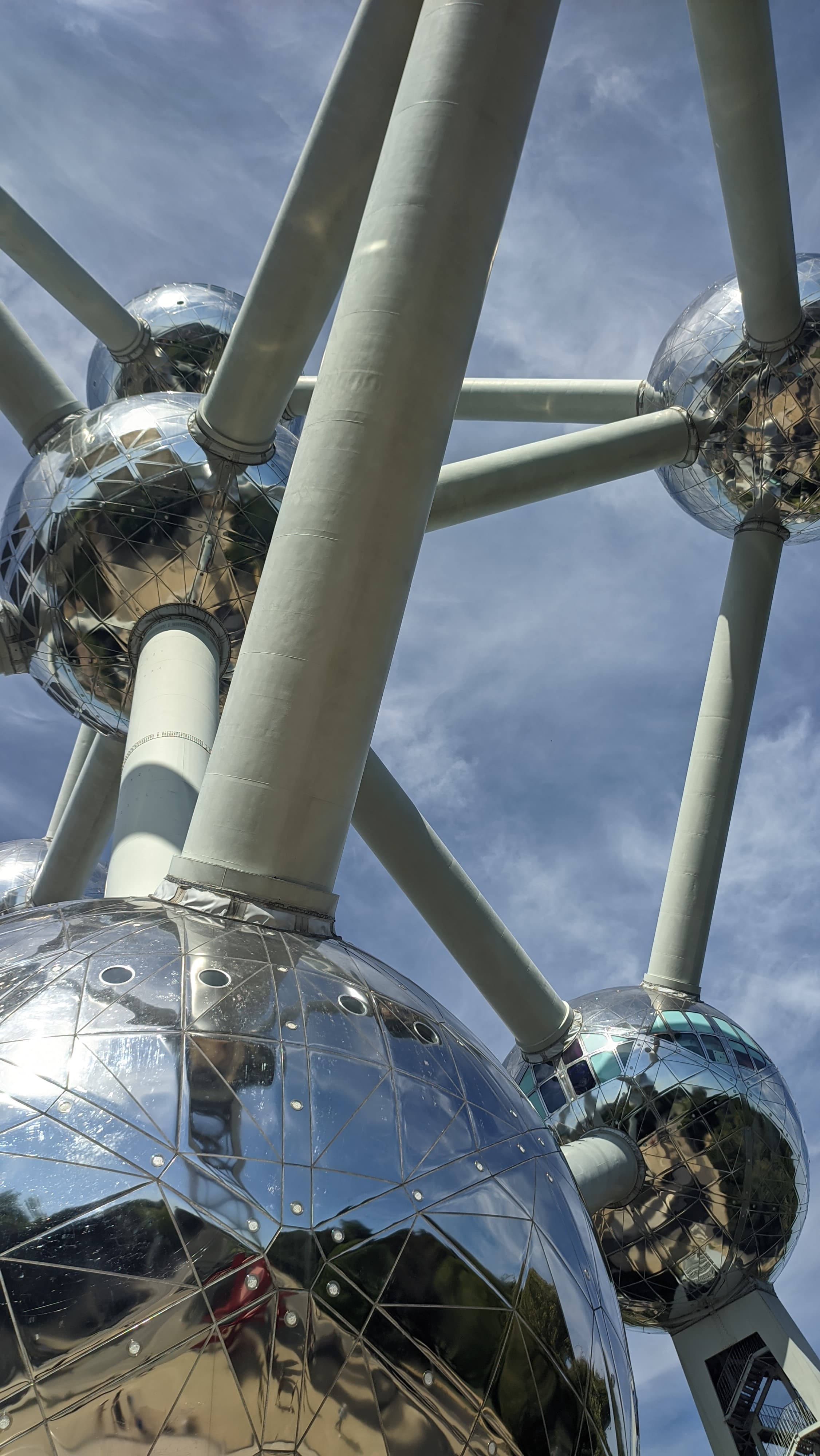
The departure board at London St Pancras said 09:01 to Brussels Midi. By the time I had had lunch I had ascended the Atomium and headed back to the city centre. I still had time for a leisurely afternoon walking around the old town, checking what the Manneken Pis was or wasn't wearing, and sitting in a bar near the Grand Place drinking a Leffe. At 06:10 the following morning, I stepped off the train in Berlin with functioning legs, a properly stocked bloodstream, and the sort of calm that airport travel has never, in my experience, produced.
The European night train is having a moment. After decades of slow retreat, ÖBB, European Sleeper, SJ, and a handful of ambitious new operators have been adding routes faster than the rail industry usually manages anything. For marathon runners who already know how punishing a 4am alarm and a Heathrow security queue can be two days before a race, this is worth paying attention to.
The Short Cut
- Sleeper trains eliminate most of the physical stresses of pre-race travel: cabin pressure, forced immobility, dehydration from recycled air, the 4am alarm.
- European networks now link London to Edinburgh, Brussels, Amsterdam, Berlin, Prague, Vienna, Paris, and Hamburg with overnight connections, covering the majority of the continent's high-profile marathons.
- No baggage scales on a platform. Your race shoes, your foam roller, your litre of electrolyte mix, and your seven-day travel wardrobe travel with you.
- Booking via an alternative hub city, rather than flying direct to the race city, can sidestep the marathon premium on flights and hotels during race weekend.
- The continent's four main operating networks are: ÖBB Nightjet, European Sleeper, SJ (Scandinavia), and the Caledonian Sleeper and GWR Night Riviera in the UK.
- Announced routes to Barcelona and Venice will extend the network further within the next two to three years.
What actually happens to your body on a plane
Most runners already know that flying is not ideal pre-race preparation. The reasons are worth being specific about, because vague awareness tends not to change behaviour.
Aircraft cabins are pressurised to roughly 75% of sea level, equivalent to an altitude of around 2,400 metres. At that pressure, blood oxygen saturation drops measurably, fluid shifts between body compartments, and the humidity inside the cabin typically falls below 20%, less than the average desert. You arrive at your destination in a mild state of altitude-induced dehydration that, if you are unlucky with timing, you have 36 hours to reverse before race day.
Then there is what flying does to your legs specifically. Sitting in an economy seat for two or three hours puts your hamstrings and hip flexors in a shortened, loaded position with no option to interrupt it. For a runner who has spent months building up around careful recovery protocols, this is a minor but real insult to the system at exactly the wrong moment.
A sleeper berth is not a luxury spa. But you can stand up, walk the carriage, use a massage ball against your lower back, and eat what you actually planned to eat rather than whatever the tray table delivers at 30,000 feet.
The network, explained
The map below shows the current operating network across Europe. Four operators carry most of the traffic.
ÖBB Nightjet
The dominant operator on the continent, covering two distinct arcs. The northern network connects Amsterdam and Brussels to Vienna via Cologne and Zurich, with Hamburg feeding in from the north. For a runner targeting the Vienna City Marathon in April or BMW Berlin in September, this is your primary booking engine. The Italian network is separate: Munich and Vienna both send nightly Nightjets through the Alps to Rome (via Bologna and Florence) and Venice, making the Rome Marathon in March genuinely accessible without a flight from either city.
European Sleeper
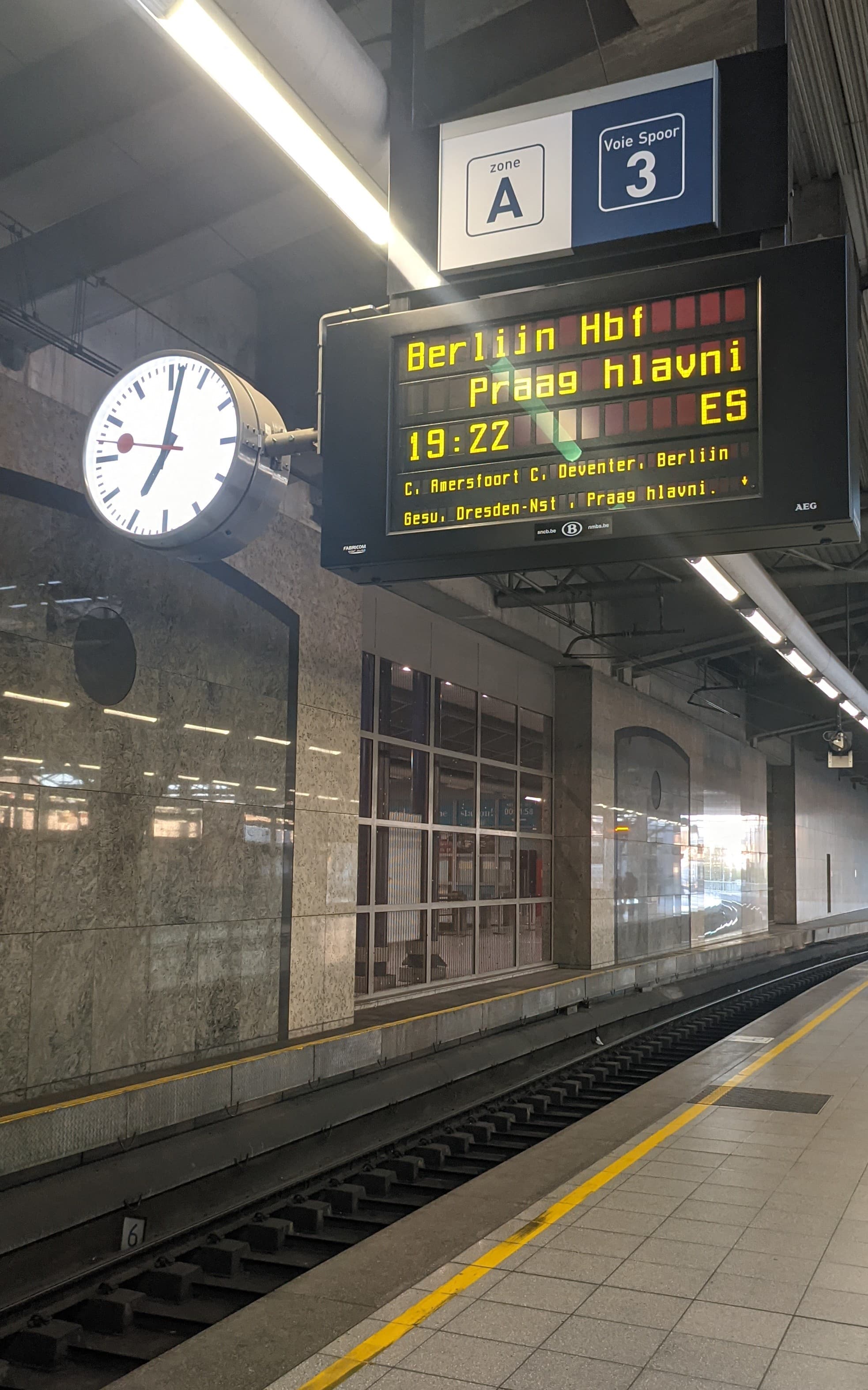
The newer operator now running three corridors. The Brussels-to-Prague service travels north through Rotterdam and Amsterdam, then Amersfoort, before crossing into Germany and stopping at Berlin and Dresden on the way to Praha Hlavní Nádraží: the Prague Marathon within a single overnight from Antwerp or Rotterdam, the Dresden Marathon reachable from Brussels without a connection. The Paris-to-Berlin service, launched in March 2026 and running three times weekly, departs Paris Nord in the late afternoon, calls at Mons, Brussels, and Liège, and arrives at Berlin Hauptbahnhof at ten in the morning; from 13 July it extends to Hamburg Harburg. Brussels-to-Milan via Liège, Cologne, and Zürich, with stops through the Gotthard corridor, opens in September 2026, reaching Milano Porta Garibaldi directly.
SJ
SJ runs Scandinavia's network, including the extraordinary Night Train 94 that tracks north from Stockholm through Kiruna to Narvik. From there, a bus connection to Tromsø puts the Midnight Sun Marathon in reach of anyone willing to watch dawn never fully arrive.
Caledonian Sleeper and GWR Night Riviera
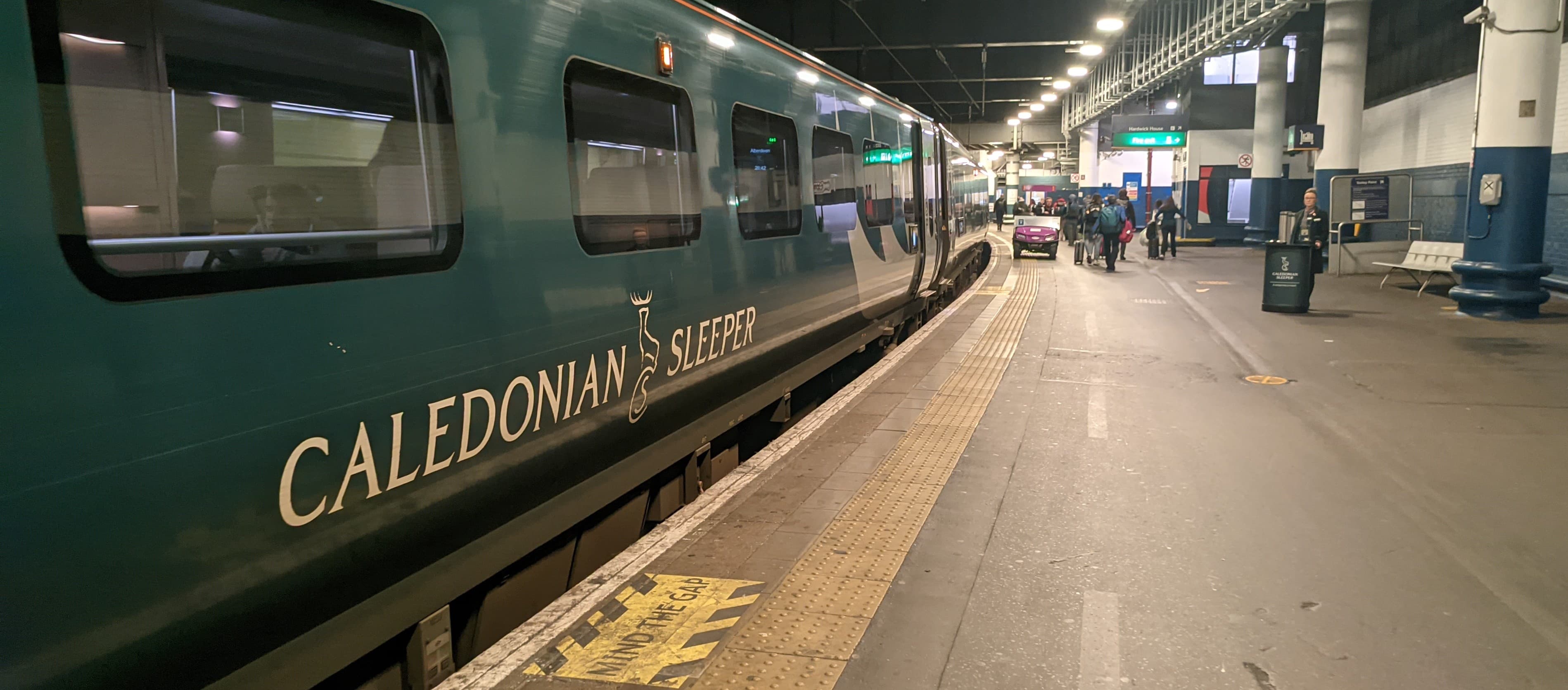
The Caledonian Sleeper runs five distinct services from London Euston: the Lowland routes to Edinburgh and Glasgow Central, and the Highland routes to Inverness, Aberdeen, and Fort William. The Lowland service to Edinburgh arrives at Waverley in time for a slow breakfast before the Edinburgh Marathon Festival's Saturday events. The Highland service to Inverness is the practical gateway to the Loch Ness Marathonin October, arriving with time to spare before the point-to-point route through the Great Glen. The GWR Night Riviera, running from London Paddington to Penzance, serves an entirely different purpose: delivering runners to the Eden Project Marathon and Cornwall's hill-heavy terrain via a train that somehow still uses 1970s Mk3 coaching stock and is better for it.

The appeal was straightforward. Friday evening from Euston, Saturday morning in Inverness, Sunday marathon, Sunday evening train back, Monday at the desk. Three nights, no annual leave. The Loch Ness Marathon was my first sleeper race weekend, and the plan mostly held.
The Caledonian Sleeper gets into Inverness early enough for parkrun (9:30 start in Scotland), which required a light jog to reach Torvean Park in time, but was well placed for a detour to the expo on the way back into town. The marathon itself finished with enough time to eat properly, sit down, and not feel rushed before the evening train south.
There was one thing nobody had mentioned: waking somewhere in the Cairngorms as the light came up. The plateau was pink and completely still, and the train was the only moving thing in it. Worth setting an alarm for.
One thing I got wrong: the bed. As a solo traveller, a private cabin costs considerably more than a seat, and I decided to save the money. The seats on the Caledonian Sleeper are not made for sleeping. This is not a controversial observation. Book the cabin. You're about to run 26.2 miles through the Great Glen, and the upgrade pays for itself before you reach Fort Augustus.
The Brussels layover question
The journey from London to Berlin via Eurostar and the Nightjet takes around 14 hours door to door if you run it as a through-trip. The better option, if your race schedule allows, is what I did: take a morning train, spend the afternoon in Brussels, and board the 19:22 overnight service from Midi to Prague via Berlin Hbf.
Brussels is a surprisingly comfortable city to spend half a day in. The Grand Place is ten minutes from the station on foot. The Marolles flea market is in the other direction. By 7pm you have eaten well, walked the legs loose, and found that the beer is better than the city's reputation for administrative dullness would suggest. Board at Midi, choose your berth class based on budget and how much you value not sharing your personal space with a stranger who also has a foam roller, and step onto the platform at Berlin Hbf at 06:10 with enough time for a shakeout run and a proper breakfast before the city wakes up. The train continues to Prague. You do not.
That version of the journey compresses nothing. You arrive with two full days before race day, having slept rather than sat upright, having eaten from a bag rather than a foil wrapper, and having already done a small amount of continental exploration that costs nothing extra except a Duvel.
The luggage argument, which is better than it sounds
The standard counter-argument to train travel is time. Flights to Berlin from London take two hours. This is true, and if time is the only variable, the argument is over. But "time" for most runners flying to a marathon includes: getting to the airport two hours early, navigating security, waiting at the gate, boarding, the flight itself, deplaning, baggage reclaim if you checked a bag, ground transport from the airport to the city, and then the quiet realisation that you are dehydrated and your left hip flexor feels unusually tight.
Sleeper trains eliminate the bag-checking question entirely. There are no scales on the platform. A runner carrying a foam roller, race shoes in a rigid case, a full week of clothing, and a litre of powdered electrolyte supplement boards without drama and stows everything in the berth. Liquids, including gels and hydration mixes, travel unchallenged. This matters more than it might seem: the runner who arrives with their full intended pre-race nutrition intact is not making improvised decisions in the expo hall.
Avoiding the marathon premium
Race weekends in Berlin, Vienna, Stockholm, and Prague move hotel prices in ways that airline pricing mirrors almost exactly. Runners booking flights to Berlin Tegel or BER for marathon weekend encounter exactly the market conditions you would expect when 47,000 people are trying to do the same thing on the same weekend.
The sleeper route offers a partial workaround. Flying into Brussels, Amsterdam, or Zurich on Thursday and boarding the overnight on Thursday evening means your accommodation spend falls in a city where the marathon premium does not apply. You arrive in Berlin on Friday morning ahead of expo opening hours, before the bulk of race-weekend flight arrivals. This will not suit everyone. But for runners with flexible work schedules and a tolerance for strategic overthinking of their own race logistics, it is worth modelling.
What's coming
The Zurich-to-Barcelona corridor, planned as an ÖBB Nightjet service in partnership with SBB, will connect Switzerland directly to Catalonia overnight. When it runs, it will make the Barcelona Marathon in March accessible from Central Europe without a flight. The Midnight Trains operator, a French boutique night-train project, has announced a Paris-to-Venice service that would transform the Venice Marathon in October from a logistically awkward destination into a romantically logical one. Neither has a confirmed operational date that has survived unchanged through to publication; check ÖBB and Midnight Trains directly for current status.
One thing you will not find on the train
Stress is the wrong word, but something adjacent to it defines the airport pre-race experience: the background hum of things that could go wrong and the sustained low-level vigilance required to stop them going wrong. The bag might not make it. The flight might be delayed. The transfer might be tight. The hotel check-in might not take you early enough to eat before expo.
None of that exists on a train. You board. The countryside unreels. Somewhere past Amsterdam the heating in the carriage becomes excessive and you peel off a layer and stare at the lights of small Dutch and German towns sliding past in the dark. You fall asleep to a motion that is nothing like turbulence.
At Berlin Hbf, the platform is cool and clean and the S-Bahn is three minutes away. Your legs are fine.
The Extra Mile
- The Man in Seat 61: the definitive independent guide to train travel in Europe and worldwide. Country-by-country routing advice, ticket-buying instructions, and sleeper train specifics that go well beyond what any operator's own site will tell you. If you are planning a rail journey and have a question, this is the first place to look.
- ÖBB Nightjet booking: official booking for Central European routes including Berlin, Vienna, Amsterdam, Zurich, and onward connections.
- European Sleeper: Brussels to Prague via Berlin; check here for the Milan expansion status.
- SJ Night Train (Sweden): Stockholm to Hamburg and the Arctic Circle route to Narvik.
- Caledonian Sleeper: London Euston to Edinburgh, Glasgow, Inverness, Aberdeen, and Fort William.
- GWR Night Riviera: London Paddington to Penzance.
- Midnight Trains (Paris to Venice, announced): check for confirmed operational dates.
- Interrail / Eurail Pass: if your marathon calendar runs to three or more cities in a season, a global pass can reduce the per-journey cost of sleeper supplements considerably.
Timetables, fares, and route status on all operators listed above are subject to change. Verify directly with each operator before booking.