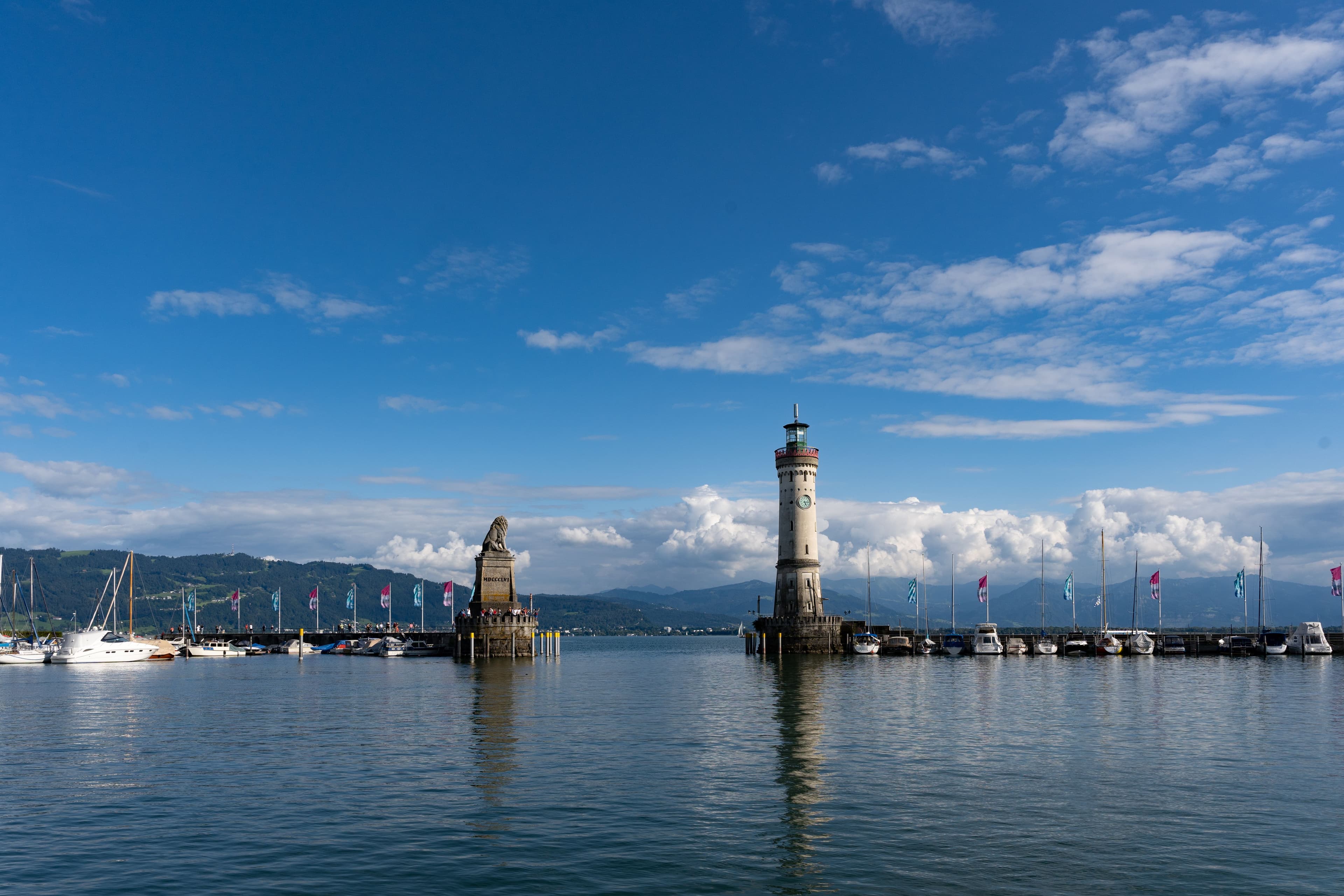
The Race
| Next Race Date | Sunday 11 October 2026, 9:45am start |
|---|---|
| Course type | Point-to-point: start on Lindau island, Germany; finish at the ImmoAgentur Stadium, Bregenz, Austria; roughly 25km apart around Lake Constance |
| Registration | Online only via sparkasse-3-laender-marathon.at, tiered pricing, first-come, closes 25 September 2026 at midnight. On-site late registration 9-11 October. |
| Ballot Opens | Not applicable: no ballot system |
| Total finishers | Marathon-specific totals not isolated from whole-weekend figures (marathon, relay, half marathon, quarter-marathon, Nordic walking, children’s races); whole-weekend participation reported at 5,000+ in some sources |
| Avg race-day temp | Mid-October on Lake Constance typically runs 8-14°C at race time, with wind off the lake and rain a realistic possibility |
| Cutoff time | 6 hours net time; finish closes 4:30pm; a broom car travels at 7km/h behind the field |
| Free race-day transport | Yes: free train and bus travel within the Vorarlberg network for bib-holders, coupon-based free travel for spectators, and a free ferry between Bregenz and Lindau on race morning |
| Course certification | AIMS-measured, measurement log deposited with the Austrian Athletics Federation (ÖLV) and AIMS; run under international competition rules |
| Sleeper Train | Not accessible |
Three Countries, One Race
The race starts in Germany, spends most of its distance in Austria, and crosses into Switzerland at St. Margrethen without so much as a passport check, met, by the organiser’s own account, with cowbells and a proper crowd. Then it finishes back in Austria. Total elevation difference across the whole course: 17 metres, among the smallest of any marathon anywhere. The 2022 course record, 2:09:25, would hold up well outside the six Majors. Three countries and a fast, flat course: that is the pitch, and it needs no dressing up.
History
The Sparkasse 3-Länder-Marathon’s identity is built entirely around its route rather than a long institutional history: it is not one of Europe’s older marathons, but it has built a reputation as one of the fastest courses outside the major city marathons, helped by its near-total flatness, just 17 metres of elevation difference across the full distance, and its route along Lake Constance. The current course record of 2:09:25, set by Kenya’s Benard Kipkorir in 2022, stands as evidence that the course rewards serious pace as well as tourist-friendly scenery.
The race’s tagline, “Borders only exist in your head,” captures its central selling point directly: runners start in Germany, run largely through Austria, cross briefly into Switzerland at St. Margrethen without any passport control, and finish back in Austria. This is a three-country marathon in the literal sense, not a marketing stretch, and the crossing at St. Margrethen, met, by the organiser’s own description, with the sound of cowbells and enthusiastic local crowds, is one of the most distinctive single moments on the European marathon calendar.
The course
The marathon starts on Lindau island in Germany and finishes at the ImmoAgentur Stadium in Bregenz, Austria, a point-to-point course of 42.195 kilometres. Roughly 60% of the route runs alongside Lake Constance itself, mostly on asphalted roads and paths. The course passes the floating stage of the Bregenzer Festspiele in Bregenz, crosses into Switzerland at St. Margrethen, follows the Rhine for approximately 3 kilometres back toward the lake, and passes the historic Mehrerau monastery before the final stretch into the stadium finish. Total elevation difference across the whole route is 17 metres, between a lowest point of 398m and a highest point of 415m above sea level, flat by any marathon standard.
Km 0-8: Lindau to the Austrian shore.The opening kilometres run through Lindau’s historic island town and along the German shore of Lake Constance, giving the race an immediately scenic start before the field settles into its rhythm. The course then moves into Austria.
Km 8-20: The Austrian lakeshore. The route passes the floating stage used for the Bregenzer Festspiele, an architectural landmark that draws 160,000 visitors each summer, and continues along the Austrian lakeshore past a series of marinas.
Km 20-23: The Swiss crossing.The standout moment on the course comes at St. Margrethen, where runners cross the EU external border into Switzerland without any passport check, greeted, per the organiser’s own account, by cowbells and enthusiastic local support carrying runners through the village centre.
Km 23-26: The Rhine return. This Swiss section is short: the route follows the Rhine back toward the lake for roughly 3 kilometres before recrossing into Austria. It is the psychological centrepiece of the race and worth treating as a highlight to anticipate rather than a place to lose focus on nutrition and pacing.
Km 26-42.195: Mehrerau to the finish.Back in Austria, the route passes the Mehrerau monastery, described by the organiser as a moment of quiet and mental recharge before the final push, ahead of the finish inside Bregenz’s ImmoAgentur Stadium. With only 17 metres of total elevation difference across the entire distance, the physical challenge here comes down to pace and wind management along the exposed lakeside sections, not terrain.
Follow the blue tangent line throughout; on a lakeside course with sweeping curves rather than tight corners, holding the tangent still makes a measurable difference over 42.195 km.
Historic island town, immediate lakeside character on the German shore, before the course moves into Austria.
Passing the Bregenzer Festspiele floating stage and a series of Austrian lakeside marinas.
Border crossing into Switzerland at St. Margrethen, no passport check, strong local crowd support, then a short Rhine-side stretch back into Austria.
Passing Mehrerau monastery before the finish inside the ImmoAgentur Stadium, Bregenz.
Pacers
Official pacers are confirmed for both the marathon and half marathon, marked on course with flags showing the appropriate goal time. Specific target times are confirmed closer to each event via the final runner guide.
What to wear
Mid-October mornings on Lake Constance tend to be cool, and the largely lakeside course means wind exposure is a bigger factor than temperature alone. A throwaway layer for the start area on Lindau island is sensible, particularly given the early 9:45am start and the ferry or transport journey many runners will have already made that morning.
Entry
Entry is online-only via sparkasse-3-laender-marathon.at, with registration closing at midnight on 25 September 2026. On-site late registration is available from 9-11 October during the running fair’s opening hours, and on race morning itself from 7:00-9:00am at the Festspielhaus in Bregenz. There is no ballot; entry is first-come within tiered pricing bands. Confirmed 2026 marathon entry fee tiers: €82 through 31 December 2025, €85 through 31 March 2026, €90 through 30 June 2026, €98 through 31 August 2026, €105 through 25 September 2026, and €110 for late/on-site registration. Minimum age for the marathon is 18.
Registration fee reimbursement is not offered under any circumstances, including for medical reasons, though a free transfer of a starting place to another participant is permitted up to the registration deadline via email to the organiser, and on-site transfers are possible for a €7 handling fee. Changing from marathon to a shorter distance is possible up to the deadline, with the fee difference charged.
Fast Runner / GFA Standards
Not applicable. No Good for Age or fast-entry route was found; entry is standard tiered-fee registration. Elite and prize-money categories exist separately and are not a general-entry pathway.
Race Weekend
Expo
The running expo, described by the organiser as a “sport-active-fair,” runs across three days, 9-11 October 2026, at the Festspielhaus (festival hall) in Bregenz, spread across 1,300 square metres of exhibitor space. Confirmed bib pickup hours: Friday 9 October, 1pm-6pm; Saturday 10 October, 9am-6pm; and Sunday 11 October (race day itself), 7:00am-9:00am. Bib numbers must be collected in person with a valid registration confirmation. The Festspielhaus also hosts the pre-race pasta party (Friday and Saturday), a free medical advice session on Saturday 10 October (10am-12pm) with two specialist orthopaedic and trauma doctors, and a health symposium with a full lecture programme for runners.
Race Morning
Because start and finish are in different countries, the organiser explicitly recommends basing race morning in Bregenz rather than Lindau. A free ferry service (Vorarlberg Lines) runs continuously from 8:00am from Bregenz harbour to Lindau island, taking around 20 minutes; a valid bib number counts as the ticket, with departures at 8:15am, 8:20am, 8:50am, 9:10am, and 9:35am, though the two latest departures are not suitable for marathon, relay, or quarter-marathon participants given the 9:45am start. Companions and spectators can buy return ferry tickets for €9. Free train and bus travel across the Vorarlberg public transport network is also available on race day for bib-holders and, with a coupon, for spectators.
Clothing bag drop-off is at Reichsplatz in Lindau, immediately after the start area, between 8:30am and 10:30am, with bags transported to the finish and available for collection between 11:45am and 4:00pm; bags must carry the sticker provided at bib pickup and cannot be loose bags or boxes. The finish closes at 4:30pm with a 6-hour net-time cutoff. Post-finish showers are available via mobile shower trucks at the finish and, for women, at Bregenz’s public swimming pool (Hallenbad).
Logistics Map
The map below shows the point-to-point route from Lindau island through Austria, across the Swiss border at St. Margrethen, and back to the finish at the ImmoAgentur Stadium in Bregenz, plus the Festspielhaus expo venue. Tap any marker for details.
Nutrition on Course
Refreshment points fall every 5km plus start and finish, with additional water-only points every 5km from km 12.5. Water and electrolyte sports drink are available at the main stations, with fruit also provided. Private supply stations are available on request at km 10, 17, 21.8, 25.5, 29.5, 34.3 and 40.3 for runners who arrange their own containers in advance. Toilets are located at km 5, km 10, and every 2.5km after each board stand.
Spectating
Spectating this race means choosing between two countries and a lake, which makes planning different from a single-city marathon. The organiser’s free public transport for bib-holders and coupon-based free travel for spectators makes multi-point spectating realistic without needing a car. Basing yourself in Bregenz gives access to the finish inside the ImmoAgentur Stadium and a walk to the harbour area near the Bregenzer Festspiele floating stage to catch runners passing earlier in the course. For a distinctive vantage point, the Swiss border crossing at St. Margrethen draws strong local crowds, reachable via the free public transport network, though the road closes to general traffic from late morning to early afternoon on race day. The ImmoAgentur Stadium finish in Bregenz remains the simplest single-location option, with the board town, results postings, and clothing bag collection all concentrated in the same finish area.
Post-Race Food
Wirtshaus am See in Bregenz, Gasthaus Kornmesser and Pier69 Bregenz are finish-side options for a post-race meal; check that each is open on the Sunday before relying on it.
Where to Stay
Bregenz centre is the organiser’s own recommended base, given the finish, expo, pasta party, and most race-weekend logistics are all concentrated here. Excellent finish convenience; getting to the Lindau start requires the free ferry or train. Moderate noise and limited room availability on race weekend.
Lindau island
The best base for start-morning proximity, with the ability to walk to the start rather than travel. The trade-off is a required journey back to Bregenz after finishing, since the finish is in a different country. Accommodation here tends to be pricier and more limited.
Lochau
A quieter Austrian lakeshore town between the two race endpoints, requiring transport connections to both start and finish, suited to runners who want lakeside calm over the simplest possible logistics.
St. Margrethen / Swiss side
An unusual choice: staying on the Swiss side of the border the race itself crosses. Requires transport for both start and finish, and functional rather than charming as a base, but appeals to anyone who wants to build a Switzerland stay around the race.
Dornbirn
Offers better hotel value and availability than the lakeside towns, with train connections to both race areas, at the cost of a non-lakeside setting.
Recommended hotels
A central Bregenz base close to both the expo at the Festspielhaus and the finish, with a free ferry or train needed to reach the Lindau start. Limited room count on race weekend.
Close to the lake and Bregenz train station, priced at the upper end locally, with straightforward transport to the Lindau start.
A classic island-town hotel on the Lindau harbour, giving runners a short walk to the start line, though the finish is in a different country, so a ferry or train back is needed after the race.
Straightforward value near Bregenz station, with a free train connection to the Lindau start.
Better value and availability than the lakeside towns, at the cost of a non-lakeside setting and a train connection needed at both ends of the race.
Booking timeline
Book refundable accommodation as soon as marathon entry is confirmed. The cross-border, two-city nature of this race means hotel stock is split across several towns, with lakeside supply running short in both Lindau and Bregenz, so this is a race where early booking matters more than for a typical single-city marathon.
See & Do
The finish sits in Bregenz, with Lindau’s start-area old town a short ferry or train ride away.
Bregenz lakefront
The finish-area town itself, offering a low-effort recovery walk along the lake with views toward the Bregenzer Festspiele floating stage.
Lindau island harbour
The start-area old town, worth a pre-race stroll rather than extended standing given the morning ahead; a compact, walkable historic core.
Pfänder cable car
Rising above Bregenz, the cable car offers wide views over Lake Constance and the surrounding Alps with minimal walking required, since the cable car itself does the climbing. Check the current timetable before planning around it.
St. Gallen
A short train ride into Switzerland, offering a full cultural day trip built around its UNESCO-listed abbey library, distinct from the brief on-course Swiss crossing. Check current train times before travelling.
Read Before you Run
Bodensee (Lake Constance regional guide)
Various regional publishers
A Lake Constance / Bodensee regional guide suits this race better than a single-city guidebook, given the route’s identity is built around the lake and its surrounding three countries rather than any one town.
After the Race
The Sparkasse 3-Länder-Marathon runs in October. These itineraries range from a same-day trip around Bregenz’s own lakefront to a three-night extension to the Alps.
A low-effort day combining a lakeside walk with the Pfänder cable car for wide Alpine views, manageable on tired legs since the cable car removes the need for any serious climbing.
Returning to the start town for a calmer overnight stay, offering a chance to properly explore the historic island town without race-morning time pressure.
A Swiss cultural extension by train from Bregenz, centred on the town’s UNESCO-listed abbey library, offering a fuller taste of Switzerland than the brief on-course crossing at St. Margrethen.
An Alpine city change of pace, reachable by a single direct train, trading Lake Constance’s flat shoreline for Alpine peaks inside Innsbruck’s city limits.
Frequently asked questions
Should I stay near the start or the finish?
The organiser recommends basing yourself in Bregenz, near the finish, since it hosts the expo, pasta party, and most race-weekend logistics, with a free ferry to reach the Lindau start.
How far in advance should I book a hotel?
Well ahead of the race. Accommodation is split across two countries and several towns, and lakeside stock in both Lindau and Bregenz runs short.
Is public transport free on race day?
Yes, free for participants with a bib number across the Vorarlberg public transport network, and free for spectators using a coupon; a free ferry also connects Bregenz and Lindau on race morning.
What is the best area to stay?
Bregenz centre, for the simplest overall logistics given the finish and expo are both there.
When does the expo open, and what do I need to bring?
9-11 October 2026 at the Festspielhaus in Bregenz; bring your registration confirmation to collect your bib in person.
What is the weather typically like on race day?
Mid-October on Lake Constance tends to be cool, with wind off the lake and rain a real possibility.
How do I get from the airport to the city centre?
Zurich, Munich, or Friedrichshafen airports are the main options depending on flight availability, with onward rail connections to the Bregenz/Lindau area.
Is there a bag drop at the race?
Yes, clothing bags are dropped at Reichsplatz in Lindau near the start and transported to the finish in Bregenz for collection between 11:45am and 4:00pm.
Should I bring a throwaway layer to the start?
Yes, lake mornings can be cool and windy, and the 9:45am start follows an early ferry or transport journey for most runners.
How do I get back to my hotel after finishing?
The finish is in Bregenz; free public transport with your bib number covers onward travel, including back toward Lindau if that’s where you’re staying.