The Race
| Next Race Date | 11 October 2026 |
|---|---|
| Course type | Point-to-point (start and finish approximately 0.8km apart) |
| Certification | UKA-affiliated entry discount confirmed; specific AIMS/World Athletics label not confirmed |
| Start | Chester Racecourse (the Roodee), New Crane Street |
| Finish | Castle Drive, near the River Dee |
| Total finishers | ~5,000 |
| Avg race-day temp | 8 to 14°C (October) |
| Cutoff time | 6 hours |
| Free race-day transport | Not confirmed; racecourse parking is paid and weather-dependent |
| Course certification | UKA/RunBritain measurement assumed, certificate not sighted |
| Sleeper Train | Not accessible |
History
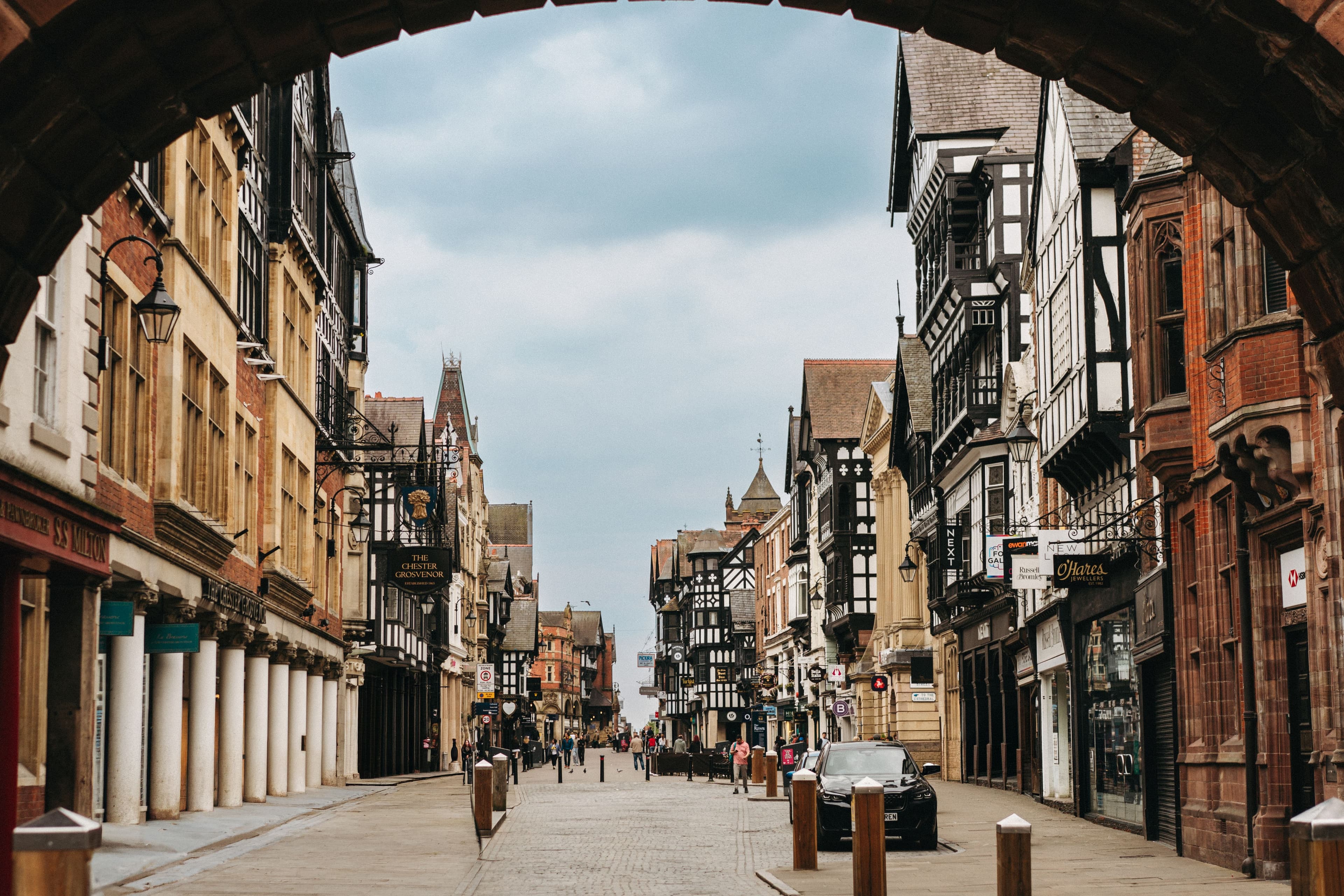
Chester’s marathon began the way a lot of good ideas begin: two friends deciding the local running calendar had a gap worth filling. Andy White and Chris Hulse, both keen runners and triathletes, built an event around the city they already knew. Chester never tried to be a capital-city spectacle. It became something narrower and, for a lot of runners, more useful: a closed-road, runner-first marathon that treats a fast course and manageable logistics as more important than scale.
Three things came to define it. Speed came first: organiser figures put the PB rate above 70%, and independent route descriptions consistently call the course fast, a claim runners themselves complicate slightly. Heritage came second: Chester hands the race its Roman walls, the Rows, the Eastgate Clock and the cathedral within the opening and closing miles, which gives a domestic UK marathon a city-marathon feel rare outside London or Manchester. Geography came third: the route crosses from England into Wales and back within a single loop, a detail few UK marathons can offer.
For years, Chester’s practical selling point was that it sat usefully in the calendar: a same-year option for runners who missed the London ballot or wanted a second crack at a PB after a spring race. That changed by 2026. The event, along with its companion Metric Marathon, sold out before late entry ever came into play, and the sensible new advice for future editions is to enter the moment registration opens; Chester does not work as a fallback to book in August.
The race has picked up recognition beyond its own finishers, listed as a three-time winner of the UK’s Best Marathon award and Racecheck Gold-rated. Course records lean toward established fact: Marshall Smith’s 2:16:59, run in his 2024 win, stands as the current men’s all-time race record.
The course
The course starts at Chester Racecourse on New Crane Street at 09:00, on a single mass start with no wave system. The opening kilometres pass through Chester’s historic core: the Roman walls, the cathedral precinct, the Eastgate area and the covered Rows, before the route leaves the city for closed roads through the Cheshire countryside. Runners cross into North Wales at about km 15, beyond Pulford, and run through Rossett and Holt before recrossing the Dee into England at Farndon around km 26.5, through villages and open farmland with thinner crowd support than the city-centre miles. Two climbs mark the closing stages: a rise out of Farndon at around 17 miles (27km), and Sandy Lane at around 25 miles (40km), the latter arriving directly into a headwind on the days it blows. The route returns to Chester through increasingly urban surroundings, finishing on Castle Drive close to the River Dee.
Published figures for total climbing disagree, from roughly 76 to 80 metres in organiser-adjacent copy to 190 to 250 metres in runner estimates. The elevation chart keeps the whole course inside a 30 m band. Its steepest ground comes early, a 24 m climb from the Racecourse into the city centre and a 20 m rise on Eaton Road at km 5 to 6; the late climb out of Farndon is about 15 m, and Sandy Lane is a rise of only a few metres that feels bigger at 25 miles.
One Start, No Waves
Chester runs a single mass start at 09:00 with no wave or corral system, a detail that separates it from almost every other marathon on this site. There is no wave-time anxiety and no corral-positioning strategy to plan around; everyone in the field goes off together. It simplifies race-morning decision-making considerably, though it also means the pre-start wait at the Racecourse pens can run longer than at a race with staggered starts, so arrive with a throwaway layer and a plan for the toilet queue; there is no wave system to manage the crowd.
Km 0-3: The Racecourse start. Chester starts its runners somewhere most UK marathons would envy: the Roodee, Chester Racecourse, which gives the event room for pens, bag drop and toilets without herding anyone to a retail park on the edge of town. Expect a compressed first kilometre as several thousand runners funnel out of the racecourse gates and into the city streets.
Km 3-8: Roman Chester. The route threads past the city walls, the cathedral and the Rows, with crowd noise bouncing off sandstone in a way that flatters even a modest pace. Cool weather, tight streets and genuine crowd energy make it easy to burn five kilometres faster than the training plan intended; treat this section as controlled enthusiasm, not the race itself.
Km 8-20: Into the shires.Chester’s city character drops away here, replaced by Cheshire lanes, hedgerows and open sky that either flatters a still day or punishes a windy one. Wind, not hills, is the dominant variable through the middle third. Support thins to village clusters. This is rhythm territory: hold effort, not pace.
Km 20-29: North Wales and the Farndon climb. The England-Wales border crossing, out at km 15 and back over the Dee from Holt to Farndon at about km 26.5, gives Chester its best travel anecdote, but the more practical detail is what waits just after it: a climb of about 15 m up Stannage Lane out of Farndon, around the 17 to 18-mile mark, to the course’s highest point. It is not a mountain, worth two to five minutes over a genuinely flat course, not a race-defining obstacle, but a headwind here has been compared to running into a wall by more than one finisher.
Km 27-40: Sandy Lane and the long return. The second half of Chester asks more of a runner than the first; a slight positive split, banking time in the first half, is the pattern several sub-3-hour finishers describe using deliberately. Sandy Lane, around the 25-mile mark, is the second and final climb, and its reputation outstrips its size, but it lands exactly where legs are least willing to argue.
Km 40-42.195: Back to the Dee. The closing two kilometres pull runners back into recognisably urban Chester, support thickening again as the route nears Castle Drive and the River Dee. The finish trades big-city scale for something more intimate: a scenic, walkable conclusion close enough to the racecourse and city-centre hotels that logistics stay simple even on tired legs.
The blue line marks the tangent throughout the course, and following it is worth a measurable amount over the full 42.195km. Chip timing and exact mile-marker placement should be confirmed against the 2026 race guide, since marker placement has been reported as inconsistent in past editions.
A single mass start (no waves) funnels quickly from the Racecourse into Chester’s historic core. Crowd energy and cool air make this the easiest five kilometres to run too fast; hold back.
City character gives way to open Cheshire lanes. Wind, not hills, is the defining challenge here. Settle into rhythm and bank patience.
The route crosses into North Wales at km 15 and back over the Dee at Farndon, then climbs about 15 m out of Farndon around 17 miles. Manageable alone, harder on tired legs or into a headwind.
The second half is genuinely tougher than the first; several fast finishers pace it deliberately positive. Sandy Lane’s climb at 25 miles is the last obstacle before a scenic finish by the River Dee.
Course Map
The map shows the course from the Racecourse through the city, south through Eccleston and Pulford into Wales around Rossett and Holt, and back through Farndon, Aldford and Huntington to the Castle Drive finish, with Chester railway station marked. Tap a marker for details, and scrub the slider or press play to move the orange marker along the course with the elevation profile beneath it.
Pacers
Official pace groups are listed as included by third-party ticketing sources, but exact 2026 target times were not confirmed on official pages. Because Chester runs a single mass start with no waves, pacers are organised by target finish time: expect bands around 3:00, 3:15, 3:30, 3:45, 4:00, 4:30 and 5:00, though the specific 2026 list should be checked against the final race guide before relying on one.
What to wear
October in Chester averages around 11°C at race time, with highs closer to 14°C and a real chance of rain; treat a dry start as a bonus, not a plan. Wind is the more consistent variable: the course runs through open Cheshire and Welsh farmland with little shelter, and a headwind on the exposed middle and closing miles has caught out more than one runner expecting a sheltered UK autumn race.
A throwaway layer for the start pens at the Racecourse is close to essential, particularly given the queue for toilets and bag drop before a 09:00 gun. Gloves are worth carrying in a pocket. Shoes with reliable grip on wet tarmac matter more here than on a dry-weather course, since October rain is common enough to plan for.
Entry
| Registration type | Open entry (2026 sold out; waitlist via RunThrough) |
|---|---|
| 2026 fee tiers | £55 special (to 31 Oct 2025) · £65 standard (to 27 Sep 2026) · £69 late (if places remained) |
| Minimum age | 18 |
| Fast runner / GFA entry | Not applicable; open entry only, no qualifying standard |
Chester runs open entry with no ballot, which sounds straightforward until the practical reality catches up with the theory. The 2026 marathon sold out before late entry ever applied, and the companion Metric Marathon sold out alongside it; both are running through a waitlist via RunThrough. The headline advice for anyone eyeing a future edition is simple: register the moment entries open, not when the training plan starts.
There is no qualifying standard, good-for-age category or seeding requirement to enter Chester; the race is built for first marathoners and competitive PB-chasers on the same start line. No single official charity-entry scheme was found, though individual charities may hold allocated places; no tour-operator entry route was identified either.
Transfer terms are unusually clear and worth flagging prominently for international travellers booking flights around a place: runners can transfer their entry to another runner, but cannot transfer to a different event or defer to a future year, and the event does not offer refunds. Reddit discussion around the 2026 event bears this out in practice, with a steady stream of runners buying, selling and transferring places through the closing months before race day.
Race Weekend
Expo and Number Collection
Full 2026 expo details, including venue name, address and opening hours, were not confirmed on accessible official pages. What is confirmed: runners who entered after 23:59 on Thursday 1 October 2026 must collect their race pack from the Help Desk over race weekend rather than in advance. The start and finish area sits within easy walking distance of the city centre and station-side hotels, so runners collecting race-weekend should not need transport beyond a short walk from a central base.
Race Morning
Chester’s race morning has one structural feature that changes most of the usual advice: there is no wave or corral system. Every runner starts together at 09:00 from Chester Racecourse. That simplicity does not remove the need to arrive early. Toilets, bag drop and pen access all still take time, and a race with a single start compresses that demand into one window.
The simplest race-morning plan is to stay centrally in Chester and walk to the Racecourse; from the railway station, allow 20 to 25 minutes on foot. Driving remains possible but is the less attractive option: racecourse parking is listed at £5 and explicitly weather-dependent, meaning a wet forecast could close or restrict it with little notice.
Bag drop for the half-marathon distance at this event has previously operated from a marquee on the course centre; marathon-specific 2026 arrangements should be confirmed against the final race guide. A throwaway layer is worth planning for regardless of forecast, given the queue reality at a 09:00 October start.
Finish provisions reported by third-party event listings include a medal, goodie bag, finisher T-shirt, chip timing, event photography and on-course or finish massage, though the precise 2026 contents should be checked against the official race guide. The finish area on Castle Drive, close to the River Dee, is compact enough that most central hotels remain walkable straight after finishing.
A brief, honest note on organisation: past editions have reported inconsistent mile-marker placement, including markers at mile 13 sitting closer to 12.8 and confusion between mile and metric markers in the 20-23 mile range. Most runner feedback on the event overall is warm, but it is a reason to pace from a GPS watch as well as the course markers.
Nutrition on Course
Exact aid station locations and contents for the 2026 course were not confirmed on accessible official pages. What is confirmed: the official route information describes two first-aid points positioned so that runners pass them twice across the course, plus a start-line first-aid presence and a main medical area at the finish. Sports drink brand, cup type, and whether a personal bottle service exists have not been published. Given the uncertainty, runners planning a specific nutrition strategy, particularly those attempting a PB, should treat self-carried gels as the more reliable option until the final race guide confirms on-course provision.
Spectating
A spectator planning a single vantage point should head for the city centre and finish area; on the rural loop crowds thin considerably once the route leaves Chester. Town Hall Square offers an early sighting as runners pass through the historic core; the finish gantry on Castle Drive draws the largest crowd of the day. Chester Racecourse itself is the obvious choice for watching the single mass start at 09:00.
A more ambitious spectator plan can use a car to reach villages such as Saughall or Rossett along the rural section, where crowds are thinner but the runner-to-spectator ratio feels more personal. This carries real risk: road closures across the Cheshire and North Wales sections make casual driving between viewpoints unpredictable, and any car-based plan should be built around the official road-closure map.
Itinerary A (city-centre, no car needed): Start at Chester Racecourse for the 09:00 start, walk into the city centre for an early sighting near Town Hall Square, then return to Castle Drive on foot for the finish.
Itinerary B (two sightings, on foot): Start at Chester Racecourse for the start, walk to a vantage point along the early city-centre miles near the Rows or the cathedral precinct, then walk to Castle Drive in good time for the finish.
Itinerary C (rural sighting, car required, higher risk): Drive to a village along the rural loop, such as Saughall or Rossett, before road closures take effect, watch the field pass through the quieter rural section, then allow significant driving time back into Chester for the finish.
Where to Stay
Chester city centre is the default recommendation and, for most runners, the only real decision worth making. It sits within walking distance of both the Racecourse start and the Castle Drive finish, close enough that the choice between “near the start” and “near the finish” barely matters here the way it does at bigger, more spread-out marathons. The trade-off is Saturday-night noise in a city-centre pub scene the night before an early alarm.
City centre / inside the walls
The highest-convenience choice, walkable to both start and finish. Runners sensitive to Saturday-night noise should look slightly further out.
Railway station area
A practical middle ground. Still walkable to the Racecourse, roughly 20 to 25 minutes on foot, and tends to price slightly lower than the historic core, though it trades away the Roman walls and half-timbered Rows that make staying inside the old city worthwhile.
Boughton and the Dee-side
East of the centre, working well specifically for the finish, with quieter riverside access and a calmer base for the night before the race. The trade-off runs the other way to the city centre: fewer restaurants within walking distance and a quieter night before the race.
Out of town, with a car
The least recommended option for this race specifically, not because the accommodation is worse, but because Chester’s road closures and weather-dependent racecourse parking make race-morning logistics genuinely harder than a short walk from a central hotel. Anyone choosing this route should build in a longer buffer than they think they need.
Recommended hotels
The premium option inside the walls, close enough to both start and finish to remove all race-morning logistics. Likely to book out earliest of the five given its size and reputation.
Sits on the racecourse side of the centre, which shortens the walk to the start specifically. A sensible middle-tier choice for runners who want proximity without the top price bracket.
Apartment-style rooms close to the Racecourse, useful for runners who want kitchen facilities for pre- or post-race food. Availability is likely the tightest of the five given the smaller room count.
A practical mid-range option with spa facilities that suit stiff legs the day after. The longer walk back post-race is worth planning for, particularly for slower finishers.
The predictable budget option for runners prioritising cost over character. Expect standard chain-hotel pricing to surge on marathon weekend even at this tier.
Booking timeline
Chester does not run a ballot, so there is no single results-announcement date driving a hotel rush the way there is at London. Instead, the relevant trigger is entry itself: places for 2026 sold out well ahead of the event, and hotel availability in central Chester follows the same pattern. Book a central hotel at the same time as securing entry. Flights are not typically a factor for this race given its UK domestic audience, but international visitors flying into Manchester or Liverpool should book rail connections early.
See & Do
The finish near Castle Drive puts you within an easy walk of Chester’s compact, sandstone-walled historic core. All of what follows is reachable on foot.
Chester Cathedral
0.9km (0.6 miles) from the finish. A working cathedral with roots stretching back to a 10th-century Benedictine abbey, sitting directly on the early race route. Its interior offers a good sit-down option for tired legs without much further walking required.
The Rows
0.7km (0.4 miles) from the finish. Chester’s double-decker medieval shopping galleries, a genuinely distinctive piece of the city’s fabric that the marathon route runs directly beneath. Low physical demand makes it a realistic post-race activity.
City walls walk
0.5km (0.3 miles) from the finish. The full circuit follows the line of the old Roman and medieval defences and overlaps closely with the race’s opening kilometres. Walking a section of it is the more realistic choice on race-day legs.
Chester Zoo
Approximately 5km (3 miles) from the city centre; not walkable from the finish. One of the UK’s largest zoos and a strong family option, but its distance means it needs a bus or taxi and a proper block of time. Better suited to a Monday visit than a same-day post-race outing.
Grosvenor Park and the Dee-side walk
Adjacent to the finish area. The lowest-effort recovery option on this list, a flat riverside walk beside the Dee close to where the race itself finishes.
Read Before you Run
Roman Chester: Fortress at the Edge of the World
David J.P. Mason
A focused history of Roman Deva, the fortress that gave Chester its street pattern, its amphitheatre and much of the line the current city walls still follow. Runners retracing the early race-route landmarks will recognise the ground the book describes.
After the Race
Chester Marathon runs in October, a workable month for both racing and onward travel across England and North Wales. These itineraries range from a same-day riverside walk to a four-night extension into the Lake District.
A low-effort day for stiff legs: a flat riverside walk along the Dee followed, for those with energy to spare, by an afternoon at Chester Zoo.
A short, low-logistics trip into a city built for exactly this kind of recovery weekend: strong museums, a genuinely good food scene, and minimal walking demanded if legs need it.
Castles, sea air and a noticeably slower pace than Chester itself, with walking intensity easy to scale down for recovering legs.
The best option for international visitors with time to spend, though it demands more travel effort than the other excursions here. October weather in the Lakes is genuinely unpredictable.
Frequently asked questions
Should I stay near the start or the finish?
Stay central. Chester Racecourse, the start, and Castle Drive, the finish, sit close enough together, roughly 0.8km apart, that city-centre accommodation works well for both.
How far in advance should I book a hotel?
As early as possible. The 2026 marathon sold out ahead of race day, and central Chester’s hotel stock tightens at the same pace as entries.
Is there free transport to the start?
No free race-day transport entitlement has been confirmed. Racecourse parking exists but is paid and weather-dependent, so walking from a central hotel is the more reliable plan.
What is the best area to stay?
Chester city centre, inside or close to the walls. It sits within walking distance of both the Racecourse start and the Castle Drive finish.
When does the expo open?
Specific 2026 expo hours have not been published. Runners who entered after 1 October 2026 should expect to collect their race pack from the Help Desk over race weekend rather than in advance.
What is the weather typically like?
Cool and often damp. October in Chester averages around 11°C, with highs closer to 14°C, and wind exposure on the rural sections of the course is a more consistent factor than rain.
How do I get from the airport?
Manchester and Liverpool airports both connect to Chester by rail, though a change is usually required. Build in extra time for a Sunday-morning journey.
Is there a bag drop?
Bag drop is expected to operate, based on past editions, though the exact 2026 location and hours have not been published.
Should I bring a throwaway layer?
Yes. October mornings in Chester are cool enough, and queues at the start compressed enough by the single mass-start format, that a throwaway layer is worth planning for regardless of forecast.
How do I get back to my hotel after finishing?
Most central hotels are walkable from the Castle Drive finish area. The finish is compact, so a short walk is more realistic here than at larger marathons.