The Race
| Next Race Date | Early May 2027, to be confirmed |
|---|---|
| Course type | Point-to-point |
| Registration | Open entry |
| Ballot opens | Not applicable |
| Start | Porta Nova, Barchi, 09:00 (2026) |
| Finish | Arco d'Augusto, Fano |
| Total finishers | Not published |
| Avg race-day temp | 9 to 20°C (early May) |
| Cutoff time | 7 hours (2026 rules) |
| Free race-day transport | Shuttle from Fano to the start (2026 rules) |
| Course certification | FIDAL certified, Type B. No World Athletics Label |
History
The ColleMar-athon is organised by ASD ColleMar-athon Barchi and describes itself as the marathon of values. It links the hill town of Barchi, in the Terre Roveresche municipality, with the coastal city of Fano, taking runners from the inland hills of the Marche down to the Adriatic. In 2026 the organiser ran the 22nd edition. It is a FIDAL regional championship race for individuals and teams, and the 2026 programme included the Italian Paralympic half marathon championship.
The event has three distances: the marathon, a half marathon that starts at Mondolfo and a 10 km that starts at Tombaccia. All three finish in Fano. Local press has reported crowds of well over a thousand runners across all distances in some editions, but the split by distance and the year were not confirmed.
The event's future has been uncertain. A January 2025 local news report said the May 2025 edition would not take place because the founder was reducing his role, and that he hoped it would return in 2026 with new organisers. The 2026 edition is documented. The 2027 date is not yet announced.
The course
The ColleMar-athon starts at Porta Nova in Barchi, about 320 m above sea level, and finishes at the Arco d'Augusto in Fano. The 42.195 km course is FIDAL certified as Type B. The organiser calls the road asphalted, varied and closed to traffic, and names Mondavio, Orciano, San Giorgio, Piagge, Cerasa and San Costanzo among the places passed.
The route passes all six in that order: Orciano and Mondavio at 3 to 8 km, San Giorgio at 10 to 13 km, Piagge at 14 to 19 km, Cerasa at 20 to 24 km and San Costanzo at 24 to 28 km, before the run down the Via della Tombaccia into Fano. The course descends from the hills to the sea but it is not a straight downhill. It drops about 75 m in the first 2 km, rolls for the next 20 km with short climbs of up to 40 m, falls about 170 m from 24 to 38 km, most of it in a steep drop around 30 km, and finishes on a flat run at close to sea level.
The organiser reports two electronic intermediate timing points. The time limit in 2026 was seven hours.
Kilometre by kilometre
Km 0 to 10: off the hill. The race leaves Barchi at about 310 m and the first kilometre falls 56 m at 5.6 per cent, the steepest of the opening stretch. By 2 km the course is at about 233 m, then a climb of 28 m over 1.1 km at 2.5 per cent takes it back to about 261 m at 3 km in Orciano. It passes through Mondavio at 4 and 5 km, returns through Orciano at 6 and 7 km and drops 39 m from 8 to 11 km. Runners who bolt the first downhill will feel it later, so hold back and let gravity do the work without adding to it.
Km 10 to 20: rolling ridges. The descent continues in steps. San Giorgio at 10 to 13 km is at about 200 m, a 24 m climb over 1.4 km at 1.7 per cent comes at 13.6 to 15 km on the way into Piagge, and a descent of 51 m over 5 km from 16.6 to 21.6 km takes the course through Piagge at 14 to 19 km to about 157 m at 20 km. The roads between the villages are likely to be quiet.
Km 20 to 30: the last hills. Through Cerasa at 20 to 23 km the course falls to a low of about 135 m at 23 km, and then comes the largest climb of the race: 41 m over 1.1 km at 3.7 per cent at 23.4 to 24.5 km, at the start of San Costanzo. It arrives after 23 km on quads already worn by descent. The course then falls through San Costanzo at 24 to 28 km to about 102 m at 29 km.
Km 29 to 33: the drop to the coast. This is the steepest section. On the Via della Tombaccia the course loses about 100 m in two kilometres, from about 102 m at 29 km to 81 m at 30 km, 24 m at 31 km and 10 m at 32 km, with the single steepest kilometre at about 5.7 per cent between 30 and 31 km. It is the last real gradient of the race, and a hard one on tired legs. The 10 km race starts on the Via della Tombaccia.
Km 33 to 42.2: the coastal plain. The final nine kilometres are flat at 0 to 5 m above sea level, through Fano's outskirts on Viale Piceno and Viale Alcide De Gasperi, then along Viale Adriatico and the seafront promenade, the Passeggiata del Lisippo, at 39 and 40 km. The course then turns inland on Viale Cristoforo Colombo at 41 km and climbs about 16 m into the old town. After the hills it can feel like relief, and wind off the Adriatic can turn it into a grind. The finish is at the Arco d'Augusto, a Roman arch.
The half marathon starts at Mondolfo and the 10 km at Tombaccia, and both finish in Fano. Check whether their routes join the marathon in the final section and whether the road is shared. The organiser reports two intermediate timing points and unannounced FIDAL checks.
A steep first kilometre out of Barchi, then rolling ground through Orciano and Mondavio. Hold back.
San Giorgio and Piagge on a run of small rises and falls through quiet country roads, dropping to about 157 m.
A 41 m climb at 23.4 km into San Costanzo, then a steep descent on the Via della Tombaccia around 30 km.
Flat, at sea level, along the Fano seafront and back into the old town to the Arco d'Augusto.
Course Map
The line is the route of the 22nd edition, until the organiser publishes the 2027 route. Tap a marker for the start, the finish and the finish village, and scrub the slider or press play to move the orange marker along the course with the elevation profile beneath it.
Early May in the Marche is spring. The 09:00 start at Barchi, on a hilltop at 320 m, is likely to be cool, and the finish on the coast will be warmer. That difference means a single layer choice has to work at both ends. A light vest or T-shirt with arm sleeves suits most runners, and a cap helps on the exposed coastal stretch. A throwaway top for the wait in Barchi is sensible.
Wind off the Adriatic can be strong on the flat final kilometres. Sunscreen is worth applying because the last stretch has little shade. The organiser transports a labelled bag from Barchi to Fano, so leave dry clothes and flip-flops in it. Drop-bag limits were not described.
Entry
The 2027 fees and opening dates are not announced. For scale only, the 2026 marathon fees were €35 until 31 December 2025, €45 until 31 January, €55 until 31 March and €65 until 29 April, with online registration closing on 30 April. At €1 to £0.858 those are about £30, £39, £47 and £56. These are not 2027 prices. In 2026 registration was through the ICRON platform.
There is no ballot, guaranteed-entry standard or charity allocation described.
Entering from outside Italy. In 2026 the rules allowed foreign residents aged 20 or over to enter with a club card from a foreign federation recognised by World Athletics, or with a RunCard and a valid competitive medical certificate that specifically covers athletics. Domestic runners needed FIDAL membership, a RunCard or an eligible sports promotion body card, plus a certificate. A certificate alone was not enough. A runner whose paperwork is unresolved can be refused a chip bib without a refund.
The rules did not describe a non-competitive waiver route for the marathon. Confirm the 2027 rules with the organiser before paying.
Fast runner standards
There is no guaranteed-entry or qualifying standard.
ColleMar-athon: official site →Race Weekend
Bib collection
In 2026 bib collection was at the Fano finish village on Saturday from 10:00 to 20:00, or at Barchi on Sunday from 07:00 to 08:30. Proxy collection was allowed with a written authorisation and a copy of the runner's ID. Runners collecting on the Sunday morning at Barchi may have their race pack delivered to Fano after the race. Saturday in Fano is the calmer choice and it removes a task from race morning.
Bring your ID and any original medical or membership paperwork that was required for entry. Merchandise and pack contents are not described.
Getting to the start
Because the race is point-to-point, the start is a bus ride from the finish. In 2026 the organiser ran shuttles from Fano to Barchi between 06:45 and 07:15 from four pick-up points: Sport Park on Via dello Scalo, the cemetery on Via della Giustizia, Pesce Azzurro on Viale Adriatico 52 and Porta della Mandria. The 2027 pick-up list, any reservation requirement and the timetable need checking.
At the start. In Barchi the organiser provided toilets, changing space and coffee. A labelled bag deposited at Barchi is delivered to Fano. The start is at Porta Nova at 09:00.
At the finish. In Fano there were toilets, showers, medical help, massage and a pasta party. Fano railway station is the sensible public-transport arrival point. The organiser names Ancona-Falconara as the airport.
Nutrition on course
The 2026 rules promised refreshment and sponge points every 5 km, which gives eight stops across the distance. They did not list what was served, the type of cup or the policy on personal bottles. The finish had a pasta party.
Carry the gels you have trained with. The long descent in the first half can hide effort, so eat on schedule and not by feel.
Spectating
The best base for a supporter without a car is the finish area around the Arco d'Augusto and the Pincio in Fano, where the finish village is. The inland villages are only useful to a supporter with a car, and because roads on the course are closed to traffic the organiser does not encourage driving alongside the runners.
In 2026 the programme said live video of the start was shown at the Fano finish village and on YouTube, which gives supporters in Fano something to watch while they wait. Confirm this for 2027. Safe public-transport intercepts along the route have not been published.
- Follow the start video at the finish village
- Watch the seafront on the Passeggiata del Lisippo at about 39 to 40 km
- Walk to the Arco d'Augusto for the finish
Post-race food
The finish village serves a pasta party. For a sit-down meal in Fano, the organiser's hospitality page suggests Ristorante Il Galeone, Pesce Azzurro and Pesciutta. Fano is known for its fish stew, brodetto, and for a coffee called a moretta made with anise, rum and lemon zest. Confirm that the restaurants are open on a Sunday and whether they take bookings.
Where to Stay
Stay in Fano. The race ends there, the finish village is there and the shuttle to Barchi leaves from there.
Fano centre and Pincio
The best base. The Arco d'Augusto finish, the finish village and the shuttle points are close. Old-town streets are quiet at night and it is a short walk to restaurants.
Fano station area
Suits runners arriving by rail. Check the walk to the shuttle pick-up points.
Fano seafront
May offer more rooms and sea views. Check the walk to the shuttle.
Barchi
Easy for the start, but a return transfer after the race is needed and rural bed stock is limited.
Mondavio and Orciano
Workable with a car but they need a plan for closed roads on race morning.
Terre Roveresche is a municipality, not a single hotel district, so check each property's address.
Booking timeline
Wait for the organiser to confirm the 2027 date before treating early May as firm. A refundable room in Fano is a reasonable early booking. Book rail travel to Fano, not to Barchi.
Check the shuttle schedule, the May holiday weekend and any strike notices before fixing travel. Registration prices in 2026 rose across four bands, so entering early is likely to be cheaper, but the 2027 bands are not published.
See & Do
Everything below is in Fano, close to the finish.
Arco d'Augusto
A Roman arch at the edge of the old town, and the race's finish landmark. It is free and you can walk under it.
Piazza XX Settembre and the Fontana della Fortuna
The central square, with a fountain topped by a statue of Fortune. Flat, paved and a natural place to sit after the race.
Corte Malatestiana
A palace of the Malatesta family that now holds the civic museum. Check the opening days and prices.
Roman walls
Stretches of the Augustan wall survive around the old town, including the Porta della Mandria. Level walking, free and quiet.
Fano seafront
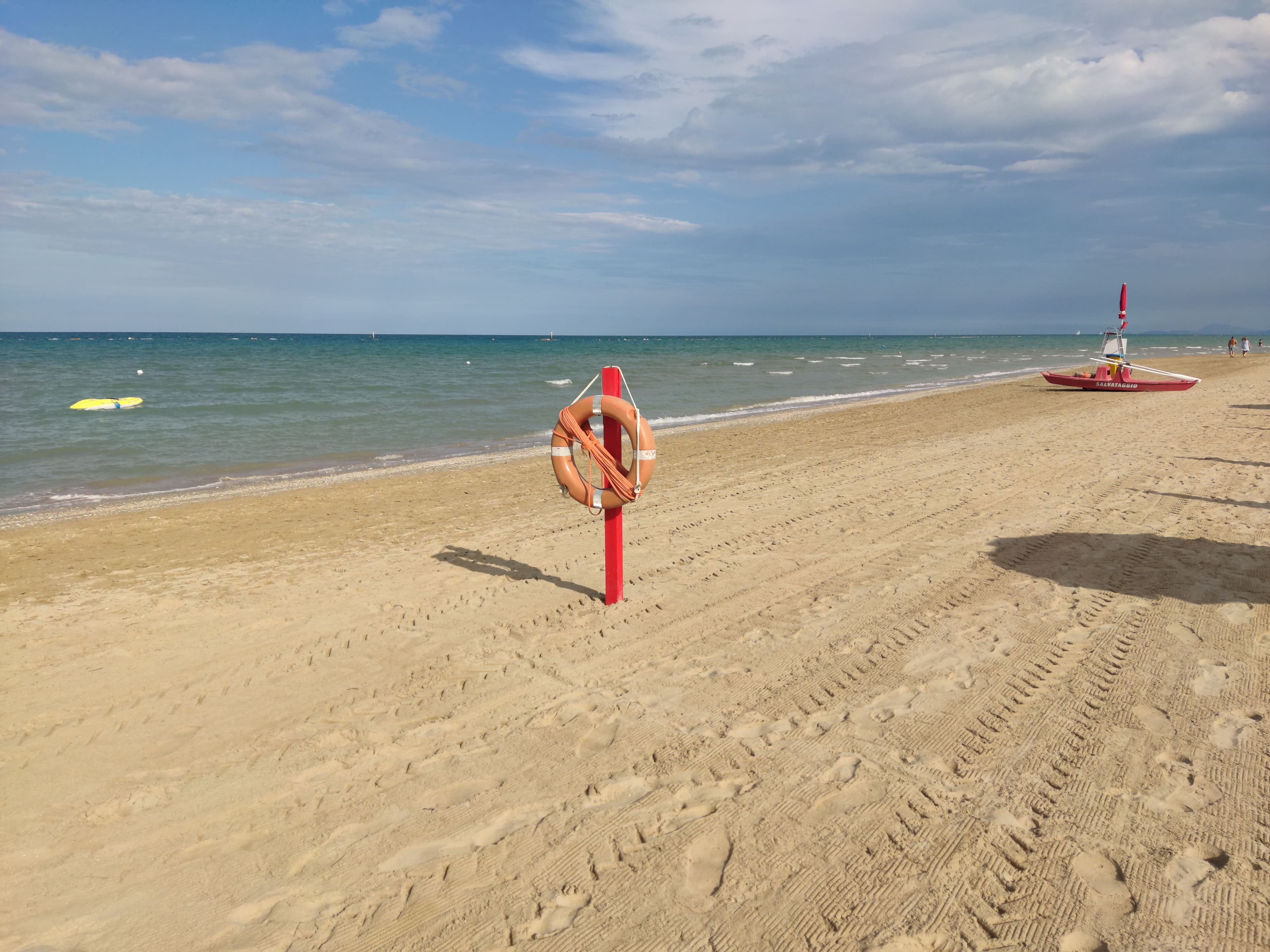
A long flat beach promenade. Good for a slow walk the day after the race. Some beach venues may be closed in early May.
After the Race
Early May is mild on the Adriatic coast. Recovery days can stay in Fano or take a short train to Pesaro, Ancona or a bus up to Urbino.
A flat recovery day in the finish town, with a Roman arch, a central square and a level seafront.
A Renaissance hill town with a ducal palace and steep streets. Choose the bus over the walking.
Rossini's birthplace and a flat seaside city with a central square and a long bicycle-friendly promenade.
A working port with a hilltop cathedral and a wild coast just south, reached by local bus.