The Race
| Next Race Date | Sunday 11 April 2027 |
|---|---|
| Course type | Out-and-back road course from one base, start and finish about 170 m apart |
| Registration | Open online entry, no ballot |
| Ballot opens | Not applicable |
| Start | Eleftheriou Venizelou, outside the National Stadium, 07:00 |
| Finish | Inside the Chania National Stadium |
| Total finishers | Not published |
| Avg race-day temp | 11 to 20°C (April daily range) |
| Cutoff time | 6 hours |
| Free race-day transport | To be confirmed |
| Course certification | Organiser states SEGAS approval and AIMS-certified routes; certificate not published |
History
The Crete Marathon began in Chania in 2016 and is run by the Chania Health Runners Association, the local club that still organises it. By the third edition, in April 2018, the AIMS preview described a start at the municipal market. The current route starts outside the National Stadium, and the sources do not say which edition made the change.
The date moves. AIMS records editions on 8 May 2022, 7 May 2023, 14 April 2024, 6 April 2025 and 19 April 2026, so recent editions have all fallen in April or early May. The 2026 race was the tenth edition and was dedicated to Metropolitan Ireneos Galanakis. For the ninth edition, a branch of the ancient olive tree at Vouves was cut as a kotinos and carried by torch relay from the Chania regional unit building to the start.
The marathon sits inside a larger festival with 10 km, 5 km and 2.5 km runs. A local news report put total registrations at 3,800 for the tenth edition, with more than 500 people in the marathon and nearly 200 of them from abroad. Neither figure counts marathon finishers.
Runbeat reported Martin Müller winning the 2026 men's race in 2:28:44 and Athina Charalampaki the women's in 3:06:23, and called both times course records. The organiser's results page showed no readable rows. The organiser is a full AIMS member; no World Athletics Label has been found.
The course
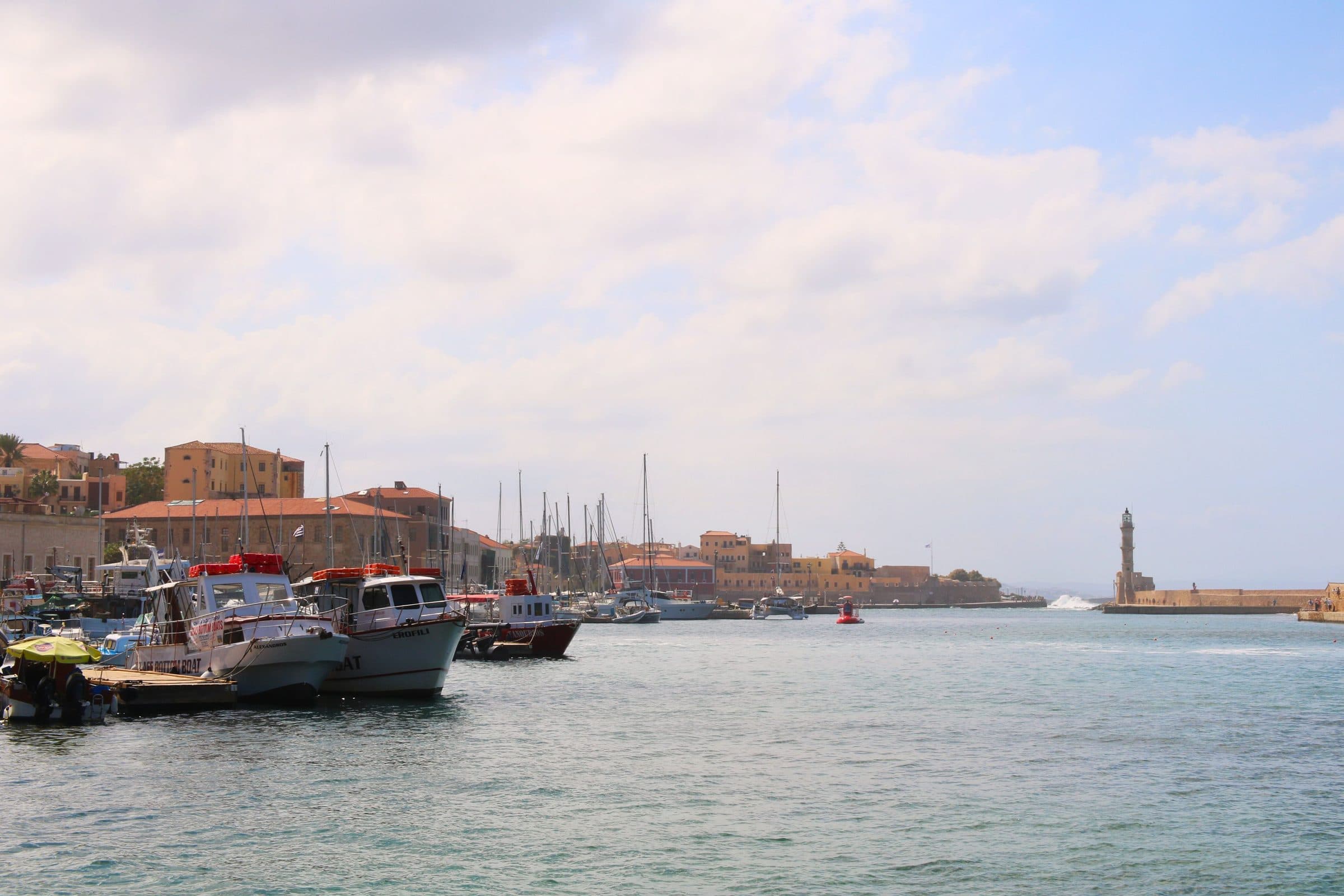
The race starts on Eleftheriou Venizelou outside the main entrance of the Chania National Stadium and finishes about 100 m inside it. It runs along the Venetian harbour front on Akti Koundouriotou at km 1 and Akti Kanari at km 2, climbs through Spyrou Mousakli at km 3 and joins the Chania to Kissamos road at km 4.
That road carries the course west through Daratsos at km 6, Kato Stalos at km 9 and 10, Agia Marina at km 11 and 12, Platanias at km 13 and 14, Gerani at km 15 and 16 and Maleme at km 17 to 20. The turnaround is a hairpin near the Tavronitis junction at about km 21, almost exactly halfway.
The return follows the same road. Daratsos comes round again at km 36. The course leaves the Kissamos road near km 37 for streets through Daskalogianni, rejoins it near km 39, leaves it once more near km 40 on Stefanou Lekanidi and comes back along Kissamou and Charilaou Trikoupi to the stadium.
The whole course sits between 2 m and 26 m above sea level. The first climb is the longest: 18 m over 1.2 km, an average of 1.5%, from the low point of 2 m at km 3.2 to the day's high point of 26 m at km 5.5, followed by an 18 m descent over the next 4.4 km. The only other sustained climb is 15 m over 2.3 km at about 0.7% between km 14.6 and 16.9, towards Maleme. The organiser publishes no total climb, and the coast road has no shelter from wind.
Kilometre by kilometre
Km 0 to 5: stadium, harbour and the first rise. The race opens on built-up streets and reaches the harbour front on Akti Koundouriotou at km 1. Turns come quickly, and a runner starting mid-field will spend the first kilometres finding space on narrow pavements, so use the opening kilometre to settle. The only real hill is here: the route drops to 4 m on Spyrou Mousakli at km 3, then climbs 11 m in the next kilometre to join the Kissamos road.
Km 5 to 15: the coast road. The course peaks at 26 m near km 5.5, drops through Daratsos at km 6 and is then flat at 4 to 11 m through Kato Stalos, Agia Marina and Platanias. A long straight road, a clear line of sight and almost no change of direction make this the stretch where pace drifts unnoticed. Water and isotonic drink are available every 2.5 km, so use each one as a pace check.
Km 15 to 21: towards Maleme. The one other climb comes here, 15 m over 2.3 km from km 14.6 to the high ground of about 20 m at Maleme, km 17. The turnaround comes at about km 21 near the Tavronitis junction. It is a hairpin of roughly 170 degrees, so the road carries runners in both directions at once. The organiser has not said where the halfway mat is.
Km 21 to 36: the way back. The return uses the same road, so the pace set in the first half has to hold on ground you have already seen, with any wind on the other side of the body. The descent from km 25.6 to 28 loses 16 m. Gel and cola are at 32.5 km, with sponges at 32.5 and 40 km.
Km 36 to 42.2: into Chania. Daratsos comes round again at km 36 and the course leaves the outbound road near km 37 for Daskalogianni, where it climbs 11 m between km 38 and 39 to 20 m. It drops to 9 m on Stefanou Lekanidi at km 40, rejoins Kissamou road and finishes inside the National Stadium, with the last 100 m inside the gates. Chip mats at the start, finish and intermediate controls are electronic.
Narrow streets, the harbour front at km 1, then an 18 m climb to the day's high point of 26 m at km 5.5.
A straight, exposed road through Platanias and Maleme to the turnaround near Tavronitis, with a 15 m rise at km 14.6 to 16.9.
The outbound line repeated in reverse. Daratsos at km 36 is the last village on the road.
A short loop through Daskalogianni with an 11 m rise, then Kissamou road and the finish inside the National Stadium.
Course Map
One out-and-back from the National Stadium to a hairpin near Maleme and home along the same coast road. Tap a marker for details, and scrub the slider or press play to move the orange marker along the course with the elevation profile beneath it.
For the ninth edition the organiser held a ceremony in which a kotinos, the olive branch awarded in the ancient Olympic tradition, was cut from the ancient olive tree at Vouves and carried by torch relay from the Chania regional unit building. The ceremony is documented for that edition only and nothing confirms it for 2027.
April in Chania brings daytime highs near 19 to 20°C and overnight lows near 11 to 12°C, with about 31 mm of rain over six days in a typical month. Those are monthly figures, not an average for a 07:00 start. The sea sits around 16°C, which only affects post-race plans.
The first hour is cooler than the last. A runner finishing in four to five hours reaches late morning with the sun well up and a high UV index, so carry a cap or visor and sunscreen even if the start feels cool. The route is a long coastal road with no published wind data, so check the forecast the evening before.
A removable layer helps in the wait at the start. The organiser provided a clothing store inside the stadium in 2026, so a bag is safer than a throwaway garment. No clothing-donation scheme has been confirmed.
Entry
Entry is open and online through the organiser's registration site, registrations.sdyh.gr, with no ballot, no Good For Age route and no confirmed charity or tour-operator place. Check that the form names the marathon and 42.195 km before paying: the same site registers the 10 km, 5 km and 2.5 km races.
The price rises in four steps as race day approaches. The previous edition's fees are shown below as the structure; the organiser has not published the 2027 schedule. The organiser's PDF and fees page disagree on the end of the second window (15 December against 31 December), and the PDF prints the backpack extra as "seven (12)" euros against €12 on the web page, so treat both as unresolved until the new schedule appears.
The entry includes a bib, timing, finisher medal, certificate, photos and an event shirt, with a backpack available as an extra. A group is ten or more runners, and concessions need supporting documents. The marathon was capped at 600 places in 2026. Registration closed about two days before race day, with limited in-person registration afterwards if places remained. The 2026 refund date was 31 January, ten weeks before the race. No transfer, deferral or insurance terms were found, so confirm those before booking flights.
| Registration window | Individual | Group or concession |
|---|---|---|
| Through the end of September | €25 | €20 |
| October to December | €30 | €25 |
| January and February | €35 | €30 |
| From 1 March | €40 | €35 |
Fast runner standards
There are no Good For Age or fast-runner standards for this race.
Register on the organiser's site →Race Weekend
Number collection
Number collection in 2026 was at the Chania National Stadium, Andrea Papandreou 59, the same complex as the start and finish. The registration centre was open on the Friday from 10:00 to 15:00 and 16:00 to 20:00, and on the Saturday from 10:00 to 15:00 and 16:00 to 19:00. It issued the bib, timing chip and event materials.
It is a registration centre and not a commercial expo: nothing in the sources describes exhibitors, a merchandise hall or a pasta party. Bring photo identification, the registration confirmation and any evidence for a concession. Proxy-collection rules and Sunday collection have not been published, so collect on the Friday or Saturday. The Saturday window closes at 19:00 after a three-hour afternoon gap, which leaves little margin for a late flight. The association's office at Sfakion 4 is not the collection point.
Getting to the start
The marathon starts at 07:00 on Eleftheriou Venizelou, outside the stadium's main entrance. A runner staying in central Chania can walk, and the clothing store is inside the stadium, so one trip covers bag drop and the start. No wave letters, corrals or staggered starts have been published, and nothing describes toilets, a warm-up area or the closing time of the bag store, so work back from 07:00 and arrive well before the store closes.
Hotel buffets often open after a runner needs to leave. Ask for an early or packed breakfast the day before, and carry familiar food. Free Chania city buses ran on race day in 2026. That is not an early airport shuttle or a resort transfer, and the 2027 entitlement is unknown. Runners staying in western resorts such as Agia Marina need a confirmed early taxi or transfer that can reach a drop-off outside the road closures.
The finish is inside the stadium. After the line, follow the funnel, collect your bag and meet companions away from the finish area. A central hotel allows a slow walk back; runners based in the west should book a pickup in advance, since taxis cannot always reach the finish during closures. The organiser has not said whether headphones, pushchairs or handcycles are permitted.
Nutrition on course
The organiser's proclamation for the previous edition sets out the provision. Runners may use their own drinks or supplements through an accompanying-person arrangement every 5 km from the 5 km mark; the procedure and deadline have not been published, and the organiser's outside-assistance rules have to be read with that clause. No source gives the drink brand, gel carbohydrate or caffeine content or the cup sizes, so carry any gel you depend on.
| Provision | Where |
|---|---|
| Water and isotonic drink | Start, finish and every 2.5 km |
| Bars | 7.5, 17.5, 25 and 35 km |
| Bananas | 12.5, 20, 30 and 37.5 km |
| Gel and cola | 20 and 32.5 km |
| Sponges | 10, 17.5, 32.5 and 40 km |
Spectating
The start, the harbour front and the finish are all within the old town and stadium area, and the long middle of the course is a coast road that closes to traffic. The organiser has not published a spectator map, closure plan, grandstand or live-tracking app. No bus line is named here because none could be verified for race morning, so every plan below is on foot unless a taxi can be confirmed.
Runners pass Platanias at about km 13.5 and again at about km 28.5, Agia Marina at about km 11.5 and 30.5, and the Maleme turnaround at about km 21. Estimate when a runner reaches a point from their pace and the kilometre position, not from the distance between towns, and agree to call after the finish. Missing a sighting is better than crossing a closed road.
- Watch the start from the pavement outside the stadium.
- Wait for the finish inside the stadium complex, with no transport needed.
- Agree a meeting point outside the finish funnel and away from the barriers.
- Walk to Akti Koundouriotou on the harbour front, which runners reach at km 1, about a kilometre from the stadium.
- Walk back to the stadium for the finish. The course returns by Kissamou road and Charilaou Trikoupi, so the harbour is not passed a second time.
- Check the street against the closure map once it is published.
- Choose one legal roadside point on the old national road, such as Platanias, which runners pass twice.
- Road closures will affect bus and car times on that road, so the plan only works once the traffic arrangements are known.
Post-race food
The organiser has not published finish-area food, so plan a meal in town. Pallas Chania serves breakfast, lunch and dinner from 08:00 on the old harbour, a walk from the stadium that has not been measured. Square, the restaurant at the Kydon hotel by Sofoklis Venizelos Square, is central and lists a restaurant and bar. Theodosi, at the Alexis Hotel, suits runners staying on that side of town and is better for an evening meal.
Confirm Sunday kitchen hours and book. Ask for a plain cooked main with a starch side, and say so when booking if vegetarian, vegan or allergy needs apply. Prices, recovery menus and runner discounts have not been published.
Where to Stay
The start and finish share one sports complex, so a hotel within walking distance of the National Stadium works for both ends of the day. The choice is which part of Chania suits the rest of the trip.
Central Chania around the market and 1866 Square
The default recommendation. The Kydon hotel is near Sofoklis Venizelos Square, the Samaria hotel is on 1866 Square and Chrispy City Living is at Zimvrakakidon 47. Check the walking approach to the stadium against the closure plan once it is released, because a short distance on a map can mean a detour around closed roads.
The old harbour
Suits a runner who wants the Venetian quarter on the doorstep. Cobbled and pedestrianised streets make luggage and taxi access harder, and no noise survey exists, so ask about a room away from the waterfront bars.
Nea Chora and the western city
A longer walk or short taxi ride from the start, with more space and a beach front. It suits a longer stay and a more involved race morning.
Chalepa
The district is a pleasant base for culture but is not automatically the quickest route to the start, so check the walking time from the specific property.
Parigoria
The Alexis Hotel is here. It is a western option and not a stadium neighbour, and the organiser has used it as a partner in past editions.
Agia Marina and the western resorts
Chrispy Beach Resort is the organiser's past partner here. Being on the marathon's westward corridor does not put a runner near the start: the resort needs a confirmed pre-dawn transfer, and its April opening should be checked.
The organiser has listed hotel offers for earlier editions, some with 2025 or 2026 dates. No 2027 room block, shuttle or free-cancellation policy has been established, so treat the partner list as a source of leads to contact. Whichever district you choose, ask about breakfast before the start, Sunday showers, late checkout and the cancellation date.
Recommended hotels
A central base for both start and finish. It was an organiser partner with a published discount in 2026; no 2027 discount has been found.
A central address the organiser has listed as a partner. Ask about early breakfast before booking.
An independent central option near the market and town services. No race rate or late checkout has been confirmed.
A western-side option with its own restaurant. Plan a walk or taxi to the stadium in advance; the organiser's page still shows an old discount.
A coastal extension for a longer stay. The start needs an arranged early transfer, and the April opening has not been confirmed.
Booking timeline
There is no ballot, so there is no results date to wait for. AIMS lists the race date independently, so refundable accommodation can be held while operational details appear. Compare each hotel's free-cancellation deadline with the point at which entry fees step up and refunds close: the 2026 refund date was about ten weeks before the race and the March price step is the last increase. Book flights once the entry is paid, and prefer fares with a change option until race instructions are issued.
No occupancy figure or sell-out curve was found, so no month is given as a booking deadline. When 2027 partner offers appear, check that the booking link names the correct edition. In the final week, reconfirm the start time, the collection venue, breakfast, the route from your hotel to the stadium and any airport transfer.
See & Do
The stadium is on the eastern edge of the old town, so most of these are short trips from it. Distances are straight-line.
Archaeological Museum of Chania
A seated gallery visit suits tired legs. The museum has a first-party visit page and a Ministry of Culture listing. Check current opening hours, and take a taxi if the walk looks too long.
Maritime Museum of Crete
Open Monday to Saturday 09:00 to 16:00, last admission 15:30, and closed on Sundays and public holidays. Standard admission was €5. Saturday before the race or the Monday after are the practical days. Ask about stairs and accessibility.
Venetian harbour
The harbour is on the race route at km 1 and makes a flat, adjustable waterside walk with plenty of cafés. Choose a short stretch and sit down often.
Vouves olive tree
A monumental olive tree documented in regional tourism material, and the source of the branch cut for the race's opening ceremony. Reach it by taxi or hire car, and check access and step-free routes first. Samaria Gorge is not a safe April default: the park's opening depends on trail conditions, and a full descent straight after a marathon is a poor choice.
After the Race
Mid-April on Crete is mild walking weather and the sea is still cold. Four itineraries run from a single day at Aptera to three nights across Rethymno and Heraklion. Journey times are planning estimates; check KTEL timetables for April.
A plateau above Souda Bay with Roman cisterns, a theatre and nearly four kilometres of fortification walls, plus two Ottoman-era forts nearby. Keep the main bag at the hotel.
A Venetian and Ottoman old town on the north coast, 60 km east of Chania, with a fortress above the harbour and flat pedestrian streets below it.
A west-coast base for the long sand of Falassarna and the ancient harbour site at its northern end. Sea temperature in April is still cold.
A night in Rethymno, then two in Heraklion for the Archaeological Museum and the Palace of Knossos, with a flight home from Heraklion.