The Race
| Next Race Date | 17 January 2027 |
|---|---|
| Course type | Flat road course, historically a double out-and-back along the coastal corridor |
| Certification | World Athletics Label Road Race (specific tier unconfirmed for 2027) |
| Start | Jumeirah, near Madinat Jumeirah |
| Finish | Jumeirah, about 200m from the start |
| Total finishers | ~2,300 (from a runner’s account of a recent edition, not a published 2027 target) |
| Avg race-day temp | 15 to 24°C (January) |
| Cutoff time | 6 hours |
| Free race-day transport | Not confirmed for entrants |
| Course certification | World Athletics rules apply; specific AIMS measurement body not confirmed |
| Sleeper Train | Not accessible |
History
The 2026 edition was marketed by the organisers as the 25th running of the race, which places its first edition in 2002. That timeline puts Dubai’s marathon roughly a generation younger than the historic city marathons of Europe, and its founders built something different from the start. There was no old town to route through, no centuries of running club tradition to lean on. What Dubai offered instead was money, flat roads and a Gulf winter cool enough to race in.
That combination pulled in serious speed. The organisers have leaned hard into an elite identity: East African athletes have dominated the podium for years, and the 2026 race produced a debut winning time of 2:04:00 from the Ethiopian runner Nibret Melak, with Anchinalu Dessie taking the women’s race by a wide personal-best margin. Prize money runs to five figures for the winners, a detail that says something about what this race is trying to be.
For a long stretch it was not obvious that ordinary international runners could get a start-line spot at all. Recent editions have carried an air of uncertainty about how open the full marathon distance actually is to age-group entrants. The most important fact for anyone planning a 2027 trip is that this has been resolved: the official registration page lists the full 42.195 km distance for any runner aged 18 or over, at a flat entry fee, alongside the 10K and 4K events. Dubai in January 2027 is both a serious elite race and a bookable one for a visiting club runner chasing a winter marathon between the Gulf’s flat roads and its coastline.
The course
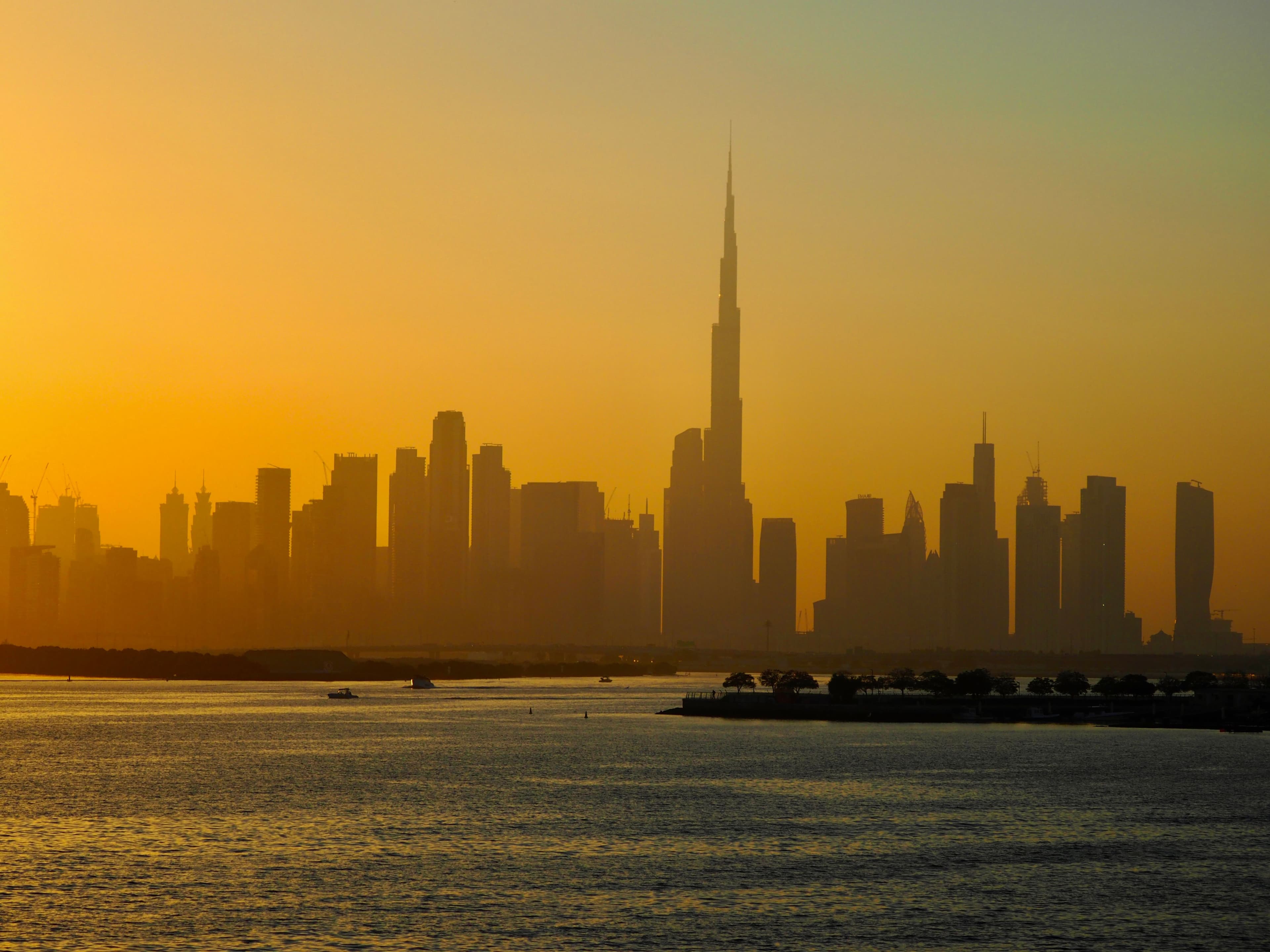
The Dubai Marathon starts at 06:30 in Jumeirah, close to Madinat Jumeirah, and finishes about 200m from the start. The most recent course was a series of out-and-backs on Jumeirah’s coastal roads: west along Al Sufouh Road to a turn near Dubai Media City at about km 6 and back, then twice north-east along Jumeirah Road to turns in Jumeirah 3 at about km 20 and km 34.5. The whole route sits within about 10 m of sea level, among the flattest marathon profiles anywhere. The road surface throughout is standard asphalt on wide, modern carriageways. There are no significant landmarks directly on the finish approach in the way Berlin has the Brandenburg Gate; Dubai’s skyline is visible from the course without framing its final metres.
The Sunrise Race
Most marathons treat their start time as a scheduling detail. Dubai’s 06:30 start is closer to the whole point of the race. In January, that gun time buys the field roughly the coolest two or three hours the city will offer that day, on a course with almost no shade to fall back on once the sun clears the skyline. The temptation this creates is specific and predictable: the opening kilometres feel almost too easy, cool air and flat roads combining to make marathon pace feel like a jog, and runners who chase that feeling tend to pay for it in full somewhere past the 25 km mark, once the temperature curve has caught up with them. The honest way to read Dubai’s start time is not as a mark of the race’s elite ambitions, though it is that too, but as the organisers’ one real tool for managing a heat problem they cannot otherwise solve. Treating the first hour as a gift, not a licence, is the difference between a fast morning and a difficult afternoon.
Km 0-6: The dark start. The gun goes at 06:30, which in mid-January Dubai means racing in genuine pre-dawn darkness for the opening half hour. The field heads west along Al Sufouh Road towards Dubai Media City on flat, wide road. For a runner who has trained through a British winter, the temperature at the start, typically somewhere in the high teens, will feel almost absurdly kind. That is the trap. Nothing about the opening kilometres tells the body to hold back.
Km 6-13: The first turn and back. The route turns near Dubai Media City at about km 6 and runs back east along Al Sufouh Road past the start area at Umm Suqeim, holding within a few metres of sea level for this entire stretch. Crowd support thins out here compared with the start and finish areas. With no hills and few turns to break rhythm, a runner has almost nothing external to check their effort against beyond a watch and how their legs feel.
Km 13-21: North-east along Jumeirah Road. The route continues north-east along Jumeirah Road through Umm Suqeim to a turn in Jumeirah 3 around the 20 km mark. By this point the early darkness has usually given way to full daylight.
Km 21-29: The turn for home, briefly. The route heads back along Jumeirah Road towards the start and finish area at Umm Suqeim, around km 27. Because the course runs this stretch out and back twice, this section is the first return leg, not the run-in to the finish, so pacing discipline still matters more than any sense of nearly being done.
Km 29-37: The second reach. A second push north-east along the same stretch of Jumeirah Road follows, to a turn at about km 34.5, mirroring the first. This is the section where the temperature curve usually bites. What began as a comfortable dawn run has typically become a fully risen-sun affair by now, and a runner who went out too hard in the cool first hour will feel it here, well before the end.
Km 37-42.195: The return to Jumeirah. The final stretch brings the route back to finish near the start point. The road stays at sea level to the line, so there is no late sting from a hidden rise. Direct sun and rising heat remain the dominant challenge right to the line.
The course follows the blue tangent line for its full length; running it accurately on the open road sections is the difference between a watch reading close to 42.195 km and one reading well over 43 km by the finish. The location of the finish timing mat relative to the visible finish arch has not been confirmed for 2027; check the final event guide.
The race starts in darkness at 06:30 and stays close to sea level throughout. This is the fastest-feeling stretch of the day and the most dangerous for a runner racing a PB, because nothing in the terrain signals that restraint is needed.
After the Media City turn, the route heads north-east along Jumeirah Road to its first turn in Jumeirah 3 before heading back toward the start/finish area. Daylight has usually arrived in full by this point, and the temperature begins its climb.
A second out-and-back stretch follows the shape of the first, but the sun is now fully up. Early over-pacing tends to surface here.
The course returns to sea level for the finish, with no late hills to punish a tired runner. Managing heat and hydration matters more here than managing terrain.
Course Map
The map shows a previous edition’s route (the 2027 route has not been published): west to Dubai Media City and back, then twice north-east along Jumeirah Road, plus the historical start, finish and the nearest Dubai Metro station. Tap a marker for details, and scrub the slider or press play to move the orange marker along the course with the elevation profile beneath it.
Pacers
No official mass-participation pacer programme has been published for 2027. If one is confirmed closer to race day, this section will be updated; until then, plan your race by effort and a personal watch.
What to wear
January temperatures in Dubai typically range from around 15°C at the coolest point before dawn to somewhere near 24 to 25°C by mid-morning, so the 06:30 start sits at the mild end of that range while the second half of the race runs into the warmer part of the day. Humidity and direct sun matter more here than cold ever will; rain risk in January is low but not zero. A light throwaway layer for the start line makes sense given the pre-dawn temperature, but overdressing is the more common mistake among runners arriving from a British winter, who tend to misjudge how quickly the morning warms.
Sunglasses and sunscreen are race-day kit, since later waves and slower finishers will spend real time running under a fully risen sun on exposed, shade-free roads. A light cap helps for the same reason. Standard racing kit, vest and shorts, works for the vast majority of finish times; this is not a race that calls for cold-weather layering once the sun is up.
Entry
| Registration type | Open, no ballot identified |
|---|---|
| 2027 entry fee | US$150 (marathon) · US$85 (10K) · US$50 (4K Fun Run) |
| Minimum age | 18 |
| Fast runner / GFA entry | No qualifying-time standard identified for 2027 |
Entry for 2027 is straightforward and does not appear to involve a ballot. The official registration page lists the full 42.195 km marathon as open to any runner aged 18 or over, starting at 06:30, priced at US$150. The 10K sits at US$85 and the 4K Fun Run at US$50. Registration is handled online through the official site.
This marks a real change from the uncertainty around recent editions, where regional race restructuring left some prospective entrants unsure whether the full distance was genuinely open to visiting age-group runners. As of this research, it clearly is.
Charity entry is referenced on the official site under a fundraising section, but a named charity-place programme with specific partner organisations has not been verified in accessible 2027 text. Tour operator and travel-package entry routes are linked from the official travel pages, but named 2027 operators and package pricing were not accessible during this research.
Travel and medical insurance is explicitly the runner’s own responsibility under the official rules. Refund, deferral and transfer terms beyond a general terms page were not fully extracted; international runners booking flights and hotels around this race should treat their entry as non-flexible unless the organiser states otherwise in writing.
No fast-runner or Good-for-Age seeding standard was identified in the accessible 2027 materials, so entry should be treated as open.
Race Weekend
Expo and Number Collection
The 2027 expo venue, address, dates and opening hours were not accessible in official materials at the time of writing. What can be stated with reasonable confidence, based on standard practice at this race and comparable Gulf events, is the shape of bib collection rather than its location: international runners should expect to need a passport or other photo ID alongside their confirmation email or QR code to collect a bib in person, with collection likely to run across two or three days before race day, not on the morning itself. Check the final 2027 athlete guide for the confirmed venue, transport route, bag-size restriction and queue pattern before travelling.
Race Morning
The 06:30 start makes race morning less about ceremony and more about not being late in the dark. Wave times, corral letters and a first-marathon wave policy have not been published for 2027, so the guidance here is general.
Getting to the start should not be left to chance. Dubai’s road closures on race morning can turn a normally short taxi ride into something considerably longer, so check the official road-closure map once published and build in a wide buffer. Where a Dubai Metro station sits close enough to the start to be useful depends on the confirmed 2027 start point; until that is published, a hotel within realistic taxi range of Jumeirah is the safer planning assumption than betting on a specific Metro line.
Clothing on the morning itself needs a light touch. Pre-dawn temperatures in the high teens Celsius can feel genuinely cool standing around at a start line, which tempts some runners into an extra layer they will regret within the first 10 km once the sun is up. A cheap, disposable top for the corral wait, discarded at the start, is a reasonable compromise; full base layers are not needed for a January Dubai morning.
Toilet queues, bag-drop mechanics, headphone rules and post-finish provisions have not been detailed in accessible 2027 materials. What is confirmed is the six-hour official cutoff, applied with police and medical support along the route; participants still out on the course after that point are asked to move to the footpaths. Medical staff have the authority to withdraw a runner from the race if they judge it necessary, and the organisers explicitly place responsibility for travel and medical insurance on the individual entrant.
On-course massage, changing facilities, showers and any medical deferral or pregnancy policy specific to this event have not been sourced. Given the heat risk in the second half of the race, runners with any pre-existing heat sensitivity should treat the six-hour limit and the medical-withdrawal rule as a meaningful part of their race plan, and should hydrate in the days before the race.
Nutrition on Course
Bisleri is named as the official water partner for the 2027 race, which confirms water will be available on course, but a station-by-station breakdown of exact km markers, sports-drink brand, gel provision and cup type has not been published.
Given the race’s climate, one detail worth confirming before the event guide is published is whether the organisers offer any cooling provision beyond standard water and sports drink, such as sponges or misting points, which matter more here than at a cooler-climate marathon. Personal bottle service has not been confirmed as available; runners who rely on a specific nutrition brand or concentration should plan to carry what they need.
In the absence of a confirmed table, sensible on-course strategy is to hydrate earlier and more consistently than instinct suggests, given how quickly the temperature curve moves through the race, and to treat every water station as mandatory rather than optional, particularly from the middle third of the course onward once the sun is fully up.
Spectating
Spectating this race well depends heavily on the confirmed 2027 route, which had not been published at the time of writing, so the guidance below is a planning framework.
Dubai’s road closures on race morning affect cars more than trains, so the Dubai Metro Red Line, which runs broadly parallel to the historical coastal race corridor, is the most promising tool for a spectator hoping to see a runner more than once, though its specific usefulness for this particular race depends on the unconfirmed 2027 course. Taxis remain workable for a single fixed viewing point, most obviously the finish area, but should not be relied on for moving between two points during the closure window.
A cautious, low-effort plan is to pick one point, most likely the finish, and stay there, avoiding any risk of a closed road or a missed train leaving a spectator stranded when their runner comes through. Live GPS tracking via the runner’s bib, standard at races of this scale, should let a spectator time their movements more precisely than guesswork.
Single-point plan:base at the finish area from before 06:30 and stay put through the runner’s expected finish window, using bib GPS tracking to judge timing. A confirmed two-point Metro itinerary requires the 2027 route map; specific station names will be added once that route is public.
Where to Stay
Until the 2027 start and finish points are officially confirmed, the single most useful principle for choosing where to stay is to prioritise proximity to whichever district the race actually starts and finishes in over any general neighbourhood preference. That said, four areas cover most of the realistic choices for a visiting runner.
Dubai Marina and Jumeirah Beach Residence (JBR)
The district most associated with the race’s historical route, given its position along the coastal corridor referenced in recent course descriptions. It suits runners who want beach recovery within walking distance after the race, with a dense concentration of restaurants and waterfront paths for an easy shakeout walk beforehand. It works less well if the confirmed 2027 start sits well to the east, since Marina traffic and taxi queues at peak times can be genuinely slow.
Downtown Dubai
Built around Burj Khalifa and Dubai Mall, this makes sense for runners treating the trip as sightseeing first and racing second. It runs at a higher price tier than Business Bay or Deira, and its convenience for race-morning logistics depends entirely on how far the confirmed start point sits from it, so it should not be booked purely on reputation.
Business Bay
A practical, modern base with generally easier taxi access than the more tourist-dense zones, at the cost of a less resort-like feel in the evenings. A reasonable middle-ground choice for straightforward road access without Downtown or Marina prices, though its convenience is entirely route-dependent until the 2027 course is public.
Deira and Bur Dubai
The budget option, built around Dubai Creek's souks and old wind-tower architecture rather than the beachfront race corridor, and useful for proximity to Dubai International Airport for runners flying in close to race day. It suits a traveller prioritising cost over race-morning convenience, and works less well for anyone wanting a resort feel or beach recovery.
Recommended hotels
A straightforward, well-run budget-to-midrange option close to Dubai Mall, useful for a runner treating this trip as much about sightseeing as racing.
A reliable, no-frills budget choice for a runner arriving close to race day who wants a predictable airport-adjacent base.
Positioned for beach-based recovery given the race’s historical proximity to this corridor, at a premium price point that suits comfort over budget.
A strong-service option with central road access, useful for straightforward taxi logistics without committing to a beachfront address.
A base near Dubai Creek's old wind-tower architecture and abra crossings, with reasonable airport access, a different setting from the glass-and-steel race corridor.
Booking timeline
There is no ballot result date for this race in the way London or New York have one, so there is no single moment when demand for hotels spikes overnight. What drives the booking calendar instead is Dubai’s position as a peak-season international destination throughout January regardless of the marathon, which means rooms and flights tighten for reasons unconnected to race entries. Booking three to four months ahead is a reasonable general guide for January travel to this city, though this reflects seasonal tourism patterns.
See & Do
January is the most comfortable month to be outdoors in Dubai. The Jumeirah beach strip, the Burj Khalifa, the historic Creek district and the desert beyond the city are all accessible in January heat that reads as pleasant.
Burj Khalifa / At the Top
The observation deck of the world’s tallest building rewards booking a timed ticket in advance. It suits a recovery day better than race-morning sightseeing, since the experience involves standing and waiting rather than walking.
Dubai Marina waterfront
A flat, paved waterfront path that works well as a gentle recovery walk in the cooler evening hours after the race, with restaurants and cafés lining the water for a low-effort stop along the way.
Jumeirah Public Beach
The most straightforward recovery option for a runner staying anywhere near the Marina or Jumeirah corridor, offering sea access without significant additional walking, which matters more than usual the day after a marathon.
Dubai Mall and the Dubai Fountain
The scale of the mall itself can turn what sounds like low-effort shopping into several kilometres of walking on tired legs, so it is worth visiting selectively rather than treating it as a rest-day activity by default.
Al Fahidi Historic District and Dubai Creek
The clearest counterpoint to the modern race corridor, with narrow lanes and traditional wind-tower architecture along the Creek. Best visited in the cooler morning or evening hours given the amount of walking involved.
Read Before you Run
City of Gold: Dubai and the Dream of Capitalism
Jim Krane
A grounded account of how Dubai grew from a small trading port into the skyline a runner will pass through on race day, useful context for a city whose race identity, built on flat roads and prize money, mirrors its own compressed modern history.
After the Race
The Dubai Marathon runs in January, the best month for outdoor travel in the wider Gulf and Levant region. Abu Dhabi is 90 minutes away and requires no flight. Muscat is a short domestic-feeling hop. Jordan in January is cool, clear and manageable at a post-marathon pace. All itineraries below assume legs that have had at least one day of recovery, except the local Marina and Jumeirah Beach day, which is built for the day immediately after.
A low-effort recovery day built around beach access and a flat waterfront walk, well suited to the day immediately after the race.
The Sheikh Zayed Grand Mosque and the Louvre Abu Dhabi, both a short drive apart, in a quieter and more considered city than Dubai.
Dramatic mountain and sea fjords at the tip of the Arabian Peninsula above the Strait of Hormuz, with dhow boat tours out of Khasab.
A change of pace from the coastal race corridor: desert dunes closer to the city, and cooler mountain and lake scenery further out at Hatta.
The Mutrah Souk, the Sultan Qaboos Grand Mosque and a Corniche built for slow evening walking, in a quieter Gulf capital than Dubai.
The Nabataean city carved into rose-red sandstone, and the desert valley of Wadi Rum beyond it. The most ambitious extension here, and the coolest climate of any of them in January.
Frequently asked questions
Should I stay near the start or the finish?
The Dubai Marathon has historically started and finished in the same Jumeirah area, near Madinat Jumeirah. The official 2027 start and finish points had not been published at the time of writing, so book a hotel within easy taxi reach of Jumeirah and confirm proximity once the route map is released.
How far in advance should I book a hotel?
There is no ballot result date driving a sudden booking rush here, since entry does not appear to involve a lottery. January is peak tourist season in Dubai regardless of the race, so book three to four months ahead as general seasonal guidance.
Is there free transport to the start?
No free Dubai Metro or RTA transport entitlement for entrants has been confirmed for 2027. Plan and pay for your own taxi, Metro or hotel transfer, and check the official road-closure plan in advance, since closures can extend normal journey times on race morning.
What is the best area to stay?
This depends on the confirmed 2027 start and finish location, not yet published. Dubai Marina and JBR align with the race’s historical coastal corridor and suit beach-based recovery; Business Bay offers easier general taxi access; Downtown suits sightseeing priorities; Deira and Bur Dubai suit budget and airport convenience.
When does the expo open?
The 2027 expo venue, dates and opening hours have not been published in accessible official materials. Check the official athlete guide closer to race day.
What is the weather typically like?
January in Dubai typically ranges from around 15°C at its coolest, before dawn, up to roughly 24 to 25°C by mid-morning. Rain risk is low but not zero. Direct sun and rising heat through the race matter more for planning than cold ever will, given the 06:30 start.
How do I get from the airport?
Dubai International Airport connects to the city by both the Dubai Metro and a well-established taxi network. Taxis tend to be simpler for runners carrying race kit or arriving fatigued; the Metro can be quicker and cheaper when it aligns with a hotel’s location.
Is there a bag drop?
Specific bag-drop arrangements for 2027 have not been confirmed in accessible official materials. Check the final pre-race athlete guide.
Should I bring a throwaway layer?
A light, disposable top for the pre-dawn corral wait is a sensible choice given typical January temperatures in the high teens Celsius before sunrise, but overdressing is the more common mistake among runners used to a colder home climate.
How do I get back to my hotel after finishing?
Post-race transport depends on which roads remain closed and the confirmed 2027 finish location, neither available in accessible official materials at the time of writing. Plan on the Dubai Metro where a station sits within reasonable walking distance, and on taxis otherwise, checking the official road-closure timeline before race day.