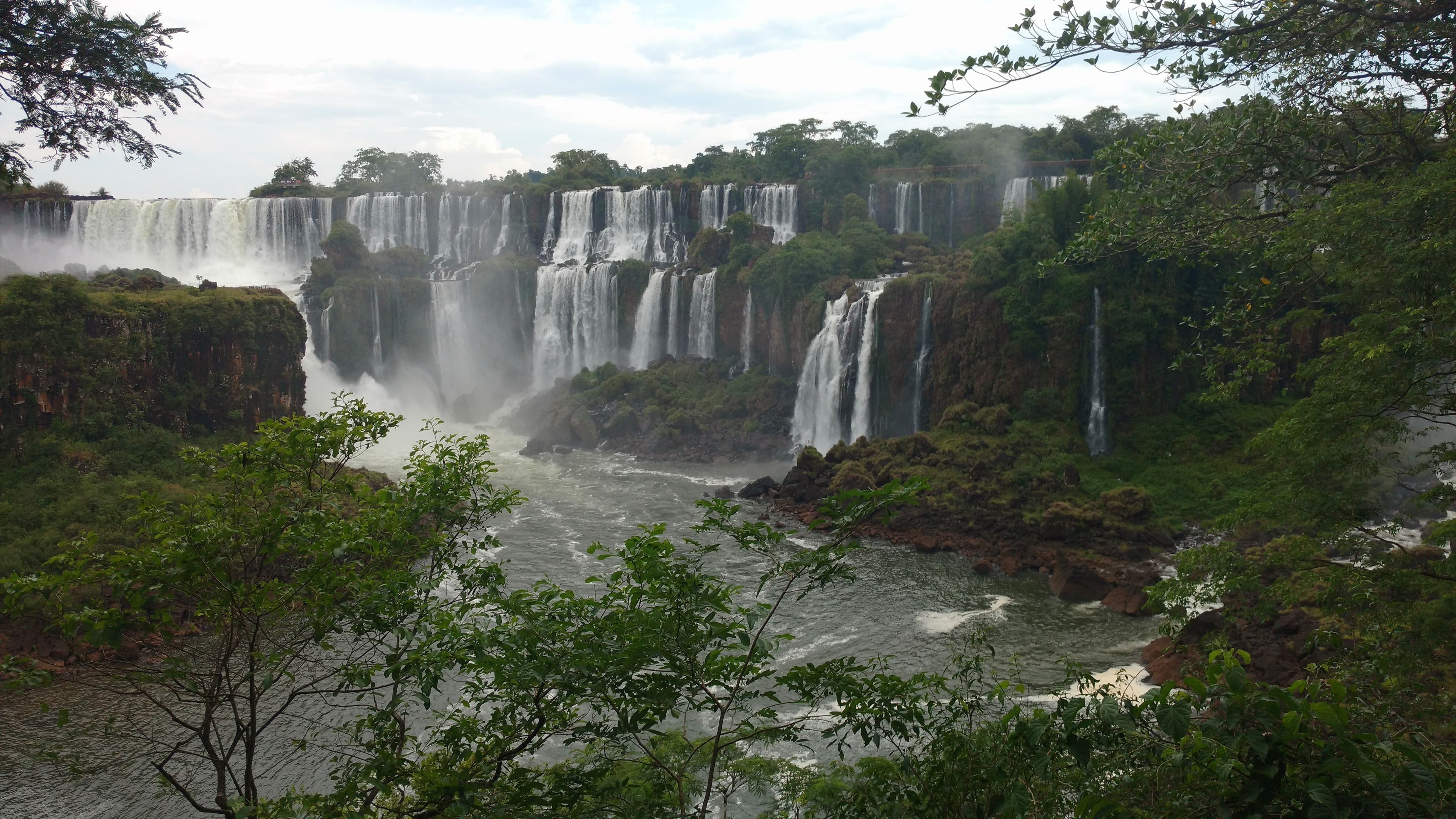
The Race
The marathon is entirely in Brazil, and no border crossing is involved. Foz do Iguaçu airport (IGU) is in Brazil. Iguazú airport (IGR) is in Argentina. Check which airport you book.
| Next Race Date | To be announced (the 2026 edition ran on Sunday 27 September) |
|---|---|
| Course type | Point-to-point road, Itaipu dam to the national park |
| Registration | Paid online entry through Sesc Paraná; medical certificate required; no ballot found |
| Ballot opens | No ballot |
| Total finishers | About 325 (2026, calculated from published results) |
| Average race day temperature | September low 17°C, high 26°C |
| Cutoff time | 6 hours from the category start (the rules also describe a 06:00 to 12:00 event window) |
| Free race-day transport | Official transfers for athletes in eight partner hotels; not general city buses |
| Course certification | CBAt Permit Ouro 37/2026; measurement certificate not seen |
History
The first race was run on 12 October 2007 as the Maratona Internacional das Águas. Sesc Paraná counted 223 marathon athletes, alongside a much larger local walk and run, and names Vanderlei Cordeiro de Lima as its first patron. In 2008 the race drew 505 marathon runners on 21 September, and Charles Kipngetich Korir is credited with 2:19:01, the men's best time. That is the organiser's figure, not an audited record.
The race took its present name in 2009, in honour of the host city, and by 2010 there were 729 marathon runners within a programme of 2,782. A two-person relay joined in 2012, with each runner covering about half the course. That is why the entry page carries a "21k" tile: it is a relay leg and not a separate half marathon.
The history has gaps. There was no race in 2014 because of the football World Cup. In 2015 the start moved to Sesc Foz during a strike at Itaipu, and in 2016 it returned to the Mirante do Vertedouro. The pandemic cancelled 2020 and 2021, and the race came back in 2022. The festival reached 3,419 athletes in 2023 and 5,045 in 2024. Local coverage says 2025 was not held after calendar changes, which is why the 2026 race was the 16th and not the 17th.
On 27 September 2026 Derlys Ayala won the men's race in 2:26:46 gun time, 2:26:45 net, and Vivian Jelagat Jeptepkeny won the women's in 2:39:37. Sesc reported 5,079 participants across the festival. A 17th edition was projected after the race, with no date.
The course
The marathon is a point-to-point road race. It starts at the Mirante do Vertedouro inside the Itaipu Binacional complex, runs south through Foz do Iguaçu and finishes inside the Parque Nacional do Iguaçu, near the Brazilian side of the falls. The start and finish are about 33 km apart in a straight line, and the whole course is in Brazil. No border crossing is involved.
The recorded line leaves the dam and runs almost due south down Avenida Tancredo Neves, then Avenida Juscelino Kubitschek, to reach the centre by km 16. It turns south-east onto Avenida das Cataratas at km 18 and follows the Rodovia das Cataratas to the park. The relay changeover is at 21.097 km, outside the Shopping Catuaí. The organiser's traffic notice also names Avenida República Argentina, Avenida Brasil and Avenida Jorge Schimmelpfeng among the affected roads.
The course rises and falls throughout. It drops 23 m in the first 3 km, climbs 53 m on Avenida Tancredo Neves to km 7.4 at 201 m, and stays between 177 and 189 m to km 17. A 59 m climb (2.3%) from km 17.8 takes the line onto Avenida das Cataratas, to 221 m at km 20. The longest sustained climbs after halfway are 48 m from km 25.9 to 28.8 and 54 m from km 32.5 to the high point of 240 m at km 37.4. The finish, at about 221 m, is 54 m above the start.
The finish is described in two ways. The regulations place it at Porto Canoas, and the distance page places it beside the Belmond Hotel das Cataratas. Both are in the park, close together, and the exact chute is not yet clear.
Kilometre by kilometre
The start. The start is inside a controlled hydroelectric complex, not in a public square. Runners are admitted from 05:00 with an ID or a bib, and companions cannot enter. The general start is at 06:30. The dam is the picture on the poster, but the water is not guaranteed: Itaipu's visitor operator says the spillway opens only when the reservoir has surplus water. The organiser's 2026 post-race report described open spillways that morning.
Km 0 to 16: Itaipu to the city. The route leaves the dam and runs south through the city, losing 23 m in the first 3 km, then climbing 53 m on Avenida Tancredo Neves to km 7.4. It is flat from there, between 177 and 189 m, to the centre. These are urban roads with partial closures, and the field is most compact here. The relay's first runners share this stretch, so watch for category signs.
Km 16 to 25: the bend and the climb. At km 18 the line bends south-east onto Avenida das Cataratas. A dip to 170 m is followed by a climb of 59 m (2.3%) to km 20. The relay changeover at km 21.097 outside Shopping Catuaí is a useful orientation point for a solo runner, not a place to stop. After it the road drops 41 m by km 24.
Km 25 to 37: the long rolling section. The Rodovia das Cataratas climbs 48 m from km 26 to 29, drops 45 m, then climbs 21 m and drops 25 m before the last long ascent of 54 m from km 32.5 to the high point of 240 m at km 37.4. Water stations come every 2 km from km 32, which helps in the warmest part of the morning.
Into the park. The last 5 km drop 20 m and rise a few metres to the finish inside the national park, beside Porto Canoas or the Belmond Hotel das Cataratas. The exact chute is yet to be published.
Do not plan on flat, downhill or fast. The profile rises and falls from start to finish.
A 23 m drop, a 53 m climb to km 7.4, then flat on partly closed avenues to the centre. Watch for relay signs.
The line bends south-east at km 18, then climbs 59 m to km 20. The relay changeover is at 21.097 km.
Three climbs of 48, 21 and 54 m between falls, topping out at 240 m at km 37.4. Water every 2 km from km 32.
A short drop of 20 m leads into the national park and a finish by the falls.
Course Map
The course as recorded for the 2026 edition, from the Itaipu dam south through Foz do Iguaçu and along the Rodovia das Cataratas to the national park. Tap a marker for details, and scrub the slider or press play to move the orange marker along the course with the elevation profile beneath it.
Pacers
No official pace teams had been announced when this page was written. Check the organiser's channels nearer the race.
The course starts inside the Itaipu complex and finishes inside the Iguaçu National Park. Start and finish are about 33 km apart in a straight line, so your bag travels with the organiser and you come back by bus.
The regulations place the finish at Porto Canoas and the distance page places it beside the Belmond Hotel das Cataratas. Both are in the park, close together. Wait for the organiser's map before you plan a meeting point.
The 21k tile on the entry page is the first or second leg of a two-person marathon relay, changing over at 21.097 km, and not an entry for a half marathon. Solo marathon entrants use their own rules.
September is spring in Foz do Iguaçu. A weather provider's September averages give a daily low of 17°C, a daily high of 26°C and 158 mm of rain. They are monthly figures with no stated station, not a forecast for 06:30 at the dam, and rain and changeable weather are possible.
A removable layer is sensible for the wait at the start, and a cap and sunscreen for the later kilometres on Avenida das Cataratas. Solo bags travel from the start to the finish, so you can send a dry top. No clothing-donation point was found, so do not leave clothes on the road. Shirtless running is not permitted.
Entry
No entry for the next edition has been announced. The details below belong to 2026.
The 2026 entry window opened on 18 June at 09:00 and was extended to 17 September at 23:59, subject to places. The solo marathon cost R$130 for the general public and R$80 for eligible members of the Sesc commerce group, who must hold an updated Sesc customer card. Athletes with disabilities entered free after a validation process. The relay was a separate team product.
Payment alone does not secure a place. A medical certificate stating that you can take part in unrestricted physical activity was compulsory for the marathon. It had to be dated after 28 September 2025 for that edition and sent to the organiser within ten calendar days of registering. Unpaid slips and unaccepted documents lead to exclusion, and the shorter Sesc events' PAR-Q form does not replace the certificate. Overseas runners should ask about the accepted language and format before the deadline.
The minimum age was 20 by 31 December 2026. There were twelve age groups from 20 to 24 up to 80 and over. Choose your category and distance carefully, because the rules do not allow later changes or private transfers of a bib. Handing a bib or chip to another person carries a two-year suspension. Refunds are not normally given, although a documented injury, accident or surgery can be put to the committee.
Elite entry is controlled separately, through CBAt or the Paraná federation, with a sporting CV and at least two official performances in the previous 24 months. Sending evidence does not guarantee admission, and each elite field is capped at 50. The regulations mention 4,500 athletes overall, the launch advertised 5,000 and the organiser reported 5,079 festival participants. None of those is a cap on the solo marathon.
| Elite reference | Men | Women |
|---|---|---|
| 10 km | Up to 38:00 | Up to 46:00 |
| Half marathon | Up to 1:15:00 | Up to 1:30:00 |
| Marathon | Up to 2:35:00 | Up to 3:15:00 |
Race Weekend
Bib collection
In 2026 numbers were collected at Shopping Catuaí Foz do Iguaçu, on Avenida das Cataratas, on Friday 25 September from 14:00 to 20:00 and on Saturday 26 September from 09:00 to 16:00. No kit was issued on race day. Some transfer material mentioned only Saturday, but the regulations gave both days.
Bring original photographic ID. Foreign runners were told specifically to bring a passport, and Sesc commerce entrants needed their updated customer card. Your payment and medical certificate must already have been accepted, although if the system has no electronic acceptance you may have to sign the forms at the desk.
A third person may collect your kit with a copy of your photo ID and the collector's own original ID. Ask about a foreign passport copy before you send someone. That is collection only, not a transfer of the entry.
The kit holds the number, a biodegradable shirt and the timing chip. Check your details, category and chip before you leave, since complaints are not accepted after chip collection. Elite athletes had a bottle handover on Saturday 26 September from 14:00 to 16:00 at the same mall. No exhibitor list or queue times were found.
Getting to the start
The 2026 marathon started in stages, on Brasília time: wheelchair athletes at 06:00, athletes with disabilities at 06:05, elite women at 06:10, and elite men, commerce runners, age groups and the first relay runners at 06:30. Do not borrow a 06:35 time from a shorter race.
Itaipu admitted runners from 05:00 on showing an ID or bib. Companions were barred from the start compound, so a family car cannot drop everyone at the dam and wait. The exact gate-to-start route, the bus departures and the last admission time have not been published.
Eight hotels were named as partners for programmed transfers: Águas do Iguaçu, Bella Itália, Bogari, Foz Plaza, Pietro Angelo, Rafain Centro, San Juan Tour and Tarobá. The transfers cover airport reception, collection, the start and the return, for athletes staying there. They are not general free city transport. Elsewhere, arrange your own approach. City bus 120 is a normal airport option, but the race-week notice announced diversions and closures from 04:00 to 13:00, so do not rely on it before dawn. Foz do Iguaçu airport (IGU) in Brazil and Argentina's Iguazú airport (IGR) are different places.
Hotel breakfast is a problem. Bogari's starts at 06:30 and Tarobá's at 06:00, both too late before a transfer, so ask for a packed early meal.
Solo bags are handed in at marked facilities at Itaipu, carried to the finish and reclaimed with your bib. Relay bags go elsewhere. Toilets, medical posts and a rescue bus are provided.
The time limit is six hours from the category start for prizes, but the rules also call the event a 06:00 to 12:00 window. Ask whether a 06:30 starter is supported until 12:30.
After the finish an internal bus runs from near the Hotel das Cataratas to the park entrance, where the hotel buses wait. The rules suggest a later return, since the awards run into the middle of the day.
Nutrition on course
In 2026 water was offered about every 3 km up to km 30 and every 2 km from km 32. The course had ten sports-drink points whose positions were not published. Toilets were provided on the course. The positions of gels, food and the brand and volume of the drinks were not published. Elite tables stood at km 13, 18, 23, 28, 33 and 38, supplied by the athlete. Elite bottles were handed in on Saturday and are not an open service.
At the finish, fruit, isotonic drinks and soft drinks were advertised, with a massage area. Carry your own gels. Medical posts, ambulances and kilometre signs are stated in the rules.
Spectating
Companions cannot enter the start at Itaipu. The best plan is the park finish or a city position, and they cannot easily be combined.
For companions of full-marathon runners in 2026, the park ran a special service from 07:00 to 08:00. Tickets were sold in person only, at the Visitor Centre between 05:00 and 07:50. Normal sales and transport resumed at 11:00. These are race arrangements and not the park's weekend schedule.
That makes two sightings hard. At an even four-hour pace, halfway comes around 08:30 and the finish around 10:30 from a 06:30 start. Those are arithmetic examples, not predictions. A companion at the relay changeover at km 21.097 could miss the early park window.
Wait outside the athlete lanes and agree a meeting point after baggage. No live tracking was found.
- Arrive at the Visitor Centre before 07:50 and buy a ticket for the full-marathon group.
- Take the authorised internal transport to the finish area.
- A three-hour runner from 06:30 finishes around 09:30.
Post-race food
Fruit, isotonic drinks, soft drinks and massage are advertised at the finish. That is not a meal, so keep a snack if lunch will be some time away.
Canoas Mirim, in the Espaço Porto Canoas at the end of the falls-trail area, is the park operator's current lunch recommendation. It is open daily from 12:00 to 16:00, serves a Brazilian buffet with drinks and desserts extra, and needs park admission. The older Cocar restaurant at the Visitor Centre is temporarily closed for works. Check the return bus before you linger.
Bona Trattoria, at Rua Almirante Barroso 883 in the centre, is an Italian restaurant that Visit Iguassu lists as open on Sunday from 12:00 to 15:00 and from 18:00 to 23:00, by reservation. Treat those hours as a directory listing to reconfirm. A central lunch needs the internal bus, the hotel bus and a shower first, so allow for them.
Where to Stay
The best reason to choose a hotel is its place in the transfer scheme, and not a walk to the finish. Itaipu and the falls are at opposite ends of a full marathon, with the city in between. Central Foz do Iguaçu keeps you on the Brazilian side, avoids a pre-dawn border crossing and gives an organised return from the park.
Centro, partner hotels
Tarobá Hotel is at Rua Tarobá 1048, about 12.6 km from the start and 22 km from the finish in a straight line. It is not the Tarobá Express, a different property, and its breakfast runs from 06:00 to 10:00 with checkout at 11:00. Bogari is at Avenida Brasil 106, with breakfast from 06:30 and the same checkout, and its own page puts it about 10.4 km from Itaipu and 26.4 km from the Brazilian falls as ordinary destination distances. Águas do Iguaçu is at Avenida Brasil 84. Bella Itália, at Avenida República Argentina 1700, has a restaurant and a tourist desk. Rafain Centro, at Rua Marechal Deodoro 984, advertises adapted rooms and is not Rafain Palace.
Ask each hotel for an early packed breakfast, a late checkout and written confirmation of the 2027 transfer. A property near the airport or on Avenida das Cataratas suits a tourism trip, but no unnamed hotel is recommended. Staying in Puerto Iguazú adds a border crossing and an unverified race transfer, so it fits better after the race.
Recommended hotels
Rua Tarobá 1048. A named partner, not the Tarobá Express. Lists baggage storage and a 24-hour desk. Breakfast is 06:00 to 10:00 and checkout 11:00, so ask for an early meal and late checkout.
Avenida Brasil 106. A named partner. Its own page gives about 10.4 km to Itaipu and 26.4 km to the Brazilian falls as ordinary destination distances, not race routes. Breakfast starts at 06:30.
Avenida República Argentina 1700. A named partner with a restaurant and a tourist desk. Check cancellation terms for your rate and ask about road noise.
Avenida Brasil 84. A named partner. Confirm early food, room equipment and late checkout.
Rua Marechal Deodoro 984. A named partner with a restaurant and adapted rooms advertised. Its own page gives about 24 km (14.9 miles) to the falls as a general distance. It is not Rafain Palace.
Booking timeline
Wait for the 2027 announcement before committing to a September Sunday. The race skipped 2025, so a last-Sunday pattern is not safe. Refundable enquiries are fine, but a projected date is not an open entry.
When registration opens, choose the individual 42.195 km race and the correct category. In 2026 the medical certificate was due within ten calendar days of registering. Check the new certificate model, the date rule and the email address, and check the list of confirmed athletes. The R$130 and R$80 fees were 2026 prices.
Book a partner hotel only after confirming that it takes part in the 2027 transfers, serves early food and allows late checkout. Arrive in time for the desk: in 2026 collection closed on Saturday at 16:00, with no kits on Sunday.
In race week, get the gate and transfer timetable, your category start, the cutoff clarification and the baggage plan. For Argentina or Paraguay, check your own passport, visa and re-entry requirements, and allow for border queues. The shuttle does not guarantee a same-day international flight.
See & Do
Distances are from the finish in the national park, in a straight line, kilometres first, where they could be measured.
Brazilian side of Iguazu Falls
The park is the finish setting, but the visit is a separate ticketed day. It normally opens 09:00 to 16:00 on weekdays and 08:30 to 16:00 at weekends, with timed entry and an internal bus. The falls trail is about 1 to 1.5 km on the operator's pages, with steps and wet surfaces. Take breaks, and do not assume the race bib admits you.
Parque das Aves
A separate paid bird park on the Rodovia das Cataratas at km 17.1, open daily from 08:30 to 16:30, with about two hours of forest walking on the municipal listing. Do not stack it with a full falls visit on the same day after 42 km.
Itaipu Panorâmica
A bus-led tour of the dam complex lasting about 1 hour 10 minutes, with security screening. The operator and the municipality give slightly different start windows, so check the first departure. The spillway is open only when the reservoir has surplus water. A good low-effort option the day after the race.
After the Race
The marathon is on a Sunday, and the falls are minutes from the finish, so the first free day can be the Brazilian falls at a slow pace after a night of recovery. The Argentine falls and San Ignacio need a border crossing and more nights. Check your passport, visa and re-entry requirements before you plan across the border.
The national park's timed entry and the falls walk at a slow pace, after a night of recovery. The Parque das Aves is a separate ticket.
A night in Argentina and a visit to the other side of the falls the next morning, with a limited circuit.
The Jesuit-Guaraní ruins in two nights, to avoid an 11-hour same-day trip.
Three or four nights in Buenos Aires after the falls, with short visits in San Telmo and rest between museums.