The Race
| Next Race Date | 4 July 2027 |
|---|---|
| Course type | Out-and-back coastal road |
| Certification | World Athletics Label Road Race, AIMS Certified |
| Start | Broadwater Parklands, Southport |
| Finish | Broadwater Parklands, Southport (finish chute beside the Broadwater) |
| Total finishers | ~15,000 (2025 marathon-only field) |
| Avg race-day temp | 7 to 15°C at the gun, warming through the morning |
| Cutoff time | 6 hours 40 minutes (from the final wave’s start) |
| Free race-day transport | Yes: G:link tram, free for registered participants showing their race number |
| Course certification | AIMS Certified |
| Sleeper Train | Not accessible |
The Gold Coast Double
Runners who complete both the China Airlines Half Marathon on Saturday and the ASICS Gold Coast Marathon on Sunday, a combined 63.3km across the two days, qualify for the FIXX Nutrition Gold Coast Double. The reward is a second medal and gift, collected from a dedicated tent near the big screen on the event lawn after the Sunday race. It is a genuinely demanding proposition: back-to-back half and full marathon distances on consecutive mornings, with only one night’s recovery between them.
History
The Gold Coast Marathon began as a health campaign, not a spectacle. On 2 September 1979, 124 runners lined up outside the Evandale Civic Centre for six laps over the Chevron Island Bridge, through Surfers Paradise and back across the Isle of Capri Bridge. Eric Sigmont and Mary Murison won that first edition. Nobody involved could have guessed it would grow into Australia’s only World Athletics Label marathon outside Sydney.
The race found its identity slowly, then all at once. Moving the course onto the flat coastal strip between Southport and Miami turned Gold Coast into a byword for personal bests: roughly six in ten finishers now leave with a new number next to their name. Japanese distance running has shaped the record books more than any other nation’s. Yuta Shitara ran 2:07:50 in 2019, Naoki Koyama trimmed it to 2:07:40 in 2023, and in 2025 Yuki Takei, running his first marathon outside Japan, took it to 2:07:33, with eight of the top ten finishers that year also Japanese.
Then came 2026. Haftu Strintzos, 26, broke clear of the field and crossed the line in 2:06:20, cutting 73 seconds from the course record and, in the same stride, the Australian national record previously held by Andy Buchanan since Valencia in 2024. It was the first Australian win at Gold Coast since Lee Troop in 2006. “I felt pretty good by about 30km,” Strintzos said afterwards, crediting the pacers for holding an even, disciplined tempo through the race’s flattest, most temptation-laden middle section.
The 46th edition drew entries from a record 60 countries and sold out within eight hours of registration opening, part of a field that has more than doubled in size since the pandemic-era cancellations of 2020 and 2021.
The course
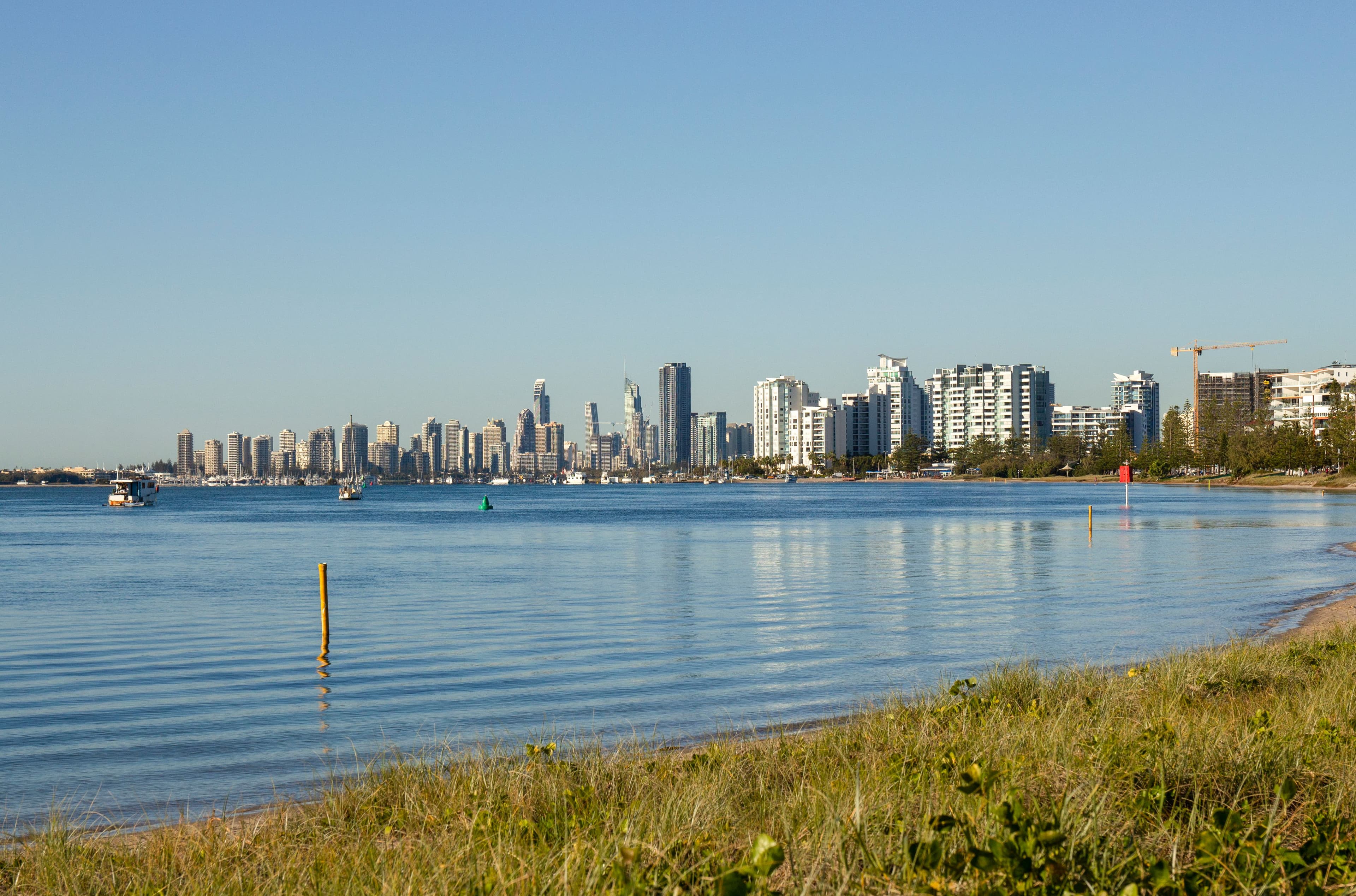
The Gold Coast Marathon starts and finishes at Broadwater Parklands in Southport. The route runs out-and-back along the coastal strip: south along the Esplanade past the city’s surf beaches to a turn point at Miami, then north through Runaway Bay before returning to the finish chute beside the Broadwater.
The course is flat by any marathon’s standard: total elevation change across the full distance is approximately 62m, with no sustained climbs or descents at any point. Nearly 29km of the route runs within sight of the Pacific, and the surface throughout is sealed coastal road. The course is AIMS Certified and accepted for Boston Marathon qualifying.
Km 0-5: Southport out.The gun goes off at 6:15am from Broadwater Parklands, early enough that most of the field is still working out whether they needed the throwaway layer they packed. The opening kilometres run flat along the Gold Coast Highway and out and back on Sea World Drive along The Spit, and the temptation here is the same one every flat course sets: the pace feels too easy, so runners bank time they don’t have.
Km 5-15: The surf beaches.This stretch is the course’s postcard section, running within sight of the Pacific for long unbroken periods. Crowd support builds through the beachside suburbs, though the character of the field starts to separate here: PB-hunters holding disciplined splits, and everyone else discovering that flat is not a synonym for easy.
Km 15-25: Miami and the turn. The course reaches its southern turn point at Miami at about 17 km, then heads back north past Broadbeach and Surfers Paradise. Turning back on yourself on an out-and-back route means passing the field coming the other way, which is either a motivating spectacle or a demoralising one depending on how the first half has gone. Whatever wind there is on race day tends to be noticed here, since there is nothing but open water and low-rise buildings to break it.
Km 25-37: back through Southport to Runaway Bay.The route passes the start area at about 31 km and continues north along the Broadwater through Labrador and Biggera Waters to a final turn at Runaway Bay at about 37 km. This is the flat course’s honest reckoning. There is no hill to blame for a fade, so any pacing error from the first half shows up here as cramp, heavy legs or a stubbornly climbing heart rate at unchanged pace. Humidity, not heat, is usually the more relevant risk in Queensland’s winter, and it can make effort feel harder than the temperature alone would suggest.
Km 37-42.195: Back to the Broadwater.The finish approach returns runners south along Marine Parade to Southport and the Broadwater Parklands precinct, with the finish chute set beside the water. Well-paced runners benefit from the total absence of late climbing, and the finish area, with the event village and grandstand crowd, is one of the race’s genuine strengths.
The blue tangent line marks the shortest legal route between the turn points: follow it, since the difference between hugging the tangent and drifting wide adds up over 42.195km.
Flat, straight and deceptively easy. Hold the pace you planned, not the pace the empty road is tempting you toward.
The course's scenic high point, with the Pacific in view for long stretches. Crowd support builds through the beachside suburbs.
The southern turn point at about 17 km, where wind exposure is most noticeable and the field passing the other way becomes hard to ignore.
Past the start at 31 km to a final turn at Runaway Bay at 37 km, then back to the Broadwater. No hills left to hide behind. Pacing discipline from the first half decides how this section feels.
Course Map
The map shows the official 2026 course route from Southport south to Miami and north to Runaway Bay, the shared start/finish at Broadwater Parklands, the expo venue, and the free G:link tram stations serving the precinct. Tap a marker for details, and scrub the slider or press play to move the orange marker along the course with the elevation profile beneath it.
Pacers
The official site maintains a Pace Runners page, and Strintzos credited pacers directly for his 2026 course record. Wave seeding is based on predicted finish time, entered at registration and adjustable via the Update My Entry portal before race number collection.
What to wear
Race-day conditions in 2026 read 15.1°C at report time with a “feels like” of 7.1°C, 75% humidity and a southerly wind around 21kph, a reminder that a Gold Coast winter morning can bite more than the postcard suggests. Broadly, expect a cool, sometimes damp start before 7am, warming through the morning as the field moves south and back.
A throwaway layer for the start village is standard practice here, since gun time is well before sunrise warmth arrives and the wait in the corrals can run long for a big field. Humidity, more than heat, is the practical risk on the Gold Coast: even a mild morning can feel harder than the thermometer suggests once the field is an hour into the race. Wind is the other variable worth planning for, since the exposed waterfront sections around the turn point offer little shelter. Sunscreen matters more for later waves and slower finishers, who are on the course into the late morning when the winter sun has more bite than expected. Standard racing kit otherwise applies: this is not a course that punishes underdressing the way a cold-weather major might, but conditions have varied enough year to year that checking the seven-day forecast close to race week is worth the five minutes it takes.
Entry
| Registration type | Open, no ballot |
|---|---|
| 2026 entry fee | A$235 (approx. £124 at a late June/early July 2026 rate) |
| Other pathways | Good for Age, Charity Place, official travel partners |
Entry to the ASICS Gold Coast Marathon is open, with no ballot. Registrations for the 2026 race opened at 9am AEST on 2 December 2025 and sold out within eight hours, part of more than 33,000 registrations across all eight race-weekend events in the first 24 hours alone.
The 2026 marathon entry fee was A$235, which converts to approximately £124 at a late June/early July 2026 rate of roughly £1 to A$1.90. Given the marathon and half marathon both sold out in hours in 2025 and 2026, the practical advice is to enter as soon as the window opens, before confirming travel plans, and to accept that shorter distances may still have room after the marathon itself is gone.
Beyond standard entry, three other pathways exist. A Good for Age program admits runners who have met specific time standards in a previous marathon or half marathon, with 2026 applications closing 30 January. Charity Place Entries are available through official charity partners in exchange for raising a minimum of A$2,000. International runners can also book through official travel partners, including Marathon Tours & Travel, which packages race entry with accommodation.
Wave seeding is based on predicted finish time, entered at registration and adjustable via the Update My Entry portal before race number collection. Entry transfers in 2026 were only permitted through an official window (24 March to 24 May), a policy the race enforces partly because of scalping and scam activity once distances sell out.
No official Good for Age or Fast Runner standards table has been published for this race; do not treat any third-party figure as confirmed until the organiser publishes one.
Race Weekend
Expo and Race Pack Collection
The ASICS Sport & Leisure Expo runs at the Gold Coast Convention and Exhibition Centre in Broadbeach, billed as Australia’s largest running exhibition. In 2026 it opened Thursday 2 July from midday to 7pm, Friday 3 July from 9am to 8pm, and Saturday 4 July from 9am to 4pm. Friday is the last day to collect a race number for the Saturday events (half marathon and the 10km, 5km and junior distances); marathon runners racing Sunday have the full three-day window.
The official guidance flags Thursday’s 4pm to 6pm slot and Friday’s 11am to noon and 4pm to 5pm windows as the historically busiest collection periods, useful information for anyone wanting to move through quickly. Bring your entry certificate, sent with your confirmation email, to collect your race number; if collecting for someone else, bring a copy of their certificate too. Teams of 20 or more can arrange group collection or postage instead. The expo houses the only official merchandise point, an ASICS pop-up store, alongside sponsor stands and exhibitors.
Getting to the Start
Race weekend runs across two days. On Saturday: the China Airlines Half Marathon, Wheelchair and standard 10km and 5km events, and the Junior Dash. On Sunday: the Wheelchair Marathon and the ASICS Gold Coast Marathon itself at 6:15am, with a cutoff of 6 hours 40 minutes from the final wave’s start.
Staying in Southport or the Main Beach precinct puts runners within easy walking distance of the start and finish, both at Broadwater Parklands on Marine Parade. For anyone based further along the coast, the G:link tram is free for registered participants who show their race number when boarding, running from 4am to 2:30pm on Saturday and 4am to 3:30pm on Sunday; alight at Southport, Southport South or Broadwater Parklands. Drivers are directed to Australia Fair Shopping Centre’s east-side car park, which offers up to three hours free from 4am across the weekend. Road closures between Paradise Point and Miami begin at 3:30am and run until roughly 1:30pm Saturday and 2:30pm Sunday, so spectators and support crews should factor that into any cross-town plans.
Runners assemble in start zones matching the letter printed on their race number; running from the wrong zone risks disqualification, so anyone whose predicted time has changed since entering should update it via the Update My Entry portal before number collection, not on the morning itself. A disposable layer for the pre-dawn wait is standard practice, since gun time is well before the morning warms.
After Finishing
The Recovery Area at Broadwater Parklands is where finisher shirts, medals and finisher gifts are distributed, alongside options to download a finisher certificate or add a personalised Medal Tab. Anyone doing the Gold Coast Double collects an extra medal and gift from a dedicated tent near the big screen on the event lawn. Given the scale of the finish precinct on race day, agreeing a specific meeting point with family or support crew before the gun goes off is worth the extra planning.
Nutrition on Course
The course runs 16 water and refreshment stations across 42.195km, roughly one every 2.5 to 3km. FIXX Nutrition’s Fuel X sports drink is available alongside water at select stations.
| Km marker | Water | Sports drink | Notes |
|---|---|---|---|
| 2.5 | Yes | No | Water station |
| 5 | Yes | Yes | Refreshment station |
| 7.5 | Yes | No | Water station |
| 10 | Yes | Yes | Refreshment station |
| 12.5 | Yes | No | Water station |
| 15 | Yes | Yes | Refreshment station |
| 17.5 | Yes | No | Water station |
The same roughly-every-2.5km pattern of alternating water and refreshment stations continues from 20km through to the finish. There is no strong evidence of systemic aid-station failure from research, and no personal-bottle-service procedure has been confirmed for this course. Given the humidity risk noted above, the practical advice is to drink at the earlier stations even if the morning still feels cool.
Spectating
Southport and the Broadwater Parklands precinct give spectators the simplest plan: stay at the start-finish area and watch the field pass at least twice, since the out-and-back structure sends runners south past the same point before doubling back north later in the race.
For a more active spectating day, the G:link tram makes it possible to see a runner at one point along the course, then move ahead to catch them again closer to the finish.
Itinerary A: start at Southport for the early kilometres near Broadwater Parklands, take the G:link tram towards Main Beach or Surfers Paradise for a mid-race sighting along the beachside stretch, then return to Southport by tram in time for the finish.
Itinerary B:start at Broadbeach for a sighting on the southern out-leg, take the tram north to Southport ahead of the field’s return, then walk to the finish chute at Broadwater Parklands.
Itinerary C: watch the start at Broadwater Parklands, take the tram to Runaway Bay for the northern return leg, then walk back or tram south to the finish.
The official event app and finish-line live cameras allow remote tracking for anyone not planning to move around on the day.
Where to Stay
Southport / Broadwater Parklands
Southport and the Broadwater precinct are the obvious choice for anyone prioritising race-day logistics: this is where the start and finish both sit, so it removes transport planning from the morning almost entirely. It is functional and marina-adjacent rather than a lively night-before base, but that trade-off is exactly the point.
Main Beach
Main Beach adds a beachier, quieter residential feel without pushing race-morning transport time up much, roughly 2km from the precinct by a short tram ride or walk.
Surfers Paradise
Surfers Paradise is the coast’s best-known strip, tram-connected direct to Southport and lively, though that liveliness cuts both ways the night before a 6:15am start. It suits runners prioritising nightlife and dining variety over a quiet pre-race sleep.
Broadbeach
Broadbeach sits a little further south and works as a polished compromise between strong dining options and manageable race-morning logistics via the tram, calmer than Surfers Paradise but still well served by restaurants for the days either side of the race.
Mermaid Beach, Miami and Burleigh Heads
Mermaid Beach and Miami suit spectators wanting proximity to the course’s southern turn point, though they add morning travel time for runners themselves. Burleigh Heads is relaxed and surf-focused, the strongest post-race lifestyle base among these options but the furthest from the precinct and best suited to time after the race.
Booking timing matters more than the neighbourhood choice itself: with entries selling out within hours, hotel rooms across all these areas book up fast in the following weeks, particularly anything within walking distance of Broadwater Parklands.
Recommended hotels
Closest realistic accommodation to the start-finish precinct, with self-contained apartment-style rooms that suit runners wanting a kitchen for pre-race breakfast.
A straightforward, well-priced base within walking distance of Broadwater Parklands, useful for runners prioritising a short race-morning walk over resort amenities.
Tram-connected to Southport via G:link, with the trade-off of Surfers Paradise's livelier Saturday night against easier access to the strip's dining and nightlife the evening after finishing.
Positions runners close to the Pacific Fair dining precinct and the Convention Centre expo venue, at the cost of a longer race-morning tram trip to Southport.
A full-service casino resort suited to runners treating race weekend as a broader holiday rather than a pure performance trip; the trade-off is the same tram commute as other Broadbeach options.
Booking timeline
There is no ballot for the Gold Coast Marathon, so there is no results-announcement date driving a booking rush the way there is for ballot-entry majors. Instead, the trigger is entry day itself: with the marathon and half marathon both selling out within hours in 2025 and 2026, hotel availability in Southport and the immediately surrounding precinct tightens fast in the days after registration opens, typically early December.
The practical advice is to book accommodation in the same week as entering, not after, particularly for anything within walking distance of the start and finish. Winter is the Gold Coast’s dry season and a popular one for domestic tourism generally, so marathon weekend competes with ordinary July demand on top of the race itself. Flights into Gold Coast Airport from other Australian capitals are frequent and rarely require booking further than six to eight weeks out, though international travellers connecting through Brisbane or Sydney should allow more buffer.
See & Do
The finish at Broadwater Parklands puts you in Southport, within reach of the Gold Coast’s beaches, its best-known strip, and the Convention Centre precinct in Broadbeach.
Broadwater Parklands
The race’s own finish precinct doubles as a genuinely pleasant public park along the water, with shaded lawns that suit the low-effort recovery walk most finishers actually want in the hours after 42.195km. There is little practical reason to go further afield on race day itself.
Surfers Paradise Beach
The classic Gold Coast beach stop, wide and patrolled, reachable by a short tram ride from Southport. A low-effort way to spend an afternoon with sore legs and sand rather than pavement underfoot.
Burleigh Head National Park
Genuinely scenic coastal headland walking with ocean views and, in season, whale sightings, but it involves actual hills, so it suits day two or three of a stay.
SkyPoint Observation Deck
Views over the coastline from height with minimal walking once inside, a reasonable option for a low-leg-load activity on the day of the race itself.
Pacific Fair, Broadbeach
A practical post-race food and shopping base with enough variety to suit a group with different appetites, close to several of the recommended Broadbeach hotels.
Read Before you Run
The Land Before Avocado
Richard Glover
A wry, affectionate account of Australian suburban and beach culture before it became fashionable, useful shorthand for overseas visitors trying to understand the very particular, unpretentious character of a Queensland beach town on race weekend.
After the Race
The Gold Coast Marathon runs in July, the dry, mild heart of the Queensland winter. These itineraries range from a same-day walk at Burleigh Heads to a four-night extension north to Noosa and the Sunshine Coast.
A half-day of coastal walking at Burleigh Head National Park followed by a calm paddle or swim at Tallebudgera Creek, a gentler alternative to the ocean for anyone whose legs have had enough impact for one day. July's mild, dry winter weather suits this kind of unhurried outdoor day well.
A quick rail connection turns the Gold Coast trip into a two-city visit, with Brisbane's riverside precincts and galleries offering a change of pace from beach and marathon logistics. Winter in southeast Queensland means comfortable daytime temperatures for walking the city without summer humidity.
A well-worn extension for Gold Coast visitors, trading marathon infrastructure for a slower, more bohemian beach town with its own strong food and coffee culture. Booking transport a few days ahead is sensible, since shuttle seats fill around race weekend.
A longer, more relaxed Queensland coastal extension, suited to runners treating the marathon as the start of a proper holiday. July's mild days and cool evenings make this an easy season for walking Noosa's national park headland without summer's heat.
Frequently asked questions
Should I stay near the start or the finish?
They are the same place. The Gold Coast Marathon starts and finishes at Broadwater Parklands in Southport, so there is no trade-off to weigh between the two, unlike marathons with separated start and finish precincts. Staying in or near Southport removes race-morning transport planning almost entirely.
How far in advance should I book a hotel?
As soon as you have an entry confirmed, ideally the same week. Entries have sold out within eight hours in each of the last two years, and hotel rooms in Southport and Broadbeach book up quickly once that happens. Winter is also general tourist season on the Gold Coast, adding ordinary demand on top of the race.
Is there free transport to the start?
Yes. The G:link tram is free for registered participants who show their race number when boarding, running from 4am to 2:30pm on Saturday and 4am to 3:30pm on Sunday of race weekend. Alight at Southport, Southport South or Broadwater Parklands for the shortest walk to the precinct.
What is the best area to stay?
Southport or Main Beach for the simplest race morning, since both sit within walking distance of the start and finish. Broadbeach is a strong compromise for anyone who wants a stronger dining scene and does not mind a short tram ride on race morning.
When does the expo open?
In 2026 it ran Thursday to Saturday at the Gold Coast Convention and Exhibition Centre in Broadbeach, with Friday as the last day for anyone racing on Saturday to collect their number. Exact 2027 dates and hours had not been published at the time of writing.
What is the weather typically like?
Expect a cool, sometimes damp start well before sunrise, warming through the morning. Humidity, more than raw temperature, is the practical risk here, and wind is noticeable on the more exposed waterfront sections. A throwaway layer for the corrals is standard practice.
How do I get from the airport?
Gold Coast Airport connects to Southport and the wider coastal strip by shuttle, taxi or rideshare, with the journey typically taking 30 to 45 minutes depending on traffic and exact destination. There is no direct tram link from the airport itself.
Is there a bag drop?
The race runs a bag drop and recovery area at Broadwater Parklands, though exact procedures and any size restrictions should be checked against the current athlete guide closer to race week.
Should I bring a throwaway layer?
Yes. Gun time is well before the morning warms, and the wait in the start corrals for a field this size can run long. A cheap layer you're happy to discard at the start line is standard practice for this race.
How do I get back to my hotel after finishing?
The G:link tram remains free for registered participants through the afternoon (until 3:30pm on Sunday), which covers most reasonable post-race timeframes. For anyone finishing later or staying further out, a taxi or rideshare from the Broadwater Parklands precinct is the practical fallback.