The Race
| Next Race Date | Sunday 22 November 2026 |
|---|---|
| Course type | Loop: start by City Hall, finish on the Boulevard, about 100 m apart |
| Registration | Open online entry, no ballot; sold out for 2026 |
| Ballot opens | No ballot |
| Start | Hernani Street, beside City Hall, 09:00 (10 km at 08:15) |
| Finish | The Boulevard, by the old town |
| Total finishers | 5,100 (2025) |
| Avg race-day temp | About 8 to 16°C (AEMET San Sebastián airport November normal); 6 to 7°C at the 2025 start |
| Cutoff time | 5 hours, with limits every 5 km |
| Free race-day transport | No |
| Course certification | RFEA certified; no World Athletics label |
History
San Sebastián ran its first marathon on 15 October 1978, less than five months after the first Madrid Marathon, which makes it one of Spain’s oldest. Rafa Puignau, a former international athlete, talked a group of local volunteers into staging it. The course was one lap of about 4 km and two of about 19 km. Officials measured it first with a wheel, which proved unreliable on the rough asphalt, then with a tape over several Sundays, and worked out the results by hand.
The women’s race produced early national records. Seventeen-year-old Rosi Talavera from Hernani won the first women’s race in 3:27, a Spanish best at the time, and Ana Isabel Alonso ran a Spanish record of 2:26:51 here in 1995. In 1993 the city staged the IAAF World Cup Marathon. The course moved several times, with starts or finishes at the Anoeta stadium, before a new route in 2022 brought the whole race into the centre and replaced the stadium finish with a long straight on the Boulevard. Zurich became title sponsor in 2016.
The course records are Timothy Cherigat’s 2:09:34 from 2002 and Rebecca Tanui’s 2:23:09 from 2022. The 2025 edition, the 46th, sold all 7,000 marathon places and drew 11,500 runners with the 10 km, from 70 countries; 5,100 finished the marathon. Britain’s Thomas Holliday won in 2:22:34 and the local runner Maite Arraiza in 2:44:59. The 2026 marathon sold out before September.
The course
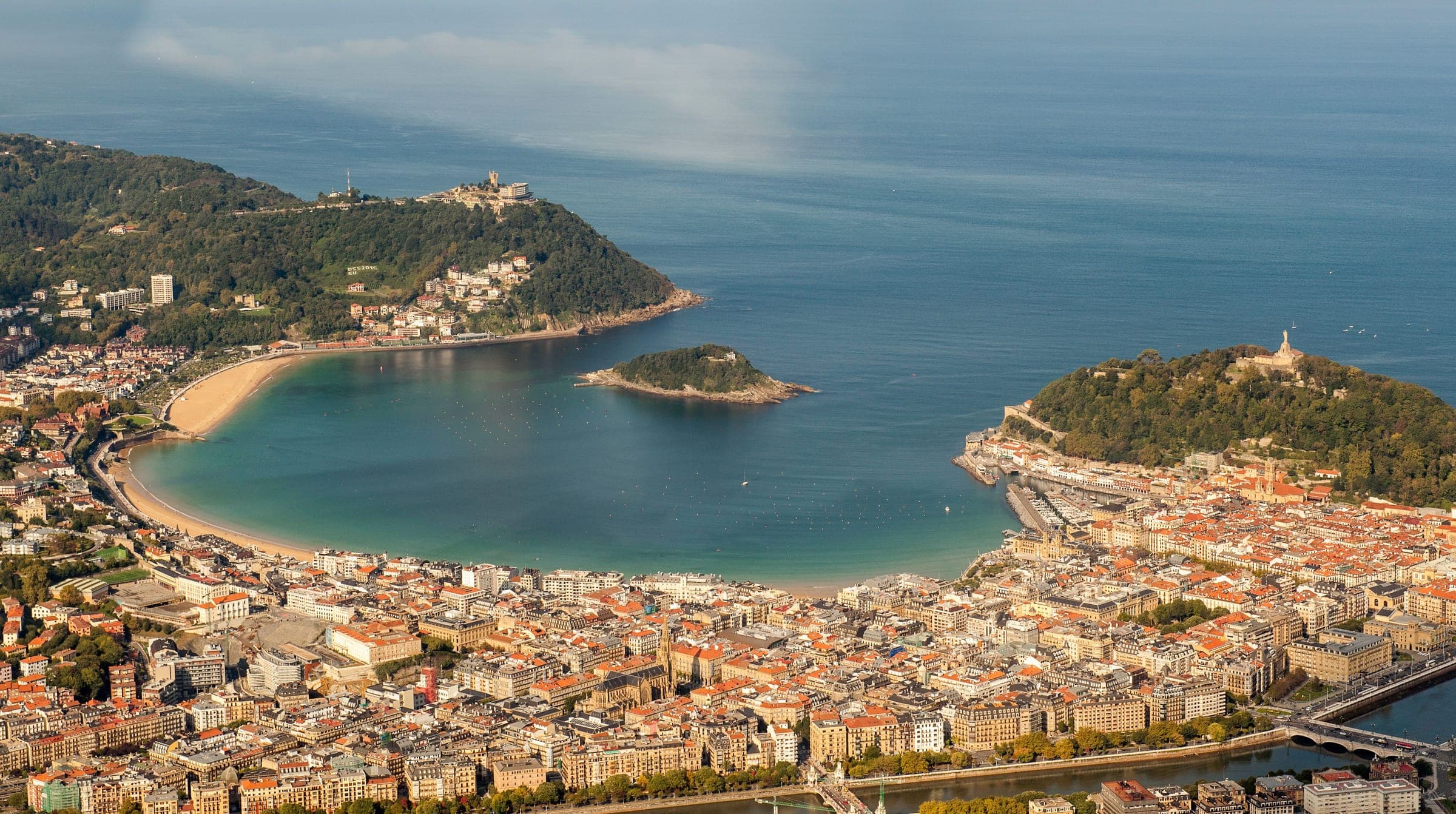
The marathon starts at 09:00 on Hernani Street, beside City Hall and the Alderdi Eder gardens at the eastern end of La Concha, and finishes on the Boulevard, about 100 m away at the edge of the old town. In between it loops through four districts: Centro, Antiguo to the west, Amara to the south and Gros across the river to the east.
The route runs south along the River Urumea through Amara to the Anoeta stadium area three times, at about km 3 to 5, km 16 to 19 and km 33 to 36; the furthest point from the start is at Anoeta, km 16.8, only 2.6 km out. It runs west along La Concha past the Miramar palace to Antiguo twice, turning at km 10.7 and km 28.0, and crosses the Urumea into Gros past the Kursaal and Zurriola beach twice, at km 22 to 25 and km 39 to 42, before the final straight to the Boulevard.
The organiser calls it flat and at sea level, and the elevation data agrees: almost all of it sits between 5 m and 20 m. The rises are short ramps onto the Urumea bridges and the gentle drag on Avenida de Tolosa out of the western turns. The surface is asphalt. The difficulties are the corners, of which there are many, and the weather on the two seafronts.
Kilometre by kilometre
Km 0 to 8: south to Anoeta and back. Runners start from boxes assigned by expected finish time on Hernani Street, with the pacers in the matching boxes. The first loop runs south up the Urumea through Amara to the Anoeta area around km 3 to 5, then back north to the river by the Maria Cristina hotel at km 7. With 7,000 marathon runners and repeated corners, the first two kilometres are crowded. Take the shortest line and do not try to make up time yet.
Km 8 to 14: La Concha and Antiguo. The route turns west along the bay past the Miramar palace to Antiguo, turning at km 10.7, and comes back. La Concha is the most exposed stretch of the course: on a calm day the finest running in the race, and when an Atlantic front comes through, the place the wind and rain hit hardest. Do not judge goal pace from one windy kilometre here.
Km 14 to 21: Amara again. The course returns south to Amara and Anoeta, its furthest point at km 16.8. The roads are broader and the crowds thinner, and this is where a flat course starts to feel long.
Km 21 to 25: Gros. The route crosses the Urumea into Gros, past the Kursaal towards Zurriola beach, the second exposed seafront, and back across the river. Metal bridge joints and painted road markings are slippery when wet.
Km 25 to 32: La Concha a second time. Back west along the bay to Antiguo, turning at km 28.0. By now you know exactly how far away the turn is, which helps some runners and not others.
Km 32 to 42.2: Anoeta, Gros and the Boulevard. A third trip south to Amara and Anoeta, where the crowd is thinnest, then north along the river into Gros around km 40 and back across into the centre. The finish is at the end of a flat straight on the Boulevard. You see it coming a long way off; do not start the sprint too early.
Timing mats are at the start, 10 km, halfway, 30 km and the finish, and every runner must cross all of them. Kilometres are marked; no blue line has been advertised.
A crowded start and a trip up the river to Anoeta. Take the shortest line and wait.
The bay is the best and most exposed running; Amara is broad and quiet.
Two seafronts in ten kilometres. Watch the wind and the wet bridge joints.
A last trip south, back through Gros, and a long straight to the Boulevard.
Course Map
Three trips south to Anoeta, two west along La Concha and two across the river into Gros, all within 2.6 km of the start. Tap a marker for the start, the finish, the Kursaal, the landmarks and the stations, and scrub the slider or press play to move the orange marker along the course with the elevation profile beneath it.
Pacers
The organiser lists 35 pacers across eight targets: 2:45, 3:00, 3:15, 3:30, 3:45, 4:00, 4:30 and 5:00. They carry flags and start from the box matching their target. There is no 4:15 group; runners aiming between 4:00 and 4:30 should choose one and adjust. Runners targeting faster than 2:30 can apply for a paid personal pacemaker.
The race starts on Hernani Street, beside City Hall, but the bag drop is at the Kursaal on the other side of the River Urumea, 500 m away. It opens at 07:00 and closes at 08:15 for marathon runners. Drop the bag with your bib already pinned on, then walk 8 to 10 minutes back over the Zurriola or Santa Catalina bridge to the start boxes. After the finish on the Boulevard, walk back the same way to collect it, between 08:45 and 14:30.
Five hours from the first runner crossing the start mat in each programmed start, with intermediate limits: 5 km 35:33, 10 km 1:11:06, 20 km 2:22:12, 25 km 2:57:45, 30 km 3:33:18, 35 km 4:08:51 and 40 km 4:44:24.
Dress for a cool, damp Atlantic morning. AEMET’s November normals for San Sebastián airport are about 8°C at night and 16°C by day, and in 2025 it was 6 to 7°C at the start with a light breeze. It is rarely hot; overdressing is the bigger risk once running.
Rain is the main variable. San Sebastián is one of the wettest cities in Spain, and a front can bring heavy rain and wind across La Concha and Zurriola. Wear clothes that work wet: vest or T-shirt, shorts, and arm warmers or thin gloves that can come off. For the wait, a cheap waterproof layer or bin bag beats a heavy top: bags go in at the Kursaal by 08:15, so there is time to stand around cold. No clothing-donation scheme has been confirmed. Shoes with good grip help on wet painted lines, bridge joints and metal covers.
Entry
Entry is first come, first served, with no ballot, and it sells out. The marathon has 7,000 places; they were all taken in 2025, and the 2026 allocation was gone before September.
Prices rise with bib number, not date: €59 for numbers 1 to 1,000, €69 for 1,001 to 2,500, €79 for 2,501 to 4,000, €89 for 4,001 to 5,500 and €95 for 5,501 to 7,000. Runners without a Spanish federation licence pay a further €5 for a one-day licence, which covers most overseas entrants. Your start box is set from the finish time you give when entering, and can be changed through "Manage your registration".
Transfers are allowed through the official platform: the outgoing runner starts it, the new runner registers and pays, and the original fee is refunded less €12. An older FAQ on the site says changes of holder are impossible; the regulations are more recent, but confirm with the organiser before money changes hands. Selling a bib outside the system can get it cancelled and bring a four-year ban. Withdrawal brings no refund unless you bought the optional money-back guarantee, and there is no deferral.
Fast runner standards
There is no good-for-age, charity or tour-operator route. Fast runners can contact the organiser about elite conditions and paid personal pacemakers for sub-2:30 targets.
Official San Sebastián Marathon site →Race Weekend
Expo
Bib collection and the Expo Sports are at the Kursaal conference centre, Zurriola Hiribidea 1, on the Gros side of the river beside Zurriola beach. It opens on the Friday before the race from 16:00 to 20:00 and on Saturday until 20:00; the expo page gives Saturday opening as 09:00 and the regulations say 10:00, so plan on 10:00.
There is no race-day collection, and an uncollected bib is forfeited after Saturday’s close. Bring official photo ID and the email showing your bib number; someone else can collect for you with that email and a copy or phone photo of your ID. The pack has the chip bib, the runner bag and the shirt. The Kursaal is also the race-morning bag drop, so it is worth knowing the building before Sunday.
Getting to the start
The 10 km starts at 08:15 and the marathon at 09:00, both on Hernani Street beside City Hall. Any 10 km runner caught by the marathon leaders is taken out of the race.
Getting there. Walk. The start is 5 to 15 minutes on foot from Centro, the old town and the eastern end of La Concha, and 15 to 25 minutes from Gros. From Amara it is 20 to 30 minutes; Dbus city buses run but are diverted, so walking is more dependable. Remember the sequence: Kursaal bag drop first, then back across the river to the start.
Boxes. Staggered start boxes are assigned from the estimated time you gave at registration. The organiser refers to two programmed starts; exact minutes and box letters had not been published.
Rules. Headphones are not allowed. The bib and chip go on the chest, unfolded. No outside pacers, bicycles or prams, and refreshments only from official stations.
The finish. The Boulevard leads to the medal, refreshments and a recovery and massage area. Showers are provided; the venue had not been named on the public site. Bags are collected back at the Kursaal, 8 to 10 minutes away across the Zurriola bridge. In rain that walk is cold; keep moving.
Nutrition on course
Aid stations stand every 5 km from 5 km to 40 km, with refreshments at the finish. The organiser confirms water and an isotonic drink, and gels at some stations, but had not published a product table by late September. Carry your own gels and treat any on the course as a bonus.
Personal bottles are only for men under 2:30, women under 2:40 and approved Basque and Gipuzkoa championship runners, handed in at the bag drop by 07:45. The rules forbid taking food or drink from anyone outside the official stations, so a friend with a bottle on the pavement is not allowed. November means most runners need less fluid than in spring, but the humidity is high; drink to thirst.
| Km | Water | Sports drink | Other |
|---|---|---|---|
| 5 | Yes | Yes | |
| 10 | Yes | Yes | Timing mat |
| 15 | Yes | Yes | |
| 20 | Yes | Yes | |
| 25 | Yes | Yes | |
| 30 | Yes | Yes | Timing mat |
| 35 | Yes | Yes | |
| 40 | Yes | Yes | |
| Finish | Yes | Food, medal, recovery area |
Spectating
The repeated loops make San Sebastián easy to watch on foot. A spectator on the river between the start and the Kursaal can see a runner four times, at km 7, 22, 25 and 39, and the finish is a short walk away. The Boulevard and Centro are the busiest places; Amara is quieter. Streets on the course close, so walk.
The organiser offers live tracking through its site; check the details in race week. Pick a precise meeting point after the finish, since bags are collected at the Kursaal, not on the Boulevard.
- Watch the 09:00 start on Hernani Street
- Walk 5 minutes to the Urumea by the Maria Cristina hotel for km 7.2
- Stay by the river and the Kursaal for km 22 to 25 and km 39 to 42
- Walk to the Boulevard for the finish
- Stand on the Paseo de la Concha for the first westward pass, about km 8 to 9
- Stay for the return and the second pass, km 25 to 26
- Walk 10 minutes east to the Boulevard for the finish
- Walk south, 20 to 25 minutes, to a quiet stretch near Anoeta, which the course reaches three times
- Return north on foot or by Euskotren from Amara
- Join the Boulevard crowd for the finish
Post-race food
The Boulevard finish is on the edge of the Parte Vieja, where most of San Sebastián’s pintxo bars are packed into a few streets. After a marathon a sit-down meal is kinder than a bar crawl: pick up the bag from the Kursaal first, get warm, then eat.
Gandarias, on 31 de Agosto Kalea in the old town, serves pintxos at the bar and full plates of grilled meat and fish in the dining room. Bar Antonio, on Bergara Kalea in Centro, has counter food including tortilla and hot pintxos. La Espiga, on San Martzial Kalea, is a traditional pintxo bar; the tortilla and croquettes suit a quick refuel. For a group, book a table in Centro from 14:00.
Where to Stay
The start and the finish are about 100 m apart, Hernani Street and the Boulevard, so stay in Centro or the old town for both. The complication is the bag drop and expo at the Kursaal, across the river in Gros, which is the second-best base.
Centro
Centro, the grid between the Boulevard, La Concha and the river, is the best all-round base. The start and finish are 5 to 12 minutes away, the Kursaal 10 to 15, and the railway station and airport-bus stops are walkable. Race-weekend prices are high and some streets near bars are noisy.
Parte Vieja
The old town sits right beside the Boulevard finish and 5 to 10 minutes from the start, with the best food in the city on the doorstep. Narrow streets and nightlife; avoid it if you sleep lightly.
Gros
Gros, across the river, is beside the Kursaal expo and bag drop, and 10 to 20 minutes from the start and finish. It has Zurriola beach, surfers and cafés, and the course passes twice. Avoid rooms above the busiest Zurriola bars.
La Concha and Miraconcha
La Concha and Miraconcha stretch west of the start along the bay, 10 to 25 minutes’ walk, quieter than the old town. The upper Miraconcha streets are steep; choose a waterfront address.
Amara
Amara, south of Centro around the Euskotren station, is residential and often cheaper, 20 to 30 minutes’ walk from the start. The course passes through it three times.
Book a flexible room when you enter. The 7,000 marathon places sell out and the good central rooms go with them. The official accommodation link goes through Viajes Equinoccio; compare its rates with booking direct.
Recommended hotels
Almost beside both the start and the Boulevard finish. Expect old-town noise and premium race-weekend rates.
The city’s grand hotel, on the river between the start and the Kursaal bag drop, with the course at the door at km 7, 22 and 39.
A quieter central position near the bay, 20 m from the course at km 13.9 and 31.1. Check breakfast times against a 09:00 start.
Booking timeline
There is no ballot. The marathon sells out, so enter when registration opens and book a cancellable room at the same time: rooms in Centro, the old town and Gros are limited, and entry prices rise as bib numbers are taken.
San Sebastián Airport (EAS) is about 20 km away but has few routes, mainly to Madrid and Barcelona. Bilbao Airport (BIO), about 105 km away, has far more international flights and a direct coach of about 1 hour 15 minutes; Biarritz (BIQ), about 45 km across the border, is another option. Arrive by Saturday morning at the latest: bib collection closes at 20:00 on Saturday and there is no race-day collection.
See & Do
The finish is on the Boulevard between Centro and the old town, and the bay, the old town and the museums are all a short, flat walk.
La Concha promenade
The seafront beside the start, flat and free, and the easiest recovery walk in the city. In November wind and rain can make it hard going.
San Telmo Museum
The museum of Basque society, in a former convent at the foot of Monte Urgull in the old town. Indoors, a good wet-weather Monday.
Cristina Enea Park
A quiet park near the railway station, better as a pre-race leg stretch than after the race, since its paths slope.
Peine del Viento
Eduardo Chillida’s steel sculptures on the rocks at the western end of Ondarreta beach. Take a Dbus one way. Winter waves are dramatic; wet rock is slippery.
Monte Igueldo funicular
A funicular from Ondarreta up to the viewpoint over the bay, so the climb costs nothing. Check it is running in November and that the cloud is high enough to see.
After the Race
Late November on the Basque coast is off-season and often wet, but the towns are quiet and the food is the same. Hondarribia and Getaria are bus rides along the coast, Bilbao is on the way to the airport, and Saint-Jean-de-Luz is across the border by train.
A walled town at the mouth of the Bidasoa, with a flat fishermen’s quarter of painted houses and a small ferry across the river to France.
A long, flat beach promenade at Zarautz and the fishing town of Getaria, with grilled fish, txakoli and the Balenciaga Museum.
The Guggenheim and a flat riverside walk along the Nervión, with the airport 20 minutes away for the flight home.
A French Basque harbour town on a sheltered bay, where Louis XIV married in 1660, with Biarritz a short train ride away.