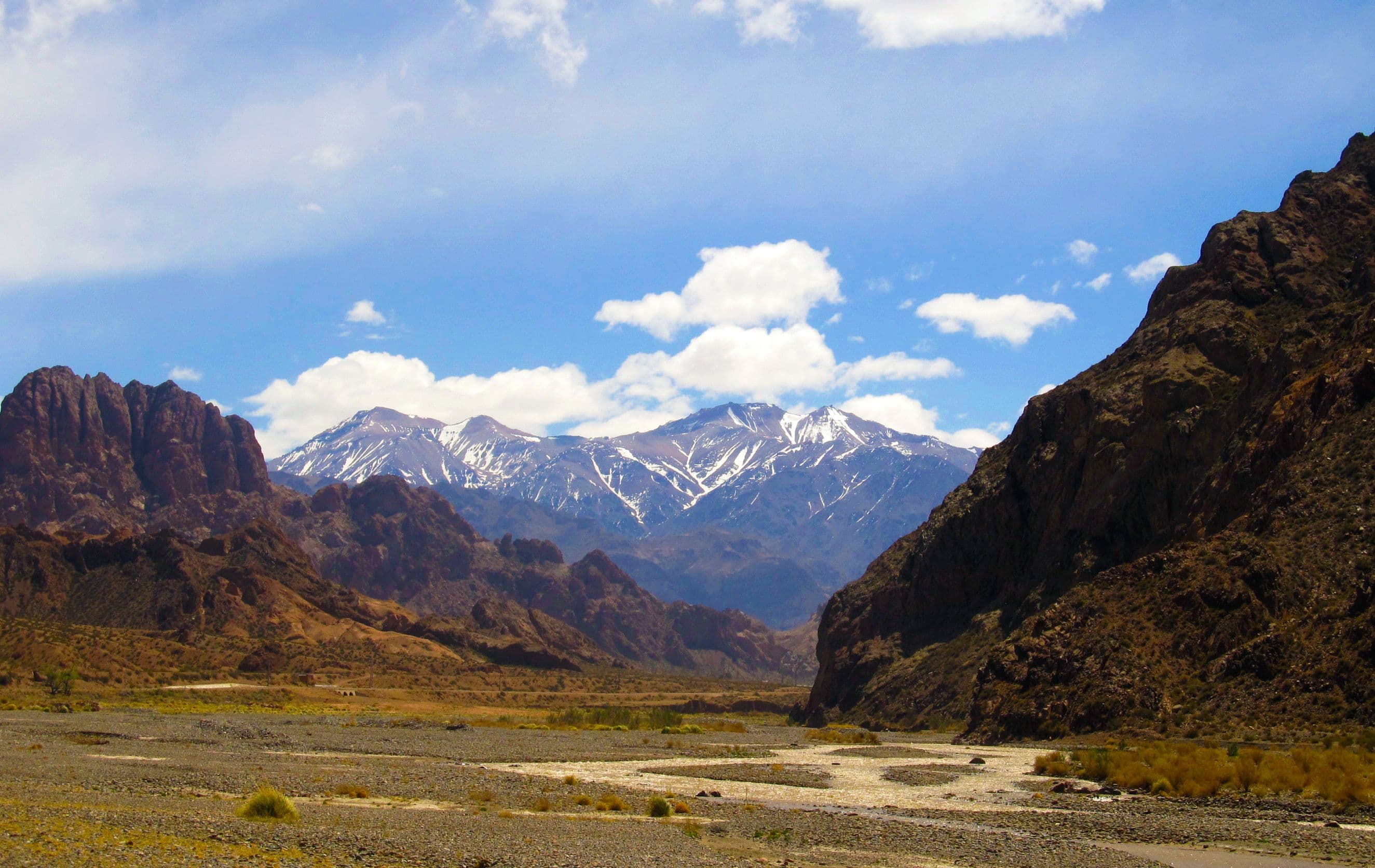
| Next Race Date | 2 May 2027 |
|---|---|
| Course type | Point-to-point: the Cacheuta foothills to Parque General San Martín, about 28 km apart in a straight line |
| Registration | Open online entry through Eventick; no ballot |
| Ballot opens | Not applicable |
| Start | Provincial route 82 near Puente Colgante Cacheuta, 08:00; the start closes at 08:10 |
| Finish | Portones del Parque General San Martín, Mendoza |
| Total finishers | Not published (more than 9,000 participants across all distances in the most recent edition) |
| Average race day temperature | About 7 to 19°C (May city normals at Mendoza airport; the Cacheuta start is higher and colder) |
| Cutoff time | 5 hours 30 minutes |
| Free race-day transport | None. An optional official bus is sold separately |
| Course certification | Organiser states IAAF and AIMS homologation since 2018; no current certificate or World Athletics Label confirmed |
Plan your pace for the Mendoza International Marathon for you and your supporters
Turn a goal time into grade-adjusted splits, and see when your supporters should be where.
Build your pace planBefore you go
Entry, accommodation and travel: what to sort out before you book.
Entry
Entry is open and direct. Argentine and foreign runners register online through Eventick, which the organiser's 2027 page links to. There is no ballot, and no charity place or tour-operator allocation is confirmed.
The base fee in mid-October 2026 was ARS 95,000 for residents, about £47.50, and ARS 140,000 for foreign runners, about £70, at an October 2026 rate. Both exclude Eventick's variable service charge and any options, so check the total at checkout. The checkout shows entries closing at 16:00 on 1 May, the day before the race, while the tariff row runs to 2 May, so plan on the earlier date.
Runners upload a currently valid medical certificate with a complete digital signature to their Eventick Pass. The regulations ask for identity details, dated fitness wording and the registered doctor's stamp and details. A foreign runner should ask the organiser whether a particular certificate meets that wording before travelling. The minimum age for the marathon is not clearly stated.
The official bus is a separate purchase. It is optional, limited in seats, sold for a specific distance and cannot be switched to another distance, so a foreign runner should buy the 42K bus. The standard entry includes the official shirt and finisher medal. The site also sells VIP finish access, an extra finisher shirt, medal engraving, shirt printing, photos and purchase protection. Protection has a 72-hour cancellation condition and does not refund protection or ticketing charges.
Resale and bib swapping are prohibited. Check deferral and transfer terms before buying non-refundable flights.
Fast runner standards
The Mendoza International Marathon has no qualifying times or guaranteed-entry standard.
See the Eventick entry page (2027) →Where to Stay
Stay in the city, on the finish side. The race starts in the foothills and finishes at the park gates, and the official bus leaves from inside the park before dawn, so a bed at the start does not shorten the morning and the bus does not return to Cacheuta. Distances are straight-line from the finish gates and rest on geocoded points.
Near Parque General San Martín
The park is large, so choose a hotel by its walk to Caballitos de Marly, not by the label near the park. This area reduces the pre-dawn journey and the return after racing. No hotel's walk has been measured.
Plaza Independencia
The city's central square is the base for a visitor who wants restaurants and short outings alongside the race, about 1.6 km from the finish. Park Hyatt and Hotel Argentino are here. The Argentino's own site gives about 1.2 km to the park, a landmark distance and not a measured walk to the gates. Its normal checkout is 11:00, so ask about an extension.
The western central district
Diplomatic Hotel is about 1.2 km from the finish and Villaggio Hotel Boutique is also in central Mendoza. They suit a runner who wants a city base with a separately planned walk or short taxi to the bus. A higher-category hotel does not guarantee an early race breakfast, bag storage or a shuttle.
San Lorenzo and Plaza Italia
Raíces Aconcagua, at San Lorenzo 545, is about 1.5 km from the finish and advertises late checkout on request, with rates and availability to be confirmed at reception. It is not a guaranteed race-weekend benefit.
Chacras and Vistalba
These wine-country areas suit a longer stay. The course passes through them at km 21 to 31, but the half marathon start at Barrio Portal Vistalba does not help the marathon bus, so a stay here needs its own race-morning transport plan.
Cacheuta
A bed near the start could shorten the first transfer, but it leaves a journey back after the race, and no accommodation-plus-transfer arrangement has been found.
Compare cancellable rates, lift access, early food and late checkout directly. For a family, a city hotel keeps support simple while the runner leaves before dawn.
Recommended hotels
Has a restaurant on site, useful for a Sunday meal. No race shuttle is promised.
A city-centre base at Plaza Independencia. Plan the early walk or taxi to the Caballitos de Marly bus, and ask about a breakfast box.
Offers late checkout on request, subject to availability and rate. Ask before relying on it.
A smaller central hotel. Standard checkout is 11:00, which is early for a marathon finisher.
A boutique alternative in the centre. The street address was not confirmed, so check the walk to Caballitos de Marly.
Booking timeline
The date is confirmed, but the expo schedule and hotel benefits are not. Book a cancellable city room first, then confirm the entry and the bus. Budget for the bus separately and choose the 42K option.
A sensible visit is arrival by Friday, collection once the schedule is published, a quiet Saturday, the race on Sunday and a recovery Monday before longer travel. Ask the hotel about food before the normal breakfast time. Entry closes at 16:00 on 1 May on the checkout, so resolve it well ahead of that.
Keep the expo window free until the timetable appears, and recheck baggage arrangements before planning a warm layer for the start. For extensions, book wine visits and mountain transfers with flexible cancellation. May is autumn in the city, and the high Andes follow a separate, colder calendar, so check access with the operator before paying.
Race weekend
The expo, number collection and the days either side of the start.
Race Weekend
Expo and number collection
The 2027 expo is announced for the Nave Cultural, Las Cubas 201, in central Mendoza. Dates and opening hours have not been published. At the most recent edition, collection ran across the Friday and Saturday before the race. Treat that as a guide only.
The organiser asks for the Eventick Pass, the medical certificate uploaded to the account, and a DNI or passport. A proxy collector needs printed copies of the identity documents of both the entrant and the collector. The certificate is valid for one year and must carry the matching digital signature. The rules say there is no kit handover on race day.
The pack contains the official shirt, the bib with chip, safety pins and the authorised baggage bag. The finish medal is given on the finish line. Arrive before the last collection day: a rejected certificate upload needs time to fix, and a runner who lands on Saturday afternoon has little margin. Keep the passport in your hand luggage, not in a bag that will be left anywhere.
Getting to the start
Set the alarm around the bus, not the gun. The last marathon bus leaves Caballitos de Marly, inside Parque General San Martín, at 05:30, and the organiser says to arrive earlier, so a target of 05:00 to 05:15 at the boarding area is a sensible buffer. The bus is sold separately, is signed by distance and makes no intermediate stops. The 10K bus has a later last departure of 06:30, which does not apply to a marathon entrant.
Stay in the city. No ordinary public bus has been confirmed as reaching Cacheuta before the start, and no late rescue transport is promised. A private transfer would need a drop-off that fits the road closures and a plan for the driver afterwards. Check the walk from your hotel to Caballitos de Marly in daylight, then allow extra time in the dark.
The gun is at 08:00 and the start closes at 08:10, so there can be a long gap between leaving the city and running. Eat before boarding, and ask the hotel for an early food box, because breakfast may not be served at 04:30.
At the start, use the marathon venue and not the half marathon pin at Barrio Portal Vistalba. Toilets are listed at each start and at the finish. Bags: the rules include a baggage service using the issued bag but also say belongings are not accepted at the starts, so identify the desk and the deadline before boarding. Do not leave a passport, phone or wallet in any bag.
The cutoff is 5 hours 30 minutes, an average of about 7:49 per km. At the finish, keep moving out of the chute and meet supporters in public space outside it. A paid VIP pass gives extra finish access and is not an entitlement of every runner. A car left at Cacheuta needs a separate retrieval plan, because the official bus does not return to the start.
May is autumn in Mendoza. The 1991 to 2020 normals for the airport put the average May maximum at 18.7°C and the minimum at 6.8°C. The start at Cacheuta is higher and in a valley, so expect it to be colder than the city, and a journalist at the most recent edition described a cold start that warmed through the morning.
Shorts or tights with a short-sleeved top and arm warmers work, with gloves and a thin hat. Bring a warm layer for the wait at the start: the gun is at 08:00 and the last bus leaves the city at 05:30, so there can be a long interval in the open before running. An old long-sleeved top that can be dropped in the first few kilometres is the sensible choice.
The rules say a baggage service is included, but they also state that nobody accepts belongings at the starts. Assume you will not see anything you leave at the start. No clothing donation scheme has been published, so treat dropped clothes as lost.
The finish is in full morning or early afternoon sun, so take sunglasses and sunscreen. Dry air raises fluid loss even when the temperature is mild.
Race day
The course, the clock, getting to the start and what to carry.
The Race
The course
The marathon starts on provincial route 82 near Puente Colgante Cacheuta, beside the Mendoza River at 1,262 m, and finishes at the Portones del Parque General San Martín at about 790 m. The finish is 28 km from the start in a straight line, and the course falls about 470 m between them without a single sustained climb.
From the start the road drops through Cacheuta to Blanco Encalada at km 7 to 9 and Las Compuertas from km 10 to 20, losing 191 m between km 5.1 and 21.1 at an average of 1.2%. It reaches Vistalba at about km 21, makes a short out-and-back of about 1 km along Roque Sáenz Peña between km 20 and 22, and turns north on Juan Manuel Ortiz de Rosas. The ground is flattest from km 21 to 25, between 1,018 and 1,031 m, as the course crosses the Luján de Cuyo wine belt.
The fall resumes at km 25 through Vistalba and Chacras de Coria, 56 m over 3.3 km from km 24.6, and the steepest part runs from km 31 to 35 down the Corredor del Oeste past La Puntilla and El Trapiche at about 2.0%, 78 m in all. The last 7 km run through Villa Hipódromo and along Boulogne Sur Mer at 0.5 to 1.4%, to the park gates at km 42. The half marathon starts at Barrio Portal Vistalba, the 10K at the Rotonda de Palmares Valley and the 4K inside the park, so the marathon is the only distance that starts at Cacheuta.
The elevation profile below is an estimate.
Kilometre by kilometre
Before the gun: the transfer. The start cannot be reached on foot from the city. The last official marathon bus leaves Caballitos de Marly, inside Parque General San Martín, at 05:30 for an 08:00 start, makes no stops on the way and does not return to the start.
Km 0 to 10: the foothills. The start is on route 82 near the suspension bridge at 1,262 m. The road falls from the first kilometre, 1.1% over the first kilometre and 17 m in the fourth, through Cacheuta and Blanco Encalada to 1,158 m at km 10. Hold back: the start closes at 08:10 and the first 10 km lose 104 m.
Km 10 to 20: Las Compuertas. The fall continues at about 1.2% through Las Compuertas along route 82 and Roque Sáenz Peña, from 1,158 m to 1,033 m at km 20. Aid tables are at 10 km (feeding), 12.5, 15 and 17.5 km (hydration).
Km 20 to 25: the flat section. The course turns onto a 1 km out-and-back along Roque Sáenz Peña near Vistalba, between km 20 and 22, then runs north on Ortiz de Rosas. The ground stays between 1,018 and 1,031 m for about 5 km. This is the wine-growing belt of Luján de Cuyo; the route does not pass named wineries. Aid is at 20 (feeding), 22.5 and 25 km.
Km 25 to 35: the long run in. The fall resumes through Vistalba and Chacras de Coria, then steepens on the Corredor del Oeste at km 31 to 35, about 2.0% at La Puntilla and El Trapiche. Aid appears at 28 km, 30 (feeding), 32.5 and 35 km (feeding). The spacing is irregular, so a station is not always 2.5 km away.
Km 35 to 42.195: into the city. The last 7 km run from 864 m to the finish at about 794 m, through Villa Marini and Villa Hipódromo and then along Boulogne Sur Mer from km 39, at 0.5 to 1.4%. Water is at 38 km. The finish is at the park gates, close to Caballitos de Marly.
Gradient. There is no climb. A fall of this length punishes the thighs from about 30 km, and the chart shows no uphill after the km 21 spur. No full list of timing mat positions has been published; the rules describe kilometre signs and electronic controls.
From 1,262 m at Cacheuta to 1,158 m at km 10, falling from the first kilometre. A pace that feels easy here costs more after halfway, so run it slower than goal pace.
A steady 1.2% fall to 1,033 m at km 20, with aid at 10, 12.5, 15 and 17.5 km.
A 1 km out-and-back near Vistalba, then 1,018 to 1,031 m through the Luján de Cuyo vineyard belt, dropping again from km 25. Fatigue shows without a hill to blame.
The steepest fall, about 2.0% at La Puntilla and El Trapiche from km 31 to 35, then Villa Hipódromo and Boulogne Sur Mer to the park gates. Aid at 30, 32.5, 35 and 38 km.
Course Map
A point-to-point course from the Cacheuta foothills to the gates of Parque General San Martín in the city, with the official bus boarding point beside the finish. Tap a marker for details, and scrub the slider or press play to move the orange marker along the course with the elevation profile beneath it.
MarathonPassport
Pace plan and spectator planner for the Mendoza International Marathon
Enter a start time and goal finish, then tap the course map. Each point you pick shows the window of time your runner is expected to pass it.
Pacers
The organiser site, the regulations and the ticket page give no pacer range, identification or wave table.
The start is in Cacheuta and the finish is in the city. The last official bus leaves the city at 05:30 for an 08:00 gun, it is a paid extra, it makes no stops and it does not return. Book it with the entry, stay in the city and plan breakfast and a warm layer for the start.
Build a grade-adjusted pace plan for this course
Nutrition on course
The 2027 regulations list hydration at 5, 7.5, 12.5, 15, 17.5, 22.5, 25, 28, 32.5 and 38 km, and hydration with a feeding point at 10, 20, 30 and 35 km. The spacing is irregular: the list changes from 25 to 28 km and from 35 to 38 km, so a table is not always 2.5 km away. Hydration and feeding are also described generally at the finish.
The drink and the food items are not named, and no gel service is promised, so carry gels and plan fuel around the published feeding points. Cups, personal bottles, elite tables, sponges, ice and on-course toilets have not been published. Cold mornings lower the urge to drink, so set a watch reminder at each table.
Spectating
The geography discourages chasing a runner around the course. The marathon, half and 10K start at separate places at the same time, and the official bus is for participants with the correct booking, so do not assume supporters can ride it.
The simplest plan is to watch at the finish, at the Portones del Parque General San Martín. Agree a meeting point in public space outside the controlled exit. A runner at 3:30 pace covers 5 km in about 24:53, and at 4:30 pace in about 32:00, so a plan to see a runner at one point in the city and then reach the finish has to fit the walk and any road closures inside that gap.
- Stay at the park gates and wait in public space outside the finish exit.
- Barrier access and the barrier plan have not been published.
- Arrange transport independently and confirm a legal drop-off.
- Do not plan this as a start-and-finish double: no public timetable or supporter bus is confirmed.
- Boulogne Sur Mer carries the course from about km 39 to the gates, so a position there is close to the finish.
- Check the organiser's high-resolution map once it is published.
After the race
Where to eat, what to see and how to spend the days after the finish.
See & Do
Distances are from the finish at the Portones del Parque General San Martín, in a straight line, kilometres first.
Parque General San Martín
The park was designed by Carlos Thays and holds the zoo, a football stadium and the national university. Cerro de la Gloria, at the top, gives a view over the city, about 2.8 km (1.7 miles) from the gates. Race fencing may limit access on race day, so leave the climb for Monday and walk only a short, flat loop.
Plaza Independencia
The city is organised around this square, with Avenida Sarmiento running through it. An exterior walk needs no booking. Exhibitions and public events change, so check dates.
Museo del Área Fundacional
The municipal museum reopened after renovation and describes accessibility provision. School-visit hours are not the public timetable, so confirm visitor hours before going.
Bodegas López
A working winery at Ozamis Norte 375 offering guided visits in Spanish, English and Portuguese, with a restaurant open at lunchtime from Wednesday to Sunday. It is on the Metrotranvía line, about 30 minutes from central Mendoza. The race is on a Sunday, so the following Monday and Tuesday fall outside the restaurant's days. Book a visit in advance and keep the transport plan simple.
Post-race food
Plan the first meal around a short walk and a seat. The finish is at a large park, and the area is controlled for part of the day.
Azafrán, at Sarmiento 765, is about 1.2 km from the finish in a straight line, has a booking link and published menus, and suits a planned dinner. Fuente y Fonda serves dishes to share, a reasonable choice for a group, and the Diplomatic Hotel's restaurant serves Argentine and international dishes. Check Sunday hours for all three and book.
Keep lunch flexible. A finish time cannot be fixed in advance, and a remote vineyard booking or an unconfirmed transport link can leave a tired runner stranded. Carry a snack, collect belongings and change before committing to a longer meal.
After the Race
The race is on a Sunday in early May, and Monday is the first free day. Termas de Cacheuta is about 39 km from central Mendoza, Maipú is on the Metrotranvía line, the city itself keeps two nights busy, and Uspallata sits about 100 km west on the road to Chile. Timetables and fares are indicative, so confirm them when you book.
Thermal pools at the foot of the Andes, near where the race starts. Open every day from 10:00 to 18:00, with warm-water soaking that asks nothing of the legs.
A night in the wine-growing district reached by tram, with a guided winery visit and an Andes-facing restaurant on the days it opens.
Two nights without moving luggage, with the square, the old-town museum and the park, and a winery day by tram in between.
A base in the Uspallata valley, with the colonial ruins at Las Bóvedas, the natural bridge at Puente del Inca and the Aconcagua visitor centre, in the weeks when snow can close trails.
Background
History
The organiser dates the first Maratón Internacional de Mendoza to 1999. The original race ran on city streets with both ends in Parque General San Martín. It later became the point-to-point course used now, starting in the foothills at Cacheuta and following provincial route 82, the Corredor del Oeste and Avenida Boulogne Sur Mer to the park gates. The year of each change is not given.
The organiser, Fundación Filípides, says the course has been homologated by the IAAF and AIMS since 2018. That is a statement about measurement history. It does not show that the current route holds a valid certificate or a World Athletics Label.
The 26th edition ran on Sunday 3 May 2026. Carlos Becerra won the men's race in 2:22:27 and María Belén Alegre won the women's in 2:53:43. The listed records are José Luis Luna's 2:19:01 from 2006 and Adela Barrios's 2:47:44 from 2019, although the same table gives Patricia Correa 2:38:16 for the women's race in 1999, faster than the stated women's record. The difference may reflect a change of course, so no record table is shown here.
The marathon shares its weekend with a half marathon, a 10K and a 4K participation race, which start at different points and all finish at Parque General San Martín. The combined field was put at more than 9,000 runners, from every Argentine province and more than 20 countries.