The Race
| Next Race Date | 7 March 2027 |
|---|---|
| Course type | Point-to-point: Calistoga to Napa along the Silverado Trail |
| Registration | Online via the official registration platform, first-come with no ballot. A one-year deferral is available for $100, deadline 25 January 2027. |
| Ballot Opens | Not applicable: first-come entry with no ballot mechanism |
| Total finishers | 1,942 (2026 edition, marathon distance only; not the same as the combined marathon/half marathon/5K weekend total of 7,100) |
| Avg race-day temp | Cool start typical of March wine country, around 56°F (13°C) at race time with cloud cover common in recent editions; rain is possible and afternoons tend to warm |
| Cutoff time | 6 hours (approximately 13:44 per mile). A sweep bus sits at mile 22.7 with a hard 12:45pm checkpoint: runners who miss it are bussed in and receive a half marathon finisher medal instead of a full marathon one. |
| Free race-day transport | Yes: a bus to the Calistoga start is included in registration. Runners select a bus stop and pickup time in advance. |
| Course certification | USATF certified |
| Sleeper Train | Not accessible |
The Mile-22.7 Cutoff: Know This Before You Start
A sweep bus is positioned at mile 22.7 of the course, and runners must reach it by 12:45pm sharp. Anyone who arrives after that time is loaded onto the bus and receives a half marathon finisher medal rather than a full marathon one, regardless of how close they were to completing the remaining distance. Runners near the back of the field, or anyone targeting a finish time close to the overall six-hour cutoff, should pace specifically against this checkpoint rather than assuming the overall finish-line cutoff is the only threshold that matters.
History
The Napa Valley Marathon has run every March since 1979, making it one of the longer-running destination marathons in the United States, predating most of the modern wine-country tourism boom that now surrounds it. The marathon distance itself is capped around 3,000 runners by design, a deliberately small-field race rather than one struggling to sell out. That figure is distinct from the combined marathon, half marathon and 5K weekend total, which has reached a reported 7,100 entrants in record years; the two numbers describe different scopes and should not be conflated when comparing field size against other races.
The course has stayed consistent in its basic shape for decades: starting in Calistoga at the northern tip of Napa County, running the length of the Silverado Trail, and finishing in downtown Napa at Vintage High School. Garrett Corcoran holds the men’s course record at 2:15:48, set in 2025. The women’s record picture is less settled in publicly available sources: Wikipedia’s results archive lists Ann Centner’s 2:38:29 (2022) as the fastest women’s time through 2025, but separate press coverage describes a new women’s course record of 2:35:48 by Abigail Shoemaker, also an Olympic Trials qualifying time, from a more recent edition than Wikipedia’s table currently reflects. Runners wanting a definitive current record should check the official results and awards page directly rather than relying on either figure alone.
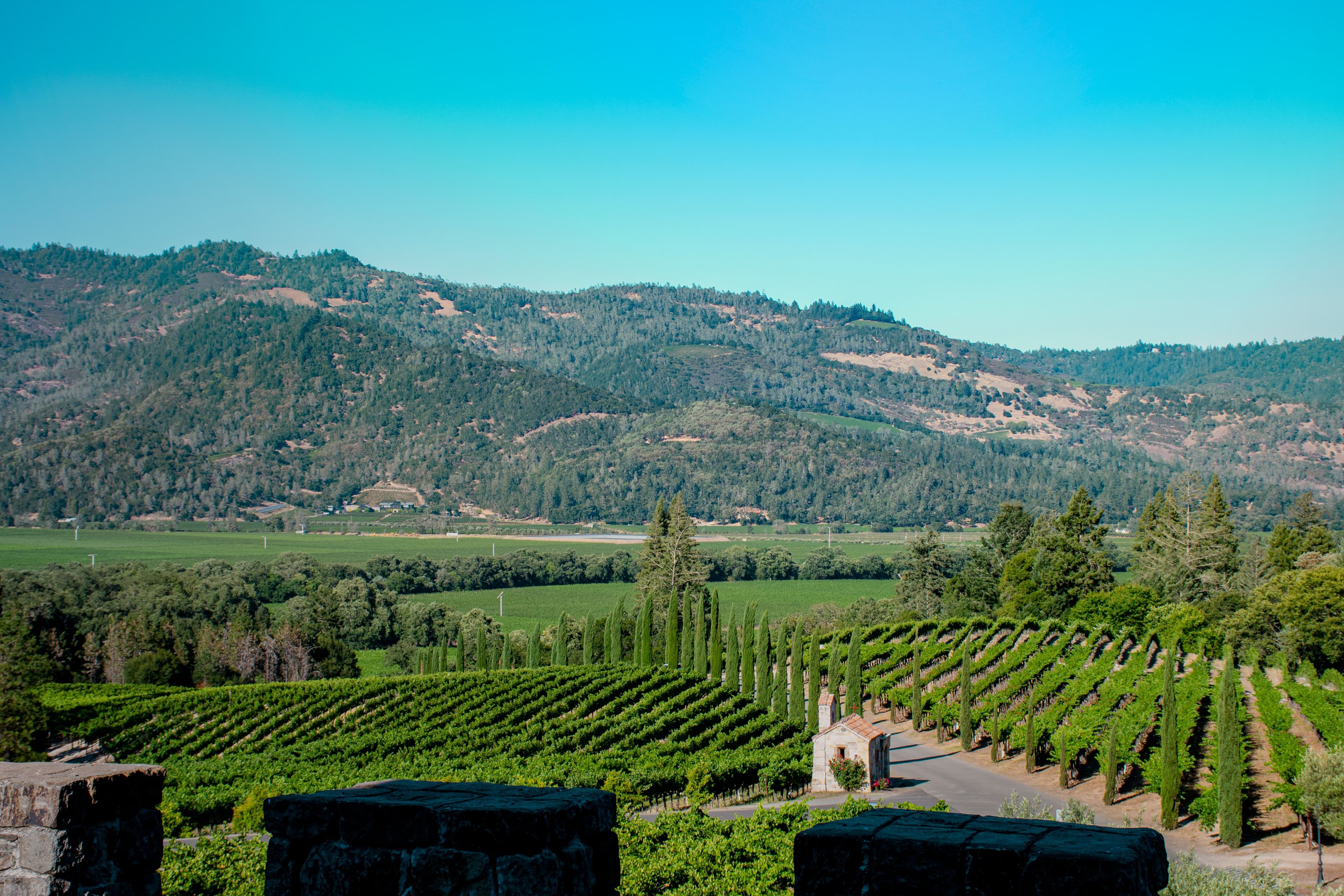
Race winners in both the men’s and women’s fields receive their weight in wine, a tradition distinctive to this event among US marathons and a detail that reflects the race’s wine-country identity more directly than generic vineyard scenery does.
The course
The course runs point-to-point from Calistoga to Napa, starting on the Silverado Trail at Brannan Street in Calistoga and finishing at Vintage High School in Napa. The first 23 miles run along the Silverado Trail itself, and organisers market the course on having only four turns across the final four miles, a low-turn layout by marathon standards. The course descends net from around 395 ft (120 m) at the Calistoga start to around 56 ft (17 m) at the Napa finish, a net drop of roughly 339 ft (103 m). This is not a single smooth descent: rolling hills appear between miles 15 and 20, before the final five miles run flat into the finish.
Mile 0-6: Calistoga onto the Silverado Trail. The race starts on the Silverado Trail at Brannan Street in Calistoga, at the northern tip of Napa County. Runners arrive here by the included race-morning bus rather than under their own transport, so the start itself has an operational, staging-area character before the field settles onto the Trail. Aid stations at miles 2.1 and 4.3 come early, useful given the cool morning start typical of this race.
Mile 6-15: The open Silverado Trail. This is the longest uninterrupted section of the course, running the length of the Trail through vineyard country with minimal turns and limited crowd support compared with a city marathon. Aid stations at miles 6.6, 9.4, 12.0 and 13.9 keep support reasonably frequent even though roadside crowd density stays low. The net-downhill framing of this course should not be mistaken for effortless: long straight roads with little visual change can be more mentally demanding than physically easy, and this stretch is where that shows up most.
Mile 15-20: The rolling section.This is where the course’s rolling hills are concentrated, the one stretch that pushes back against the race’s overall net-downhill, fast-course marketing. Aid stations at miles 16.1 and 19.0 sit within this section. Runners chasing a specific goal time should expect this section to cost more effort than the earlier miles suggested, and should not bank all of their pacing on the course’s flat reputation holding uniformly.
Mile 20-25: Flat running toward the cutoff checkpoint.The final five miles run flat into Napa, following the rolling section. This is also where the race’s firm cutoff enforcement becomes operationally relevant: a sweep bus sits at mile 22.7, and runners must reach it by 12:45pm sharp or be loaded onto the bus and receive a half marathon medal rather than a full marathon finish. Aid stations at miles 20.8, 22.4, 24.0 and 25.1 support this closing stretch.
Mile 25-26.2: Into the finish at Vintage High School.The course’s final four miles bring its only significant direction changes, following 23 miles of the comparatively straight Silverado Trail. The finish sits in the parking lot at Vintage High School in Napa, a functional rather than a landmark finish setting.
Follow the blue tangent line throughout; on a course this straight for most of its distance, the tangent line matters less for turns and more for staying consistently on the racing line along the Trail itself, where drifting to one side or the other over 23 relatively straight miles can add real distance. The timing mat sits at the Vintage High School finish itself.
Starts on the Silverado Trail at Brannan Street after an included race-morning bus transfer. Cool March start; frequent early aid stations at miles 2.1 and 4.3.
Long, largely straight vineyard roads with light crowd support. Net downhill on paper, but mentally demanding given the visual sameness over these miles.
The course's only hilly stretch, pushing back against its overall fast-course marketing. Don't bank all of your pacing on the flat reputation holding here.
Flat final five miles, but a sweep bus at mile 22.7 (12:45pm cutoff) converts stragglers to a half marathon finish. The only real turns come in the final four miles into Vintage High School.
What to wear
March mornings in Napa Valley run cool, commonly in the mid-50s°F (around 13°C) at race time with cloud cover a real possibility based on recent editions’ conditions; rain is a real risk this time of year in wine country, and afternoons typically warm considerably from the morning start. A throwaway layer for the Calistoga start is sensible given the early, cool conditions and the bus-transfer wait beforehand.
Because the course runs largely along the open, rural Silverado Trail rather than through a sheltered city street grid, wind and direct sun exposure over the middle miles matter more here than on a course with more building cover; sunscreen is worth applying before the start even on a cool, cloudy morning, since conditions can clear as the race goes on. Given the firm six-hour cutoff and the mile-22.7 sweep-bus checkpoint, runners near the back of the field should dress with the practical possibility of a long day out on an exposed rural road in mind, not just the forecast at the start line.
Entry
Entry to the Napa Valley Marathon runs through the official registration platform on a first-come basis, with no ballot or lottery mechanism. A one-year deferral is available for a $100 fee, with a firm deadline of 25 January 2027 for the 2027 edition, a useful option given the course’s point-to-point, wine-country logistics make a last-minute no-show a bigger loss than on a race with simpler travel.
No fast-runner or good-for-age entry route was confirmed for this race; entry is general first-come rather than a seeded category, despite the course’s Boston-qualifying reputation. Runners specifically targeting a Boston-qualifying time here benefit from the course’s USATF certification and net-downhill profile without needing a separate qualifying entry pathway; the standard entry route is sufficient.
Given the race’s deliberately capped field, around 3,000 for the marathon distance, this is a smaller, more controlled marathon than most on this site, and runners should not expect the entry competition or price escalation seen at larger city marathons, though wine-country accommodation costs are a separate and real consideration.
Fast Runner / GFA Standards
Not applicable. No fast-runner or Good for Age route was confirmed for this race.
Planning to Run Napa Valley?
Entry is general and first-come, so the main planning task is booking travel and accommodation early rather than tracking a ballot date. Set a reminder to lock in your hotel as soon as your place is confirmed, given Napa Valley’s constrained hotel supply.
Race Weekend
Expo
The race expo is hosted at the Napa Valley Marriott Hotel & Spa, 3425 Solano Avenue, Napa, which also serves as the event’s official host hotel. Bib pickup is free in person at the expo, or available by mail for a $20 fee (the 2026 edition’s deadline was 26 January); runners unable to attend the expo in person can arrange for someone else to collect their bib by submitting a form through the official registration account system.
Given the expo doubles as the host-hotel venue, runners staying at the Marriott itself have a more convenient bib-collection experience compared with runners based elsewhere in Napa or in Calistoga, worth factoring into hotel choice if minimising pre-race logistics matters.
Race Morning
The race starts at 7:30am on the Silverado Trail at Brannan Street in Calistoga. A bus to the start is included in registration, and runners select their preferred bus stop and pickup location in advance of race day (the 2026 edition’s selection deadline was 11 February); this is not an optional convenience but the primary way runners reach the start, given the point-to-point course and the distance between Napa, where most runners stay, and Calistoga.
Because the finish is in Napa but the start is in Calistoga, roughly 20 to 25 miles north depending on the specific route, race-morning logistics hinge on the shuttle system working smoothly; runners should treat their selected pickup time as fixed rather than approximate, particularly given the cool, potentially rainy conditions typical of a Napa Valley March morning while waiting for the bus and at the start itself.
Bag drop, changing facilities and on-course massage locations were not confirmed from an official source. Given the course finishes at a school parking lot rather than a purpose-built event venue, on-site facilities may be more limited than a large city marathon’s finish area; runners should not assume equivalent post-race infrastructure without checking the official race-information page closer to race day.
The Shuttle Bus Is Mandatory, Not Optional
Because the course runs point-to-point from Calistoga to Napa, the race-morning bus transfer from Napa (or wherever a runner is staying) to the Calistoga start is not a convenience runners can skip in favour of driving themselves. It is included in registration and is the primary way the field reaches the start line. Select a bus stop and pickup time well ahead of the selection deadline, and treat that pickup time as fixed.
Logistics Map
The map below shows the point-to-point route from the Silverado Trail in Calistoga to Vintage High School in Napa, with the mile-22.7 sweep-bus checkpoint and the Napa Valley Marriott Hotel & Spa expo marked. Tap any marker for details.
Nutrition on Course
Aid stations for the full marathon are positioned at miles 2.1, 4.3, 6.6, 9.4, 12.0, 13.9, 16.1, 19.0, 20.8, 22.4, 24.0 and 25.1, a total of 12 stations across the course. The spacing is not perfectly even: stations cluster more closely in the final six miles, roughly every mile and a half, than across the open middle section of the Silverado Trail, worth planning a personal hydration and fuelling strategy around rather than assuming uniform spacing throughout.
The specific sports nutrition brand used on course, cup type, and any personal-bottle or drop-bag provision were not confirmed from an official source. Given the course’s rural, low-crowd-density character, runners more accustomed to city marathons’ dense aid-station culture should treat each station on this course as a deliberate, necessary stop rather than an optional one, since the gaps between them run longer than a typical city marathon’s spacing in the early-to-middle miles.
Spectating
Spectating this race is fundamentally a car-based exercise, unlike the transit-served races elsewhere on this site: the course runs point-to-point along the rural Silverado Trail between Calistoga and Napa, with no meaningful public transport parallel to the route itself. Supporters without a car are effectively limited to the finish area at Vintage High School in Napa; those with a car can follow the Trail by road, though the official race-morning bus system for runners means supporters should not expect to easily park near the Calistoga start itself given the road’s operational use for the shuttle fleet.
The finish at Vintage High School is the most practical single sighting point for most supporters, reachable by car from anywhere in Napa without needing to navigate the rural Trail itself.
Itinerary A (recommended for most supporters):Drive directly to the Vintage High School finish area in Napa ahead of the runner’s expected finish time. The simplest and most reliable plan given the course’s rural, largely non-transit-served route.
Itinerary B: Drive to a point along the Silverado Trail itself, allowing time for road-use restrictions tied to the official runner shuttle. Requires a car and a pre-agreed plan with the runner, since the Trail offers limited pull-off points and no organised spectator infrastructure.
Itinerary C (not recommended without specific arrangements):The Calistoga start area is primarily used for the runner shuttle fleet’s staging, and supporters without a specific arrangement should not expect straightforward parking or viewing access here.
Post-Race Food
Oxbow Public Market, a food hall in Napa with multiple independent vendors, is the most flexible post-race option, suited to a group with different appetites and no single reservation needed. Gott’s Roadside Napa, a well-known local burger and fries spot, works for a straightforward, quick post-marathon meal rather than a sit-down occasion. Grace’s Table is a further option worth checking for brunch-style recovery dining, useful given many marathons finish around a time better suited to brunch than dinner. Given the finish is at a school in Napa rather than downtown itself, all three options involve a short drive or rideshare from the finish rather than a walk.
Where to Stay
Downtown Napa, near the finish at Vintage High School, is the strongest all-round base for this race: it offers the shortest post-race return, access to the official race-morning shuttle to Calistoga, and the widest choice of restaurants and hotels in the valley. It is also the busiest and most expensive option, reflecting Napa’s status as a wine-country tourism hub rather than a simple support town for the race.
Downtown Napa / Oxbow
The Oxbow and east Napa area, built around the Oxbow Public Market, offers good finish-area access if a hotel sits nearby, with a food-and-market focus that suits a runner prioritising post-race dining over evening nightlife. It is busy but practical rather than quiet.
Calistoga
At the opposite end of the course from the finish, Calistoga is a wine-country resort town in its own right, known for hot springs and spa culture. Staying here means an easy race-morning shuttle pickup but a considerably harder return journey after finishing in Napa, roughly 20 to 25 miles away. This is a deliberate trade-off for runners who want a resort stay built around the race rather than the simplest possible race-day logistics.
Yountville
Further from both the start and finish than the other options here, Yountville is Napa Valley’s fine-dining capital, home to several nationally known restaurants. It suits a luxury-focused trip more than a straightforward race-logistics one, and requires a car or taxi for both the shuttle connection and the return from the finish.
American Canyon
At the valley’s southern, less touristic edge, American Canyon offers better value than the core Napa hotel stock, at the cost of requiring a car for both race-morning shuttle logistics and the general Napa Valley experience; runners without their own transport should be cautious about this option specifically.
Given Napa Valley’s limited and expensive hotel stock relative to its tourism profile, and the point-to-point course’s shuttle-dependent logistics, booking well ahead of race weekend matters more here than for a typical city marathon of similar size.
Recommended hotels
A well-located downtown option with real finish-area convenience and shuttle access to the Calistoga start.
A characterful riverside inn near the Oxbow Public Market, combining finish-area convenience with strong post-race dining access.
Larger suite-style rooms with included breakfast, a practical choice just outside the downtown core.
A resort-style stay at the start end of the course, trading straightforward race-morning logistics for a harder post-race return to Napa.
A value option at the valley's southern edge, only sensible for runners with their own transport.
Booking timeline
There is no ballot-results date driving a hotel-booking spike, since entry runs first-come; the operative advice is to book Napa Valley accommodation as soon as entry is confirmed, given the region’s constrained hotel supply relative to its tourism demand. Wine country accommodation is expensive by default, not just during marathon weekend, so runners should not expect a race-specific price spike to be the dominant factor the way it might be in a smaller city with otherwise cheap lodging.
Flights typically route through San Francisco, Oakland, Sacramento or Santa Rosa, none of which sit directly in Napa Valley itself; a rental car or a pre-arranged shuttle from the airport is generally necessary, since Napa Valley’s public transport does not reach any of these airports directly. Book car rentals as early as flights, given wine country’s seasonal demand fluctuations beyond just race weekend itself.
See & Do
The finish sits at Vintage High School in Napa, putting downtown Napa, the Oxbow Public Market and the wider valley’s wine-country attractions within reach of a short drive.
Oxbow Public Market
Napa, near downtown. An indoor and partly open-air food market with multiple vendors, a low-effort recovery option requiring no more walking than a runner wants to do.
Napa Valley Wine Train
Departs Napa. A seated, scenic way to see the valley without walking, running through the wine country the marathon itself passes on foot. Book ahead given limited daily departures.
Calistoga hot springs and spas
Calistoga, at the opposite end of the course from the finish. A recovery-appropriate option for runners staying in or willing to travel to Calistoga, though it requires a car or taxi from Napa if not staying there overnight.
Vineyard tasting rooms
Valley-wide. Widely available across the valley, but not a low-effort option immediately post-race unless seated and transported; most tasting rooms require reservations and are better suited to the day after the race than the immediate afternoon.
Read Before you Run
The Silverado Squatters
Robert Louis Stevenson
Stevenson's own account of an 1880 honeymoon spent in an abandoned mining camp above Calistoga, directly tied to the Silverado Trail the marathon runs for 23 of its 26.2 miles. A direct thematic match rather than a generic wine-country substitute.
After the Race
The Napa Valley Marathon runs in March. These itineraries range from a same-day walk around downtown Napa to a three-night extension to San Francisco.
A low-effort day around downtown Napa and the Oxbow Public Market, staying close to the finish area itself.
A spa-focused recovery extension to the town at the start end of the course, built around Calistoga's hot springs and mud baths.
A wine-country contrast to Napa itself, built around Sonoma Plaza, California's largest town square, best reached by car.
A full city extension reached by car or public transport depending on the day of the week, since some connecting services do not run weekends.
Frequently asked questions
Should I stay near the start or the finish?
Stay in Napa, near the finish. Every runner reaches the Calistoga start by the same included race-morning shuttle, so hotel location doesn’t affect getting to the start, but it makes a real difference to how easily you get back after finishing roughly 20 to 25 miles from Calistoga.
How far in advance should I book a hotel?
As early as possible. Napa Valley's hotel supply is limited relative to its tourism demand, and this is true year-round, not just on marathon weekend.
Is public transport free on race day?
The race-morning shuttle bus to the Calistoga start is included in registration. No general public transport is confirmed as free on race day beyond this.
What is the best area to stay?
Downtown Napa or the Oxbow area, for the shortest return from the finish and the widest choice of restaurants and hotels.
When does the expo open?
Held at the Napa Valley Marriott Hotel & Spa, the official host hotel; check the current year’s dates and hours on the official race-information page.
What is the weather typically like on race day?
Cool at the start, commonly in the mid-50s°F (around 13°C), with cloud cover and rain both real possibilities in March wine country; afternoons typically warm up.
How do I get from the airport to the city centre?
Most runners fly into San Francisco, Oakland, Sacramento or Santa Rosa airports, none of which sit directly in Napa Valley; a rental car or pre-arranged shuttle is generally necessary.
Is there a bag drop at the race?
Not published by the organiser. Check the official race-information page closer to race day.
Should I bring a throwaway layer to the start?
Yes, given the cool, potentially rainy conditions typical of a Napa Valley March morning and the wait involved in the race-morning shuttle system.
How do I get back to my hotel after finishing?
Most runners will need a taxi, rideshare or pre-arranged transport from the Vintage High School finish area, since the course is point-to-point and the finish is not within easy walking distance of most non-downtown hotels.