The Race
| Next Race Date | Sunday 8 November 2026 |
|---|---|
| Course type | Loop, start and finish about 0.6 km apart at Parque da Cidade |
| Registration | Open online entry, no ballot |
| Ballot opens | No ballot |
| Start | Avenida da Boavista by the Queimódromo, Parque da Cidade, 08:00 |
| Finish | Queimódromo, Parque da Cidade |
| Total finishers | More than 4,000 (2025) |
| Avg race-day temp | About 9 to 16°C (IPMA Porto November normal) |
| Cutoff time | 6 hours; the finish closes at 14:00 |
| Free race-day transport | No |
| Course certification | AIMS accredited |
History
The Porto Marathon began in 2004 with 317 finishers. Runporto, the city’s road-race organiser, grew it steadily: 857 finishers in 2009, 2,755 in 2013 and more than 4,600 in both 2017 and 2018, then the largest marathon field in Portugal. EDP, the energy company, became title sponsor, and the event kept shorter races alongside the marathon, now a 10 km and an untimed 6 km walk.
The course has always been built round water: the Atlantic edge of the city, the port of Leixões in Matosinhos and the Douro. Start and finish sit beside Parque da Cidade, the large park on the coast. There was no race in 2020. It came back in 2021 with its fastest men’s time: Zablon Chumba of Kenya won in 2:08:58, still listed by the organiser as the course record. Monica Jepkoech of Kenya set the women’s record of 2:26:58 in 2017.
In 2025 the race ran on 2 November. Aspel Kiptoo of Kenya won in 2:13:17, 11 seconds ahead of Joshua Kemboi, and Betty Jepleting of Kenya won the women’s race in 2:31:05. More than 4,000 runners finished, over 250 of them under three hours. The organiser promotes the whole weekend at about 15,000 participants, and in mid-September 2026 about 100 marathon places remained.
The course
The marathon starts at 08:00 beside the Queimódromo on the western edge of Parque da Cidade, by Castelo do Queijo, and finishes at the Queimódromo about 600 m away. The marathon, 10 km and 6 km start together and split early. The whole course is on the Porto side of the Douro; it does not cross into Vila Nova de Gaia.
The first 2 km climb gently inland, about 18 m, before the route drops 27 m into Matosinhos by km 5. From there it runs round the port of Leixões, flat and close to sea level, out to a turn in Leça da Palmeira at km 10, back over the Leça swing bridge at km 14 and south past the start at km 19.
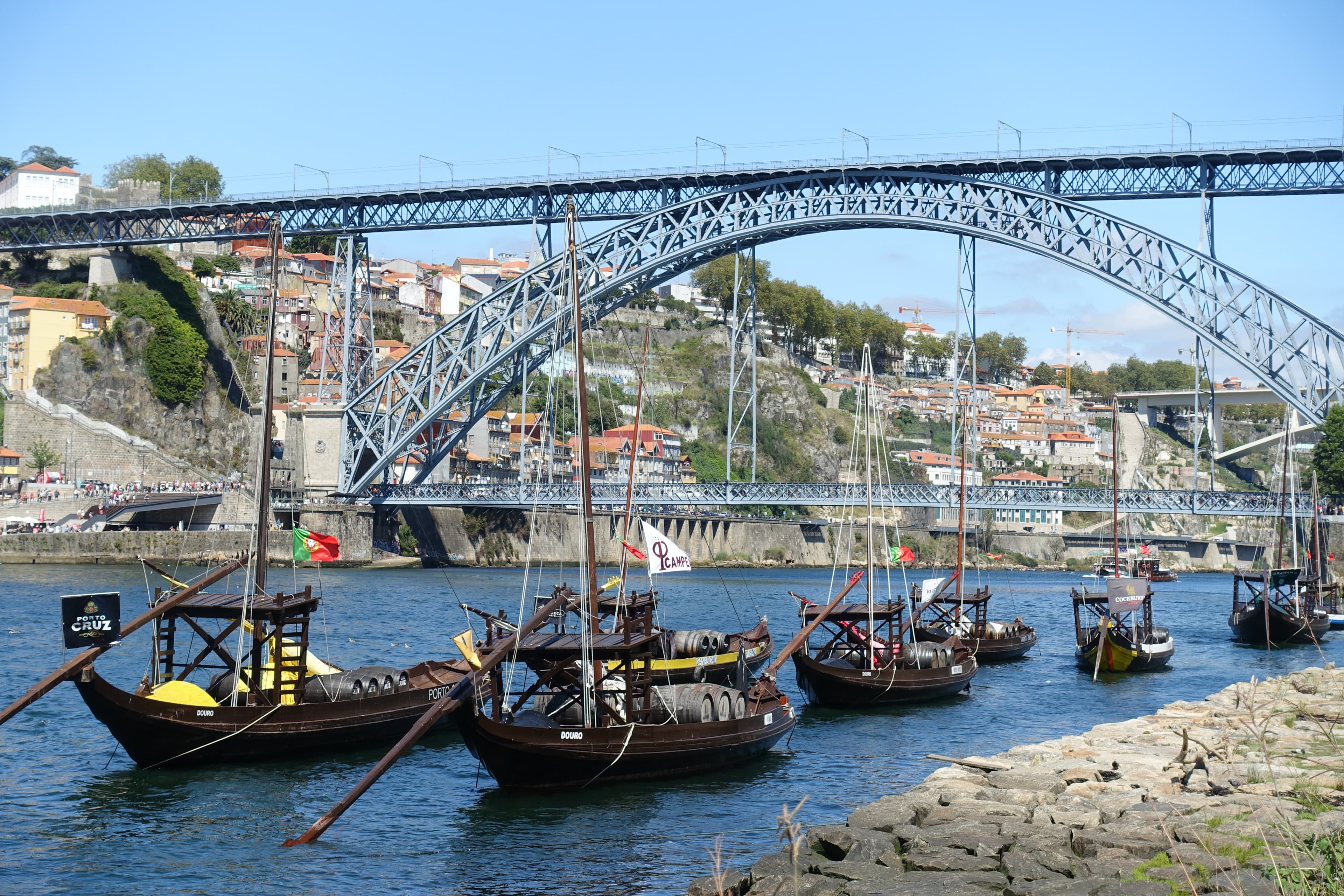
The second half is the river. The course follows the coast through Foz do Douro and turns east along the Douro, under the Arrábida bridge at km 24.9, past the Alfândega at km 26.7 and under the Luís I bridge at the Ribeira at km 27.8, to a turn near the Freixo bridge at km 30, the furthest point from the start at 8.6 km. It retraces the river and the coast and finishes with a gentle rise to the Queimódromo. The riverside road stays within about 10 m of the water; wind off the Atlantic and along the Douro, and the turnarounds, matter more than gradient.
Kilometre by kilometre
Km 0 to 5: the start and the only early climb. Three races leave together at 08:00, so follow the 42 km signs. Corrals run Elite, Sub-Elite, A (under 3:15), B (3:15 to 3:45) and C (over 3:45). The first 2 km rise gently inland and the next three drop to Matosinhos. Easy to overcook on a cold start.
Km 5 to 19: Matosinhos and the port. Round the port of Leixões to the northern turn at Leça da Palmeira, km 10, and back. Working-port country: long straight roads, roundabouts, container cranes and out-and-back legs where you see the field coming the other way. The wind can change from behind to head-on at every turn. Food starts at 10 km. The course passes the start again at km 19.
Km 19 to 30: the coast and the Douro. South through Foz do Douro and east along the river, under the Arrábida bridge, past the Alfândega and the Ribeira and under the double-deck Luís I bridge. Powerade starts at 20 km. The turn near the Freixo bridge at km 30 is a tight 180 degrees; the stream of runners on the other side helps pacing.
Km 30 to 42.2: home along the river and the coast. The riverside again, then the coast at Foz. The last Powerade is at 35 km; 40 km has water and food only. The last kilometres rise gently to the Queimódromo, enough to notice on tired legs.
The course is measured to AIMS standards along the legal road; no painted line is advertised. The last-runner schedule is 09:25 at 10 km, 11:04 at halfway, 12:27 at 30 km and 13:42 at 40 km, with the finish closing at 14:00.
Three races together and the only early climb. Let the 10 km runners go.
Port roads, turnarounds and wind that changes with every direction. Run by effort.
Under Porto’s bridges to the turn at km 30. Fuel at 20 and 25 km.
Last sports drink at 35 km, then a gentle rise to the Queimódromo.
Course Map
North round the port of Leixões, then along the Douro under Porto’s bridges and back, all on the Porto bank. Tap a marker for the start, the finish, the expo, the landmarks and the metro, and scrub the slider or press play to move the orange marker along the course with the elevation profile beneath it.
Pacers
Pacers run at 3:00, 3:15, 3:30, 3:45, 4:00, 4:15, 4:30 and 4:45 from the single 08:00 start. There is no group slower than 4:45, and Sub-Elite placement needs proof of a sub-3:00 (men) or sub-3:15 (women) time sent to the organiser by mid-October.
The Porto Marathon starts and finishes at Parque da Cidade on the Atlantic edge of the city, about 7 km west of the Ribeira. The course reaches the Ribeira at km 28, but the start, the finish, the wardrobe and the showers are all by the Queimódromo. Plan where to sleep around that.
The marathon, the 10 km and the 6 km walk all start at 08:00 and split early. Follow the 42 km signs from the first corner, stay in your own corral, and do not be pulled along by the 10 km field.
November in Porto is cool and often wet. IPMA’s November normals are about 9°C at night and 16°C by day, and Atlantic weather decides the race: rain, wind off the sea and wind funnelled along the Douro.
Wear a disposable layer or bin bag to the start, because three races share the start area and the wait in the corral can be long. Gloves and a cap are worth having in rain. Once running, most people are comfortable in a vest or T-shirt. Wet road paint and tram rails on the riverside can be slippery, so avoid shoes with worn outsoles, and pin the bib at four points. Changing tents and showers are at the finish, so leave dry clothes in the wardrobe bag.
Entry
Entry is direct and first come, first served through the organiser’s site. There is no ballot, and places run out: in mid-September 2026 about 100 marathon places were left.
Prices rise in three steps: €65 until 31 March, €70 until 31 August and €80 until 30 October, plus a 5% online processing fee. A VIP marathon entry costs €250. Entry includes the chip bib, a T-shirt, a finisher medal, a diploma and results. Overseas runners need no federation membership; the minimum age is 18.
Fees are not refundable, and entries cannot be transferred to another person or year.
Fast runner standards
There is no qualifying entry. Sub-Elite start-pen seeding needs a recent result under 3:00 for men or 3:15 for women, emailed to the organiser before a mid-October deadline.
Official Porto Marathon site →Race Weekend
Expo
The expo and bib collection are at the Centro de Congressos da Alfândega do Porto, the old customs house on Rua Nova da Alfândega by the river, on Friday and Saturday from 10:00 to 19:00. It is free to enter.
There is no collection on race morning; a bib not collected by 19:00 on Saturday is lost. A friend can collect with a copy of your photo ID and the confirmation email. The Alfândega is on the course at km 26.7, 7 km from the start, so a Friday visit leaves Saturday free.
Getting to the start
The marathon, 10 km and 6 km all start at 08:00 beside the Queimódromo in Parque da Cidade.
Getting there. The start is on the Atlantic edge of the city, not in the centre, so where you sleep decides the morning. From Foz do Douro or Nevogilde it is a 10 to 30 minute walk. The Matosinhos Sul metro stop (line A) is 1.4 km from the finish. From the centre and the Ribeira, allow 45 to 70 minutes by metro and on foot. Buses are diverted on race morning.
Bag drop. The wardrobe is at the finish area beside the start. Bags must be closed and marked with the bib number. Arrive by 06:30 to 07:00 if using it. Tea and coffee are available at the start.
The finish. Water, food and Super Bock beer, a recovery and massage tent for marathon runners, and changing tents and showers in Parque da Cidade.
Nutrition on course
Aid stations come every 5 km. Powerade is only at four stations, 20 to 35 km, and the organiser does not say what "food" means or whether there are gels, so carry your own gels for the full distance. There is no personal-bottle service for ordinary runners.
| Km | What is there |
|---|---|
| 5 | Water |
| 10 | Water, food |
| 15 | Water, food |
| 20 | Water, Powerade, food |
| 25 | Water, Powerade, food |
| 30 | Water, Powerade, food |
| 35 | Water, Powerade, food |
| 40 | Water, food |
| Finish | Water, food, Super Bock beer |
Spectating
The start and finish are side by side and the course passes the start area again at km 19, so a spectator who never leaves Parque da Cidade sees a runner three times. The Douro riverside is the most scenic sighting and a two-for-one, because runners go out and back along it: the Ribeira sees them at km 27.8 and km 32.2. No live-tracking app is named.
- Watch the 08:00 start
- Walk a few minutes to Castelo do Queijo for the pass at km 19
- Return to the Queimódromo for the finish
- After the start, walk south along the seafront to Foz, about 2 km
- See runners at km 22 and again at km 38
- Walk back to the finish
- Take the metro to São Bento before the closures and walk down to the Ribeira
- Watch at km 27.8 and km 32.2
- Only realistic to reach the finish afterwards for runners slower than about 3:30
Post-race food
The finish is closer to the seafood grills of Matosinhos than to the Ribeira. Rua Roberto Ivens in Matosinhos, about 2 km north of the finish, is lined with fish restaurants that grill on charcoal outside: O Gaveto is the best known. Book, because marathon Sunday fills it.
The francesinha, Porto’s layered sandwich of steak, ham and sausage under melted cheese and beer sauce, is heavy straight after 42 km; Café Santiago on Rua de Passos Manuel serves one of the best known. Save it for the evening.
Where to Stay
The finish is at the Queimódromo beside Parque da Cidade, and the start is 600 m away. Stay near it. Most visitors’ instinct is the Ribeira, which is about 7 km away and on the wrong side of the city for this race.
Foz do Douro and Nevogilde
Foz do Douro and Nevogilde, the seaside districts at the mouth of the river, are 10 to 30 minutes’ walk from the start and finish along the flat seafront, and on the course at km 20 to 22 and km 38 to 40. Quiet at night, with a small number of hotels and good restaurants. The best choice for a race-first weekend.
Matosinhos Sul
Matosinhos Sul, just north of the park, is 20 to 30 minutes on foot to the finish along the promenade, with metro line A to the centre and the airport and the best seafood in the region. Hotels are cheaper than in the centre.
Boavista
Boavista has the city’s larger business hotels, 4 km from the finish, with buses and taxis along Avenida da Boavista. A practical choice when Foz is full; plan the route on Saturday.
The centre and the Ribeira
The centre and the Ribeira are the Porto on the postcards and the worst race-morning base: steep streets, Saturday night crowds and 45 to 70 minutes to the start. Stay here after the race, not before.
Book as soon as you enter; Foz has few hotels.
Recommended hotels
A nineteenth-century mansion on the Avenida de Montevideu seafront, 40 m from the course at km 20 and km 40, with a spa. A flat 15-minute walk to the start.
An older seafront hotel near the river mouth with a rooftop pool, 40 m from the course at km 22 and km 38. Ask for a renovated room.
A large hotel between the centre and the coast with a rooftop pool, near Serralves. The approach to the coast is hilly.
A large full-service hotel with a spa, useful when Foz is full. Book a taxi before the roads close.
A tall business hotel on Avenida da Boavista with a straight run towards the coast. Confirm early breakfast.
Booking timeline
There is no ballot, so booking starts the day you enter. Foz has few hotels and they fill for race weekend; book a refundable room at entry, ideally in spring when the entry price is lowest. Entry fees cannot be refunded or transferred.
Flights to Porto (OPO) are frequent from the UK and most of Europe. The airport is on metro line E, which joins line A towards Matosinhos; for Foz a taxi takes about 20 minutes. Arrive by Saturday afternoon: bibs must be collected at the Alfândega by 19:00 on Saturday.
See & Do
The finish is on the Atlantic edge of Porto, with the park, the seafront and Serralves close by; the Ribeira is 7 km east.
Parque da Cidade and Castelo do Queijo
The largest urban park in Portugal runs down to the sea next to the finish, with lakes and flat paths, and the small seventeenth-century fort of Castelo do Queijo stands on rocks at its corner.
Serralves Museum and gardens
Portugal’s leading contemporary art museum, in a building by Álvaro Siza, set in large gardens with an Art Deco villa. Mostly flat.
Foz do Douro seafront
The promenade from the park to the mouth of the Douro passes small beaches, the Felgueiras lighthouse and cafés. Completely flat.
Ribeira and the Luís I bridge
The riverside quarter under the double-deck iron bridge, a UNESCO World Heritage site. The streets behind it are steep; use the Guindais funicular.
After the Race
November in northern Portugal is the month after the harvest: the Douro vines turn copper, the cities of the Minho are back to their students and residents, and most of it is reachable by train from Campanhã or São Bento.
The medieval birthplace of Portugal: the Paço dos Duques, the Largo da Oliveira and Praça de Santiago on flat granite paving. Better with an overnight; fine as a day trip.
Portugal’s ecclesiastical capital: the Sé, the Jardim de Santa Bárbara and Café Vianna for the pastries. Bom Jesus do Monte is 5 km out, and the funicular goes up.
A flat riverfront, the Chafariz fountain on the Praça da República and a double-deck iron bridge by Eiffel’s firm, with a funicular up to Santa Luzia.
A river town in green Minho hills: the Ponte de São Gonçalo, the monastery cloister and the Museu Amadeo de Souza-Cardoso.
Everything in Aveiro is flat: the moliceiro canal boats, the Art Nouveau facades, ovos moles and the striped houses of Costa Nova.
A railway along the river to Pinhão, its tiled station, a rabelo cruise and port estates open by appointment in November.
One night in medieval Guimarães and two in Braga, two UNESCO sites in a linear car-free route.
Guimarães, Braga and Aveiro across four nights without a hire car, with Porto as the transfer hub.