The Race
| Next Race Date | 11 April 2027 |
|---|---|
| Course type | Point-to-point (start and finish approximately 1 km apart in the city centre) |
| Certification | World Athletics Gold Label Road Race |
| Start | Schiedamsedijk, at the foot of the Erasmus Bridge |
| Finish | Coolsingel, near Beursplein/WTC (moved approx. 300 m from its earlier Coolsingel position for the 2026 edition due to Hofplein construction works) |
| Total finishers | ~18,000 entries allocated (marathon distance) |
| Avg race-day temp | 5 to 14°C (April), with roughly a one-in-five chance of rain |
| Cutoff time | 5 hours 30 minutes, with intermediate checkpoints at 21.1 km (2h45) and 28 km (3h40) |
| Free race-day transport | Not confirmed as included with registration |
| Course certification | AIMS/World Athletics-certified measurement, overseen by the Atletiekunie |
| Sleeper Train | Not accessible (Rotterdam is a short-haul European destination reached by direct Eurostar or regional rail from London, Brussels and Paris rather than an overnight sleeper route) |
You’ll Never Walk Alone
Since 1995, every start line in Rotterdam has opened with a live performance of “You’ll Never Walk Alone,” a tradition begun by Dutch singer Lee Towers and now as fixed a part of race morning as the gun itself. It returns at the finish too, timed to greet the bulk of the field coming down the Coolsingel through the middle hours of the day, when the crowd is thickest and the song does the most work.
History
The first Rotterdam marathon-distance race grew out of a 25-kilometre event organised by the Rotterdam Athletic Union PAC in May 1980 to mark its 85th anniversary. The full marathon followed in 1981 with 200 runners at the start line. It has run every April since its third edition in 1984, making it one of the earliest fixtures on the European spring marathon calendar.
The race built its reputation on speed rather than scale. Between 1985 and 1998 it twice produced the world’s best marathon time: Carlos Lopes ran 2:07:12 in 1985, and Belayneh Dinsamo’s 2:06:50 in 1988 stood unmatched for more than a decade before official world records were first ratified by World Athletics in 2004. Tegla Loroupe set a women’s world best of 2:20:47 here in 1998. The current course record belongs to Bashir Abdi, whose 2:03:36 in 2021 is also a European record; Tiki Gelana holds the women’s course record at 2:18:58, set in 2012. In April 2026, on the race’s 45th edition, World Athletics presented the event with its Heritage Plaque, the 115th such award worldwide and the fourth in the Netherlands, recognising its contribution to the history of road running.
The race carries World Athletics Gold Label status and is a recognised Boston Marathon qualifying course. It now sits within a five-race Golazo Sports spring marathon circuit that also includes Ghent, Leuven and Utrecht, used as an overflow option for runners not selected in Rotterdam’s own ballot. Demand for entry has consistently outstripped the field the city can accommodate: for the 2026 edition, the Municipality of Rotterdam informed organisers there was no capacity for further growth, and the marathon distance now allocates its roughly 18,000 places through a pre-registration lottery rather than first-come registration. The event has grown from a single race into a full weekend programme spanning a marathon, quarter marathon, business relay, city run and children’s races, drawing several hundred thousand spectators to a city whose flat, wide boulevards were built for exactly this kind of speed.
The course
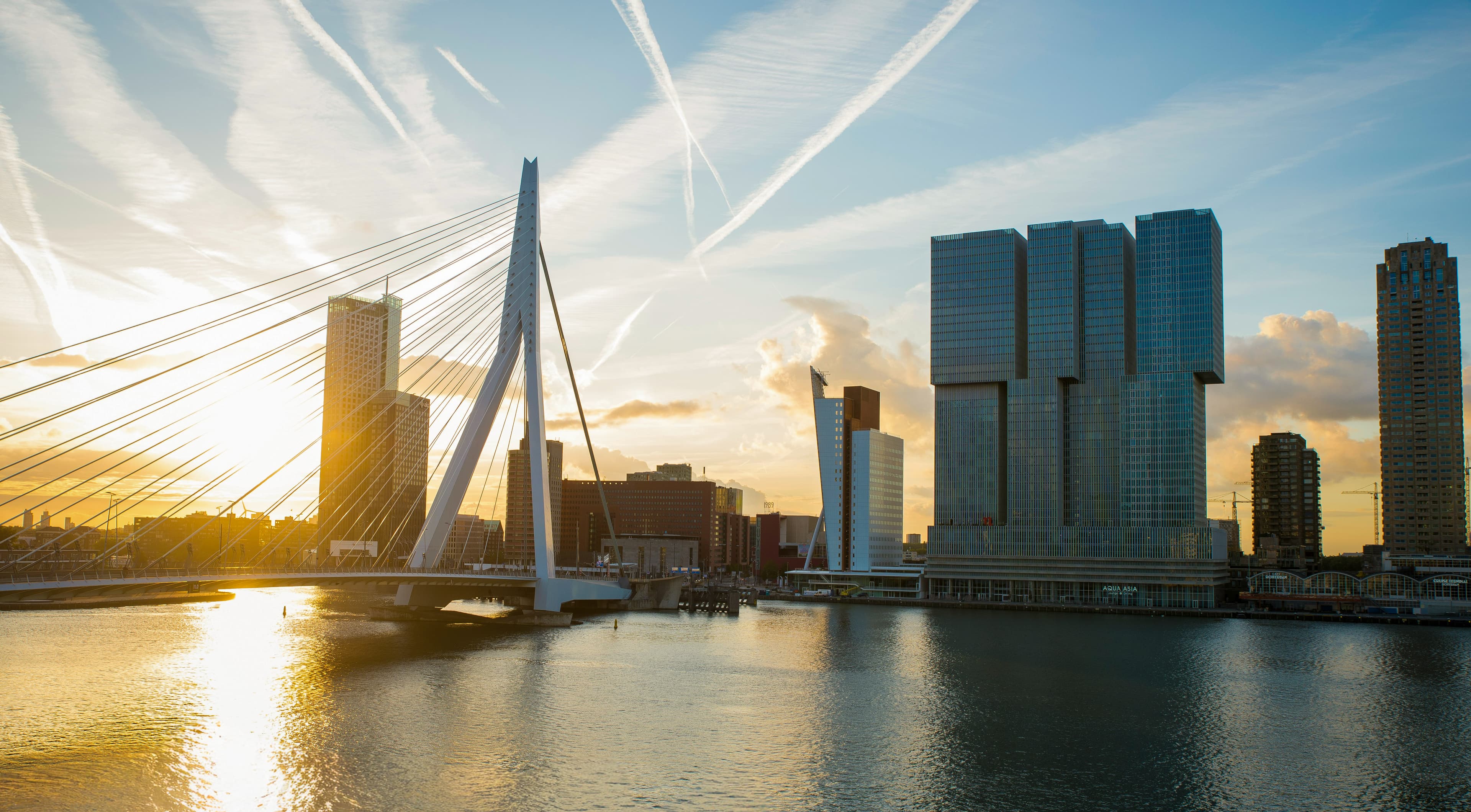
The marathon starts on Schiedamsedijk, at the foot of the Erasmus Bridge, and finishes on the Coolsingel in front of Rotterdam City Hall, a point-to-point route that returns runners to within a kilometre of where they began. The course crosses the cable-stayed Erasmus Bridge twice: once heading south in the opening kilometres, and again on the return leg in the second half. Between the two crossings, the route runs through Feijenoord past Feyenoord Stadium (De Kuip), loops through IJsselmonde, runs west through Charlois on the Havenspoorpad, and makes a double passage along Oldegaarde, which replaced the former Zuiderpark loop for the 2026 edition. Two additional short wooden-bridge sections, at roughly the 5 km and 30 km marks, are the only other notable rises on an otherwise flat, wide-road course built through Rotterdam’s rebuilt post-war city centre.
After the second bridge crossing the course runs through the centre and Crooswijk, loops the Kralingse Bos and the Kralingse Plas lake, and returns past the Cube Houses and the Markthal to the Coolsingel. For the 45th edition, the finish moved roughly 300 metres earlier than in previous years, to a point nearer Beursplein and the World Trade Centre, due to construction works at Hofplein.
Km 0-3: The Erasmus Bridge, twice before it matters. The race starts on Schiedamsedijk with waves released in five-to-seven-minute intervals from 10:00, and the Erasmus Bridge arrives almost immediately. At this point in the race the 2-3% gradient over its roughly 400-metre span barely registers; the field is still tight, adrenaline is doing most of the work, and the bridge functions more as a landmark than an obstacle. It will feel different the second time.
Km 3-13: Feijenoord and the Feyenoord-bocht. South of the river the route runs along Laan op Zuid through Feijenoord and past Feyenoord Stadium, known locally as De Kuip, at about 4 km, then loops through IJsselmonde on Olympiaweg, Spinozaweg and Pascalweg. For the 45th edition the organisers introduced a loop around the stadium in this section, already nicknamed the Feyenoord-bocht, expected to become one of the loudest points on the course. A short wooden-bridge crossing around the 5 km mark is the only interruption to what is otherwise wide, flat, well-surfaced road.
Km 13-21: The Havenspoorpad and Oldegaarde. A dead-straight four kilometres west along the Havenspoorpad through Charlois leads into a double passage along Oldegaarde, introduced in 2026 in place of the former Zuiderpark loop, between about 17 and 20 km. Straight roads, consistent surface, and enough distance from the finish that crowd density thins out make this the section for settling into target pace.
Km 21-28: The second bridge. The route heads back north along Brielselaan and Laan op Zuid, crossing the Erasmus Bridge a second time at about 27 km. Race reports consistently flag this as the course’s defining tactical moment: the same gradient and distance as the outbound crossing, but arriving as glycogen stores start to protest rather than while the legs are still fresh. A firm cutoff applies at this point: runners must clear the Erasmus Bridge heading back toward the city centre by 2:15pm local time.
Km 28-33: Blaak, Crooswijk and the second wooden bridge. Back in the centre, the course passes Blaak and heads north-east through Crooswijk towards the Kralingse Bos. A further short wooden-bridge section, around the 30 km mark, arrives exactly where fatigue starts to make even minor rises feel more significant than they measure. Race reports describe this stretch as the point where Rotterdam’s reputation for total flatness starts to feel slightly exaggerated, without the course ever becoming genuinely hilly by any wider standard.
Km 33-40: Kralingse Plas. The closing kilometres loop the Kralingse Bos and the Kralingse Plas, Rotterdam’s largest lake, the lowest ground of the course, on flat paved roads with lake views to one side. Crowd support builds steadily back toward the city centre.
Km 40-42.195: Cube Houses to the Coolsingel. The final stretch passes the Cube Houses and the Markthal before turning onto the Coolsingel for the finish, moved slightly earlier than in previous editions due to Hofplein construction works but retaining the grandstand-lined run-in the race is known for.
Follow the blue tangent line throughout: on a course this flat, running the shortest legal line is one of the only genuine time savings available over 42.195 km. The timing mat sits at the finish itself on the Coolsingel, not at any earlier landmark, so chip time continues until that line regardless of where the crowd thins.
The Erasmus Bridge arrives almost immediately after the start. At this stage its gentle gradient is barely noticeable; use it to settle into goal pace rather than surge.
The course runs through Feijenoord past De Kuip, loops IJsselmonde, then settles into the straight Havenspoorpad and a double passage along Oldegaarde. This is the section for holding an even, disciplined pace.
The Erasmus Bridge returns at about 27 km, this time when it counts. A firm cutoff applies here (2:15pm crossing deadline). A further short wooden-bridge rise near km 30 catches tired legs off guard.
The closing lakeside loop and a run past the Cube Houses and Markthal lead into the finish on the Coolsingel, shortened slightly for 2026 due to nearby construction but keeping its grandstand finish.
Course Map
The map shows the 2026 course across both Erasmus Bridge crossings, through Feijenoord, IJsselmonde, Charlois and Oldegaarde, and around the Kralingse Plas, the start at Schiedamsedijk, the finish on the Coolsingel, the expo at the WTC, and key transport stations. Tap a marker for details, and scrub the slider or press play to move the orange marker along the course with the elevation profile beneath it.
Pacers
Official pacers run through the Nationale-Nederlanden Pacing Team, powered by Runner’s World and organised by the Dutch Pacing Team. Sign-up for the Pacing Team closes around 1 April and is free; pacers are recognisable by white NN-branded kit and a flag showing their target time, and start in the same wave as the runners they are pacing.
| Wave | Start time | Corrals | Pacers available |
|---|---|---|---|
| Wave 1 | 10:00 | Fastest seeded runners | 3:00 · 3:10 · 3:20 |
| Wave 2 | 10:07 | Sub-3:40 seeded | 3:30 · 3:40 |
| Wave 3 | 10:14 | Sub-4:10 seeded | 3:50 · 4:00 (extra pacers allocated) · 4:10 |
| Wave 4 | 10:21 | Sub-4:40 seeded | 4:20 · 4:30 |
| Wave 5 | 10:28 | Remaining seeded | 4:40 · 4:50 · 5:00 |
The pacer-to-wave allocation above is inferred from the general wave-seeding principle rather than an official published pacer-wave table; the pacer target times themselves are confirmed from the Dutch Pacing Team’s own site.
What to wear
April in Rotterdam averages 5-14°C, with the coolest starts closer to 4-5°C and the warmest recent race days climbing into the mid-teens by midday. Rain is a real possibility rather than an edge case: April is statistically Rotterdam’s driest month, but that still means roughly nine days of measurable rainfall across the month. Wind exposure is most noticeable on the two Erasmus Bridge crossings, where the open span carries whatever breeze is coming off the Maas.
A throwaway layer for the 09:00 start-area wait and the walk to the start boxes is worth keeping regardless of forecast; temperatures at the Schiedamsedijk start area in the hour before the gun are consistently several degrees cooler than by the time the sun is up over the finish. Runners targeting four hours or slower should plan for temperatures to have risen by the time they reach the second bridge crossing, making a light, breathable top a safer default than full cover for the whole distance.
Entry
| Registration type | Pre-registration ballot |
|---|---|
| Pre-registration fee | €5 |
| 2026 total entry cost | €150 (pre-registration fee deducted from this total) |
| Charity minimum | €500 via KWF Run Against Cancer |
Entry to the marathon distance is not first-come, first-served. Since the Municipality of Rotterdam capped further growth of the event ahead of 2026, the organisers allocate the roughly 18,000 marathon places through a pre-registration lottery: runners register during a fixed window (9-22 September for the 2026 edition), pay a €5 administration fee, and are then randomly assigned a place, with no advantage for registering early within that window. Selected runners receive an invitation to complete registration and pay the remaining fee, which brought the total entry cost to €150 for 2026; the €5 pre-registration fee is deducted from this total. Runners not selected are offered a guaranteed, discounted place at one of the organiser’s other spring marathons in the Netherlands or Belgium (Ghent, Leuven, the National Park Marathon, or Utrecht) as a fallback.
There is no fast-runner or GFA qualifying-time entry route: the ballot applies equally regardless of predicted finishing time. Runners who have completed the race ten times or more can register outside the ballot as Super Marathon Masters, and entrants in the Dutch Marathon Championships (NK Marathon) similarly register separately rather than through the general pre-registration window.
Charity entry exists through the organiser’s partnership with the Dutch Cancer Society (KWF): entrants who raise at least €500 for KWF through an official Run Against Cancer fundraising page receive their entry fee back, and there is a similar arrangement with the KLABU refugee-sport charity via a small number of dedicated bib numbers. Neither route bypasses the ballot cap directly, but both offer a path to a confirmed place tied to a fundraising commitment rather than the lottery outcome.
Bib numbers can be transferred to another runner up to 31 March, and a cancellation-insurance product, purchased at the time of registration, is the only route to a fee refund; cancellation without insurance is not possible after 1 March. Waves are seeded by the estimated finishing time submitted at registration, which can be edited up to 28 February before bib production locks it in.
Race Weekend
Expo and Race Pack Collection
The Marathon Sport Expo runs from the Postillion Hotel & Convention Center WTC Rotterdam, in the city centre a short walk from both the Coolsingel finish and Rotterdam Centraal station. For the 2026 edition it opened Friday 10 April, 10:00-20:00, and Saturday 11 April, 10:00-19:00, with Marathon Rotterdam Walk participants able to collect from 07:00 on the Saturday; on race-day Sunday, only a limited bib-collection desk operates, from 07:00-10:00, with the expo floor itself closed.
Bib collection requires the e-ticket sent by email roughly a week before race weekend, plus physical photo ID; a runner may collect on behalf of someone else by presenting that person’s physical ID. Runners registered by 8 March have their first name printed on the bib. Billed as the largest running expo in the Benelux, it covers clothing, nutrition and equipment exhibitors alongside the standard bib and t-shirt collection, and hosts a ticketed Pasta Party on the Saturday evening, run in two sittings (17:00-19:00 and 19:00-21:00).
International runners follow the same three-day collection window as domestic entrants. Given the compact geography, the expo sits close to several of the neighbourhood options covered in Where to Stay, making a Friday collection a straightforward add-on to an early arrival rather than a dedicated trip. Uncollected bibs cannot be claimed on race morning outside the 07:00-10:00 Sunday window, so runners arriving late in the weekend should prioritise Saturday collection over leaving it to race-day itself.
Getting to the Start
The start area on Schiedamsedijk, at the foot of the Erasmus Bridge, opens at 09:00. The marathon starts in five waves between 10:00 and 10:28, released roughly seven minutes apart, each wave’s start boxes closing five to ten minutes after its gun. Wave assignment follows the estimated finishing time submitted at registration, locked in from 28 February, so there is no option to move to an earlier wave on the day; moving to a later one is always possible without notifying the organisers.
Getting to the start from the city centre is a short walk or tram ride rather than a logistical exercise: most recommended accommodation areas sit within Rotterdam’s compact centre, on the same side of the river as the finish, with the start a walkable 15-25 minutes away or a few stops on the Rotterdam tram network. Runners staying in Kop van Zuid, on the south bank, are closer still to the start itself but face a longer trip back across the river to the Coolsingel afterwards.
Changing facilities and bag drop-off operate on race day only, not on the Saturday supporting-distance day. Changing rooms are at De Doelen, entered via Kruisplein, open 08:00-17:00; access requires the changing-facility icon on the bib, and there are no showers on site. Bag drop-off is at tents on Schouwburgplein, also 08:00-17:00, and must be selected as a paid add-on (€5.50) at registration; choosing bag drop-off automatically includes changing-facility access. Toilets are positioned at the start area, at intervals along the course near the aid stations, and at the finish; expect the usual pre-race queue pressure in the final 30 minutes before the first wave.
After Finishing
All finishers receive a medal, with on-site engraving available at Schouwburgplein throughout the weekend, or pre-ordered via the runner’s dashboard up to 1 March. Finish-line provisions include AA Drink Smart recovery drink, water and fruit; no fruit is provided at on-course aid stations, only at the finish. Runners without a bag-drop reservation who need dry kit after finishing should plan to meet supporters directly at the Coolsingel rather than relying on facilities there, since changing rooms are at De Doelen rather than at the finish itself.
Nutrition on Course
Aid stations are positioned at 5, 10, 15, 20, 25, 30, 35 and 40 km, offering AA Drink sports drink and water at each point; separate sponge stations sit between these, at 12.5, 17.5, 22.5, 27.5, 32.5 and 37.5 km, giving a water or sponge point roughly every 2.5 km for the second half of the race. No solid food or fruit is provided at any on-course station; fruit is available only at the finish, alongside AA Drink Smart recovery drink and water.
There is no confirmed personal-bottle-service procedure published for this race, and cup type at aid stations is standard disposable cup rather than bottle based on available race photography. Given the flat, fast nature of the course and its appeal to PB-focused runners, the eight-station spacing sits slightly wider than some comparable Gold Label races; runners relying on a specific gel-timing strategy should carry what they need between stations rather than assuming a station at every 5 km will coincide exactly with their fuelling plan.
Spectating
Rotterdam’s compact, point-to-point course and dense central tram network make it realistic to see a runner two or three times without needing a car. The strongest single spot is the Erasmus Bridge, since the same span carries the field both outbound in the early kilometres and back again in the mid-to-high twenties. Crowd density is highest along the Coolsingel itself and around the bridge on both crossings; the Oldegaarde and Kralingse Plas sections, further from the city centre, are noticeably quieter and better suited to spectators who want to walk alongside the route rather than stand in a crowd.
Itinerary A: start at the Erasmus Bridge (Kop van Zuid side) for the km 1-3 outbound crossing, stay in place or walk back across the bridge for the km 25-27 return crossing, then walk 10-15 minutes north to the Coolsingel for the finish.
Itinerary B: start on the Coolsingel near the finish to see the elite finish times early in the day, take the Rotterdam metro or tram toward Kralingen for the km 33-40 lakeside section, then return to the Coolsingel in time for mid-pack and later finishers.
Itinerary C: watch the start-area crowds gather at Schiedamsedijk from 09:00, walk or take a short tram hop to Feijenoord to see the Feyenoord-bocht loop past De Kuip, then return to the Coolsingel for the finish, allowing at least 45-60 minutes for the crossing and the crowds.
Live tracking is available via the official race app and results partner (ACN Timing), giving supporters estimated arrival windows at each timing point rather than requiring them to guess when to be in position.
Where to Stay
Rotterdam’s centre is compact enough that almost any city-centre neighbourhood puts a runner within a 20-minute walk of both the start and the finish, which makes this a race where the choice between areas comes down to price and pace of evening rather than a hard start-versus-finish trade-off.
Centrum/Coolsingel
The area immediately around the finish line itself: shopping streets, the Bijenkorf department store, and the widest hotel selection in the city. Walk time to the finish is a matter of minutes; the start at Schiedamsedijk is a 15-20 minute walk or a short tram ride. Price level rises sharply on marathon weekend given the concentration of demand right on the finish line. This is the right choice for a runner who wants zero logistics on race morning and doesn’t mind paying for it.
Kop van Zuid
South of the river, on the same side as the start, with newer design-led hotels and river views. Walk time to the start at Schiedamsedijk is shorter than from Centrum; getting to the finish afterwards means crossing the Erasmus Bridge again, on foot or by tram. Quieter on a Saturday night than Centrum. Mid-to-upper price level. Suits a runner who prioritises an easy race-morning start over an easy post-race walk home.
Cool District (within Centrum)
A livelier pocket of Centrum with more bars, boutiques and independent cafes. Similar walk times to the finish as the wider Centrum area. Noticeably louder on a Saturday night; a runner needing an early, quiet night before the race should look elsewhere or book a room away from the main strip.
Near Rotterdam Centraal / Weena
Convenient for arrival by train and for a quick departure afterwards, with larger business-oriented hotels. Walk time to both start and finish is a bit longer than from Centrum proper, in the 20-25 minute range, though the tram network closes the gap quickly. Quieter on Saturday night than Centrum. This area suits runners flying into Rotterdam The Hague Airport or arriving via Amsterdam Schiphol who want minimal onward travel once they land.
Delfshaven/Katendrecht
More distinctive, less central options further out, including hotels housed in converted maritime buildings. Walk time to the finish stretches to 30 minutes or more, so this suits runners travelling with a car, comfortable with a short taxi or tram trip on race morning, or extending their stay to explore Rotterdam’s port history rather than optimising purely for race-day convenience.
Recommended hotels
Sits inside the WTC building that hosts the Marathon Sport Expo itself, putting bib collection, the Saturday Pasta Party and the Sunday finish all within the same short walk. The trade-off is being at the centre of the loudest, busiest part of the weekend rather than a quiet retreat.
Positioned at the foot of the Erasmus Bridge itself, this is the closest realistic hotel to the start line, with river and skyline views from upper floors. Getting to the finish afterwards means recrossing the bridge on foot or by tram.
An Art Deco hotel directly on the Coolsingel itself, close enough to watch the finish-line crowds build from the doorstep. Central shopping streets right outside mean Saturday footfall and noise are higher than at a quieter address.
A design-led four-star a short walk from the Coolsingel, with a 24-hour food market rather than a fixed restaurant, useful for a runner arriving hungry outside normal meal service hours after a late-morning finish.
The most convenient option for runners arriving or departing by train, directly opposite Centraal station, with a slightly longer walk to both start and finish than the Centrum options but the easiest onward travel for a short trip.
Booking timeline
Ballot results are announced in late September (23 September for the 2026 edition, roughly six and a half months before race day), which gives a longer runway than most European majors but also means hotel demand in the compact city centre builds steadily rather than spiking all at once. Runners who wait until confirmation to book will still generally find availability given the six-month window, but the best-located Centrum and Kop van Zuid properties near both the start and finish sell out their marathon-weekend inventory first.
The recommended approach is to book a flexible-cancellation rate at the point of entering the pre-registration window in September, then confirm or release it once the ballot result arrives. Price premiums on marathon weekend are moderate compared with major-city marathons in bigger tourist capitals, reflecting Rotterdam’s position as a strong but secondary Dutch destination behind Amsterdam. Flights into Amsterdam Schiphol, roughly 25-30 minutes from Rotterdam Centraal by direct intercity train, are often cheaper and more frequent than flying directly into the smaller Rotterdam The Hague Airport.
See & Do
The Coolsingel finish sits within a few minutes of the Markthal, the Cube Houses and the widest concentration of shops and cafes in the city centre.
Markthal
A covered market hall beneath a vast painted ceiling mural, with food stalls suited to a slow, low-effort browse rather than a standing queue. Flat floors throughout make it an easy option on legs that don’t want stairs.
Cube Houses (Kubuswoningen)
A cluster of tilted cube-shaped houses built on stilts, one of which is open as a small show home. Viewing from street level requires no queueing or stairs; the show-house visit itself involves a steep internal staircase, worth skipping the day after a marathon.
Euromast
A 185-metre observation tower with city and port views, reached by lift rather than stairs, making it a reasonable option for tired legs provided the short walk or tram ride to reach it is manageable.
Kunsthal and Museumpark
A changing-exhibition art museum set in a flat, walkable park, with benches throughout for anyone needing to sit down between galleries.
Hotel New York and the Kop van Zuid waterfront
The former Holland America Line head office, now a cafe and hotel on the Kop van Zuid waterfront, with a flat riverside walk back toward the Erasmus Bridge. A good low-key option for an evening the day after the race.
Read Before you Run
The Rotterdam Blitz: The Air Attack That Destroyed a City and Changed the Course of the Second World War
Alexander McKee
An account of the May 1940 bombing that flattened Rotterdam’s historic centre, the direct reason the marathon runs through the wide, rebuilt post-war boulevards, including the Coolsingel itself, that make the course so fast. Useful context for why a Dutch city centre looks so different from Amsterdam’s.
After the Race
The NN Marathon Rotterdam runs in the second week of April, most years just ahead of the Dutch tulip season reaching its peak. That overlap is the defining editorial fact of the post-race week here: a runner who stays for seven to ten days more is in the Netherlands during the most visually specific fortnight the country produces each year.
MarathonPassport
Running Into Colour: Rotterdam and the Dutch Tulip Season
A full guide to the Rotterdam tulip season: the Keukenhof, the Bollenstreek cycling routes, the Bloemencorso parade, and how the marathon timing fits the peak bloom window.
Nineteen 1740s windmills across two canals, reachable by boat directly from the finish area without a single flight of stairs involved. April sees the mills operational for the new season with the fields still green rather than the crowds of high summer.
A compact historic centre built around the Markt, the Prinsenhof and Royal Delft, all walkable on flat, level streets. The shortest rail hop of any option on this list, making it the lowest-effort day trip for the day immediately after the race.
The Mauritshuis, home to Vermeer’s Girl with a Pearl Earring, the Binnenhof seat of Dutch government, and Scheveningen’s flat 3 km boardwalk and pier, reached by tram from the city centre.
Gouda for its stained-glass Sint-Janskerk and Thursday cheese market; Dordrecht, the oldest city in Holland, for its medieval street plan and the Biesbosch National Park’s tidal freshwater delta just beyond it.
Timed for the overlap between race weekend and Keukenhof’s peak tulip bloom in mid-to-late April. Haarlem’s Frans Hals Museum and Grote Kerk, Keukenhof’s 32 hectares of bulbs, and Amsterdam’s Rijksmuseum and canal ring round out a full onward trip.
Frequently asked questions
Should I stay near the start or the finish?
Rotterdam’s centre is compact enough that most hotels sit within a 20-minute walk of both. The genuine choice is between Kop van Zuid, on the same side of the river as the start at the Erasmus Bridge, or Centrum, right on the Coolsingel finish. Kop van Zuid shortens race-morning logistics; Centrum removes any need to cross the river again afterwards.
How far in advance should I book a hotel?
Entry is decided by a September ballot, with results announced roughly six and a half months before the April race. Book a flexible-cancellation rate as soon as you enter the pre-registration window, then confirm once your ballot result arrives, since the best-placed Centrum and Kop van Zuid hotels sell out their marathon-weekend inventory first even with that lead time.
Is there free transport to the start?
This has not been confirmed for this race. Rotterdam’s compact centre means most recommended accommodation areas are within a 15-25 minute walk of the Schiedamsedijk start, or a short tram ride, so dedicated race-day transport may not be necessary regardless.
What is the best area to stay?
Centrum, around the Coolsingel, puts you closest to the finish with the widest hotel choice, at a price premium reflecting the demand. Kop van Zuid, across the river, sits closer to the start with a quieter Saturday night, at the cost of a longer walk back after finishing.
When does the expo open?
The Marathon Sport Expo runs from the Postillion Hotel & Convention Center at the WTC, typically Friday and Saturday of race weekend (Friday 10:00-20:00, Saturday 10:00-19:00 for 2026), with a limited race-morning bib desk only on the Sunday, 07:00-10:00.
What is the weather typically like?
April in Rotterdam averages 5-14°C, with a genuine chance of rain given the wet climate year-round, though April is statistically the city’s driest month. Wind is most noticeable on the two Erasmus Bridge crossings. Recent race days have ranged from a chilly 8°C to an unusually mild mid-teens.
How do I get from the airport?
Amsterdam Schiphol is roughly 25-30 minutes from Rotterdam Centraal by direct intercity train and generally offers more frequent, often cheaper flights than Rotterdam The Hague Airport, which is a short local hop from the city centre for regional connections.
Is there a bag drop?
Yes, on race day only, at tents on Schouwburgplein, 08:00-17:00. It must be selected as a paid add-on (€5.50) at registration and automatically includes access to changing facilities at De Doelen, which has no showers on site.
Should I bring a throwaway layer?
Yes. The start area opens at 09:00 and temperatures there are consistently cooler than by the time the race finishes, and April weather can shift quickly from a cool, damp start to a milder finish. There is no dedicated collection point beyond the general start-area zone.
How do I get back to my hotel after finishing?
The finish sits on the Coolsingel in the heart of the city centre, within walking distance of most recommended hotel areas. Runners staying in Kop van Zuid will need to recross the Erasmus Bridge on foot or by tram; everyone else is likely within a 20-minute walk or a short, well-served tram hop.