The Race
| Next Race Date | Sunday 26 September 2027 (provisional; the organiser has not yet published the 2027 date) |
|---|---|
| Course Type | Single loop, with the southern sector run twice |
| Registration | Open, direct entry, no ballot |
| Ballot Opens | No ballot |
| Total Finishers | 911 (2025) |
| Average Race Day Temperature | Not confirmed: late September in Rouen ranges from cool and wet to 30°C |
| Cutoff Time | 5 hours 30 minutes |
| Free Race Day Transport | Not confirmed; the organiser recommends the metro to Joffre-Mutualité |
| Course Certification | FFA regional label, qualifying for the French Championships |
History
Seine-Marathon 76 launched in 2018 as a running weekend built around Rouen and the wider Seine-Maritime department, gathering a marathon, half marathon, 10 km, an accessible 5 km and children’s races under one name. The 10 km had existed on its own since 2013 under ASPTT Rouen before joining the combined event in its first year. The race paused in 2020 and has run every year since 2021, making 2026 the eighth edition.
The weekend has grown while the marathon itself has stayed small. By 2025 the whole event drew 16,982 participants, more than a thousand additional children in Saturday activities and over 700 volunteers, and handed €24,639 to local associations. The marathon accounted for 911 classified finishers of that total. The course has moved with the growth: the start shifted to Pont Boieldieu, the field now assembles in objective-time corrals, and the race settled into its present shape as one continuous 42.195 km loop through the historic centre and the southern districts.
Guillaume Ruel has dominated the men’s race in recent years, winning in 2022, 2023 and 2024 and lowering the event record to 2:22:38 in the last of those. Fanjanteino Felix won the women’s race across the same three years and set the standing record of 2:51:42 in 2024. Neither record fell in 2025, when Aurélien Declosmesnil won in 2:32:17 and Camille Chaigneau was first woman in 2:47:09. The race runs under FFA road rules with a regional label and qualifies finishers for the French Championships. Its official 2026 profile gives 205 m of positive gain, which corrects the 234 m figure still quoted on several third-party listings.
The course
The marathon starts on Pont Boieldieu beside the Hôtel du Département de Seine-Maritime and finishes at Prairie Saint-Sever, 59 metres away. That is the defining practical fact about this race: the start, the finish and the expo all sit in one compact riverside district, so nothing about the weekend requires crossing the city. The organiser’s official figure for the fully paved route is 205 m of climbing.
The opening kilometre crosses to the historic right bank and climbs 17 m through Rue de la République towards the cathedral quarter, before Rue Jeanne d’Arc drops 20 m straight back to the Seine. The course then crosses south and works steadily uphill through Boulevard de l’Europe, Sotteville-lès-Rouen and Avenue des Canadiens onto the plateau above Saint-Étienne-du-Rouvray, gaining 32 m between km 4 and km 11. It comes back down to the river by km 19, runs the central quays and Île Lacroix, then climbs that same southern plateau a second time between km 25 and the day’s high point of 39 m at km 31. The last eleven kilometres fall away steadily along the western quays, past Pont Flaubert at km 39, and back along Quai Jean de Béthencourt into Prairie Saint-Sever. Two long climbs of the same hill, several bridges and a set of long riverside straights are the pacing problem here, not any single steep section.
Kilometre by kilometre
Km 0 to 6: Pont Boieldieu and the historic right bank. The field assembles on the Quai Jean Moulin side of Pont Boieldieu in objective-time corrals. There is no dedicated race parking, so the organiser pushes runners towards the metro at Joffre-Mutualité. The route heads north into the old centre past Rue de la République, Rue Jean Lecanuet and the cathedral quarter, climbing 17 m in the first 1.6 km. Rue Jeanne d’Arc then gives it all back, dropping 20 m over 1.5 km to the quays. Neither movement is severe, and both are steep enough to wreck an even opening split if you chase the descent.
Km 6 to 20: the southern plateau, first time. The course crosses the Seine into broader, plainer southern streets: Boulevard de l’Europe, Rue d’Elbeuf, the Jardin des Plantes sector, Avenue des Canadiens and Parc des Bruyères. It climbs 32 m between km 4 and km 11 to reach the plateau above Saint-Étienne-du-Rouvray, holds that height to about km 12, then descends 35 m over the next seven and a half kilometres back towards the river. Aid stations appear every 5 km with water, banana, orange, dried apricots, mixed dried fruit and nuts, and sugar.
Km 20 to 35: the same hill again. This is a single continuous course that revisits its own southern corridors, and the second pass is the hard one. After the central quays and Île Lacroix, the route turns south again and climbs 34 m from km 25 to the day’s high point of 39 m at km 31, retracing the Jardin des Plantes and Avenue des Canadiens ground covered twenty kilometres earlier. The gradient averages half a per cent, which sounds like nothing and lands exactly where marathon fatigue starts. From 25 km the aid stations add cola, savoury crackers and chocolate to the fruit and sugar, a more substantial late-race table than most French road marathons put out. Spectators get a second sighting here without moving; runners get the same scenery twice.
Km 35 to 42.195: the western quays and Prairie Saint-Sever. From the high point the course falls 34 m over the closing nine kilometres, which is as generous a finish as a marathon offers. It returns to the central river corridor, then runs west along Allée François Mitterrand and the Presqu’île Rollet, with the 38 and 40 km markers on this open western stretch beside Pont Flaubert. The sight lines here are long and the finish is not visible from a distance, which makes these kilometres feel longer than they are. Quai Jean de Béthencourt is the last riverside corridor before the turn into Prairie Saint-Sever, where the finish sits inside the event village with food trucks, drinks and music, and noticeably more noise than the quiet quay a kilometre earlier.
No official blue line marking the shortest route has been published, so run sensible tangents through corners as a matter of habit. Headphones are tolerated at the runner’s own risk, explicitly so: the open riverfront sections carry traffic-management hazards of their own.
A compact, spectator-friendly city marathon
Most city marathons scatter the start, the finish and the expo across different districts. This one puts all three within a few minutes of each other around the Hôtel du Département and the central Seine crossings, and the repeated southern sector means a supporter standing in one place has a real chance of seeing a runner twice. For a first visit to Rouen, and for anyone supporting without a car, that is worth more than it sounds.
The event also carries the Fair Play For Planet environmental label for 2026, which shows up in practical ways: the aid stations are food-led instead of gel-branded, and there is very little single-use sponsor material at the tables. Runners used to heavily branded international marathons should plan their own gels accordingly.
Course Map
One continuous loop with the southern sector run twice, and a start and finish 59 metres apart. Tap a marker for the start, the finish, the Marathon Village and the metro, and scrub the slider or press play to move the orange marker along the course with the elevation profile beneath it.
Pacers
All marathon runners start together at 08:30 from objective-time corrals. Official pacers cover 3:00, 3:15, 3:30, 3:45, 4:00, 4:15 and 4:30. They carry visible markers, though the 2026 flag colours have not been published.
What to wear
Late September in Rouen is properly transitional. Cool, damp mornings and rain are entirely plausible, and so is late-season warmth: Météo-France recorded 30.1°C in Rouen during September 2025. No authoritative long-term 08:30 temperature normal has been published for the city, so treat any “average race-day temperature” you see quoted with suspicion.
A meaningful part of this course runs along exposed Seine quays, which means wind matters even where the gradient does not. A calm morning in the old centre can be breezy on the open riverfront, and the western stretch past Pont Flaubert at km 38 to 40 is the most exposed part of the race. A light disposable layer for the start is sensible on a cool or wet forecast, though no clothing-donation scheme has been published, so discard kit only where staff have designated a collection point. Given the real possibility of a warm second half, plan hydration around the forecast on the day instead of assuming late September guarantees cool running.
Entry
Entry is direct online registration with no ballot, priced in three bands: €49 (€45 for FFA-licensed runners) until 20 February 2026, €59 (€55 licensed) from 21 February, and €65 (€61 licensed) from 1 July, all excluding booking fees. Individual registration stays open until 23:59 on 23 September 2026 subject to availability, and the organiser reserves the right to close any race earlier for safety or capacity reasons.
A Pass Prévention Santé or an eligible FFA licence is mandatory, including for runners from outside France. Start corrals are seeded on declared target time, so there is no separate qualifying tier. The organiser’s own bib exchange is the only authorised transfer route and outside resale is explicitly prohibited. A €12 cancellation guarantee can be bought alongside registration, covering specified serious illness, injury, accident or family bereavement with evidence required; it cannot be added afterwards. No charity-bib allocation or international tour-operator programme has been published.
Fast Runner / GFA Standards
There is no Good For Age or fast-runner entry route. Every place is sold on the open registration described above, and a declared target time affects only which corral you start in.
Race Weekend
Expo
The Marathon Village and bib collection are at the Hôtel du Département de Seine-Maritime, entered from Quai Jean Moulin. The 2026 hours are Friday 25 and Saturday 26 September, both 10:00 to 19:00. Bring photo identification and your QR code. A proxy can collect for you with the runner’s identification, the QR code and a valid PPS or licence number, if that documentation has not already been supplied.
There is an unusual Sunday-morning fallback. A dedicated desk at the Hôtel du Département runs from 07:00 to 07:30 on race morning for marathon and half-marathon runners who cannot attend on Friday or Saturday, at a €6 fee. It has to be selected as an option in advance and availability is not guaranteed, so treat it as insurance rather than a plan. Since the Village sits in the same district as the start and finish, runners based on either bank of central Rouen can reach it on foot or by metro without difficulty.
Getting to the Start
The marathon starts at 08:30 from Pont Boieldieu, in the Hôtel du Département and Quai Jean Moulin race zone. There is no dedicated event parking. The organiser recommends parking outside the immediate zone, suggesting Gare, Mont-Riboudet/Kindarena and Boulingrin, and taking the metro to Joffre-Mutualité instead.
Bag storage opens at 07:00 on Sunday in front of the Hôtel du Département on Quai Jean Moulin. Because the finish at Prairie Saint-Sever sits 59 metres from the start, bags stay inside the same compact event zone all morning and there is no point-to-point transfer to think about. Toilets are available near both the start and the finish. There are no changing rooms and no showers anywhere on site, which is worth knowing before you plan a long drive home.
Objective-time corrals manage a large combined-weekend field, and the marathon’s pacers cover 3:00 through 4:30, so arrive with enough time to clear the entrance and find the right pen. A light throwaway layer is worth having if the morning is cool or wet, though no clothing-donation system has been published. Because the finish sits inside the event village, with food, drink, music and family activity, meeting supporters afterwards is far simpler than at a point-to-point race.
Nutrition on Course
Aid stations appear every 5 km and the menu changes noticeably as the race goes on. From 5 km through 20 km, expect water, banana, orange, dried apricots, mixed dried fruit and nuts, and sugar. From 25 km the organiser adds cola, savoury crackers and chocolate to the same base, a more substantial late-race provision than most French road marathons offer. No official gel partner has been published, so anyone who relies on a specific gel should carry their own.
The finish table goes well beyond the standard aid station: water fountains, cola, fresh fruit, a dried-fruit mix, chocolate, sugar, savoury crackers, madeleine-style cake and a Fulfil bar were all listed on the organiser’s 2026 sheet, though exact products and quantities change year to year. Procedures for personal bottles and any elite drink tables have not been published. Medical posts are distributed around the course without published kilometre positions. Toilets are confirmed near the start and finish; showers are explicitly not provided.
Spectating
This is an unusually easy course to watch. It returns through central and southern Rouen repeatedly and uses several metro-accessible corridors, so a supporter does not have to chase a runner across the city to see them more than once.
Itinerary A, the central option. Watch the start on Pont Boieldieu, walk into the historic centre around the cathedral, Rue de la République and Rue Jean Lecanuet for a sighting at about km 2 to 4, then return on foot or by metro to Prairie Saint-Sever for the finish.
Itinerary B, the southern option. Take public transport to the Jardin des Plantes and Rue d’Elbeuf sector. The repeated southern pattern gives a supporter standing here a real chance of two sightings, once in each half, roughly twenty kilometres apart in the runner’s race and perhaps ninety minutes apart in yours. Travel north to Joffre-Mutualité or Saint-Sever in good time for the finish.
Itinerary C, the river option. Position on the Quai de Paris and Quai du Pré aux Loups section for the low-30s kilometres, then move back towards central Rouen by TEOR, bus or on foot and cross to Prairie Saint-Sever for the finish.
The best single location is the Pont Boieldieu and Prairie Saint-Sever complex itself. Runners start there, cross the central river corridor mid-race and finish immediately alongside, which gives several realistic sightings with almost no travel. Check exact kilometre passages against the official map or live tracking on the day, since the repeated-loop structure makes timing harder to judge than on a linear course. Live-tracking arrangements for 2026 have not been clearly published.
Post-Race Food
The finish village on Prairie Saint-Sever is the safest option that needs no reservation: food trucks, drinks and local producers are part of the organiser’s own finish-line setup, and it is the obvious choice for anyone who does not want to walk. For a seated meal, the Vieux-Marché quarter has the highest concentration of restaurants in the city and is served directly by the Théâtre des Arts metro and tram connections. Pick somewhere confirmed open on a Sunday and reserve ahead.
The streets around Rue du Gros-Horloge and the cathedral are the other central option, and they combine recovery food with the part of Rouen most people come to see. Sunday opening varies enough in both districts that a specific shortlist is worth rechecking in race week, since independent restaurants change their hours faster than race logistics change.
Where to Stay
Stay near the finish. That is the standard advice on this site and it is unusually easy to follow here, because the start on Pont Boieldieu and the finish at Prairie Saint-Sever are 59 metres apart. A single base covers both, and the only real decision is whether you want the shortest possible post-race walk or the better side of the city to spend a weekend in.
Saint-Sever and Joffre-Mutualité
Saint-Sever is the strongest choice for pure logistics. The start and the finish both sit on this south-bank riverfront beside the Hôtel du Département, the organiser’s own recommended metro stop is here, and the walk back to a hotel after finishing is a matter of minutes. It is a working district and not the prettiest part of Rouen, which is the trade.
Vieux-Marché and Théâtre des Arts
Vieux-Marché gives the best blend of sightseeing and logistics. The historic centre is on the doorstep, Théâtre des Arts metro connects south to the start and finish district in a few minutes, and the restaurant density is the highest in the city. Friday and Saturday nights are louder here than anywhere else on this list, so ask for a quiet room.
Cathedral and Gros-Horloge
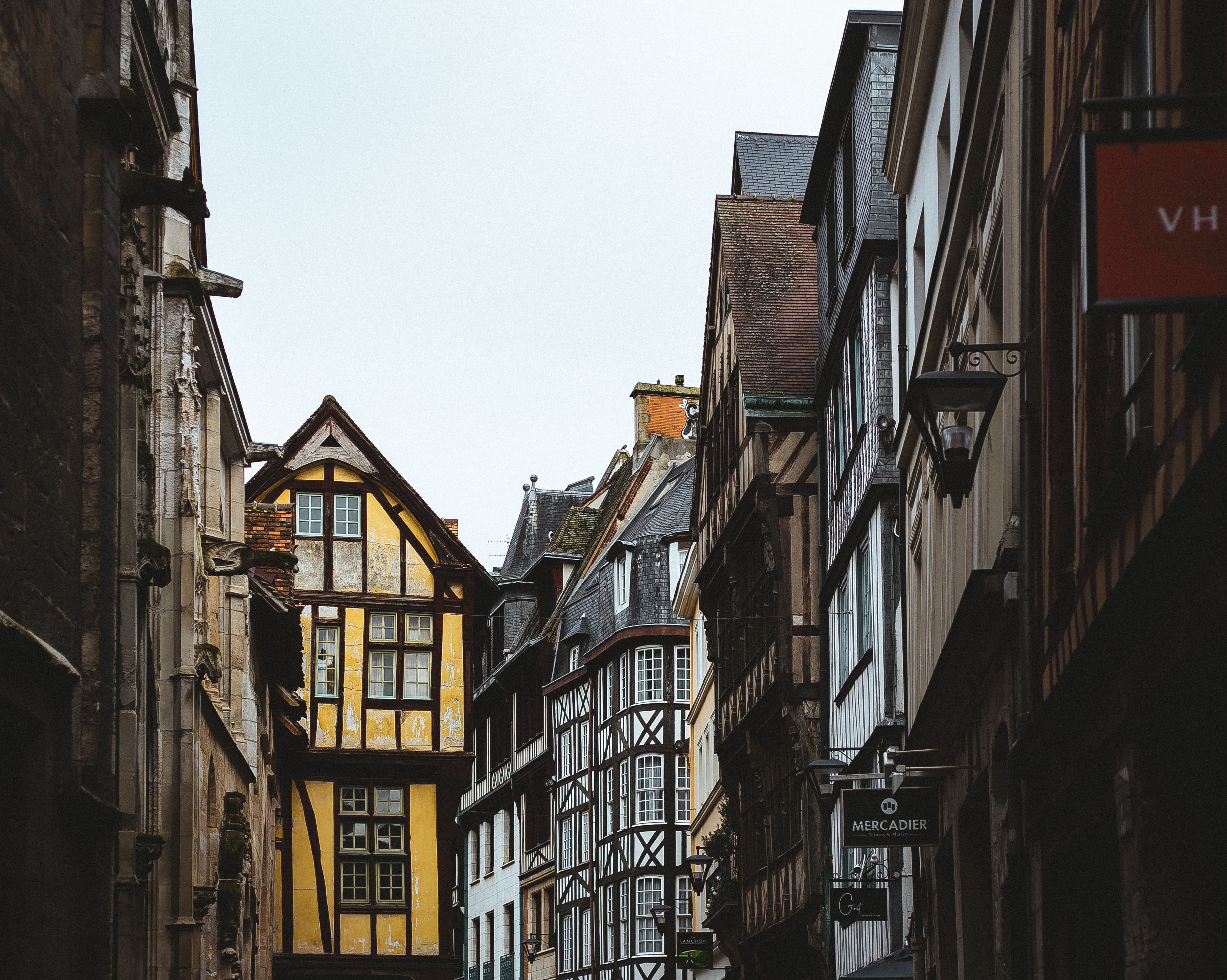
The cathedral quarter works well for a first visit to Rouen. The early course passes nearby at about km 2, Pont Boieldieu stays walkable, and the half-timbered centre is the reason most people come. The central pedestrian streets are busy through Saturday, so the same advice about a quiet room applies.
Rouen Rive-Droite station and Beaux-Arts
The station district suits arrivals from Paris and sits close to the Musée des Beaux-Arts. It is 1.4 km north of the start, mostly downhill on the way there, and the return from the finish is less direct than from Saint-Sever. Worth it if you are arriving late on Saturday and leaving early on Monday.
Quartier Pasteur and the west quays
Quartier Pasteur suits runners who want quieter riverfront accommodation. The course passes these western quays late in the race, around km 18 to 20 and again at km 38 to 40, so factor the road closures into any pre-race movement rather than assuming you can drive out on Sunday morning.
Sotteville-lès-Rouen
Sotteville-lès-Rouen is cheaper and sits beside the southern course, but it is not the default recommendation for a visiting runner. The old centre, the event village and the finish are all further away, and the district works better for drivers and for local runners than for anyone relying on transit and walking.
Recommended hotels
The strongest value of the organiser’s partner hotels at €80.55 for a single room including tax and breakfast, with late checkout to 14:00 on Sunday. It sits close to both the start and the finish, which is the whole argument for staying on this bank.
A short metro ride or walk from the race zone at €87.55 for a single room including tax and breakfast, with the same Sunday late checkout and better access into the old centre.
A solid all-round race and sightseeing base very close to the central Seine, with an official race-weekend discount of 5 per cent on one night or 10 per cent on two using the codes MARA1N and MARA2N on the flexible bed-and-breakfast rate.
Self-catering apartments walkable to the start and finish district, useful for a group that wants a kitchen. It carries the same official 5 and 10 per cent race-weekend codes as the Novotel.
A literature-themed hotel in the restaurant-dense Vieux-Marché quarter, walkable or a short metro ride to the start. No race rate has been published for it.
Booking timeline
There is no ballot. Registration opened on 19 January 2026 and prices step up in February and again in July, so enter and book accommodation as soon as your plans are settled. The whole weekend drew 16,982 participants in 2025, and while only around 900 of those were marathon finishers, the 10 km and half marathon generate most of the citywide hotel demand that marathon runners end up competing against.
The organiser has negotiated 2026 rates at several hotels specifically for the event, which are worth booking into instead of assuming general availability closer to race weekend. Rouen is reached by direct rail from Paris Saint-Lazare, so most international runners can skip a hire car entirely. Book Friday and Sunday trains as soon as fares open if you are travelling at peak times, because they rise the same way flights do.
See & Do
Everything below is within walking distance of the finish at Prairie Saint-Sever or of the hotel districts listed above, and most of it sits on or beside the early race course. Rouen’s centre is small enough that a Saturday of sightseeing need not cost you the race.
Cathédrale Notre-Dame de Rouen
Roughly 1.2 km (0.7 miles) from the finish, and directly on the early course at about km 2. The Gothic west front is the one Monet painted more than thirty times in different light. It opens roughly 07:30 to 19:00 on weekdays and 08:00 to 18:00 on Sundays and holidays through the 1 April to 31 October season, entry is free, and it makes an ideal short Saturday visit with almost no extra walking.
Gros-Horloge
About 1.2 km (0.7 miles) from the finish, a few minutes from the cathedral. A fourteenth-century astronomical clock set in a Renaissance arch over the street. Race weekend falls inside high-season hours, Tuesday to Sunday, 10:00 to 13:00 and 14:00 to 19:00, with last entry an hour before each close. The tower involves a lot of stairs, so do it before the race and not as a recovery activity.
Historial Jeanne d’Arc
About 1.3 km (0.8 miles) from the finish, in the archbishop’s palace beside the cathedral, on the site where Joan of Arc’s rehabilitation trial was held. Listed as open Tuesday to Sunday, 10:00 to 19:00, and a useful indoor option if Saturday turns wet. It closes on Mondays, which rules it out as a day-after visit.
Jardin des Plantes
About 1.5 km (0.9 miles) south of the finish, and on the race course itself in both halves. Free to enter and generally open around 08:00 to 18:45 in September. Flat enough for a gentle recovery walk on the Monday, though you will already have run past it twice, so treat it as a revisit rather than a discovery.
Musée des Beaux-Arts
About 1.6 km (1.0 mile) from the finish, near the station district. A strong provincial collection with Impressionist holdings that connect directly to the cathedral outside, and the best indoor option for tired legs after the race. Check the specific race-weekend hours before relying on it.
After the Race
Late September in Normandy is the quiet end of the season: the coast is still open, the light is low and long, and the summer crowds have gone. Everything below is chosen for legs that have just run 42 km, which in practice means short transfers, flat centres and the option of doing very little. Rouen’s own museums mostly close on Mondays, so the Jumièges day trip is the one that solves the awkward first day after the race.
A ruined Benedictine abbey in a loop of the Seine, open daily in the autumn low season from roughly 09:30 to 13:00 and 14:30 to 17:30 after 16 September. It works particularly well on the Monday, when several of Rouen’s own museums are shut.
A harbour town at the mouth of the Seine that stays active into late September without the summer crowds. The old basin and the streets around it need very little walking, which is the point the day after a marathon.
The chalk arches at Étretat and Auguste Perret’s rebuilt Le Havre, an hour apart on the same coast. Save the full cliff-top walk until the legs have recovered and use Le Havre as the flatter base.
A compact centre that adds the eleventh-century embroidery and the Normandy landing beaches without demanding much walking. Check the museum schedule ahead, since timed entry and renovation work both affect access.
The easiest extension for anyone flying home from Paris or taking the Eurostar, and it needs no car. Book near whatever you actually intend to do: marathon legs do not tolerate long cross-city days.
Frequently asked questions
Should I stay near the start or the finish?
They are 59 metres apart. The start is on Pont Boieldieu beside the Hôtel du Département and the finish is at Prairie Saint-Sever, so Saint-Sever or Joffre-Mutualité gives the easiest race morning, while Vieux-Marché or the cathedral quarter gives a better visit for a short extra walk.
How far in advance should I book a hotel?
As soon as your plans are firm. There is no ballot, registration opened in January with prices rising through the year, and the organiser has negotiated 2026 rates at several partner hotels, which is a good sign to book early.
Is there free transport to the start on race day?
No free runner entitlement has been published. The organiser recommends public transport and specifically the Joffre-Mutualité metro stop, since there is no dedicated event parking. Check the local network for race-day diversions closer to the event.
What is the best area to stay?
Saint-Sever or Joffre-Mutualité for pure logistics, since both the start and the finish sit close by. For a first visit to Rouen, Vieux-Marché or the cathedral and Gros-Horloge quarter balances the historic centre against a manageable journey to the start.
When does the expo open?
Bib collection at the Hôtel du Département runs Friday 25 and Saturday 26 September, both 10:00 to 19:00. A limited paid Sunday-morning option, €6 between 07:00 and 07:30, exists for runners who cannot attend earlier, but it must be booked in advance.
What is the weather typically like on race day?
Variable. Cool, damp mornings and rain are plausible in late September, and so is late-season warmth: Météo-France recorded 30.1°C in Rouen during September 2025. Prepare for a range instead of a single expected condition.
How do I get to Rouen from Paris?
Direct rail from Paris Saint-Lazare to Rouen Rive-Droite is the most practical route for most runners, and usually beats flying into a smaller local airport. From the station it is a short metro ride or a downhill walk of about 1.4 km to the start district.
Is there a bag drop?
Yes, beside the Hôtel du Département on Quai Jean Moulin, opening at 07:00 on race morning. Because the start and finish sit together there is no bag transfer to worry about. There are toilets near both race zones, but no showers anywhere on site.
Should I bring a throwaway layer?
Worth having if the forecast is cool or wet, since the bridge and quay start is exposed to wind. No official clothing-donation scheme has been published, so only discard kit where organiser staff have explicitly designated a collection point.
How do I get back to my hotel after finishing?
Anyone staying near Saint-Sever can walk. From the historic centre or the right bank, cross a reopened bridge on foot or use the metro or TEOR once closures lift. The finish is central rather than remote, so the journey back is short.