The Race
A new course for 2026
The 2026 marathon abandons the flat city loop used from 2023 to 2025 and runs out of Tours into the Loire vineyards, through Rochecorbon, Vouvray and Vernou-sur-Brenne, before coming back to finish at Place Anatole France. The organiser gives 276 m of climbing against a route that previously had almost none. No course record exists, because nobody has raced it: times from 2014 to 2025 belong to earlier and materially different configurations. Treat the whole of what follows as a first edition.
| Next Race Date | Sunday 26 September 2027 (provisional; the organiser has not yet published the 2027 date) |
|---|---|
| Course Type | Out to the Loire vineyards and back, finishing in central Tours |
| Registration | Open, direct entry, no ballot |
| Ballot Opens | No ballot |
| Total Finishers | Not applicable: 2026 is the first running of this course |
| Average Race Day Temperature | 12 to 21°C in September, with a real chance of a warmer day |
| Cutoff Time | 6 hours, with cutoffs at 21 km (3 hrs) and 30 km (5 hrs) |
| Free Race Day Transport | Yes: one Fil Bleu Tours Métropole ticket with every bib |
| Course Certification | FFA Bronze label |
History
The Marathon de Tours is the youngest distance in a much older running weekend built around the 10 km and 20 km de Tours, which the organiser traces back more than forty years. The marathon began on 21 September 2014 and arrived at scale for a French regional race: around 3,500 registered marathoners inside a combined weekend field of roughly 17,000. Niguse Chala Ejéré won the first edition in 2:18:10, with Genet Teka Kahsay first woman.
Through the rest of the 2010s the race built a recognisable East African elite field. Barnabas Kipyego won in 2:13:15 in 2017 and Joseph Kyengo Munywoki ran 2:13:11 in 2018, among the fastest times the old course produced. After a disrupted 2020 the race returned and shifted towards a more domestic field: Alaa Hrioued won in 2022 and again in 2023 on a newly redesigned urban course, in 2:21:47. That 2023 edition also produced a 2:40:52 run in a three-piece suit. The urban route introduced in 2023 ran through 2024 and 2025, won by Marc Pauvert in 2:25:31 and Clément Huet in 2:23:00.
For 2026 the event gained a title partner, Harmonie Mutuelle, and the marathon left the urban format behind entirely. The new course starts on Quai Paul Bert north of the Loire, runs out through Rochecorbon and Vouvray to Vernou-sur-Brenne, and comes back to finish at Place Anatole France. The organiser gives 276 m of gain against a city course that had very little. Because the route has never been raced, there is no current course record, and the 2014 to 2025 times should not be read as benchmarks for it.
The course
The race starts at 07:30 on Quai Paul Bert, north of the Loire, and finishes at Place Anatole France in central Tours, 758 m from where it began. The organiser gives 276 m of climbing across the distance, and effectively all of it lands in the first half.
The opening five kilometres run east along the river through Rochecorbon, gently at first. Then the course turns away from the Loire and climbs: 55 m between km 5.8 and km 10.7 up onto the Vouvray plateau, with the steepest kilometre, from km 6 to km 7, averaging 3.6 per cent. The high point of 116 m arrives at km 10.8, roughly 68 m above the start. From there the route rolls east through Vernou-sur-Brenne, passing the Marathon Duo relay exchange and the three-hour cutoff at km 21, and gives the height back in one long 57 m descent between km 13.2 and km 18.1. Everything from about km 23 is flat, running the Prairie track and the Loire quays between 47 and 55 m before re-entering central Tours at around km 35. It is an entirely road course, mixing rural vineyard lanes with the historic streets of Tours at either end.
Kilometre by kilometre
Km 0 to 5: Quai Paul Bert and the run east along the Loire. Marathon and Marathon Duo runners start together at 07:30, so corral position matters more than at a race with staggered waves. The start sits north of the river, 550 m east of the Place Choiseul tram stop along the quay. The first two kilometres drop very slightly, then the road tips up through Rochecorbon with a 25 m rise between km 2.3 and km 3.9 at 1.6 per cent. Nobody has raced this ground before, so pace it by effort and not by memory of the old city course.
Km 5 to 11: the climb into Vouvray. This is the hard part of the race and it comes early. The course leaves the Loire at Rochecorbon and climbs 55 m over the 4.9 km to km 10.7, averaging 1.1 per cent, and the kilometre from km 6 to km 7 up Rue des Clouet averages 3.6 per cent. That single kilometre is the steepest thing on the course by some distance. The reward is the Vouvray plateau and the day’s high point of 116 m at km 10.8. Crowds are thinner here than any city marathon; the organiser promises music and volunteer points, but a vineyard lane carries what a vineyard lane carries.
Km 11 to 21: rolling to Vernou-sur-Brenne. The plateau is not flat. The course drops 19 m to km 11.7, climbs 16 m back to km 13.2, then unwinds 57 m over the next five kilometres to km 18.1, the largest descent of the day. It turns south and west through Vernou-sur-Brenne to reach the Marathon Duo relay exchange at km 21, which is also the three-hour intermediate cutoff. Wind matters on these open Loire-side roads in a way it never did on the sheltered city course, so do not assume the pace you carried out will survive the way back.
Km 21 to 35: the flat return. From about km 23 the course is genuinely flat, holding between 47 and 55 m along the Chemin rural de la Prairie and then the Loire quays through Vouvray and Rochecorbon. There is no climbing left. On a good day this is where a race is made, because the legs that survived the Vouvray climb get twenty kilometres of level road to use them on. Aid stations appear every 5 km with a consistent menu: bananas, dates, pain d’épices, savoury biscuits, sugar, water, Saint-Yorre and Coca-Cola, alongside TA Energy sports drink, with toilets at every station.
Km 35 to 42.195: back into central Tours. The last seven kilometres return to dense city streets after twenty-five on open road, through the cathedral quarter, Avenue de Grammont and the streets of Vieux Tours. The ground stays flat, between 49 and 55 m. The finish at Place Anatole France sits on the Loire beside Rue Nationale, with hotels on the square itself and the best spectator access of the day.
Because this is the first running of the route, no official blue line has been confirmed and no account of bottlenecks exists yet, so run sensible tangents and treat the crowd notes above as expectations rather than reports. Timing-mat positions beyond the start, the finish and the cutoffs at 21 km and 30 km have not been published.
Course Map
Out along the Loire, up into the Vouvray vineyards, and flat all the way home. Tap a marker for the start, the finish, the relay exchange and the transport, and scrub the slider or press play to move the orange marker along the course with the elevation profile beneath it.
Pacers
The marathon and the Marathon Duo start together at 07:30 in objective-time corrals, with pacers covering 3:00, 3:15, 3:30, 3:45, 4:00, 4:15 and 4:30. Because there are no staggered waves to thin the field, corral position matters more here than at most races. Run&Freedom is the 2026 pacing partner; named pacers and any flag-colour system have not been published.
What to wear
Late September in Tours sits in an awkward middle ground, and the 07:30 start widens it. The morning can feel genuinely cool while the Tours-Parçay-Meslay station has recorded September days above 25°C and above 30°C in past years. A runner finishing in the back half of the field near midday can meet a very different temperature from the one at the start line. Rain is a real possibility too.
The new course also offers noticeably less shelter than the old city route. The vineyard sections above Rochecorbon and the long Loire-side return are both exposed, so sun protection is worth carrying even on a forecast that starts overcast, and wind on the open roads is a factor the urban course never had. A packable or throwaway layer for the start makes sense given the hour, but pack for a day that could warm sharply rather than assuming the cool start sets the tone. No clothing-donation scheme has been published, so discard kit only where staff allow it.
Entry
Entry is direct online registration with no ballot, priced in rising tranches: €55 for the first 500 bibs, €60 for the next 500, €70 for the next 2,000, and €75 for whatever remains. A €5 discount applies to students, jobseekers and FFA-licensed runners. The organiser’s own “last bibs available” page confirms entry is capacity-driven, so it can close before any published date.
Runners without a licence need the Pass Prévention Santé, currently €5 and valid for a year; licensed runners need a current FFA licence. There is no Good For Age route, though faster runners can claim preferential start positioning at sub-3:00 for men and sub-3:40 for women, which affects seeding and not entry. An official bib-transfer process exists for eligible individual registrations, but Marathon Duo entries explicitly cannot be transferred. A €13 postal-bib option runs until 21 August 2026 with delivery between 17 and 23 September. No charity allocation or international tour-operator programme has been published.
Fast Runner / GFA Standards
There is no guaranteed-entry standard. Men under 3:00 and women under 3:40 can claim preferential start positioning, which moves you forward in the corrals and does nothing else. Every place is bought through the open tranches above.
Race Weekend
Expo
Bib collection is at the Salon Harmonie Mutuelle Marathon 10-20K Tours, held in the Palais des Congrès de Tours at 26 boulevard Heurteloup, directly opposite the railway station and simple to reach by tram or bus. The 2026 hours are Friday 25 September from 15:00 to 20:00 and Saturday 26 September from 10:00 to 19:00. There is no standard Sunday collection, which is the detail to plan around if you are arriving late.
Bring photo identification and your registration details, and evidence of your PPS or licence if that documentation is incomplete. Runners who bought the postal-bib option receive their bib by post between 17 and 23 September and pick up any extras near bag storage on race morning instead of at the expo. Because the expo sits beside the station, it combines easily with arriving by train, and anyone staying near Place Anatole France or Rue Nationale can reach it on foot or with one short tram ride.
Getting to the Start
The marathon starts at 07:30 on Quai Paul Bert, a new location for 2026, north of the Loire and 550 m east along the quay from the Place Choiseul tram stop. Every registered runner receives one free Fil Bleu Tours Métropole ticket with their bib, which is a genuinely useful inclusion. On race Sunday the organiser plans tram service every 12 minutes from 07:00, with all listed park-and-ride sites open and guarded bicycle parking at Place Choiseul.
Free bag storage runs from 06:30 to 14:30 near the start and takes one closed bag of up to 20 litres. The exact 2026 location was still marked as information to come when this page was written, so check the organiser site in race week. The marathon and the Marathon Duo start together in objective-time corrals with pacers from 3:00 to 4:30, so arrive early enough to find the right pen. Given the hour and the possibility of a cool morning, a packable layer is worth having at the line even if the day is forecast to warm up.
After the finish at Place Anatole France, showers are available at Gymnase des Minimes, 11 rue des Minimes, from 10:00 to 15:00 on presentation of a bib. Intermediate cutoffs apply at 21 km, three hours after the start, and at 30 km, five hours after the start, with the overall limit at six hours. Runners outside those limits may be reclassified as hors course, so the 21 km cutoff in particular is worth checking against your own realistic pace before entering.
Nutrition on Course
Aid stations appear every 5 km and at the finish with a consistent published menu: bananas, dates, pain d’épices, savoury biscuits, sugar, water, Saint-Yorre mineral water, Coca-Cola and TA Energy sports drink. No official gel has been published, so anyone who relies on a particular gel should carry their own. Toilets are available at every aid station, and the organiser says extra cooling or refreshment points may be added depending on the weather, which matters on a course that now spends twenty-five kilometres on exposed road.
The event takes a deliberate zero-plastic-bottle approach and prioritises local and organic products where it can. The finish table is more substantial than the course stations: cereal bars, chocolate cake, banana, dates, apples, savoury biscuits and sugar, with Saint-Yorre and Coca-Cola. Procedures for personal bottles and any elite drink tables have not been published.
Spectating
The new course is harder to watch than the old city loop, and that is the honest headline. A long stretch runs through the Vouvray wine villages, well outside the reach of the Tours tram and bus network, so a supporter has to choose how much regional travel they are willing to do.
Itinerary A, the no-car option. Watch the 07:30 start at Quai Paul Bert, walk into central Tours for breakfast while the field is out on the vineyard sectors, and take a position at Place Anatole France for the finish. Two sightings, no transport, and several hours in a good city in between.
Itinerary B, the vineyard option. Skip or briefly watch the start, then drive or take a pre-arranged taxi to Vouvray, which the route runs straight through at around km 8 to 11 and again at km 23 to 26. That gives two sightings from one spot. Return to central Tours for the finish, and do not assume a scheduled bus connection without checking close to race day.
Itinerary C, the halfway option. Use Vernou-sur-Brenne, the Marathon Duo relay exchange at km 21, as a reliable halfway viewing point. The organiser’s free buses to this area are for Duo relay runners and are not advertised as a spectator shuttle, so plan independent transport and allow enough time to get back to Tours for the finish.
Place Anatole France is the single best location, because it is where the whole event converges and where you have the best chance of meeting a runner straight after they finish. The organiser plans a live tracking service with details still to be published.
Post-Race Food
The Hilton Garden Inn Tours Centre sits literally on the finish square at 1 Place Anatole France, with its own restaurant and bar, which is the least walking a runner can do after a race that has just taken them out to the vineyards and back. Confirm Sunday food service ahead of race day. Hampton by Hilton Tours Centre at number 2 is directly opposite and shares access to the same restaurant.
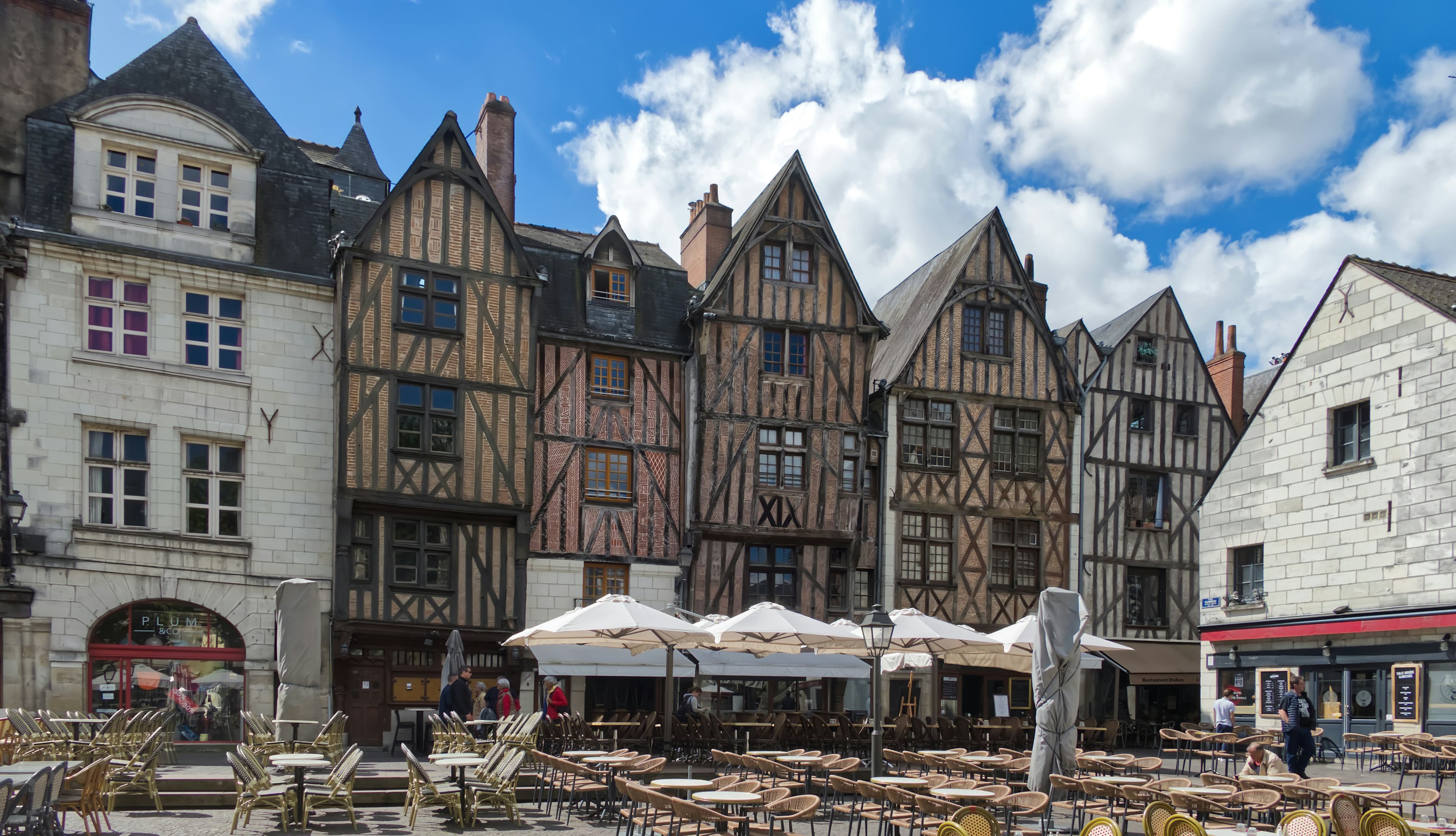
For independent choice, the streets around Place Plumereau in old Tours are a gentle ten to fifteen minutes from the finish. Sunday hours vary by venue, so reserve ahead if you are a group. The finish table itself carries a substantial range of fruit, cakes, savoury snacks and drinks, so there is no need to rush anywhere at all.
Where to Stay
Stay near the finish. The 2026 course change makes that easier to follow than it sounds, because Place Anatole France and Rue Nationale sit beside the finish and are also within a short walk or tram ride of the new Quai Paul Bert start across the Loire. The two race hubs are 758 m apart, so a single central base covers both.
Place Anatole France and Rue Nationale
Place Anatole France is the strongest overall choice and this site’s default recommendation. The finish is on the square itself, the Hampton by Hilton and the Hilton Garden Inn sit directly beside it, and the start is a short walk or tram ride across the river. The inventory on the square is small, which is the catch.
Tours station and the Palais des Congrès
The station district suits rail arrivals and makes bib collection trivial, since the expo is in the Palais des Congrès directly opposite. The start needs a short tram ride or walk north from here, and the finish stays comfortably central afterwards. It is about 1.2 km from the finish.
Vieux Tours and Place Plumereau
Vieux Tours has the medieval streets, the restaurants and the nightlife, and it is walkable to the finish and not far from the start. Saturday-night noise is the thing to weigh against a 07:30 Sunday start, so ask for a quiet room or accept an early alarm and a late night going on outside.
Cathedral and Château de Tours
The cathedral quarter east of Rue Nationale is quieter than Plumereau, close to the Loire and relatively near the start. It works well for runners who want central access without staying in the busiest part of the city, and it puts the Musée des Beaux-Arts on the doorstep for the day after.
North Loire, Paul-Bert and Choiseul
The north bank is the pure race-morning choice, putting you closest to the new start and the Place Choiseul tram stop. Hotel inventory here is smaller and the main tourist centre is on the opposite bank, so it suits a runner optimising Sunday morning over the rest of the weekend.
Vouvray
Vouvray is appealing for a wine-country stay and the course runs straight through it, but it is not a sensible race base unless you are driving and comfortable with race-morning road closures. The start and the finish are both in Tours. Save Vouvray for the night after.
Recommended hotels
Directly on the square the race finishes in, with an on-site restaurant. It is the maximum possible race-day convenience for both the start across the river and the finish. Expect noise and road closures immediately outside on Sunday morning.
Directly opposite the finish with shared access to the restaurant next door, and listed by the local tourism office as open year-round. Useful given how much of race-weekend demand concentrates on this one square.
A smaller historic-centre option within an easy walk of the race hub. Room inventory is limited, so book early and ask for something away from the street.
A long-established central hotel within walking or tram distance of both the start and the finish, with straightforward arrival logistics for train travellers.
Beside the station and the Palais des Congrès, which makes arrival and bib collection simple. The trade is being slightly further from both race hubs than the Anatole France hotels.
Booking timeline
There is no ballot. Entry prices rise by bib tranche, so book once your travel plans are firm instead of waiting for a results date that does not exist. The combined 2026 weekend expects around 20,000 runners across all distances, and demand for rooms on or near Place Anatole France is correspondingly high given how few there are.
September is not a quiet month in the Loire Valley either. Château and wine-region visitors create demand that has nothing to do with the marathon, so this is not a case of race weekend being the only pressure on prices. A refundable room booked well ahead handles both. Tours is well served by high-speed rail from Paris and other French cities, and the station sits beside the expo at the Palais des Congrès, which makes rail a practical alternative to flying for most travellers. Book peak Friday and Sunday trains as soon as fares open.
See & Do
Everything below is either within walking distance of the finish at Place Anatole France or directly connected to the ground the race covers. Tours’ centre is compact enough that a Saturday of sightseeing need not cost you Sunday.
Musée des Beaux-Arts de Tours
About 0.7 km (0.4 miles) from the finish, at 18 Place François-Sicard beside the cathedral. Indoor, seated-friendly and the obvious choice if race weekend turns wet or the legs need a break from walking. 2026 opening runs Sunday 09:00 to 18:00 and Monday 09:30 to 18:00, with admission around €8.40.
Cathédrale Saint-Gatien
About 0.8 km (0.5 miles) from the finish, a few minutes from the museum and easy to combine into one gentle outing. The west front spans four centuries of Gothic work, and the stained glass in the choir is thirteenth-century. Services can affect visitor access at certain hours, so check locally before planning around a specific time.
Old Tours and Place Plumereau
About 0.6 km (0.4 miles) from the finish. Half-timbered houses around a square of cafés, free to wander and easily broken into short sections instead of a committed circuit. Saturday evening is lively, which is worth resisting before a 07:30 start. A Monday morning wander here is the lowest-effort recovery outing in the city.
Vouvray cellar visit
Roughly 10 km (6 miles) east of the finish; car, taxi or organised transport needed. Directly connected to the race, since the new route runs straight through the appellation at km 8 and again at km 23. Cave de Vouvray runs an English-language cellar tour and tasting daily from 11:30 to 12:30 through 30 December 2026. Keep it for the Monday.
Château and Gardens of Villandry
About 18 km (11 miles) west of Tours; regional transport, car or organised tour required. The château opens 09:00 to 18:00 in September with the gardens open to 19:00, and race weekend coincides with Les Journées du Potager on 26 and 27 September 2026, which celebrates the ornamental kitchen garden. It is a lot of walking to fit in before race day, so treat Saturday attendance with caution and save it for the Monday.
After the Race
Late September in the Loire Valley keeps full opening hours and active gardens while the summer crowds thin out, and it is harvest in the vineyards you have just run through. Everything below is picked for legs that have just climbed 276 m and then run twenty flat kilometres on them, which mostly means short train journeys and one attraction a day. The Vouvray day trip is the one with the most direct connection to the race itself.
The most race-connected recovery trip on this list, since you will have run straight through the appellation on Sunday. A cellar visit and lunch need almost no walking. September is harvest, so working wineries are busy: book instead of turning up.
A compact Loire town with the château and Clos Lucé both within reach of the station. On sore legs, keep the first afternoon to one of them instead of trying to see both.
Use Blois as a single base for both. Take the lighter, more central Blois day first and save the enormous grounds at Chambord for day two, once the legs have settled.
Wine and medieval history in one place, though the fortress sits high above the town and involves more climbing than a Vouvray day trip. Better after one easy recovery day than the morning after the race.
Villandry, Azay-le-Rideau, Chenonceau and Amboise from a single base, with no hotel changes. September keeps full opening hours and active gardens. Pace them out: two châteaux in a day is plenty on marathon legs.
Frequently asked questions
Should I stay near the start or the finish?
Place Anatole France and Rue Nationale suit both. The finish is on the square and the new Quai Paul Bert start is just across the Loire, so the two race hubs are unusually close for a course that spends most of its distance out of the city.
How far in advance should I book a hotel?
Once you have entered, since there is no ballot to wait for. The weekend expects around 20,000 runners, rooms directly on Place Anatole France are limited, and September is a busy Loire Valley month anyway. A refundable early booking is the safest approach.
Is there free transport to the start on race day?
Yes. Every registered runner gets one free Fil Bleu Tours Métropole ticket with their bib, and the organiser plans tram service every 12 minutes from 07:00 on race Sunday, with guarded bicycle parking at Place Choiseul.
What is the best area to stay?
Place Anatole France or Rue Nationale, both beside the finish and a short walk or tram ride from the start. The station and Palais des Congrès area is next best for rail arrivals, since bib collection happens in the Palais des Congrès itself.
When does the expo open?
Bib collection is at the Palais des Congrès de Tours, opposite the station: Friday 25 September 15:00 to 20:00 and Saturday 26 September 10:00 to 19:00. There is no standard Sunday collection, so plan a late Saturday arrival carefully.
What is the weather typically like on race day?
It can go either way, and the 07:30 start widens the spread. Mornings are commonly cool, but the Tours-Parçay-Meslay station has recorded September days above 25°C and above 30°C. Pack for a day that may warm sharply while you are still running.
How do I get to Tours?
Rail via Paris is more practical than the small local airport for most international runners. Tours station sits centrally beside the expo, and Saint-Pierre-des-Corps just east of the city is the main high-speed interchange.
Is there a bag drop?
Yes, free storage from 06:30 to 14:30 near the start, one closed bag up to 20 litres. The exact 2026 location had not been published when this page was written, so check in race week. Showers are at Gymnase des Minimes until 15:00.
Should I bring a throwaway layer?
Worth it given the 07:30 start, even on a day forecast to turn warm. No official clothing-donation scheme has been published, so only discard kit where organiser staff explicitly permit it.
How do I get back to my hotel after finishing?
Anyone around Place Anatole France, Rue Nationale or Vieux Tours can walk, since the finish is on the square. From the station district, take the tram or walk through the centre in about fifteen minutes.