The Race
The marathon starts at 04:45, well before sunrise, and the organiser asks runners to be in the start area 15 minutes before the gun. That puts arrival at about 03:45 to 04:00, when ordinary public transport is not running. Book a room within walking distance of Jezzine Barracks.
| Next Race Date | To be Confirmed |
|---|---|
| Course type | Loop (three loops from Jezzine Barracks) |
| Registration | Open entry, capped |
| Ballot opens | Not applicable |
| Start | Jezzine Barracks, North Ward, 04:45 |
| Finish | Jezzine Barracks, North Ward |
| Total finishers | 271 (2026) |
| Avg race-day temp | 15 to 26°C (August) |
| Cutoff time | To be Confirmed |
| Free race-day transport | No |
| Course certification | AIMS certified |
History
Townsville's marathon began with a local club and not a company. Townsville Road Runners' own history says the Townsville Marathon Club was formed in 1972 by about a dozen runners to promote distance running in the city. The club later changed its name to Townsville Road Runners, partly because marathon sounded intimidating to new members. The festival describes the race as Australia's second-oldest continuously run marathon, behind Traralgon, a claim that Queensland tourism material repeats.
The festival format arrived in 1999, when the first Townsville Running Festival recorded 58 half-marathon finishers, 26 marathon finishers and 31 in the 10 km. In 2001 a new marathon course was measured and accredited by the Australian measurer Dave Cundy, using two 10.5 km loops and one 21 km loop. That structure is still recognisable. A 5 km was added in 2005, and by 2012 the festival had close to 2,000 competitors.
The men's course record is Benjamin Ashkettle's 2:22:49 from 2014, set into strong headwinds, and the women's is Hisae Yoshimatsu's 2:40:52 from 2012. Both are stated on the organiser's current results page. In 2026 Ollie Palmer won in 2:36:56 and Skye Perkins in 3:00:54, and the marathon had 321 entrants and 271 finishers.
In 2022 Damon Jaenke became the first wheelchair athlete to contest the marathon, according to the ABC, and the organiser now publishes wheelchair course guidance. A marathon relay was added for the festival's anniversary period and remained in the 2026 programme. The 04:45 start is a response to the climate: runners begin in darkness, before the tropical sun has had time to build.
The course
The marathon starts and finishes at Jezzine Barracks in North Ward, at the northern end of The Strand. The organiser describes a fast, flat, AIMS-certified three-loop course: two 10.5 km city loops and one 21.1 km loop to a turnaround at Pallarenda. It runs along The Strand with views across the Coral Sea to Magnetic Island.
The course runs the city loops running south-east on The Strand to a turnaround on Sir Leslie Thiess Drive at about 4, 13.5 and 23.5 km, and back through North Ward on Ryan Street, Isley Street and Howitt Street. The long loop then follows Primrose Street, Heatleys Parade and Cape Pallarenda Road to a turnaround at Pallarenda at about 34.5 km, the farthest point from the start, 5.9 km away.
The course is mostly sealed road and path. The organiser's wheelchair guidance lists several 180-degree and 90-degree turns, including narrow turnarounds near the casino and at Pallarenda, and a narrow passage between median strips from Sir Leslie Thiess Drive to The Strand. The final 63 m are on grass, reached over a kerb with a ramp. No official elevation figure was found and none is drawn here, because satellite elevation reads below sea level in places.
Kilometre by kilometre
Km 0 to 10.5: the first city loop. The race starts at 04:45 from Jezzine Barracks, in the dark. The route runs south-east along The Strand to a turnaround on Sir Leslie Thiess Drive at about 4 km, near the marina and casino end, and returns along The Strand and through North Ward on Howitt Street and Ryan Street to the start area at about 10 km. The roads are flat and the field is fresh, and the early darkness tempts runners into running too hard. Learn the corners, because you will see them again.
Km 10.5 to 21: the second city loop. The same loop again, with the same turns. Repetition is useful, since you know where the tight turnarounds and the narrow median passage are. By the halfway mark the first light is arriving, and the Coral Sea is visible off the promenade.
Km 21 to 28: the third city section. A third run down The Strand to Sir Leslie Thiess Drive at about 23.5 km and back through North Ward, before the route turns north-west at Primrose Street at about 28 km. By now the sun is well up for a four or five hour runner.
Km 28 to 34.5: out to Pallarenda. The route leaves the dense Strand precinct along Heatleys Parade and Cape Pallarenda Road, passing Rowes Bay at about 29 to 30 km and Town Common at about 31 km. The crowds thin, shade is limited, and the Coral Sea and Magnetic Island are offshore.
Km 34.5 to 42.2: back to Jezzine. The turnaround at Pallarenda at about 34.5 km is the quietest part of the course and the point where wind either helps or hurts. A headwind on the way back is a real possibility. The return retraces Cape Pallarenda Road and Primrose Street to the waterfront and Jezzine Barracks. The last 63 m are on grass, over a kerb and ramp, a noticeable change after more than 42 km of road and path.
The timing device is attached to the bib, so do not fold it. No blue line was documented. With multiple turnarounds, follow the cones, marshals and the measured line, and do not improvise tangents. Do not bank time in the first 10 to 15 km, because the temperature rises quickly after sunrise.
Flat, dark and repetitive along The Strand. Learn the turnarounds and hold back.
One more run down The Strand as the sun comes up, before the turn north-west.
Heatleys Parade and Cape Pallarenda Road on the exposed northern loop. Take drinks at the 5 km stops.
The turnaround, then back along the same road, and the last 63 m on grass. The temperature is now warm, so keep drinking.
Course Map
From Jezzine Barracks along The Strand to turnarounds on Sir Leslie Thiess Drive, then north-west on Primrose Street and Cape Pallarenda Road to a turnaround at Pallarenda. The line overlays itself. Tap a marker for the start and finish, the turnarounds and the ferry terminal, and scrub the slider or press play to move the orange marker along the course.
No elevation chart is drawn for this course. The organiser describes it as fast and flat, publishes no profile, and satellite elevation of the coastal roads reads below sea level in places, so it is described in prose and not plotted. The line is the route of a previous edition.
Pacers
Pacers were offered at 4:00, 4:15, 4:30 and 5:00 in the latest edition. There are no sub-four pacers and none for a slower finish, the organiser seeks pacers each year and may add more times, and the identification method for the next race is unpublished.
The organiser and Queensland tourism describe the race as Australia's second-oldest continuously run marathon, behind Traralgon, beginning with a club formed in 1972. That is the organiser's claim and it has not been checked against Traralgon's dates.
Townsville is warm and dry in August, and the race starts before dawn. The long-term August mean minimum is 14.8°C, and by 09:00 the mean is already 21.1°C, with a monthly mean maximum of 26.2°C and humidity around 63 per cent at 09:00. A three-hour runner finishes before 08:00. A five-hour runner is still racing near 10:00 in conditions that are warmer and brighter than at the start.
Dress for the later hours. A singlet and shorts are right, and the pre-dawn air at about 15°C rarely calls for more than a light top that you can carry or drop. No official clothing-donation programme was found, so only discard clothing where the organiser permits.
Sun protection matters more than rain, which is uncommon in August, with about 16 mm and roughly one wet day in the month. Sunscreen is available in the festival area, and applying it before the start is sensible even though the first kilometres are dark. A cap helps once the sun is up.
A headtorch is not listed as compulsory kit, and the roads are lit and controlled. Road shoes are right, and the last 63 m on grass need no special shoe. The organiser discourages earphones, or suggests leaving one out.
Entry
Entry is open through Race Roster, with no ballot and no qualifying time, but entries are capped. For 2026 the marathon cost A$134 at early bird and A$174 at full price, plus Race Roster fees, roughly £71 and £92. Early-bird entry ran from 8 December 2025. The marathon page said early bird ended on 28 February, while the Race Roster listing showed early-bird pricing through 31 March, so treat the checkout as authoritative.
The minimum marathon age is 18. The organiser warns entrants to register early because entries are capped, and it does not accept late race-day registration. The half marathon sold out with a waiting list in 2026. No marathon-only cap was found.
There is no fast-runner or guaranteed-entry route for the marathon, and no tour-operator allocation was found. Race number collection is mandatory and bibs are not posted. A proxy can collect with the entrant's confirmation email. Transfer, cancellation and deferral terms were not found on the current pages.
The festival supports Ronald McDonald House through its Run for Purpose programme, and the Townsville Hospital Foundation also promotes fundraising. That is fundraising alongside open entry and not a charity-place scheme. The marathon relay lets teams of two or four share the 42.2 km, and relay runners must use the changeover zones. Do not confuse relay entries with marathon entries.
Fast runner standards
There is no good-for-age route and no qualifying standard.
Townsville Running Festival →Race Weekend
Race pack collection
Race pack collection is mandatory and compact. In 2026 every entrant collected at Jezzine Barracks, on The Strand, on Saturday 1 August from 10:00 to 16:00 according to the race-info page. The FAQ gave 11:00 to 16:00, so the organiser's own pages differed by an hour, and the current competitor guide should be checked before travel. Corporate teams had a separate Friday window from 12:00 to 14:00.
Bibs are not mailed. A friend or family member can collect as a proxy by bringing the entrant's confirmation email. The bib holds the timing device and must not be folded or bent. Pins are provided. The race director was available around midday on Saturday, and course maps were displayed at registration.
The event offered a free race singlet to those who registered before the merchandise cutoff, which was 26 June in 2026. Late entrants may not get their preferred size. There is no major commercial expo. For a visiting runner, a room in North Ward or on The Strand puts collection within a walk, and there is little reason to hire a car for the race weekend if you stay there or in the CBD.
Getting to the start
The 04:45 start is the defining fact of race morning. In 2026 the half marathon started at 06:10 and the 10 km at 06:45. The organiser recommends reaching the precinct about an hour before the start and being in the start area at least 15 minutes before the gun, which means arriving around 03:45 to 04:00.
Getting there. Public transport should not be assumed at that hour. Choose accommodation in North Ward or on The Strand within a safe walk of Jezzine Barracks, or pre-book a taxi or rideshare. CBD hotels are still close but may mean a longer walk or an early taxi. Airport-area hotels are the weakest choice.
At the start. Bag drop is a tent on the grass near the assembly area at Jezzine Barracks. The briefing is held near the start in the HQ area. The bib must face forward, because the timing device is attached to it, and no bib means no time.
Clothing and rules. A light top is comfortable while waiting, and the pre-dawn air is mild. No clothing-donation programme was found, so drop nothing you want back. The organiser discourages earphones, or says to leave one earpiece out.
Finish. The finish is at Jezzine Barracks, with the last 63 m on grass. A major medical facility is near the finish, with mobile cover on the course. Bag collection stays in the precinct. Shorter races start from 06:10, so the venue gets busier as marathoners finish, and presentations begin around 09:30.
Getting back. From North Ward walk. CBD hotels are a short taxi or a longer flat walk once roads reopen. The Magnetic Island ferry terminal is about 3 km away, but a same-morning ferry straight after a marathon adds needless pressure.
Nutrition on course
The organiser does not publish a text table of every stop. It says drink stops are about 5 km apart, with water stops every 2.5 km, and that the order at each drink stop is special drinks, then electrolyte, then water. Electrolyte brand, gels, food and toilet positions are not published.
Personal special drinks are placed before the race in boxes marked with the race number and the drink-stop number. That is a real advantage on a loop course, because the same tables come round. Check the deadline and the drop-off procedure in the current competitor guide. A major medical facility is near the finish, with mobile services on the course, and sunscreen is available in the festival area.
Hydration matters more than rain gear. The temperature rises sharply after sunrise, and the Pallarenda section has little shade, so drink at every station from the start and carry gels you have tried in training.
| Provision | Official information |
|---|---|
| Water | Every 2.5 km |
| Drink stops | About every 5 km: special drinks, electrolyte, then water |
| Personal special drinks | Placed before the race in boxes marked with the race number and drink-stop number |
| Medical | A major facility near the finish, plus mobile services |
| Sunscreen | Available in the festival area |
Spectating
Townsville is easy for one or two sightings and harder for repeated chasing, because the marathon starts before dawn and the Pallarenda section runs away from the urban core. A spectator staying near The Strand can see a runner on the city loops and at the finish without any public transport. The best single location is the Jezzine Barracks and Strand interface, which combines race headquarters, early city-loop access and the finish, with toilets and food nearby. No ticket is needed for the finish.
Live timing is provided for the marathon and half marathon through the results page. A dedicated tracking app was not identified. The Pallarenda stretch is the quietest part of the course, and The Strand and the finish are the stronger zones.
- See the runner at Jezzine Barracks and The Strand on an early city loop
- Walk south-east along The Strand towards the Sir Leslie Thiess Drive end for another loop sighting
- Walk back to Jezzine for the finish, which does not depend on Sunday-morning transport
- See an early pass on The Strand
- Use a pre-arranged taxi or rideshare north-west towards Pallarenda for the long loop
- Return the same way to Jezzine, and do not rely on a tight gap because road controls may lengthen the trip
- Stay around the Jezzine Barracks and Kissing Point precinct
- Catch multiple passes on the repeated loops where access permits, then move to the finish
- This suits families or anyone with limited mobility
Post-race food
North Ward offers several practical options without a car. Watermark on The Strand opens seven days from 06:00 until late, serving breakfast, lunch and dinner, and its long opening window and waterfront position suit runner parties who will not all finish together. Shorehouse, about 0.4 km from the finish, opens from midday on Friday to Sunday and serves modern Asian shared dishes, which suits a celebration more than immediate refuelling.
Shop Six Pasta Bar on The Strand opens for Sunday lunch from 11:30 to 14:30 and for dinner, and pasta is an obvious post-marathon choice. The main decision is how far tired legs will walk, so check hours and distances against the confirmed finish layout.
Where to Stay
Stay as close to the finish as budget allows. At the Townsville marathon the start and finish are the same place, Jezzine Barracks, so the finish recommendation and the start recommendation match. The 04:45 start turns the hardest logistical part of the race into a walk.
North Ward and the northern Strand
The strongest race-first base. Jezzine Barracks sits at the northern end of The Strand, so many properties are walkable before 04:00. The area is waterfront, flat and full of cafés. Popular beachfront rooms command a weekend premium and some bars create evening activity.
Central Strand
Around the middle of The Strand, runners are within roughly 1 to 2 km of Jezzine. The area balances restaurants, the promenade and race access, and it suits families because spectators can walk along the course.
CBD and Flinders Street
More hotels and dining, close to The Strand and the ferry terminal, about 2 to 3 km from Jezzine. For a 04:45 start, some CBD properties are far enough away that a pre-booked taxi is better than a walk in the dark. Nightlife around parts of Flinders Street may matter to light sleepers.
The Ville and the Breakwater precinct
Close to the sea, the ferry terminal and the southern Strand, about 2.7 km from Jezzine. Resort facilities are strong for a post-race stay, and it is a higher price tier. It is manageable by taxi.
Airport and West Townsville
Hotels near the airport, about 4 km from Jezzine, suit a one-night stay but are the weakest choice for race morning, because public transport does not run at that hour.
Booking advice is in the timeline below.
Recommended hotels
At 75 The Strand, walkable to Jezzine and with ocean-facing rooms. Reception hours are limited, though after-hours check-in exists.
The organiser's accommodation partner, advertising pre-run breakfast packs. A short taxi or a longer walk from the start.
A CBD base with a restaurant on site, close to the ferry and The Strand. The rooftop and bar may not suit early-to-bed runners.
Resort facilities, dining and a pool, close to the ferry terminal. A busier setting than a quiet race hotel.
Booking timeline
There is no ballot rush, because marathon entry is open. Watch for entries opening around the preceding December if the pattern holds, since early-bird pricing brings a real saving.
Book North Ward or The Strand accommodation once entry is secure, especially if a walkable 04:00 departure matters. Townsville has far more rooms than an island race, but the band of rooms convenient for a 04:45 start is smaller than the city-wide inventory.
Domestic flights should be watched several months ahead. Townsville Airport has taxis, rideshare and a pre-bookable shuttle to city hotels and the Magnetic Island ferry terminal. If you add Magnetic Island, book the accommodation and the ferry separately. The passenger ferry takes about 20 minutes with several daily services, but winter weekends can still be busy. No official race hotel block was found beyond the organiser's named accommodation partner.
See & Do
Distances below are straight-line from the finish. Castle Hill and the ferry terminal are a short taxi ride away.
Jezzine Barracks and Kissing Point
The race precinct is a 15-hectare heritage site with military remains, Aboriginal interpretation, public art, coastal walkways and lookouts. It suits the afternoon before or after the race, with no extra transport. Public facilities are open daily, though internal vehicle roads close overnight.
The Strand
The waterfront promenade is part of the marathon and works for a low-effort recovery walk. August is in the dry season, so shade and sunscreen still matter.
Castle Hill
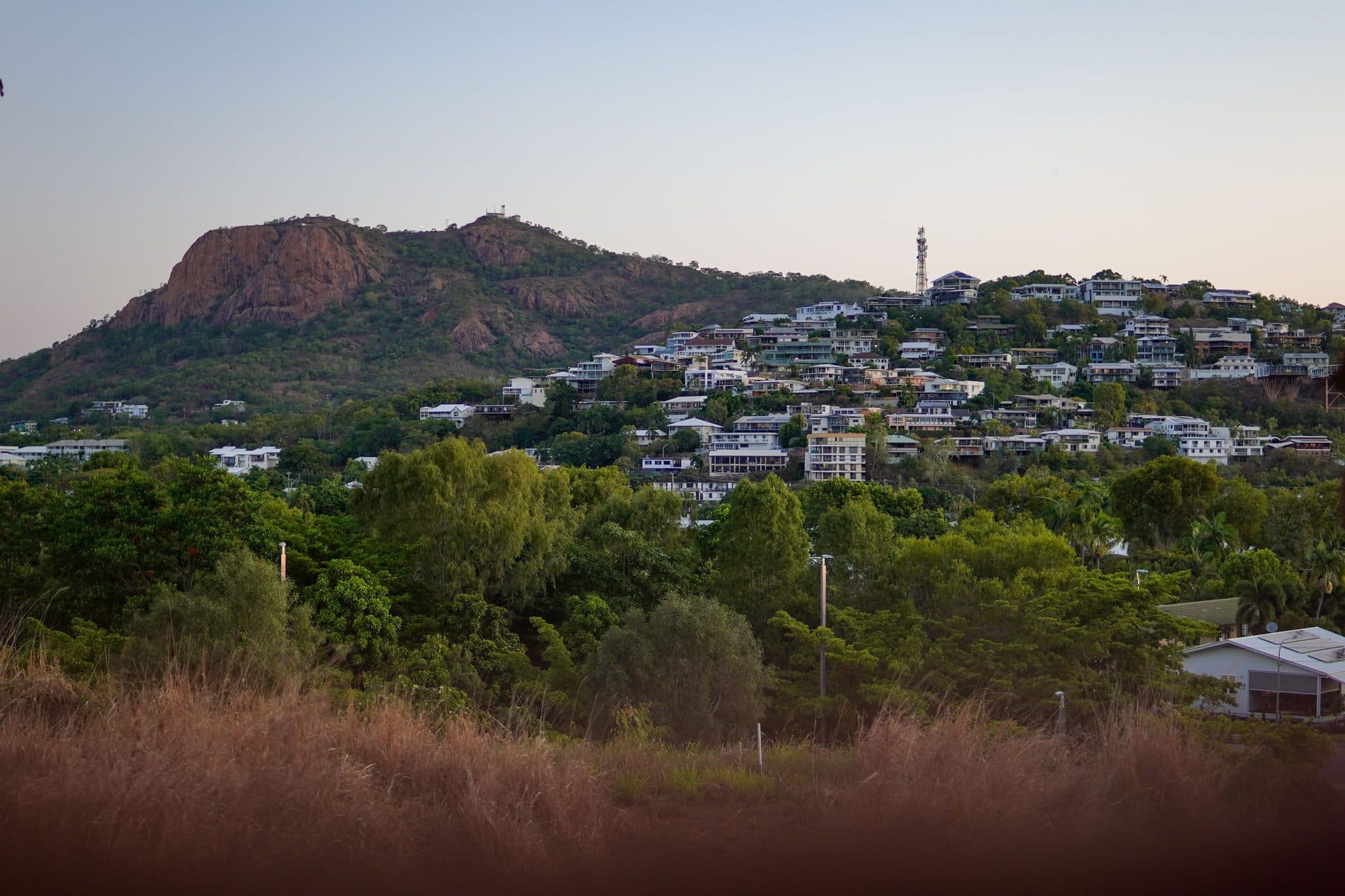
The summit gives 360-degree views over the city and Magnetic Island. Drive or take a taxi to the top, and do not walk up the day after a marathon.
Magnetic Island
The passenger ferry has up to 17 return services a day. Keep the day after the race gentle, with island buses, beaches and short stops instead of the steeper Forts Walk. August is outside the main stinger season, which is usually October to April.
Billabong Sanctuary
A wildlife attraction south of the city that needs road transport and some walking, which can be paced gently. Check opening hours for the Monday after the race.
After the Race
August is the dry season in north Queensland. The trips below start with a 20 minute ferry to Magnetic Island and continue inland and out to the reef.
A ferry ride to a granite island with koalas, beaches and a bus loop, so recovery needs no hiking.
A night on the island with no pressure to catch the afternoon ferry, and time for a bay or a koala walk.
A historic gold-rush town inland, best after a rest day, with a hire car.
A base for a reef or island cruise once recovery is under way.