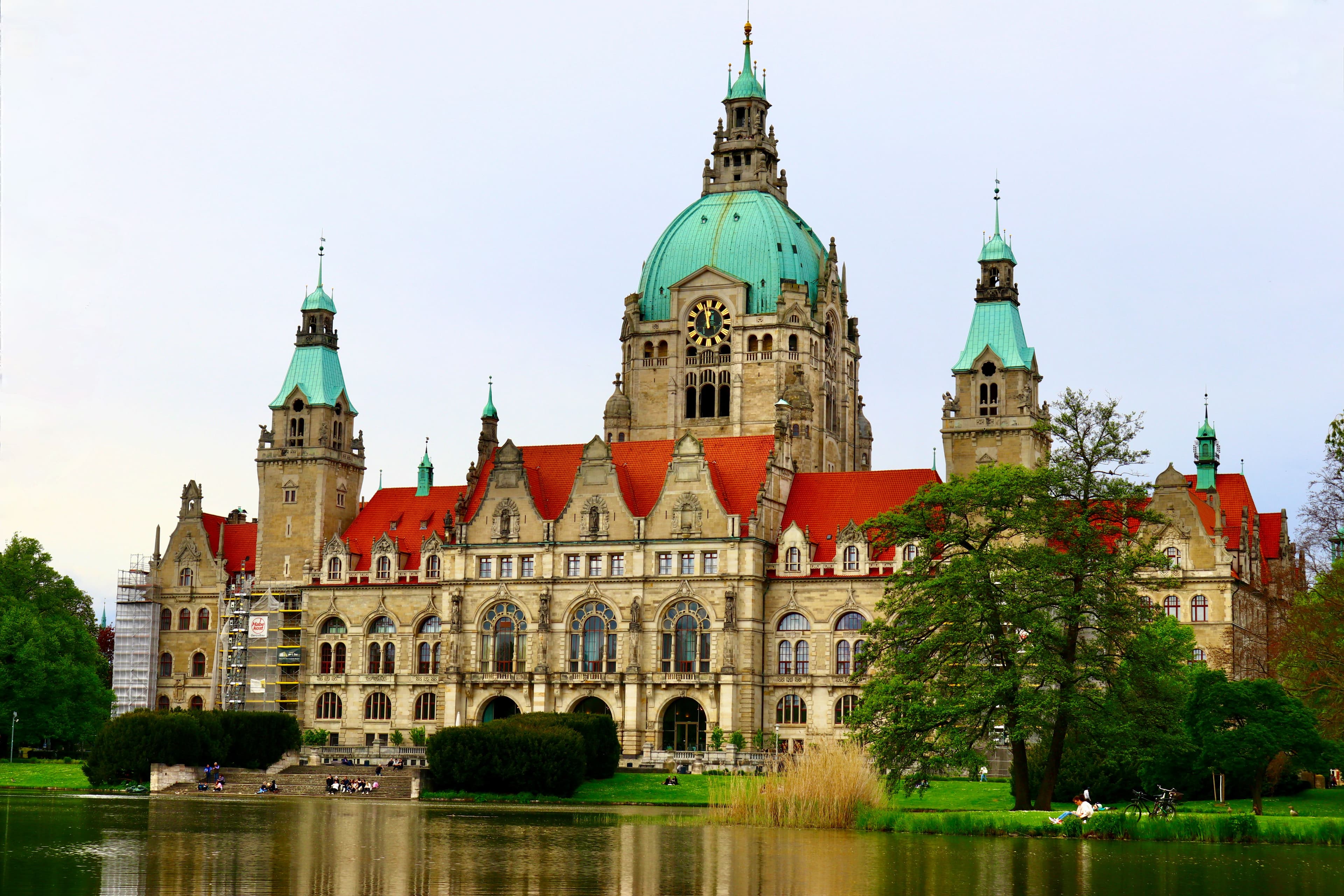
The Race
| Next Race Date | 11 April 2027 (Sunday), the 35th edition |
|---|---|
| Course Type | Loop: a single lap, starting and finishing on Friedrichswall beside the Neues Rathaus |
| Registration | Open registration, no ballot. Pricing rises by quota tier, not by calendar deadline |
| Ballot Opens | Not applicable, open entry |
| Total Finishers | 4,882 in 2026, up from 3,348 in 2025. A scale indicator: no entrant cap has been published |
| Average Race Day Temperature | 8 to 9°C mean, with a 13 to 14°C daytime high and a 4°C overnight low, on long-term April averages |
| Cutoff Time | 6 hours, a 16:00 course closure from a 10:00 start. Minimum pace 8:20 min/km |
| Free Race Day Transport | Yes. Free 2nd-class travel across the GVH transport area on race day, included with the registration confirmation and bib |
| Course Certification | Listed as a certified road race under World Athletics Rule 31.21 |
History
The modern ADAC Marathon Hannover traces back to 1991 and has run in most years since, missing only 2020 and 2021, when the event was cancelled alongside the wider disruption to mass-participation running caused by the Covid-19 pandemic. Those two missing years are the whole reason an event founded that long ago is only now reaching its 35th running, not its 37th. The edition number counts races held, not years elapsed.
Title sponsors have changed across the race’s history, as they do for most city marathons of this scale, but it has run continuously as the same event throughout. It is organised today by eichels GmbH under DLV and World Athletics rules.
Course records have fallen steadily. Amanal Petros of Germany set the men’s record of 2:06:05 in 2024, with Samuel Fitwi following in 2025 at 2:06:29. The organiser’s own results list the 2026 men’s winner as “Maru Kibet” at 2:07:53; World Athletics records the same result under the fuller name Thomas Kibet Maru of Kenya, which is the more reliable reference for the athlete’s identity even though both sources agree on the time. On the women’s side Domenika Mayer of Germany has won three consecutive editions, going from 2:23:50 in 2024 to 2:24:22 in 2025 and down to a course record of 2:21:26 in 2026. That 2026 edition also hosted the German Marathon Championships, which strengthened the domestic elite field.
The Jubilee Runners
Alongside the elite race and the wider field, the ADAC Marathon Hannover maintains a jubilee runner Hall of Fame, recognising entrants who reach milestone completion counts across their marathon and ultramarathon careers, such as a 100th or 200th finish. A runner hitting one of those milestones at Hannover is recognised as part of the event, a tradition entirely separate from the elite results.
A second detail worth its own note: registration and the bib provide free 2nd-class travel across the GVH transport network for the whole of race day, covering the return journey as well as the trip to the start. For a runner staying anywhere in the wider Hannover region, that removes both the cost and the ticket-machine friction of getting to the start and home from the finish.
The course
The ADAC Marathon Hannover starts and finishes on Friedrichswall, directly beside the Neues Rathaus, and runs as a single-lap, officially measured 42.195km road course entirely on paved, traffic-controlled streets. From the central start the route runs south beside the Maschsee to a turn in Döhren, comes back north past the Hauptbahnhof, then heads east into the Eilenriede, one of the largest urban forests in Europe, and loops through Groß-Buchholz, List and the Zooviertel before crossing the north of the city through Vahrenwald and Nordstadt and returning to the Rathaus.
Every kilometre is marked. The best-known landmarks are the Eilenriede section around km 15, Steuerndieb around km 16, the Tintengraben point at the halfway mark, and the Lister Turm around km 23.2. The organiser describes the course as very level and fast, consistent with its place on the World Athletics certified-road-race list, and the elevation chart agrees: the whole course sits inside a 17 m band, from 51 m beside the Maschsee to 68 m at the edge of the Eilenriede, with no sustained climb anywhere. No official total elevation gain has been published.
Km 0 to 12: the Maschsee and back. The race starts on Friedrichswall in front of the Neues Rathaus, loops briefly west through Calenberger Neustadt, then runs south along the eastern shore of the Maschsee from km 2 to 5 to a turn in Döhren around km 7. It comes back north up Hildesheimer Straße, past Aegidientorplatz at about km 11 and the Hauptbahnhof at km 12, both within a short walk of the start. The whole section stays within about 10 m of the start line’s elevation. With no hill to force a pace check, going out too fast here is the easy mistake.
Km 12 to 21.1: the Eilenriede and halfway. East through Oststadt and the Zooviertel, the route enters the Eilenriede around km 15 at the highest point of the course, all of 68 m, and passes Steuerndieb at about km 16. It then runs out through Groß-Buchholz on Pasteurallee and back west along Podbielskistraße to halfway at Tintengraben. The trees give some shelter from the wind, and with a 17 m range across the whole course, wind is the variable that matters on race day.
Km 21.1 to 30: List and the Zooviertel. Walderseestraße brings the course west into List and past the Lister Turm at km 23.2. It then doubles back south through the Zooviertel between km 24 and 26 and north again through List on Celler Straße and Lister Kirchweg by km 30. These are busier residential and commercial streets, with closer crowds than the forest.
Km 30 to 37: Vahrenwald. The course swings west into Vahrenwald along Vahrenwalder Straße and the streets around it, the longest stretch of the race without a named landmark. The road stays between 55 and 59 m throughout, so there is no climb or descent to break the effort into pieces; a pacer or a group is worth more here than anywhere else on the course.
Km 37 to 42.195: Nordstadt and home. Through Nordstadt on Nienburger Straße, the furthest west the course goes, then south through Calenberger Neustadt to Friedrichswall, finishing beside the Neues Rathaus about 30 m from the start line.
Throughout, the blue tangent line marks the shortest legal route around every bend. On a course with this many corners through List, the Zooviertel and Vahrenwald, following it saves measurable distance. No chip-timing mat separate from the announced finish has been confirmed, so assume the finish timing point sits at the stated Friedrichswall line unless race-week materials say otherwise.
Course Map
The map below shows the 2026 edition: a single lap from Friedrichswall south past the Maschsee to Döhren, back north past the Hauptbahnhof, east into the Eilenriede, through Groß-Buchholz, List and the Zooviertel, then across Vahrenwald and Nordstadt to the Neues Rathaus. Tap a marker for details, and scrub the slider or press play to move the orange marker along the course with the elevation profile beneath it.
The flat, fast start through central Hannover toward Maschsee and the edge of the Eilenriede. Resist the temptation a flat opening creates to bank time early; there is no hill later to force a correction.
The Eilenriede section, the Tintengraben halfway point, and the push into the List district past the Lister Turm around km 23.2. Tree cover offers some shelter from wind, the course’s real hazard on this profile.
Residential streets with no significant physical variation to break up the effort. Hold the pacing plan set from the start; this is where an undisciplined opening is paid back.
The closing stretch back through the centre to Friedrichswall. Wind, not gradient, decides how these final kilometres feel.
Pacers
Nine official pace groups run a consistent 15-minute ladder from 3:00 to 5:00, each pacer carrying a large balloon and wearing a bright pacer shirt. Block allocation for individual pace groups relative to Blocks B, C and D is not published, so find the pacer by the balloon in the corral.
What to wear
April in Hannover sits at an unsettled point in the season. Long-term averages put the daytime high around 13 to 14°C and the overnight low around 4°C, with a mean close to 8 to 9°C, but morning temperatures at the 10:00 start can sit only a few degrees above freezing even when the afternoon later warms considerably. Wind and rain are both realistic, and because the course is flat and largely exposed outside the Eilenriede, wind has a greater practical effect on comfort and pacing here than it would on a sheltered or hillier course.
Layers that can be shed as the morning warms are the sensible default. A disposable outer layer worn to the start and discarded once running works well for a race that starts later in the morning than most, giving the temperature more time to lift before the gun. No clothing-donation or collection scheme has been confirmed for the current event, so hold onto a discarded layer until reaching a clearly marked collection point. Later starters and slower finishers should still carry sun protection for the afternoon, even on a cool morning.
Entry
Entry is open registration with no ballot or lottery. Anyone can enter directly, subject to availability within the race’s quota-based pricing structure.
Pricing rises with cumulative entry volume, unlike the date-based early-bird pricing most marathons use. In practice the earliest quota tier sells out first and the price steps up as each subsequent tier fills, regardless of how far ahead of race day the entrant is booking. Entering earlier in the sales cycle is generally cheaper, but the price at any given moment depends on how many places remain in the current tier. Published tiers have run at roughly €99 for entries 1,001 to 2,500, €105 for entries 2,501 to 4,000, and €115 from entry 4,001 onward, with the first tier typically gone before most runners start looking. At an indicative £0.86 per euro those convert to roughly £85, £90 and £99. Treat any conversion as indicative only, since exchange rates move continuously.
One discrepancy: a separate independent listing shows an overall starting price around €89, roughly £76, which does not reconcile with the organiser’s own published tiers. The organiser’s tiered pricing is the primary figure to work from; the €89 number is unverified secondary corroboration.
There is no guaranteed-time entry route and no ballot to work around. No dedicated charity-entry programme and no exclusive tour-operator allocation have been confirmed. The elite and championship entry process has not been fully published, and the proof-of-time thresholds separating the B, C and D starting blocks have not been confirmed either.
Standard terms note that failing to start does not automatically generate a refund. Check transfer and deferral rules directly against the current entry terms before purchase, since these are exactly the details organisers revise between editions.
Fast Runner / GFA Standards
Not applicable. Entry is open to anyone while places remain, with no qualifying-time route and no ballot. Proof of time matters only for start-block allocation, and the thresholds separating Blocks B, C and D have not been published.
Race Weekend
Expo
Race number and bib collection happens at the Marathon-EXPO, most recently near the Altes Rathaus on Köbelingerstraße, about five minutes on foot from the Friedrichswall start and finish. Published hours for the coming edition are Friday 12:00 to 19:00, Saturday 10:00 to 19:00, and a short Sunday race-morning window from 07:00 to 08:30. Where a general event listing gives only “from 07:00” for the Sunday session without a closing time, the marathon-specific 08:30 close is the one to work to, since it reflects the operational reality of a 10:00 start, not the wider multi-event weekend schedule.
Entry to the expo is free, and it combines bib collection with a broader sports and health exhibition. Collection requires the registration confirmation (Meldebestätigung) sent after entry. No medical certificate is required. Given how tight the Sunday window is against a 10:00 start, collecting on Friday or Saturday is strongly preferable: the Sunday slot leaves very little margin for queues or transport delays on race morning. Proxy collection rules, for a runner sending someone else, have not been confirmed and should be checked with the organiser directly if needed.
Getting to the Start
The marathon starts at 10:00 for the elite field and Blocks B and C, with Block D going five minutes later at 10:05. That is well after the pre-dawn departures common to big-city marathons, which means there is no need to rush breakfast: a normal meal around 06:30 to 07:00 leaves comfortable time to digest before the gun, without the compressed, often disrupted early-morning routine a 07:00 or 08:00 start would demand.
Runners staying in Mitte or the Altstadt, around Aegidientorplatz, or in northern Südstadt carry essentially zero transport risk on race morning, since all three are within comfortable walking distance of the Friedrichswall start. No train to catch, no risk of a delayed tram, just a walk timed to arrive with a sensible buffer before the blocks close.
For runners travelling further, free public transport is included with registration: the bib and registration confirmation give free 2nd-class travel across the GVH network on race day itself, which removes both the cost and the ticket-machine friction of reaching the start by tram or bus.
Bag storage operates on Friedrichswall itself, close to both start and finish, and changing areas are available around Friedrichswall and Aegidientorplatz. Showers after the race are at the Turn-Klubb zu Hannover, and post-race massage is in the courtyard of the Sparkasse building near Aegidientorplatz.
Marathon starters go off before the relay marathon and half marathon fields on the same weekend, which meaningfully reduces crowding in the start area compared with a shared or simultaneous start across multiple distances. Headphone policy and the exact chip and bib technology have not been confirmed; check both against current race-week materials before relying on either.
Nutrition on Course
Nutrition points (VP) sit roughly every 5km, with additional refreshment points (EP) between them offering water and similar basic provision. Toilets are available at every VP and EP, and Johanniter medical teams are stationed at critical points along the route, at aid stations, and at the finish. Dextro-branded isotonic sports drink has appeared in event nutrition material in recent years, alongside bananas and a range of solid recovery products at aid stations.
Runners who want their own nutrition or drinks on course can submit them in advance for distribution at VP 1, 3, 5, 7, 9, 11, 13 and 15. There is a discrepancy in the published submission deadline worth flagging: the German-language race information gives Saturday 16:00 to 19:00 or Sunday morning until 07:45, while the English-language page states simply “Sunday 08:00”. Work to the earlier 07:45 deadline. Arriving at 08:00 risks missing the cutoff the German source implies, and there is no practical downside to treating the earlier time as the operative one.
Spectating
For a spectator who would rather not travel at all, the best spot is the start and finish district around the Neues Rathaus: runners pass this point at both ends of the race, and the official ADAC Marathon app provides live GPS tracking, so a spectator staying put can follow a runner’s progress across the rest of the course without moving.
Central, forest and finish. Start at Friedrichswall for the gun, then take the U-Bahn from Aegidientorplatz or Markthalle toward the Eilenriede and List to catch the field somewhere in the km 15 to 23 range. Return by U-Bahn to Aegidientorplatz or Markthalle in good time for the finish back at Friedrichswall.
Maschsee and the finish. Walk from the start toward Maschsee for an early sighting as the course passes the lake, then walk back to the Rathaus for the finish. This one needs no transport ticket at all, only a walk in each direction.
List and the city centre. Position near the Lister Turm around km 23.2 for a sighting in the List district, then take the U-Bahn back toward Kröpcke or Aegidientorplatz and walk the final stretch to Friedrichswall for the finish.
No paid spectator ticket is required for any part of the course. Check current transport diversions and road closures before relying on a specific tram or U-Bahn route: closures around a city marathon shift slightly year to year even when the course itself does not.
Post-Race Food
The marathon-specific post-race catering area at the finish offers carrots, mini cherry tomatoes, mini cucumbers, water, isotonic drink, alcohol-free beer, cola and apple spritzer, bananas, savoury snacks, mini salami, muesli bars and fruit bars.
For the shortest possible walk after finishing, Restaurant der Gartensaal at Platz der Menschenrechte 2, beside the Neues Rathaus, sits within a few minutes of the finish line and offers a broad menu with Sunday opening. A short distance further into the centre, Markthalle Hannover on Karmarschstraße is a covered food hall with numerous individual stalls, giving a wide range of cuisines and price points under one roof; individual stall hours on a Sunday vary by vendor, so it is worth checking which are open on race day.
For something more flexible away from the immediate finish area, the wider Altstadt and Marktkirche restaurant cluster offers a broad spread of traditional and contemporary dining. Book ahead on race weekend: marathon finishers, spectators and the companion events (relay, half marathon, 10km and family day) together put unusual pressure on tables across the city centre for Sunday lunch.
Where to Stay
Choose a hotel by its distance to the finish, not the start. On this course those are the same place, Friedrichswall beside the Neues Rathaus, so every neighbourhood below is assessed against that one shared point.
Mitte and the Altstadt
Mitte and the Altstadt are the best all-round choice for most runners: a walk of five to twenty minutes to the start and finish, with the compact old town, the restaurants and the expo venue all within easy reach on foot. The drawback worth naming plainly is Saturday-night noise near the old town bar streets, which matters for anyone who wants an undisturbed night before the race.
Aegidientorplatz and southern Mitte
Aegidientorplatz and southern Mitte trade some old-town character for pure logistical convenience. This area sits minutes from the starting corrals and is arguably the single most practical base for race morning specifically, even though it is less picturesque than the historic centre.
Südstadt, north toward Maschsee
Südstadt offers a quieter, more residential base at roughly ten to twenty-five minutes’ walk from the start, suited to runners who want some distance from the weekend’s crowds without giving up walkability.
Hauptbahnhof and northern Mitte
The Hauptbahnhof area is the strongest choice for anyone arriving by rail or on the S5 from Hannover Airport, since it sits right at the transport hub. The tradeoff is a longer walk to the start, roughly one to one and a half kilometres or fifteen to twenty minutes, and a busier immediate environment than the quieter residential options.
List
List combines a strong restaurant scene with good U-Bahn access and sits close to the km 23.2 Lister Turm section of the course, which makes it a good choice for anyone combining running with spectating duties across the weekend. It runs ten to twenty minutes from the start by transport or on foot.
Herrenhausen and Nordstadt
Herrenhausen and Nordstadt are oriented toward tourism first, sitting near the Herrenhäuser Gärten, away from race-day logistics. The area suits a longer city break built around the marathon more than a single-night trip focused on personal-best conditions and an early night before the gun.
Recommended hotels
Sits at the edge of Maschpark, within easy walking reach of Friedrichswall, which makes it one of the simplest bases for both race morning and the walk back after finishing.
Positioned right by Aegidientorplatz, one of the most practical race-morning bases in the city, with the starting corrals reachable in minutes on foot.
A straightforward mid-range option in central Mitte, close enough to walk to the start without the premium of the hotels directly on Friedrichswall.
Sits by the lake, trading a slightly longer walk to the start for a quieter setting and easy access to a flat lakeside recovery walk the day after.
The best-placed option for anyone arriving by train or on the S5 from Hannover Airport, sitting at the station itself at the cost of a longer walk to the start.
Booking timeline
With no ballot, there is no results date to wait for before booking travel. The moment entry is confirmed is the moment to book hotels and flights. Since pricing rises with cumulative quota tiers, entering earlier in the sales cycle is generally the cheaper path, and the same logic extends to travel: booking well ahead avoids the premium that builds as the weekend approaches, particularly given the several companion events sharing the dates and drawing on the same limited hotel stock.
For runners flying in, Hannover Airport connects to Hannover Hauptbahnhof on the S5 suburban line in around 18 minutes, directly from beneath Terminal C. Factor that into flight timing before defaulting to a taxi or rental car, and book flights that land with a reasonable buffer before expo hours so the race number can be collected on Friday or Saturday, not in the tight Sunday-morning window.
See & Do
These sit at or within reach of the finish and the central hotel neighbourhoods.
Neues Rathaus
At the finish line itself. The New Town Hall’s dome lift typically operates through the warmer months, April included, giving a wide view over the city without a single flight of stairs. For legs that have just run 42.195km, a lift to a view is a considerably better proposition than a stair climb.
Maschsee and Maschpark
Adjoining the finish area. Maschpark, immediately beside the Rathaus, offers an easy recovery walk on flat paths. The full Maschsee circuit runs to around 6km (3.7 miles), more than most runners will want the day after a marathon; a short lakeside section is the sensible choice unless the legs are asking for more.
Herrenhäuser Gärten
Around 4km (2.5 miles) north-west of the finish, reachable directly by tram. Hannover’s best-known single attraction is a Baroque garden complex, and April sits at the start of the growing season, so the appeal is the Baroque layout and architecture, not a peak floral display. Set expectations accordingly.
Altstadt and the Red Thread walking route
Adjoining the finish area. The compact old town core is best explored in short sections the day after a marathon, skipping the full Red Thread (Roter Faden) route linking the city’s main historic sites. Picking out the Rathaus, the Marktkirche and a handful of old-town streets covers the essentials without demanding a long walk on tired legs. The Red Thread material is also the closest thing to a good self-guided history of the city, marked physically through the old town, not sold as a book.
Erlebnis-Zoo Hannover
Around 3km (1.9 miles) east of the finish by tram. A well-regarded family-friendly zoo, but one that involves several hours on foot across a large site. Better suited to a Tuesday or later in the trip than to the Monday immediately after finishing, when legs are at their sorest.
After the Race
The ADAC Marathon Hannover runs in April, and Hannover sits at the centre of one of the better-connected rail networks in Germany. Every itinerary below is chosen for flat walking and short journey times, because the day after a marathon is the wrong day to discover a hill town.
A half-timbered old town built on a largely flat, walkable layout, with a Renaissance ducal castle and a riverside park for the gentlest possible recovery walk.
The Weser Renaissance old town behind the Pied Piper legend, compact and flat enough to see fully in a single unhurried evening and morning.
A flat harbour city built around the Alster lakes and the Speicherstadt warehouse district, with plenty to see without a single significant incline.
A UNESCO-listed old town paired with the Harz uplands, structured so the flat old-town sightseeing comes first and any mountain hiking waits until the legs and the weather allow it.
The longer extension option: a flat, transit-dense capital city that can be scaled up or down freely depending on how much the legs want to do on any given day.
Frequently asked questions
Should I stay near the start or the finish?
The same question either way. The course starts and finishes at the same location on Friedrichswall beside the Neues Rathaus, so any hotel judged by its distance from the Rathaus is judged correctly for both ends of the race.
How far in advance should I book a hotel?
There is no ballot result to wait for, so the earlier the better once entry is confirmed. Demand builds through race weekend from the marathon field plus the relay, half marathon, 10km and family day, all drawing on the same city hotel stock.
Is there free transport to the start on race day?
Yes. Registration confirmation and the race bib provide free 2nd-class travel across the GVH network on race day, useful for anyone staying beyond walking distance. Confirm it remains in place for the current edition before relying on it.
What is the best area to stay?
Mitte and the Altstadt for the best balance of walkability, restaurants and old-town character, though the bar streets can be noisy on Saturday night. Aegidientorplatz is the more purely practical choice if noise matters more than surroundings.
When does the expo open?
The Marathon-EXPO, near the Altes Rathaus on Köbelingerstraße, runs Friday 12:00 to 19:00 and Saturday 10:00 to 19:00, with a short Sunday window from 07:00 to 08:30. Collect on Friday or Saturday and skip the tight Sunday margin before a 10:00 start.
What is the weather typically like on race day?
April in Hannover averages around 13 to 14°C by day and 4°C overnight, with a mean close to 8 to 9°C, but conditions vary and both wind and rain are realistic. The course is flat and largely exposed, so wind affects the race more than temperature alone.
How do I get from the airport?
Hannover Airport connects to Hannover Hauptbahnhof on the S5 suburban line in around 18 minutes, departing from beneath Terminal C. No advance booking is needed beyond a standard local transport ticket.
Is there a bag drop?
Bag storage operates on Friedrichswall, close to both the start and finish, with changing areas in the same area and around Aegidientorplatz. Showers afterwards are at the Turn-Klubb zu Hannover.
Should I bring a throwaway layer?
Yes. Morning temperatures at the 10:00 start can sit only a few degrees above freezing even on a mild-looking day. No specific clothing-donation scheme has been confirmed, so leave a discarded layer at a marked collection point, not in the street.
How do I get back to my hotel after finishing?
The race finishes where it started, so most runners staying centrally can simply walk back. Free GVH transport on the race bib stays valid for the return journey for anyone staying further out.