| Next Race Date | 15 May 2027 |
|---|---|
| Course Type | Loop (start and finish ~1.3km apart) |
| Registration | To be Confirmed |
| Ballot Opens | Not applicable |
| Total Finishers | To be Confirmed |
| Average Race Day Temperature | To be Confirmed |
| Cutoff Time | 6:30:00 |
| Free Race Day Transport | To be Confirmed |
| Course Certification | Not certified (approximate trail distance) |
The halfway cutoff
The full marathon is two laps. Under the previous rules, a runner who has not started the second lap by 10:30 is recorded as a half-marathon finisher.
Before you go
Entry, accommodation and travel: what to sort out before you book.
Entry
For 2026 the international route cost £150 plus a minimum £1,750 fundraising commitment per runner, so £150 is not an all-in cost. The runner must be 18 or over. Kenyan residents and citizens use the separate resident route at lewasafarimarathon.co.ke, which quoted KES 20,000 (about £116 at the 28 October 2026 rate of KES 172.7 to the pound) for the full or half marathon and no compulsory fundraising minimum. Overseas applicants should check with Tusk whether they qualify for any resident rate.
Tusk names Exceptional Travel as its travel partner and Location Africa as the organiser’s event camp. Entry, fundraising, spectator charges, accommodation, transfers, conservancy fees and insurance are separate costs unless a written package says otherwise.
The 2026 terms allowed the organiser to cancel or change the event without compensating flights or fundraising. For a voluntary withdrawal, the published refund wording is unusual: 90 or more days before, the entry is refunded less bank charges; 89 to 60 days, 50 per cent is deducted; 59 to 30 days, 25 per cent is deducted; within 29 days there is no refund. Camping and AMREF evacuation fees are non-refundable. The terms and the FAQ give different deadlines for changing a runner’s name. No good-for-age standard has been published.
British citizens should check the current Kenyan eTA, passport and health-insurance requirements and itinerary-based yellow-fever rules. UK malaria guidance treats Kenya by region, so a northern safari needs individual advice. The UK Foreign Office page of October 2026 reported Ebola cases and screening.
What the entry fee does not cover
The international entry is £150 plus a minimum £1,750 fundraising commitment per runner, based on the previous edition. Camping, transfers, conservancy fees, insurance and spectator charges are separate. Confirm the current figures with Tusk.
Fast Runner / GFA Standards
There is no qualifying route or guaranteed-entry standard.
Where to Stay
This is a conservancy, so the choice is between the event camp, a lodge inside Lewa, and a base in Nairobi with a transfer. Start, finish and registration share the event village, so stay in the camp or in a lodge with an approved race transfer: walking between accommodation and the village through wildlife habitat is not safe.
Event camp and conservancy lodges
Location Africa is a fully catered temporary camp promoted by the organiser, and the resident campsite historically cost KES 3,500 per adult per night with toilets, taps and firewood but no food. The conservancy lists five lodges: Elewana Kifaru House, Elewana Lewa Safari Camp, Lewa House, Lewa Wilderness and Sirikoi. Ask each about May opening, vehicle permission for race transfers and luggage.
Nairobi
Journey times from Nairobi are about five hours by road on the organiser’s page and four hours on the conservancy’s FAQ, and flights from Wilson Airport to Lewa Downs take about an hour. The new May date overlaps the rainy period a lodge states, so confirm seasonal closures and road conditions before booking.
Recommended hotels
Listed on the conservancy’s visitor page. Race allocation and transfers need confirming.
Small lodge inside the conservancy. Check May opening and race transfers.
Operating lodge inside the conservancy.
Listed lodge. No race shuttle is promised.
Farm-to-table dining. The lodge states April and May rains, so check May availability.
Booking timeline
The sequence is date, entry route, accommodation, flights. Register or apply through the correct route (international through Tusk, resident through the Kenyan site), get written terms on the fundraising minimum, and only then book a lodge or camp for the race weekend. Check that the lodge is open in May, that it can provide a race transfer, and that your luggage fits light-aircraft limits if flying from Wilson to Lewa Downs. Do not reuse the 2026 June deadlines. For UK travellers, start health preparation at least eight weeks ahead.
Race weekend
The expo, number collection and the days either side of the start.
Race Weekend
Expo
Number collection is on site at Lewa, not at a city expo. In 2026 collection was at Lewa on the Friday from 09:00 to 18:00 and again on race morning from 05:30 to 06:30. The pack contains the bib, a wristband, a shirt and a programme. Treat the Friday session as the main one. Confirm the 2027 schedule, hours and document list with the organiser. A five-hour road transfer from Nairobi is not a safe reason to expect late collection.
Getting to the Start
The 2026 rules imply a 07:30 start (second lap by 10:30, three hours in), and race-day arrivals were asked to be at the start by 06:45. Neither is a confirmed 2027 timetable. Camp and lodge transfers must be arranged with the accommodation provider, and no public transport or free transfer has been published.
Wildlife governs movement. Slower runners keep left, litter goes in the bins, the chipped bib is worn flat on the front, and runners must follow medical withdrawal decisions. A runner who misses a cutoff is moved by rescue vehicle and the chip is surrendered. There is no upgrade from the half to the full on race day, and pets are not allowed. The rules describe bush toilets on course and an organiser medical team with a recovery area, massage and misting along the route.
The organiser requires comprehensive travel insurance. An AMREF evacuation arrangement is included but is not comprehensive medical insurance, and its published cover period and dates conflict.
What to wear
Lewa sits at around 1,700 m, so early mornings are cool and the day warms quickly. A removable layer for the wait at the start is sensible. The new May date overlaps the April and May rains stated by a lodge, so ask the organiser about wet-weather conditions and carry a waterproof bag for kit. Sun cover matters on the second lap, which is run later in the day.
Race day
The course, the clock, getting to the start and what to carry.
The Race
The course
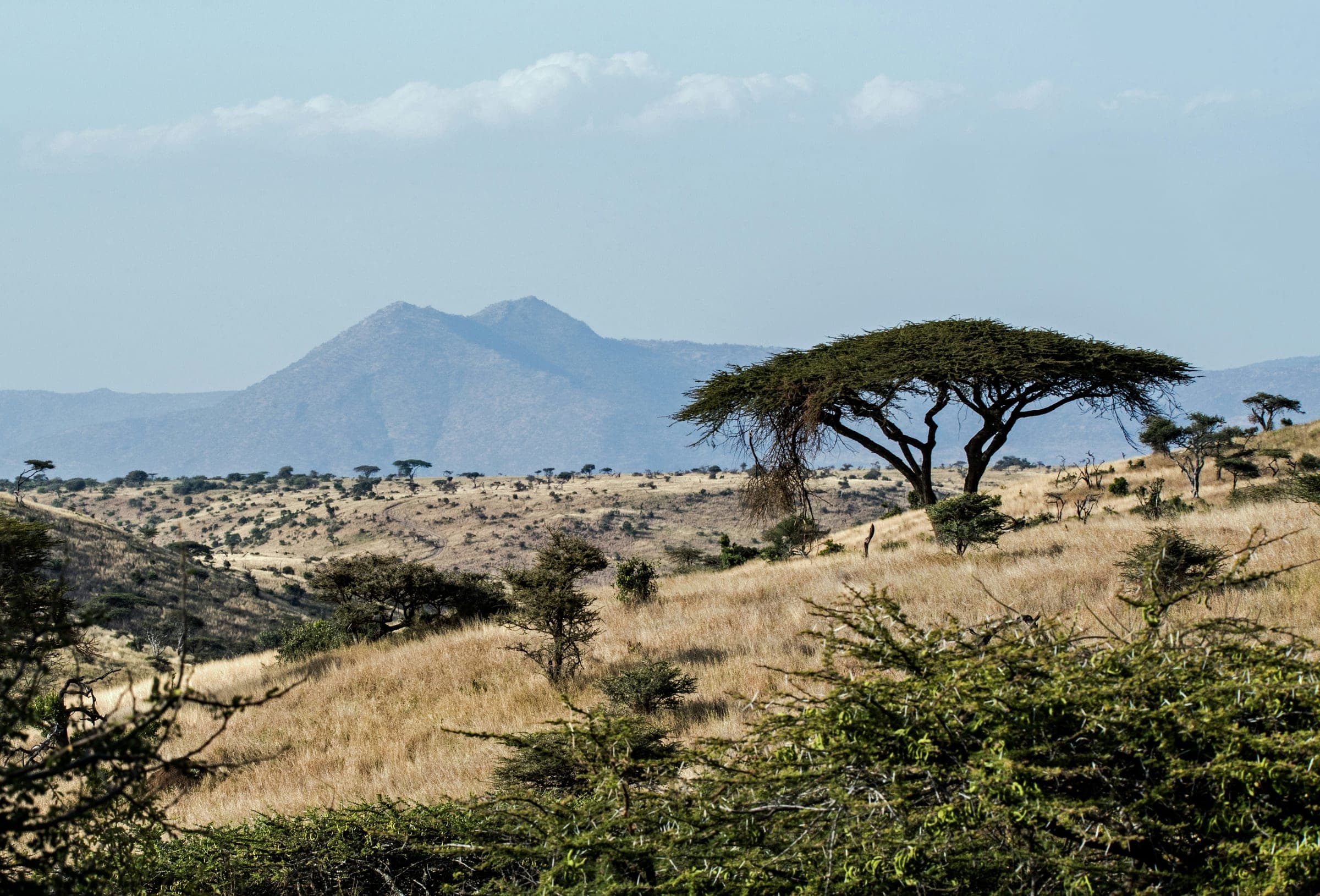
The marathon is two laps of the half-marathon course on rough dirt roads inside the conservancy. It is a trail-style event over an approximate distance, not a certified road marathon: the organiser advertises “approximately 42.2 km”. The organiser describes savannah, riverbanks and acacia woodland, and the rules describe an undulating surface at an average altitude of around 6,000 feet (about 1,830 m), while the About page gives 5,500 feet. A runner who has not started the second lap by 10:30 is recorded as a half-marathon finisher and does not continue.
Start, finish and registration sit close together at the event village, and the full course passes a second spectator area on the second lap. Runners must stay on the marked route in the reserve. Rangers and aerial monitoring are part of the safety plan, and the 2027 route has not been published.
The line on the map is two laps of about 21 km. Each runs about 7 km north-west from the village, turns, and comes back along the eastern side of the loop, over rolling ground between 1,633 m and 1,730 m. A watch reads long on winding dirt roads, so expect more than 42.2 km on your own file.
Km 0 to 5.6: out to the west and north. The lap leaves the event village heading west and north, passing 1.7 km west of it at km 2, and climbs from 1,698 m to 1,714 m at km 5.6 as it bends north-west.
Km 5.6 to 11.5: the long drop and climb.Past km 5.6 the road drops 81 m in 3.0 km, 2.7% on average, to the lap’s low point of 1,634 m at km 8.6. It then climbs 71 m in 2.9 km, 2.4% on average, to 1,705 m at km 11.5. The north-west end of the lap is at km 10.1, 6.9 km from the start, on the climb.
Km 11.5 to 17: the eastern side.The road turns south-east and rolls: a 16 m rise, a 19 m fall, then a 35 m climb to the lap’s high point of 1,730 m at km 15.9. A 53 m fall in 1.2 km, 4.4% on average, follows to 1,677 m at km 17.1, the steepest descent of the lap. The easternmost point is at km 17.0.
Km 17 to 21: back to the village. The last four kilometres climb 25 m to 1,702 m and return to the start area at km 21.1.
Km 21 to 42.2: the second lap. The second lap repeats the first line, with the same 80 m drop to 1,633 m at km 29.6, the same 72 m climb and a high point of 1,728 m at km 37. The last four kilometres climb 36 m, from 1,678 m at km 38.2 to the finish at 1,714 m, 1.3 km south of the start line.
Course Map
The map shows the two laps through the conservancy, with the start, the finish, the north-west end of the lap and the lap’s high and low points. Tap a marker for details, and scrub the slider or press play to move the orange marker along the course with the elevation profile beneath it.
Nutrition on Course
In 2026, water and energy drink stations were about every 2.5 km, with oranges and bananas, first aid and misting along the course. A previous route map labelled nine water stations. Brands, gels, cup type and personal bottle arrangements have not been published, so carry your own gels.
| Interval | Water | Energy drink | Gel | Food | Other |
|---|---|---|---|---|---|
| About every 2.5 km, plus finish | Yes | Yes | Unverified | Oranges, bananas | First aid, misting |
Spectating
Spectating is controlled because the race runs through a protected reserve. A previous route map showed spectator points close to the event village, and spectators pay separate fees. Do not follow runners in a private car or walk into wildlife areas. Ask the organiser or your lodge about authorised viewing points and vehicle transfers.
After the race
Where to eat, what to see and how to spend the days after the finish.
See & Do
These four experiences are arranged through your lodge, and all but the last are vehicle-based, which suits tired legs.
Post-Race Food
Plan food through your camp or lodge, not a restaurant walk. Location Africa is the organiser’s catered event camp, and the Kenyan resident self-catering campsite requires guests to bring their own food and equipment. Sirikoi advertises farm-to-table dining, and Lewa House and Elewana lodges serve guests, but no race-day menu or non-resident admission has been published. Confirm familiar food, dietary needs and meal times when booking.
Guided game drive
Book through your lodge. Drives are vehicle-based, so they suit sore legs. Sightings are never guaranteed and May rain affects the roads.
Anti-poaching and conservation experience
The conservancy lists behind-the-scenes activities. Book through the lodge, because they depend on operational permission.
Clinic or community visit
Listed by the conservancy. Arrange it respectfully through your host.
Lodge-based wildlife viewing
Sirikoi advertises relaxation and wildlife experiences.
Read Before you Run
Born Free
Joy Adamson
Joy Adamson’s account of raising Elsa the lioness in Kenya, in the Macmillan Collector’s Library edition (ISBN 9781909621480, 496 pages). It connects to the race’s conservation theme and to a wider Kenyan safari trip. It is not a history of Lewa.
After the Race
The race is on a Saturday in May, so the excursions start on Sunday with legs that have run two hilly laps at 1,700 m. Every option here is vehicle-based and arranged through the lodge.
A seated morning drive and a long lunch, with luggage left at your lodge.
One extra night, a conservation experience and an unhurried departure.
Two short drives, rest between them and one bag transfer.
Two nights on Lewa, then Nairobi for the flight home.
Background
History
The Lewa race was established in 2000 as a fundraiser for the conservancy and Kenyan wildlife conservation. It is reported to have begun with about 180 entries and to have grown to roughly 1,200 participants by 2023. Those are whole-event figures, not full-marathon finishers.
Tusk, the British conservation charity, runs the race with the conservancy, and money raised supports wildlife conservation, health, education and local infrastructure. The races of 2020, 2021 and 2024 were cancelled, so the edition number cannot be calculated from the founding year, and 2026 was called the 26th edition.
In 2023 John Mitei and Mercy Kwambai won the full marathon. In June 2026 Samson Lemayan retained the men’s title in 2:27:04 and Lydia Simiyu won the women’s in 2:50:39. These are reported winners, not verified course records. The 2027 date of 15 May moves the race out of its recent late-June slot, and the organiser has not said why.
Frequently asked questions
Should I stay near the start or the finish?
The start, finish and registration area share the event village. Stay in the event camp or a conservancy lodge with an approved race transfer, because walking between accommodation and the village in wildlife habitat is not safe.
How far in advance should I book a hotel?
The 2027 entry has not opened. Secure your entry route and written terms first, then book a lodge or camp that is open in May.
Is public transport free on race day?
No universal free transfer has been published. Camp and lodge transfers are arranged with the accommodation provider.
What is the best neighbourhood to stay in?
The event camp or a conservancy lodge. Nairobi is a five-hour road transfer or a flight away.
When does the expo open?
There is no city expo. In 2026, number collection was at Lewa on the Friday from 09:00 to 18:00, with race-morning collection from 05:30 to 06:30. Confirm 2027 times.
What is the weather typically like?
Cool mornings at about 1,700 m, with the new May date overlapping the April and May rains a lodge states.
How do I get from the airport?
Fly into Nairobi (NBO). Lewa Downs is served by flights from Wilson Airport, about an hour, or a road transfer of four to five hours.
Is there a bag drop?
A bag drop has not been confirmed.
Should I bring a throwaway layer?
A warm layer suits the early wait. Do not discard it on the course.
How do I get back to my hotel after finishing?
Use a pre-arranged authorised camp or lodge vehicle.