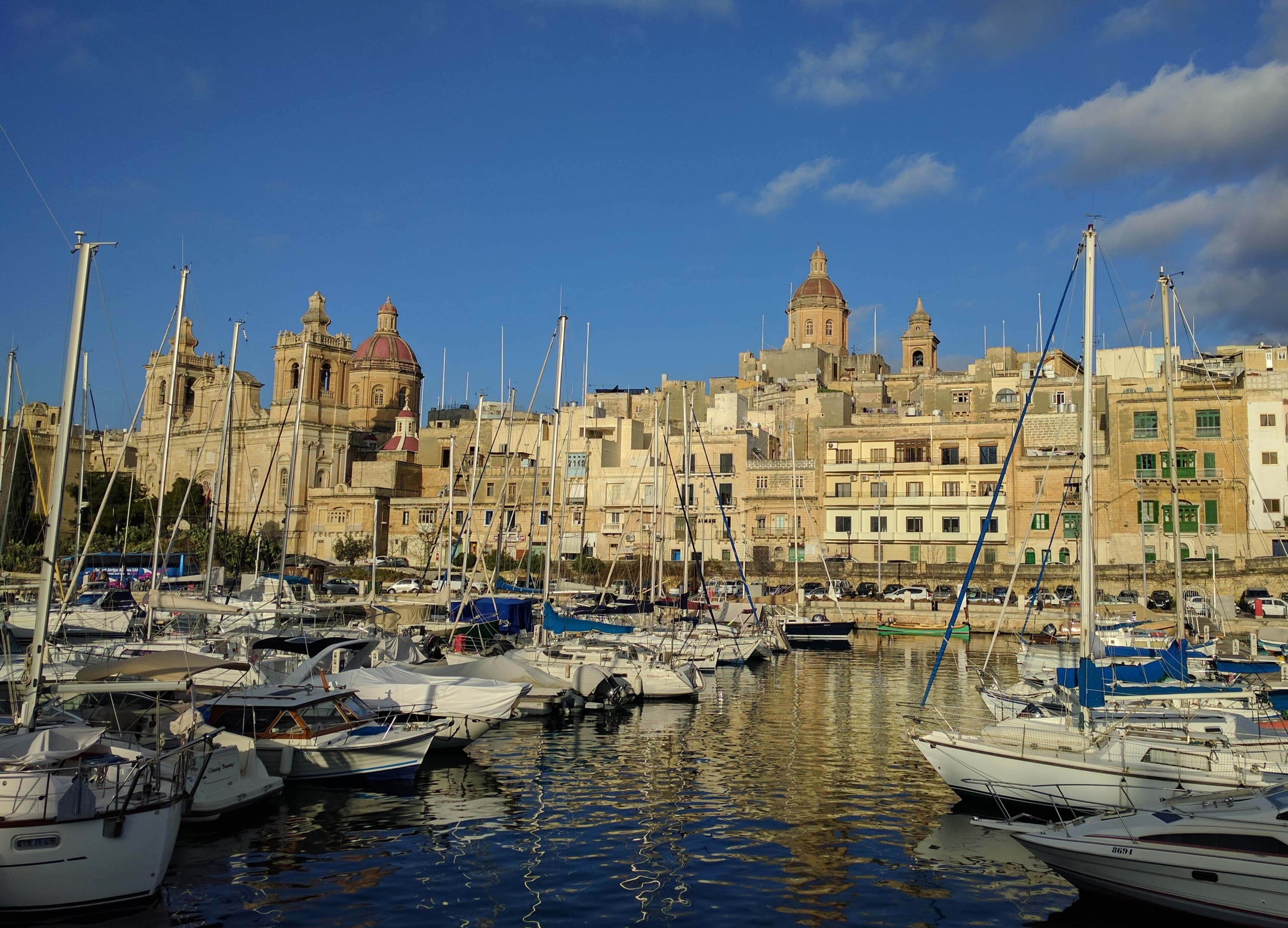
The Race
| Next Race Date | 28 February 2027 |
|---|---|
| Course type | Point-to-point, net downhill |
| Certification | World Athletics and AIMS certified route |
| Start | Mdina (fortified old capital) |
| Finish | The Ferries, Sliema |
| Total finishers | ~5,000-9,999 across all Malta Marathon weekend events combined |
| Avg race-day temp | 10 to 17°C (February) |
| Cutoff time | 5 hours (strict) |
| Free race-day transport | No; official buses cost €5, booked with entry, departing Sliema at 05:30 |
| Course certification | World Athletics / AIMS certified |
| Sleeper Train | Not accessible; Malta has no rail network |
History
Mdina had been standing on its limestone plateau for the better part of three thousand years by the time anyone thought to start a footrace beneath its walls, and the Malta Marathon has now been doing exactly that since 1986. The 2027 edition is the 42nd, which puts more continuous history behind this small island race than behind several marathons with far bigger stadiums and far louder sponsors. The organisers are protective of that lineage. Their own marketing describes it, pointedly, as “the Authentic and only Malta Marathon,” a jab aimed at a destination where imitators and confusingly similar events have occasionally muddied the waters for travelling runners trying to book the right thing.
The route logic has not changed in decades and does not need to. Runners start in Mdina, the fortified former capital that sits on Malta’s high inland ground, and finish 42.195 km later at The Ferries in Sliema, on the modern tourist seafront. Old capital to new coastline, net downhill, in the last week of February: it is a simple story to tell a visiting runner, and it has become the race’s main selling point for a growing field of British and European entrants chasing winter sunshine and a faster time than their home marathons tend to offer.
That downhill reputation needs a caveat. The organisers state a 185m drop from start to finish, but they also state 211m of climbing along the way. The course drops about 100m in the first 8km, rolls round Ta’ Qali, Attard and Mosta for the middle 18km, and only then descends to the harbour. Runners who treat the opening downhill as free time tend to pay for it later, on the flatter, more wind-exposed run into Sliema.
The course
The marathon starts at 06:45 in Mdina, on Malta’s raised interior plateau, and finishes at The Ferries, Sliema, on the coast, with a strict five-hour cutoff. The elevation chart shows the highest point of the course arriving early, around the 1 km mark at roughly 209m above sea level, before a long net descent toward the sea. The course threads inland through Ta’ Qali, Attard and Mosta between roughly 10 km and 25 km, doubling back through Attard a second time around 26-28 km, before a distinctive stretch past the old aqueducts between Mriehel and Birkirkara around 30-31 km. From there the road drops through Qormi, Ħamrun and Marsa, rises briefly into Floriana, and reaches sea level at the harbour in Msida before the finish on the Sliema promenade. Official figures put the net drop at 185m against 211m of elevation gain over the full distance, confirming a course that trends downhill overall while rolling significantly in the middle third. The final kilometres are the most exposed to coastal wind.
Km 0-5: Mdina. The elevation chart puts the start line at roughly 195m above sea level and the true high point of the entire course at about 209m, reached inside the first kilometre. This is the moment the marathon’s downhill reputation is either earned or squandered. The temptation, in the pre-dawn cool with fresh legs, is to let the descent do the work and post an early split that flatters nobody by kilometre 30. The official course notes describe 211m of cumulative climbing across the route, which means this is not a one-way slide to the sea.
Km 5-10: Into the flatter middle. The elevation drops from around 120m to just above 105m across this stretch as the course leaves the immediate Mdina high ground and settles into a lower, rolling gradient heading toward Ta’ Qali. This is a settling-in section: use it to find a rhythm and leave pace for later.
Km 10-21: Ta’ Qali, Attard and Mosta. The course exits Ta’ Qali around the 10 km mark, passes through Attard near 11 km, and spends the middle section of the race moving through and around Mosta. Elevation through here sits mostly in the 80-110m band, rising and falling in short pulses. Crowd support arrives in pockets around town centres and thins out on the connecting roads between them.
Km 21-28: Back through Ta’ Qali and Attard. The route returns to Ta’ Qali around 25 km and passes through Attard again between 26 and 28 km, retracing ground covered earlier in reverse. The chart shows a modest climb back toward 105-110m through this section before it begins its final decline.
Km 28-31: Mriehel to Birkirkara, the aqueducts. The elevation profile falls sharply here, from around 84m at 28 km to under 60m by 30 km, as the course passes the historic Wignacourt aqueduct arches between Mriehel and Birkirkara. It is the most visually distinctive section of the middle race and also one of the steepest sustained drops on the course.
Km 31-40: The long run to the coast. From roughly 60m at 31 km, the elevation falls in stages through Qormi, Ħamrun and Marsa to single figures by kilometre 39, with a couple of short false rises along the way, the last of them a climb of about 17m into Floriana at km 37 before the drop past Pietà to the harbour at Msida. This is the longest uninterrupted section of the race and the one where the wind off the Mediterranean starts to matter more than the terrain.
Km 40-finish: Into Sliema. The course flattens out almost completely for the harbour-front run through Ta’ Xbiex and Gżira into Sliema, dropping to close to sea level by the finish at The Ferries. This is also the most exposed section for crosswind and, on a clear late-February morning, direct sun. Finishers are handed San Michel water, Powerade and bananas at the line, with baggage held roughly 150m beyond the finish in an underground car park.
The blue line marking the tangent is worth following throughout: on a course with this many direction changes through town centres and roundabouts, the difference between running the racing line and drifting wide adds up meaningfully over 42.195 km.
The Cutoff Ladder
This race enforces a genuinely strict five-hour limit, with intermediate retirement points along the way. Runners not reaching 15 km by 08:30, 21 km by 09:15, 32 km by 10:30, 35 km by 11:00 or 38 km by 11:15 are required to retire, according to official guidance. Beyond these points there is no traffic management, marshalling or on-course support, and runners who continue anyway do so at their own risk, on pavements rather than closed roads. This is unusual even among marathons with firm overall time limits, and it is worth flagging clearly to anyone treating this as a target-time-optional destination race: it is not one.
The course’s true high point (around 209m) arrives inside the first kilometre, then falls toward 105m by kilometre 10. Treat the descent as pacing discipline, not free time: the official course notes still record 211m of climbing across the full route.
The middle third loops through inland towns twice, rolling between roughly 80m and 110m with no sustained descent. Crowd support clusters around town centres; the connecting roads are quieter.
A sharp, visually distinctive drop past the historic aqueduct arches between Mriehel and Birkirkara, falling from around 84m to under 60m in three kilometres.
A long, largely flat run down to sea level, finishing on the Sliema seafront. Terrain stops being the challenge here; coastal wind and, on a clear morning, direct sun become the deciding factors.
Course Map
The map shows the course, the Mdina start, the Sliema finish, and the overseas registration venue. Tap a marker for details, and scrub the slider or press play to move the orange marker along the course with the elevation profile beneath it.
Pacers
A third-party race listing states that pacers are included, but no official 2027 pace group list, target times or corral allocation could be found on the organiser’s own site. Plan your race by effort and a personal watch; a specific pace group may not be available.
What to wear
Race-day temperatures in late February typically sit between 10°C and 17°C, though the 06:45 start in Mdina, inland, elevated and pre-dawn, is reliably the coldest point of the morning. A cheap, disposable layer for the start pen is worth carrying rather than wearing to the finish: temperatures climb through the field as the sun rises, and runners in the later waves should expect meaningful sun exposure by the time they reach the exposed Sliema coast road, even in winter.
Coastal wind is the other variable to plan for: the final few kilometres run along the open harbour front from Msida to Sliema, and a blustery morning changes the effort required regardless of what the elevation chart shows. Rain is possible but not the norm; shoes that cope reasonably well with damp roads are a sensible hedge.
Entry
| Registration type | Open, first-come-first-served (no ballot, no qualifying time) |
|---|---|
| 2027 fee tiers | €55 to 30 Nov 2026 · €60 to 15 Jan 2027 · €70 after, if places remain |
| Minimum age | 18 |
| Fast runner / GFA entry | No qualifying-time or Good-for-Age scheme identified |
Applications for the 2027 LifeStar Malta Marathon opened on 15 April 2026 and close on 15 January 2027, including receipt of payment, or earlier if the event reaches capacity. Entry works on a first-come, first-served basis, and a place is only confirmed once payment clears. Fees rise in three stages: €55 for applications and payment received by 30 November 2026, €60 between 1 December 2026 and 15 January 2027, and €70 after 15 January if places remain. The entry fee includes a Malta Marathon T-shirt, the official race magazine and a finisher medal. Transport to the start costs an additional €5 and should be booked at the same time as entry.
Eligibility is straightforward: runners must be at least 18 on race day, with no qualifying time and no fast-runner or Good-for-Age entry scheme identified in official sources. No official charity-place scheme for the marathon itself was located, though smaller bundled events are listed separately on the official site. Tour-operator packages may exist in the wider destination running market, but no named official partner was confirmed.
Refund and transfer policy is strict and worth flagging plainly: application and transport fees are non-refundable and cannot be transferred to another runner or another event, even if the runner cannot travel or the event itself does not go ahead.
Race Weekend
Expo and Number Collection
Overseas race registration takes place at the Barcelo Fortina Hotel in Sliema, around 100m beyond the finish line. For the 2027 event, official opening times are Thursday 25 February (17:30-21:30), Friday 26 February (17:30-21:30) and Saturday 27 February (13:30-22:00). Local residents register separately at Eurosport in Birkirkara. Saturday afternoon at the Sliema venue is the obvious pinch point given it is the only weekend session before race day; travellers arriving Friday should aim for the Thursday or Friday evening windows where possible.
Collection includes the race number with embedded timing chip, safety pins, the prepaid transport ticket, T-shirt, official race magazine and a clothes bag. A runner can collect on someone else’s behalf using that person’s ID or passport number, useful for groups travelling together. Uncollected numbers may be reissued to other athletes, so this is not a race where late collection on race morning is a safe fallback.
Race Morning
The marathon starts at 06:45 in Mdina, and getting there is the single most important logistical decision of race weekend. The straightforward route is to stay in or near Sliema, buy the official €5 transport ticket when entering, and board one of the buses leaving the Sliema finish area at 05:30. This is not a course where improvising a race-morning taxi is a safe backup: road closures begin early across a small island, and there is no confirmation of a flexible alternative if the official bus is missed.
No official wave-start times, corral letters or first-marathon-runner policy were found in accessible sources. Given the modest overall field size relative to major-city marathons, congestion at the start is unlikely to be a major concern, but toilet queue reality in Mdina before a 06:45 start in February should be assumed to be a factor regardless.
Baggage transport is handled by DHL: marked vans at the start correspond to bib-number ranges, and bags are recovered roughly 150m beyond the finish line, in an underground car park. Runners should not leave valuables in transported bags. At the finish, runners receive San Michel water, Powerade and bananas.
Nutrition on Course
The official course summary lists eight water stations and three Powerade stations along the route, alongside three sponge stations and a fruit stand, though the exact kilometre positions of each were not extracted from accessible sources. Given the strict five-hour cutoff and intermediate retirement points at 15 km, 21 km, 32 km, 35 km and 38 km, runners should assume aid stations are spaced to support a genuinely time-pressured field rather than a leisurely one, and plan personal nutrition accordingly. At the finish, runners are given San Michel water, Powerade and bananas.
Spectating
The single best spectating position on this course is the finish at The Ferries, Sliema, both for the size of the finish crowd and for practicality: it is where hotels, registration and post-race facilities are concentrated. Multiple sightings across the course are genuinely difficult on race morning. Malta’s small road network and rolling closures make it risky to plan a car-based route that catches Mdina, the inland loop and the finish in sequence, and public transport is not well suited to hopping between spectating points before roads reopen.
A realistic plan for spectators without a car is to pick one point and stay there, most usefully the finish; the multi-stop spectator routes that work on major-city courses with metro systems do not work here. Crowd density is heaviest in Mdina at the start, in the town centres the course passes through around Ta’ Qali, Attard and Mosta, and again at the Sliema finish; the connecting roads between towns are quieter by comparison and not worth the effort of trying to reach on foot.
Where to Stay
Sliema is the neighbourhood to choose for this race, without much competition. The finish, overseas registration and the buses to the Mdina start all operate from here, which matters more on an island with no rail system and a small road network than it would in a city with a metro. Choose Sliema for logistics; it will not deliver Valletta's fortified bastions or Mdina's silent lanes, but it removes almost every point of friction on race morning.
Sliema
The default choice, and for most runners the only real decision worth making. Registration, official transport and the finish are all within a short walk of most hotels here.
St Julian’s and Paceville
Immediately along the coast from Sliema, offering more restaurants and nightlife and suiting groups travelling together, though the same nightlife makes for a riskier pre-race sleep on Saturday.
Valletta
Across the harbour, the more historically rich base, a UNESCO World Heritage capital with genuine old-city character. It adds an extra transport step to reach the Sliema buses on race morning, a real cost on a day that starts before 6am.
Bugibba and St Paul’s Bay
Further round the coast, often cheaper and popular with package holidaymakers, but considerably less convenient for both the early transport and the finish.
Recommended hotels
The official overseas registration venue as well as a finish-line hotel, which makes it the single most logistically convenient base on offer. Expect high demand and pricing to match.
Listed on the organiser’s own accommodation map, directly on the Sliema seafront near the finish. Being on the busy promenade is the trade-off for the location.
A short, mostly uphill walk from the finish, which buys a little quiet without losing meaningful convenience.
Apartment-style accommodation, useful for groups or families wanting more space than a standard hotel room.
A recognisable international chain near the finish, useful for travellers who prefer predictable standards over character.
Booking timeline
Applications for the 2027 event opened well over a year ahead of race day, on 15 April 2026, and there is no ballot delay to wait out before booking travel: acceptance is confirmed on payment, not by a later results announcement. The sensible booking window opens immediately on entry, with no ballot result to wait for as there is for London or Boston. Sliema hotels close to the finish and the official registration venue are the ones most likely to fill first. Flights from the UK to Malta in late February are outside peak summer season, which should mean more available inventory than a summer booking.
See & Do
The finish at The Ferries puts you on Sliema’s seafront, within reach of Valletta by ferry and the race’s own start city, Mdina, by taxi or transfer.
Mdina
~14km (8.7 miles) from the finish; this is the race start. The fortified former capital sits on Malta’s high inland ground and is worth a slower, non-race-day visit if time and legs allow. Its narrow lanes are cobbled and uneven, worth knowing the day after a marathon. Best reached by taxi or organised transfer from Sliema.
Valletta
~5km (3.1 miles) from the finish by ferry across the harbour. Malta’s UNESCO-listed capital rewards a slow pace, which suits tired legs the day after finishing. The regular Sliema-Valletta ferry is the easier option compared with the road route around the harbour.
Sliema and St Julian’s Promenade
0km, starts at the finish. A flat, paved seafront walk connecting the finish area to St Julian’s, useful precisely because it is flat: the best recovery walk available without adding hills or uneven ground to already-tired legs.
Upper Barrakka Gardens, Valletta
~5km (3.1 miles) from the finish, within Valletta. A public garden with a harbour view over the Grand Harbour, reachable with minimal extra walking once in Valletta.
Blue Lagoon, Comino
Boat transfer required, not walkable from the finish. A well-known turquoise-water bay reached by boat via Cirkewwa or Sliema/St Julian’s operators. Genuinely striking, but weather-dependent, and the boat crossing makes it a poor choice for the day immediately after a marathon if conditions are rough.
Read Before you Run
The Great Siege: Malta 1565
Ernle Bradford
A detailed account of the 1565 siege that shaped Malta’s identity as a fortress island under the Knights of St John, useful context for understanding why Mdina and Valletta look and feel the way they do on race weekend.
After the Race
The Malta Marathon runs in the last week of February, a mild winter window well suited to onward island-hopping. These itineraries range from a same-day ferry to Valletta to a four-night extension into Sicily.
Low physical effort for the day after a marathon: a short ferry crossing, a slow walk through Malta’s UNESCO capital, and harbour views without much climbing.
Malta’s quieter sister island, worth an overnight stay given the ferry connection involved.
Use Gozo as a base and treat the Blue Lagoon on Comino as a weather-dependent add-on; late-February seas can be too rough for a comfortable crossing.
Worth checking flight options against ferry timetables before committing, since a flight may be the more forgiving option on legs that have just run a marathon.
Frequently asked questions
Should I stay near the start or the finish?
The finish, without much debate. Registration, official race transport and the Sliema hotel cluster are all built around the finish area, and there is no equivalent infrastructure at the Mdina start.
How far in advance should I book a hotel?
As early as practical. Entry is first-come, first-served with no ballot delay, so there is no reason to wait for a results announcement before booking.
Is there free transport to the start?
No. Official transport from Sliema to the Mdina start costs €5 and must be booked alongside race entry. Buses for full marathon runners depart the Sliema finish area at 05:30 for the 06:45 start.
What is the best area to stay?
Sliema. It hosts the finish, the overseas registration venue, and the official buses to the start. St Julian’s suits groups wanting more nightlife; Valletta suits those prioritising Baroque architecture and fortified walls over convenience.
When does the expo open?
Overseas registration at the Barcelo Fortina Hotel, Sliema runs Thursday 25 and Friday 26 February (17:30-21:30 both days) and Saturday 27 February (13:30-22:00), for the 2027 event.
What is the weather typically like?
Late February in Malta typically ranges from around 10°C to 17°C, with the pre-dawn Mdina start reliably the coldest point of the day. Wind and occasional rain are possible.
How do I get from the airport to Sliema?
The Airport Direct TD3 bus service serves the Sliema/St Julian’s area, though most travellers with race-weekend luggage will find a taxi simpler.
Is there a bag drop?
Yes. DHL vans at the start are marked by bib-number range, and bags are recovered roughly 150m beyond the finish line, in an underground car park.
Should I bring a throwaway layer?
Yes. The pre-dawn wait in Mdina before a 06:45 start in February is reliably the coldest part of race morning, and a cheap layer to discard at the start is worth carrying.
How do I get back to my hotel after finishing?
If staying in Sliema, the finish is within walking distance of most recommended hotels. For Valletta or St Julian’s, a ferry or taxi is the practical option once roads reopen.