The Race
| Next Race Date | 6 June 2027 |
|---|---|
| Course type | Loop (start and finish both at BarraShoppingSul, Bairro Cristal) |
| Certification | World Athletics Label Road Race; no AIMS certificate located |
| Start | BarraShoppingSul, Av. Diário de Notícias 300, Cristal |
| Finish | BarraShoppingSul, Av. Diário de Notícias 300, Cristal |
| Total finishers | Cap of 10,350 marathon places (2026); actual finisher count not published |
| Avg race-day temp | 11 to 20°C (June) |
| Cutoff time | 6 hours |
| Free race-day transport | Not confirmed for 2027 |
| Course certification | Regulation states World Athletics / CBAt rules; no measurement certificate number located |
| Sleeper Train | Not accessible |
The Desafio Gaúcho
Alongside the standalone marathon, Porto Alegre offers the Desafio Gaúcho, a two-day challenge combining Saturday’s half marathon with Sunday’s full marathon. Athletes taking on the Desafio must check in at a dedicated challenge tent in the finish area after each stage to have their result registered, and collect a separate Desafio finisher medal once both stages are complete. The 2026 regulation capped Desafio entries at 500, a small fraction of the overall 30,000-participant weekend, making it a niche but distinctive option for runners who want two race-day results from one trip.
History
CORPA, the Clube de Corredores de Porto Alegre, has organised the race since 1983. The first edition ran in April that year with 132 entrants on a wet morning and none of the current infrastructure: no traffic interception, no marked hydration points, no distance markers. Adão Juarez Camões won in 2:35:47. Sandra Magda Lima won the women’s race in 3:15:07. The course finished at Parque Moinhos de Vento, a different landmark from today’s BarraShoppingSul hub.
The event professionalised over the following decades and now runs as a two-day festival. Alongside the marathon, the current programme includes a half marathon, 10km, 5km, a children’s Maratoninha and the Desafio Gaúcho. The 2026 regulation set a technical cap of 30,000 participants across the weekend, including 10,350 marathon places and 12,250 half-marathon places.
Three claims anchor its reputation: age, speed and climate. Porto Alegre is consistently described by organisers and Brazilian press as the country’s oldest and fastest marathon. The course runs along the flat Guaíba waterfront and through a low-lying historic centre, and runner accounts broadly support this as a genuine personal-best course. One 2025 Reddit race report called it “considered the fastest marathon in Brazil” after recording an 11°C start.
The competitive field has sharpened recently. World Athletics results for the 2025, 40th edition show Wendell Jeronimo Souza winning in 2:15:47 and Vivian Jeptanui winning the women’s race in 2:37:14. CBAt then reported a marked step up for the 2026, 41st edition: Daniel Kiprono Sang won in 2:10:21, described as both a race record and the fastest marathon ever run on Brazilian soil, while Gelane Senbet won the women’s race in 2:31:16, also a race record.
Porto Alegre currently has three overlapping speed claims worth keeping separate. This race’s 2:10:21 is described as the fastest marathon on Brazilian soil. The New Balance 42K Porto Alegre’s fastest mark to date is Johnatas de Oliveira’s 2:12:45 from 2025, a different race entirely. And Eliud Kipchoge’s 2:08:44 at the Rio 2016 Olympics, run in a third city altogether, remains the fastest marathon on South American soil; Kipchoge raced the New Balance event in July 2026 as part of his continent-by-continent project, not this one.
For travelling runners, the race resists an easy label. It is not a beach marathon: the Guaíba is a broad, lake-like river delta, and Porto Alegre’s identity is gaúcho and southern. It sits closer to a serious, cool-season PB race in a city that opens onto Rio Grande do Sul’s wine country and hill towns than to the standard Rio-São Paulo circuit most international visitors expect from Brazil.
The course
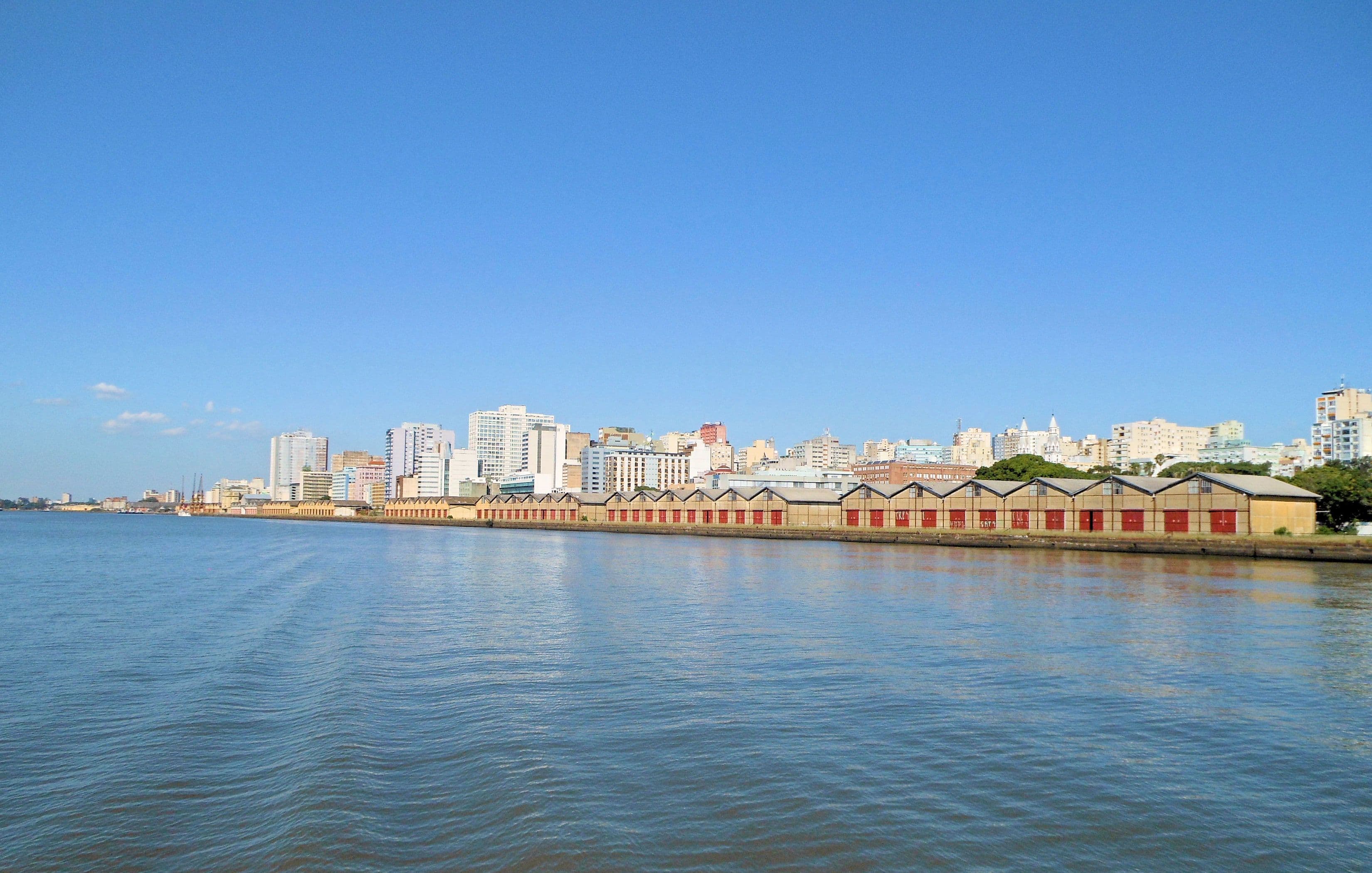
The race starts and finishes at BarraShoppingSul, Av. Diário de Notícias 300, in the Cristal district. The official site describes the 42.195km route as running along the Orla (the Guaíba waterfront), through Centro Histórico and through city parks; the 2027 course map has not yet been published, and the description below follows the most recent edition’s route. That route runs north along the waterfront past Parque Marinha do Brasil to the Usina do Gasômetro and the historic centre near the Mercado Público, loops out through Cidade Baixa past Parque Farroupilha (Redenção) to Azenha, then comes back south to Praia de Belas and repeats the waterfront and Centro Histórico before the return to Cristal.
No official kilometre-by-kilometre elevation table has been published. The elevation chart below shows the whole course inside a band of about 25m, most of it between 5 and 15m above the river, with the only perceptible rises the short ramps up into Centro Histórico around 11km and again around 33km.
The course is not coastal or beachfront. It follows the Guaíba, technically a lake-like river delta, and the visual register is urban waterfront, parkland and historic centre.
Km 0-4: The wide start. The race begins in the paved plaza around BarraShoppingSul, which gives the field space to spread out but little of the ceremonial theatre of an old-town start. The regulation opens the start line for five minutes only, so runners who misjudge their arrival time risk missing it altogether. The field runs a short out-and-back on Avenida Diário de Notícias, then heads north up Avenida Padre Cacique.
Km 4-12: Onto the waterfront and into the centre. The course reaches the Orla do Guaíba at Praia de Belas and runs north along Avenida Beira-Rio and Avenida Edvaldo Pereira Paiva past Parque Marinha do Brasil, and the running becomes exposed and open. In a good year that means cool air and room to move. In a poor one it means wind and drizzle off the water, which several runner reports flag as the single biggest uncertainty on race morning. Past the Usina do Gasômetro the route turns into Centro Histórico along Avenida Mauá, climbing about 10m, the high point of the day at roughly 20m, near the Mercado Público around 11km.
Km 12-24: Cidade Baixa, Azenha and Praia de Belas. The route passes beneath the Viaduto dos Açorianos on Avenida Loureiro da Silva, heads through Cidade Baixa along Avenida João Pessoa beside Parque Farroupilha (Redenção), and turns on Avenida da Azenha around 17km. It comes back through Cidade Baixa, then runs south down Avenida Praia de Belas to a turn on Avenida Padre Cacique at about 24km. Crowd support concentrates in the centre and around the start/finish; runners should expect enthusiastic pockets, not a wall of noise for the full distance.
Km 24-35: The waterfront and the centre again. The field repeats the run north along the Orla and the loop through Centro Histórico, with a second short ramp of about 14m up to Rua Siqueira Campos at 33km. This is the section where the course’s flatness turns from an advantage into a psychological test: there are no hills to break the distance into chapters, and a thinning field on an open waterfront can feel repetitive if the early pace was too generous.
Km 35-42.2: Back along the Orla to BarraShoppingSul. The final 7km run south along the waterfront cycle path and Avenida Padre Cacique back to the start precinct. BarraShoppingSul opens common areas and toilets to runners ahead of normal shopping hours on race day, so the finish reads as re-entering a large event site, not arriving at a narrow civic finish line.
No official blue tangent line or route-marker guidance has been published for this race.
The race leaves the BarraShoppingSul precinct and heads north up Avenida Padre Cacique. The start line closes after five minutes, so arrive with margin. Expect a controlled but crowded opening as the field spreads out.
North along the waterfront to Centro Histórico, then out through Cidade Baixa to Azenha and back south to Praia de Belas. Conditions here decide the day: cool and still is a personal-best gift, wind and drizzle off the water are the realistic alternative.
A second run up the waterfront and through the centre tests discipline more than legs. With no hills to mark progress, early overconfidence on a fast, flat course is the most common way runners fade late.
South along the Orla to the BarraShoppingSul precinct, with mall facilities opened early for runners. Treat the last kilometres as a return to a large event site, not a dramatic civic finish.
Course Map
The map shows the most recent edition’s course, from BarraShoppingSul north along the Guaíba to Centro Histórico and Azenha and back, with the start, finish and expo marked. Tap a marker for details, and scrub the slider or press play to move the orange marker along the course with the elevation profile beneath it.
What to wear
June in Porto Alegre sits at the cool end of the Brazilian calendar. Average lows run around 11-13°C and highs around 20°C, with humidity that can sit uncomfortably high even at cool temperatures. A 2025 race-day report recorded 11°C and 93% humidity at the start. Wind off the Guaíba and the possibility of drizzle are the two variables runners raise most often when discussing race-morning conditions, more than heat.
A throwaway layer for the start pen is worth the small cost: arrival is required 1h30 before the gun, which for the 06:00 marathon start means many runners are standing outdoors from around 04:30. Gloves and a light hat are reasonable for that wait, even in a year that turns out mild by midday. Once running, most competitive and recreational runners will find standard cool-weather kit sufficient. Sunscreen matters less here than on later-starting European races, given the early hour and southern-hemisphere winter sun angle, but should not be skipped entirely for runners still out on course after 9am.
Entry
| Registration type | Open, general entry via Ticket Sports (no ballot) |
|---|---|
| Pricing lots (2026) | R$215 to R$295 across five lots, June 2025 to April 2026 |
| Discounts | 50% for age 60+ and PCD (disabled) athletes |
Entry is general registration through Ticket Sports with no ballot, and closes automatically once the technical cap is reached. The 2026 regulation is the most detailed confirmed source available and should be treated as a structural template pending the full 2027 regulation.
2026 marathon and half-marathon pricing sold in five lots: R$215 from 8 June to 6 August 2025, R$235 to 7 October 2025, R$255 to 9 December 2025, R$275 to 10 March 2026, and R$295 from 11 March to 30 April 2026, all plus booking fees. At roughly R$6.90 to £1, that range sits between approximately £31 and £43 before fees.
Discounts of 50% apply for athletes aged 60 and over and for PCD (disabled) athletes, though the 60-plus kit must be collected in person with photo ID. Entries are personal and non-transferable by default, but a written transfer to a different runner is possible at kit collection for a R$100 fee, and a distance change can be requested online before the entry deadline or at kit collection for R$50, with the shirt size carried over from the original entry.
No charity-entry programme or official international tour-operator allocation has been published.
Elite entry: men need a reference time between 2024 and 2026 of 2:24:00 for the marathon, 1:09:00 for the half marathon or 30:30 for 10km; women need 2:57:00, 1:22:00 or 37:30 respectively. Qualifying elite entrants select the elite corral during registration, upload an athlete CV, and receive an entry-fee exemption if approved.
| Category | Standard |
|---|---|
| Men, marathon | 2:24:00 |
| Men, half marathon | 1:09:00 |
| Men, 10km | 30:30 |
| Women, marathon | 2:57:00 |
| Women, half marathon | 1:22:00 |
| Women, 10km | 37:30 |
There is no confirmed age-graduated GFA-style standards ladder for this race; the table above reflects the single published elite-entry standard, not a fast-runner discount system comparable to European majors.
Recommended registration window: entry does not appear to sell out instantly, unlike a lottery-style major, but hotel occupancy around race weekend has previously been forecast at close to 90% by city-hall sources. International runners should register and book accommodation as soon as the race date is confirmed.
Race Weekend
Expo and Race Pack Collection
Kit collection and the race expo take place at Centro de Eventos do BarraShoppingSul, Av. Diário de Notícias 300, Cristal. For the 2026 edition, the official site listed 27, 28 and 29 May from 11:00 to 20:00, and 30 May from 11:00 to 19:00; the BarraShoppingSul venue page separately listed the final day as 10:00 to 19:00. That discrepancy is unresolved, so the athlete guide closest to race week should be treated as the source of truth.
Collection requires proof of registration and an original photo ID or authenticated copy. A third party collecting on a runner’s behalf needs proof of registration, a signed authorisation form, a responsibility term and a copy of the runner’s ID. No collection is available on race day or afterwards.
The kit includes the bib number and timing chip. An event shirt and gymsack are listed as courtesy items, subject to stock and size availability, and the regulation is explicit that a missing preferred size is not grounds to withdraw from the race. Passports should work as photo ID in practice for international entrants, though the regulation itself only specifies “identity document with photo” without naming acceptable document types.
Getting to the Start
The wheelchair, visually impaired and special categories start at 05:55, with the main marathon field starting at 06:00. Runners are asked to arrive 1h30 before their start, which puts most marathon entrants on site from around 04:30.
BarraShoppingSul is both start and finish. The mall’s own event page states that parking opens from 03:00 and that common areas and toilets are available to runners and the public ahead of normal shopping hours. On an ordinary day, buses including lines 110, 171, 179 and T3 stop within a few minutes’ walk of Av. Diário de Notícias 300, but a 06:00 Sunday start with active road closures makes rideshare, taxi, hotel shuttle or simply staying within walking distance considerably more reliable than public transport.
Airport transfers deserve a specific caution. Porto Alegre’s airport normally connects to the city via the Aeromóvel link into the Trensurb rail system, an 814m, two-station journey of around 2m30 in ordinary operation. As of research in July 2026, the Aeromóvel remained out of service following flooding in May 2024. Runners flying in for the 2027 race should verify whether it has reopened; until confirmed, taxi or rideshare from the airport is the safer recommendation, particularly for anyone travelling with race-week luggage.
The start village offers portable toilets, a guarda-volumes bag-drop service and ambulance support. Bag drop is described as a courtesy, not a secured service; valuables are discouraged, and any bags left uncollected after 14:00 may be donated. Clothing for the wait should assume 10-13°C, damp air and a real chance of wind; a cheap outer layer to discard at the start is worth the minor cost.
After finishing, runners return to the BarraShoppingSul precinct to collect the medal, reclaim bags before the cutoff, and use mall facilities as a meeting point. Athletes completing the Desafio Gaúcho must check in at a dedicated challenge tent after each stage to have the combined result recorded, and collect the separate Desafio finisher medal after the second stage. Anyone not staying within walking distance should expect rideshare surge pricing and road-closure delays leaving the venue.
Nutrition on Course
The 2026 regulation confirms hydration posts along the course but does not publish exact locations or a kilometre-by-kilometre table; the organiser states these will be published on the event site closer to race day. The official homepage lists sponsor logos suggesting Gatorade for the on-course sports drink, Forcell Performance for gel and Valle Vita for water, though the page layout does not explicitly confirm which product sits at which station.
Hydration posts are confirmed on course, likely stocked with Gatorade and Forcell Performance gel based on homepage sponsor placement, though exact locations are not published. Medical support is confirmed, and a runner report mentioned motorcycle ambulances (motolâncias) circulating the course. Runner accounts describe hydration as generous (“hidratação aos montes”) and praise the presence of on-course toilets, which supports the organiser’s operational claims even without a published station-by-station table.
Spectating
The single most reliable spectator position is BarraShoppingSul itself, since it is confirmed as both start and finish, offers indoor toilets and common areas, and gives spectators a natural post-race meeting point without needing to navigate race-day road closures elsewhere in the city.
A stronger multi-point strategy is plausible if the 2027 route repeats the Orla and Centro Histórico corridor described in current course material, but without a confirmed 2027 map or the annual EPTC traffic plan, specific km markers and bus connections should not be treated as fact.
Provisional plan: base at BarraShoppingSul for the 06:00 start; if road closures permit, travel by taxi or rideshare toward the Centro Histórico/Mercado Público area to see the field mid-race; return to BarraShoppingSul in good time for the finish. Spectators unfamiliar with Porto Alegre’s bus network may prefer to skip the start entirely and base at BarraShoppingSul throughout, using mall facilities while waiting.
Crowd density concentrates at the start/finish precinct and central sections; long waterfront stretches run quieter. Runner reports consistently praise finish-area organisation and support; none describe continuous crowds along the full distance, so spectators should set expectations closer to a well-run regional event than a major-city crowd tunnel.
Where to Stay
Cristal
For race-morning simplicity, stay in Cristal, within reach of BarraShoppingSul. Both start and finish have sat at this venue in recent editions, which removes the early-morning taxi risk that comes with staying elsewhere and simplifies bag collection after the race. It trades away character: this is a shopping-centre precinct, not a historic city quarter, and has few classic city-break streets on the doorstep.
Centro Histórico
Centro Histórico gives easier access to the Mercado Público, MARGS and Praça da Alfândega, and may sit closer to central course sections if the route again runs through the old town. It suits travellers who want a city base with straightforward Trensurb access, provided they are comfortable arranging an early transfer to the start and checking race-week road closures in advance.
Cidade Baixa
Cidade Baixa is walkable, lively and well suited to bars and restaurants around Parque Farroupilha, but works better for a post-race night out than for pre-race sleep. Runners sensitive to Saturday-night noise should look elsewhere.
Moinhos de Vento, Bela Vista and Auxiliadora
Moinhos de Vento offers a more polished, upscale base with park access and stronger dining and hotel options, appealing to international visitors who want a comfortable stay, at the cost of being less convenient for the start than Cristal. Bela Vista and Auxiliadora suit runners who prioritise hotel quality and a quieter residential feel over walking distance to the start, with reasonable taxi access to BarraShoppingSul on race morning.
Hotel occupancy runs high on race weekend: city-hall material ahead of the 2025 edition anticipated around 90% occupancy across Porto Alegre. Runners should book as soon as the race date and their own entry are confirmed.
Recommended hotels
The closest full-service option to the start/finish precinct, which matters more here than at races with a separated start and finish. Likely to sell early and command a premium on race weekend.
A reasonable compromise between race-morning logistics and a proper city stay, though not within walking distance of the start.
A workable middle ground for runners who want some city access without committing to a central hotel; race-morning road closures may complicate rideshare pickup here.
Master Hotéis has previously operated as an official race hotel partner offering discounted rates and race-morning transport, though no confirmed 2027 partnership was found. Good for sightseeing, less convenient on race morning.
Strong for food and nightlife once the race is finished, weaker for pre-race sleep given Saturday-night noise in the area.
Booking timeline
Entry for this race is general registration with no ballot or fixed results date, so there is no single “results day” that triggers a booking rush the way it does for lottery-entry majors. The practical booking pressure instead comes from the city’s own hotel capacity: material from Porto Alegre’s city hall ahead of the 2025 edition anticipated occupancy near 90% across the weekend, and the pool of hotels genuinely close to BarraShoppingSul is small. Runners entering early in the five pricing lots have the clearest run at convenient accommodation; anyone entering closer to the March-April final lot should expect the closest hotels to already be thinning out.
Flights into Porto Alegre are less commonly booked far in advance by international runners compared with domestic connections through São Paulo or Rio, so pricing pressure on flights tends to build later than the hotel market does. Booking both entry and accommodation together, as soon as the race date is confirmed, remains the most reliable approach.
See & Do
The finish at BarraShoppingSul puts you in Cristal, within reach of the Guaíba waterfront and Centro Histórico.
Usina do Gasômetro / Orla do Guaíba
A former power station turned cultural centre on the Guaíba waterfront, and the clearest single expression of the city’s relationship with its river. Best visited in late afternoon for the sunset over the water. Suitable for tired legs if the walk from transport is kept short.
Mercado Público Central
The old central market, and a compact way to experience local food culture without a long day of sightseeing. Course material links the race route to this area, so it may double as a course landmark. Better visited the Friday before or the Monday after race day than immediately post-finish.
MARGS, Praça da Alfândega and Rua da Praia
A short cultural loop through Centro Histórico, taking in the state art museum and the surrounding square. Kept to 60-90 minutes, this suits sore legs better than a full day of walking.
Parque Farroupilha (Redenção)
A large, flat central park, useful as a gentle shakeout walk. Particularly convenient for anyone staying in Cidade Baixa.
Parque Moinhos de Vento (Parcão)
A modest neighbourhood park, and an easy, runner-friendly recovery walk for anyone staying in Moinhos de Vento or Auxiliadora.
Read Before you Run
O Tempo e o Vento
Érico Veríssimo
A multi-generational trilogy tracing Rio Grande do Sul's gaúcho history, and the strongest literary route into the regional identity that separates Porto Alegre from Rio or São Paulo. English-language editions are limited; treat this as a cultural reference to seek out.
Chronicles
Luís Fernando Veríssimo
Shorter, lighter chronicles offering a more accessible flavour of Porto Alegre and gaúcho culture than Érico Veríssimo's historical trilogy, at the cost of a less direct connection to the landscape the race itself covers.
After the Race
The Maratona de Porto Alegre runs in late May or early June, a cool-season window that favours the Serra Gaúcha hill towns and wine country as much as the coast. These itineraries range from a same-day walk along the Guaíba to a four-night extension into Florianópolis.
A low-effort recovery day in the city. Taxi to Usina do Gasômetro or the waterfront, walk only as far as legs allow, and take in the Mercado Público or MARGS if opening hours line up.
An easy extension into the Serra Gaúcha hill towns: cooler air, cafés, chocolate and an alpine-style townscape, with minimal physical demand beyond a short walk from the bus station.
Worthwhile for runners with an interest in wine and food who can commit two nights. Moving between wineries takes a taxi or organised tour.
A proper beach and island extension. Late May and early June bring cooler, quieter conditions.
Frequently asked questions
Should I stay near the start or the finish?
Stay in Cristal, near BarraShoppingSul, if race-morning simplicity matters most. Both start and finish have been at this venue in recent editions, which removes the early taxi risk of staying elsewhere and makes collecting your bag afterwards easier.
How far in advance should I book a hotel?
As soon as the race date is confirmed and entry is complete. The 2026 edition planned for 30,000 participants across the weekend, and city-hall material ahead of the 2025 race anticipated hotel occupancy near 90%.
Is there free transport to the start?
No free race-day public transport has been confirmed for 2027. Earlier editions have referenced official transport tied to a hotel partnership, but this should not be assumed to still apply.
What is the best area to stay?
Cristal, for direct access to BarraShoppingSul. Moinhos de Vento and Cidade Baixa offer a stronger city-break feel at the cost of a slightly longer race-morning transfer.
When does the expo open?
For the 2026 edition, kit collection ran from 27 to 30 May at the Centro de Eventos do BarraShoppingSul, mostly 11:00 to 20:00. Bring proof of registration and photo ID.
What is the weather typically like?
Cool by Brazilian standards. June averages sit around 11 to 13°C overnight and 20°C by day, with humidity that can feel high even at cool temperatures. Wind and drizzle off the Guaíba are realistic possibilities.
How do I get from the airport?
The airport's Aeromóvel link into the Trensurb system remained out of service as of mid-2026 following flooding in 2024. Taxi or rideshare is the more reliable option until reopening is confirmed.
Is there a bag drop?
Yes, a guarda-volumes courtesy service operates at the start/finish area. It is not a secured service, so valuables should not be left in it, and bags not collected by 14:00 may be donated.
Should I bring a throwaway layer?
Yes. The marathon starts at 06:00 and runners are asked to arrive 1h30 early, meaning many are outside from around 04:30 in cool, sometimes damp conditions.
How do I get back to my hotel after finishing?
Walking is straightforward for anyone staying near BarraShoppingSul. Everyone else should expect road closures and rideshare surge demand around the finish.
Is this the same race as the New Balance 42K Porto Alegre?
No. This is the Maratona Internacional de Porto Alegre Olympikus, Brazil's oldest marathon, held in late May or early June and based at BarraShoppingSul. The New Balance 42K Porto Alegre is a separate, newer race held in July, starting at Monumento ao Expedicionário and finishing at Parque Harmonia. The two events share a city, not an organiser, course or date.