The Race
| Next Race Date | 22 August 2027 (Sunday). From 2027 the event runs across two days, with the 5K, 10K and 21K on Saturday 21 August and the marathon on the Sunday |
|---|---|
| Course type | Point-to-point (Monumento ao Expedicionário to Parque Harmonia); 5K, 10K and half marathon start and finish at Parque Harmonia |
| Certification | World Athletics Elite Label, confirmed the only Elite Label marathon in Brazil |
| Start | Monumento ao Expedicionário, Parque Farroupilha (Redenção) |
| Finish | Parque Harmonia (Parque Maurício Sirotsky Sobrinho) |
| Total finishers | Cap of 21,500 across all distances (2026) |
| Avg race-day temp | 11 to 22°C (August) |
| Cutoff time | 6 hours |
| Free race-day transport | Not confirmed |
| Course certification | AIMS / World Athletics / CBAt rules referenced in the regulation; no certificate number confirmed |
| Sleeper Train | Not accessible |
Built for Speed
This is a young race with an old-fashioned strategy: buy elite performance with prize money and design a course flat enough to deliver it. Three editions have produced increasingly fast winning times, strong international fields, and a total prize purse that has climbed past R$1 million once record bonuses are included. The 2026 edition added the clearest possible validation: Eliud Kipchoge on the startline, and confirmation that this is currently the only World Athletics Elite Label marathon in Brazil. Runners chasing a personal best are this race’s clearest audience.
Kipchoge in Porto Alegre
Eliud Kipchoge raced the 2026 New Balance 42K Porto Alegre as the second stop on Eliud’s Running World, his project to run a marathon on every inhabited continent over three years, which opened at the Sanlam Cape Town Marathon in May 2026. Porto Alegre carried its own resonance for him: it was in Rio de Janeiro, not far up the coast, that he won the first of his two Olympic marathon golds in 2016, in 2:08:44, still the fastest marathon ever run on South American soil.
History
Run Sports built New Balance 42K Porto Alegre from nothing in 2024, and it shows in every decision the race has made since: this was never going to be a marathon that leaned on decades of local affection, because it had none. What it had instead was a flat stretch of land beside the Guaíba, a sponsor with money to spend, and a plan to buy credibility the fast way, with prize cheques large enough to make Kenyan and Ethiopian training camps take notice.
The first edition ran on 28 April 2024, with around 7,000 entrants across four distances and a course from the Monumento ao Expedicionário to a finish at Golden Lake in Cristal. Paulo Roberto Paula won the men’s race in 2:13:11. Viola Chelagat took the women’s title in 2:38:05. Those are solid times for a first edition of anything, but they were only the opening bid.
By 2025, the race had sold out with 10,000 entrants and quietly reshaped its own course to shave off climb until organisers were citing a total gain of around 17 metres, a figure Brazilian running press repeated often enough that it became the race’s whole personality. Johnatas de Oliveira won in 2:12:45. Tiringo Mulu, running for Ethiopia, took the women’s race in 2:29:48, a mark local reporting described at the time as a new best for a marathon run on Brazilian soil. Marilson Gomes dos Santos, twice a New York City Marathon champion, signed on as a padrinho for the edition, lending the race a piece of Brazilian marathon history it had not earned the slow way.
The 2026 edition moved twice: forward from April to a 12 July date built specifically around Porto Alegre’s cooler winter mornings, and physically, with the finish relocating from Golden Lake to the larger Parque Harmonia precinct. The organiser trimmed the course again, cutting the long southern loop and concentrating more of the distance in central Porto Alegre and along the revitalised waterfront. Prize money climbed past R$1 million once record bonuses were included.
The clearest sign of how far the race has climbed arrived on 3 July 2026, when the DSM-Firmenich Running Team confirmed Eliud Kipchoge for the startline, alongside confirmation that New Balance 42K Porto Alegre currently holds World Athletics Elite Label status, the only marathon in Brazil to do so.
Worth noting for anyone tempted to fold this into the race’s own speed narrative: Kipchoge’s fastest South American time was not run here. His 2:08:44 at the Rio 2016 Olympics remains the fastest marathon ever run on South American soil, a continental record entirely separate from the Brazil-soil domestic marks both Porto Alegre races have claimed in different years. The Maratona Internacional de Porto Alegre Olympikus, a separate, older race starting and finishing at BarraShoppingSul, reported a 2026 race record of 2:10:21, described by CBAt as the fastest marathon run on Brazilian soil. This race’s own fastest mark to date is Johnatas de Oliveira’s 2:12:45 from 2025. Three different superlatives, three different races, none of them interchangeable.
None of this makes New Balance 42K Porto Alegre Brazil’s historic marathon. It makes it something more specific and, for a certain kind of runner, more useful: a young, deliberately engineered speed course, timed for winter, backed by money most domestic road races cannot match, in a city most international marathoners have never considered.
The course
The marathon starts beside the Monumento ao Expedicionário, on the edge of Parque Farroupilha, known to everyone in Porto Alegre simply as Redenção. It finishes 42.195 km later at Parque Harmonia, on the Guaíba, a different postcode from the one it left. The 5K, 10K and half marathon avoid this trade-off entirely, both starting and finishing at Parque Harmonia.
The 2026 course was compacted from the previous year’s route, trading a long southern extension for more time in central Porto Alegre. It runs from Redenção through Centro Histórico, north up Avenida Farrapos and out along Avenida Sertório to a turn near Jardim Lindóia at about 15km, back through the historic centre past the Mercado Público and the Monumento aos Açorianos, out through Cidade Baixa to Azenha, and finally along the Guaíba waterfront past Estádio Beira-Rio and back to Parque Harmonia. The surface is mostly asphalt, though central Porto Alegre carries the occasional older, uneven stretch that keeps this from being a laboratory-smooth track.
No official kilometre-by-kilometre elevation table exists. The organiser marketed the 2025 course at roughly 17m of total gain and has not published a figure for the changed 2026 route. The elevation chart below shows it inside a band of about 23m: the whole course sits between about 5 and 20m, and the only perceptible change is a gentle rise to Azenha at about 31km and a 22m descent over the following 7km to the waterfront.
Km 0-5: Redenção in the dark and the old city. The main marathon field starts at 07:00, confirmed directly by the race itself, with adapted-category corrals likely starting a few minutes earlier. Most of the field is standing in Parque Farroupilha before the city has properly woken up. It is winter here, in the Southern Hemisphere sense, which in Rio Grande do Sul means a real chill. Runners shed disposable layers at the gun, drop about 8m down Avenida Loureiro da Silva, and loop through Centro Histórico by the Mercado Público, where the buildings crowd the road and the race briefly feels like a proper city marathon. Cool air and adrenaline make 5:00 kilometres feel like a jog here, and more than one runner has bought that illusion and paid for it at 32km.
Km 5-23: Farrapos and Sertório. The longest section is an out-and-back on two broad, flat avenues: north up Avenida Farrapos through Floresta and Navegantes, then east along Avenida Sertório to a turn at about 15km, and back the same way. This is where the New Balance course reveals its actual character. There are no hills to argue with, but there is nothing to hide behind either: the roads are wide, commercial and quiet, and whatever wind is blowing is a headwind in one direction. With no terrain change to break the effort into chapters, pacing discipline matters more here than almost anywhere in the race.
Km 23-35: The centre again, Cidade Baixa and Azenha. The field comes back into Centro Histórico along Avenida Mauá, then heads through Cidade Baixa and up Avenida Érico Veríssimo to a turn in Azenha, the high point of the course at about 20m around 31km, before running back down towards the river. Support concentrates around the start, the historic centre and Parque Harmonia; New Balance 42K Porto Alegre sells speed and organisation, not a continuous tunnel of noise. Runners chasing a fast time should treat the quiet kilometres as useful, not disappointing.
Km 35-42.2: The Guaíba and Parque Harmonia. The last 7km run along the waterfront on Avenida Beira-Rio, past Estádio Beira-Rio to a turn on Avenida Padre Cacique at about 38km, and back north to Parque Harmonia. The finish is a race village built for the occasion: recovery boots, ice baths, massage tables, a DJ, sponsor tents and a finish that reads more like a festival gate than a roadside line. Awards for the marathon begin at 11:00 on the current schedule, which gives finishers a reason to stay.
No official blue-line or shortest-route guidance has been published.
A winter start in Parque Farroupilha, main field away at 07:00. Cold air, disposable layers, a fast-clearing field.
A long, flat out-and-back on broad commercial avenues to a turn at 15km. Quiet, exposed, and the section that decides whether an ambitious pace plan survives to 30km.
Back through Centro Histórico and the Mercado Público, then out through Cidade Baixa to the gentle high point in Azenha at 31km.
Down to the Guaíba waterfront, out past Estádio Beira-Rio and back to a finish built as a festival, not a formality: recovery boots, ice baths, a DJ, and awards from 11:00.
Course Map
The map shows the 2026 course, from Redenção through the historic centre, out along Avenida Farrapos and Avenida Sertório, back through Azenha and along the Guaíba to Parque Harmonia, with the start, finish, expo and Trensurb Mercado station marked. Tap a marker for details, and scrub the slider or press play to move the orange marker along the course with the elevation profile beneath it.
What to wear
From 2027 the race moves from July to August, still deep in Porto Alegre’s winter though just off the coldest month, and the organiser has kept the date in the cold season on purpose. Average lows sit around 11°C, with occasional colder mornings when a front comes through, warming through the teens by mid-morning. Wind off the Guaíba is the variable to respect more than temperature alone: still cold is manageable, windy cold at 07:00 in a start pen is a different proposition.
An old sweatshirt, a cheap long-sleeve top or a disposable poncho earns its keep in the pen and can be abandoned at the gun without a second thought. Gloves and arm warmers are worth packing, to wear only if the morning demands them; if a cold front does arrive, they matter, and if it does not, they cost nothing to carry. Once running, most competitive and recreational entrants should find standard cool-weather kit sufficient, since 42km of effort at pace generates its own heat. Sunscreen is a lower priority than at almost any other race on this site, given the early hour and the southern-hemisphere winter sun, but not something to abandon entirely for anyone still moving after mid-morning.
Entry
| Registration type | Open, first-come (sold out in 2025 and 2026) |
|---|---|
| Minimum age | 18 |
| Fast runner / Elite entry | Men: sub-2:25:00 marathon or sub-1:09:00 half; Women: sub-2:55:00 or sub-1:22:00 (2022-2026 window) |
Entry runs through the NB Race Series platform via Ticket Sports, with no ballot, and the 2026 window ran from 1 July 2025 to 12 June 2026, or until the event’s 21,500-place cap was reached, whichever came first. The official page had already shown “inscrições esgotadas” (sold out) before race week, and 2025 sold out with 10,000 entrants months in advance, so this is not a race that rewards waiting.
Marathon and half marathon pricing for 2026 sold in three standard lots, R$259, R$279 and R$299 plus fees, with an extra lot later added at R$399.90 plus fees. At roughly R$1 to £0.145, those figures worked out to approximately £37.50, £40.40, £43.30 and £57.90 before service charges. The 5K and 10K were cheaper across the same lot structure, from R$219 up to a R$349.90 extra lot.
Groups of ten or more athletes could register at a flat R$249 for the marathon or half marathon and R$219 for the 5K or 10K, capped at 3,500 assessoria places overall, a detail worth flagging to any reader travelling with a running club.
Elite entry required men to hold a 2:25:00 marathon or 1:09:00 half-marathon mark between 2022 and 2026; women needed 2:55:00 or 1:22:00 over the same window. Qualifying athletes selected the elite pen at registration and emailed an athletic CV to contato@runsports.com.br for a fee waiver.
Discounts of 50% apply for entrants aged 60 and over and for ACD (adapted/disabled) athletes with supporting medical documentation. Standard Brazilian consumer-protection law gives a seven-day cancellation window from payment; after that, the regulation states entry fees are non-refundable. Transfers to another runner were possible by email before 15 December 2025, or in person at kit collection for a R$75 fee; distance changes after the email deadline attracted a R$50 fee plus any price difference.
The practical advice writes itself: register the moment the following year’s page goes live, do not wait for a “final call” that may never come, and check whether the registration platform accepts international cards and non-Brazilian identity documents before assuming it does.
Race Weekend
A Split Start and Finish
Unlike most races on this site, the marathon here starts and finishes in different parts of the city: the start at the Monumento ao Expedicionário near Redenção, the finish at Parque Harmonia on the Guaíba. This single fact should shape almost every travel decision for this race, from where to book a hotel to how to plan spectating. Runners who treat this as a normal out-and-back course risk a confused, expensive race morning.
Expo and Race Pack Collection
The Expo NB 42K Porto Alegre sits at Parque Harmonia, Av. Edvaldo Pereira Paiva 63, the same precinct as the finish. In 2026 the official page listed opening hours of 09:00 to 19:00 on the Thursday, Friday and Saturday before the Sunday race, plus a race-day window of 06:00 to 14:00. The regulation, however, states that kit collection specifically runs only from Thursday to Saturday and that athletes who miss that window cannot start the race, which sits at odds with the race-day expo hours on the main page.
Collection itself is straightforward: bring the registration protocol or photo ID. A third party collecting on someone else’s behalf needs proof of payment or registration confirmation, plus a copy of the runner’s own ID. The 2026 kit comprised a New Balance shirt, New Balance socks, the bib number, and the medal, which is issued after finishing. Earlier editions ran a substantial talks programme alongside the expo, featuring Marilson Gomes dos Santos and Adauto Domingues among others; whether this continues should be checked closer to race week.
For anyone flying in, the practical risk is timing, not language. Arrive by Friday if the schedule allows, collect the kit before Saturday evening, and keep a screenshot of the registration confirmation in case venue WiFi or phone signal proves unreliable.
Getting to the Start
Race morning splits neatly into two logistics problems, because the marathon start and finish sit in different parts of the city. The 42K begins at the Monumento ao Expedicionário beside Redenção; everything else, including the finish, happens at Parque Harmonia.
Wave timing had a genuine discrepancy between sources, now largely resolved. The official race page previously listed a staggered schedule (PCD at 06:45, elite and Pelotão A at 06:50, Pelotão B at 06:55, Pelotão C at 07:00, Pelotões D and E at 07:05), while the regulation gave a simpler 06:55 for ACD athletes and 07:00 for elite and general entrants together. The DSM-Firmenich Running Team’s own release confirming Kipchoge’s entry states plainly that the marathon begins at 7am local time, which matches the regulation’s simpler version and should be treated as the authoritative figure for the elite and general field.
Getting to Redenção for a start before 07:00 is the trickiest part of the whole weekend. Trensurb is genuinely useful for airport transfers and for spectators near the Mercado station, but its coverage does not reach Redenção directly. EPTC buses serve the Parque Harmonia corridor reasonably well, but Sunday-morning frequency this early, layered with race-day road closures, is not something to rely on without checking first. For most visiting runners, a taxi or rideshare booked the night before, direct from the hotel to Redenção, remains the simplest solution, and a pre-booked one removes the risk of a 06:15 rideshare surge catching anyone out.
The regulation confirms the basics: kit collection rules, mandatory bib and disposable timing chip, and the six-hour cutoff. It stops short of mapping start-village facilities in detail, so bag drop, toilet numbers and medical post locations should come from the final technical guide. What is confirmed is the finish: a genuine event village at Parque Harmonia, with recovery boots, ice baths, massage tables, medal customisation, a photo activation, a DJ stage and sponsor sampling, with marathon awards beginning at 11:00.
Leaving is easier than arriving. Parque Harmonia sits closer to Centro Histórico, Cidade Baixa and Praia de Belas than Redenção does, so runners staying in any of those areas have a realistic walk or short taxi home.
Nutrition on Course
No official kilometre-by-kilometre aid-station table has been published for this race, in either the regulation or the main event page. Água de Pedra and Powerade appeared among 2024 launch sponsors, but neither should be presented as the current on-course nutrition without fresh confirmation, since sponsor rosters change year to year.
What is confirmed is the finish-area recovery offering: a free zone with compression boots, ice baths and massage tables, alongside medal customisation, an LED timing photo board, a printed photo machine, a 360-degree photo and video setup, a DJ stage and sponsor tasting. The timing chip is disposable, integrated with the bib, and mandatory. A route-service map or final technical guide from the organiser is needed before an aid-station table can be published in full, since spacing is exactly the kind of detail a runner plans a race around.
Spectating
The single most reliable place to watch this race is Parque Harmonia, because it is the finish for all four distances and doubles as the race village, giving spectators food, sponsor activations and a low-risk way to guarantee seeing their runner at least once.
A stronger two-point plan pairs an early viewing in Centro Histórico or near the Mercado Público, if the current route still passes through it, with a return to Parque Harmonia for the finish. In 2025, Runking tracking reportedly updated positions roughly every 5km, which made this kind of plan workable in practice; whether the same app is in use for the current edition should be confirmed before relying on it.
A more ambitious multi-point strategy, taking in the waterfront and the area around Estádio Beira-Rio or Praia de Belas, is plausible if the current route touches those areas, but race-day road closures make car-based chasing genuinely unreliable. Spectators without a car should default to walking routes and the finish village; leapfrogging the field by taxi does not work.
Crowd density is highest at the start, through any central-city section the route retains, and at Parque Harmonia. The wide waterfront and more industrial stretches run quieter, which is worth setting expectations around.
Where to Stay
Because this race starts in one part of the city and finishes in another, the usual advice to stay near the finish needs a little more nuance than it does for a loop course.
Praia de Belas and Parque Harmonia
Praia de Belas, Parque Harmonia itself and neighbouring Cristal are the finish-focused choice, cutting post-race walking and expo access down to almost nothing. The cost is a short taxi or rideshare to Redenção on race morning, which is a fair trade for most runners once 42km of fatigue enters the equation.
Centro Histórico
Centro Histórico offers the best all-round balance: proximity to the Mercado Público and the historic core, reasonable access to Trensurb’s Mercado station, and a genuine chance of the race passing nearby if the current route still runs through the centre. It asks a little more care in hotel selection, since the area can feel quiet outside business hours.
Cidade Baixa
Cidade Baixa sits closest to the start at Redenção and offers the liveliest pre-race base, full of cafés and bars that suit a younger, more sociable crowd. Saturday-night noise is the genuine trade-off; anyone needing an early, undisturbed sleep before a 07:00 gun should choose their street, or their room, with that in mind.
Moinhos de Vento, Bela Vista and Auxiliadora
Moinhos de Vento is the comfort option: leafy, upscale, well served by restaurants, but equally distant from both start and finish, which makes it a rideshare-dependent choice. Bela Vista and Auxiliadora sit in similar territory, slightly more residential in feel, and suit runners who want quiet accommodation over course-day convenience.
For most readers, Praia de Belas or Parque Harmonia itself will matter most if finish-day ease is the priority, Cidade Baixa if the start and a livelier pre-race base matter more, and Moinhos de Vento if comfort outranks both.
Recommended hotels
The most practical race-weekend base for expo and finish access, at the cost of some character compared with Cidade Baixa or Moinhos de Vento.
A reasonable middle ground between comfort and finish-day convenience; check whether race-morning road closures affect vehicle access before booking a late arrival.
The pick for runners prioritising start-side convenience and a central location; Saturday-night noise varies by room and street, so worth checking reviews before booking.
A comfortable, restaurant-rich neighbourhood, but not a realistic walking base for either end of the course.
The reliable international-standard choice for overseas runners who want a familiar brand, at a higher price and without race-specific convenience.
Booking timeline
This is not a ballot race with a single results date, but it behaves like a sell-out one regardless. The 2025 edition sold out with 10,000 entrants well ahead of race weekend, and the 2026 official page was already showing “inscrições esgotadas” before race week arrived. That pattern suggests hotel demand builds in step with entry demand.
The practical guidance is to book with free cancellation as soon as entry is confirmed. Parque Harmonia, Praia de Belas and Cidade Baixa are the areas most likely to tighten first, given their direct relevance to race-day logistics; Moinhos de Vento and Centro Histórico tend to hold slightly more availability for longer, since they trade course convenience for comfort or sightseeing. International flights into Porto Alegre are less commonly booked far in advance than domestic connections through São Paulo or Rio, so flight pricing pressure typically builds later in the cycle than hotel availability does.
See & Do
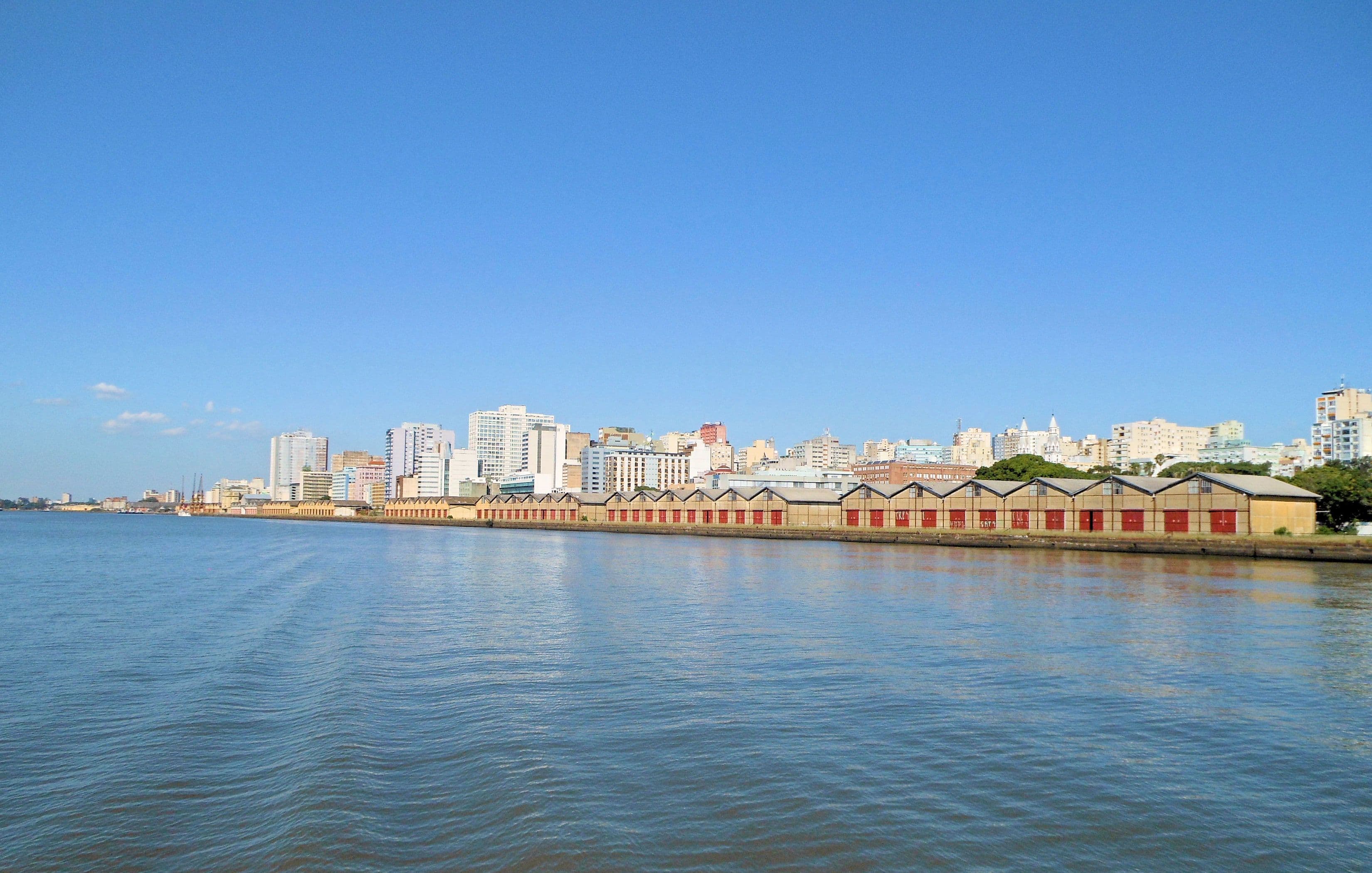
The finish at Parque Harmonia puts you on the Guaíba waterfront, within reach of Centro Histórico and the city’s central landmarks.
Mercado Público Central
Porto Alegre’s central market, and an easy way to eat and look around without committing to a full sightseeing day. It sits in Centro Histórico and pairs naturally with a short walk through the old core. Avoid peak lunchtime the day before racing if calm legs and a simple stomach matter more than a lively crowd.
Usina do Gasômetro and the Guaíba Waterfront
A former power station turned cultural venue, and one of the better low-effort things to do around this race weekend regardless of how the legs feel. The sunset over the Guaíba is the real draw. Check current opening status for the building itself; the waterfront works on its own even if it is closed.
Monumento aos Açorianos
A course-adjacent landmark near the central waterfront, best treated as a stop within an easy walk. Suitable for tired legs and short attention spans alike.
Parque Harmonia
0 km, the finish itself. Less an attraction here than the entire race-weekend hub. Use it to get expo bearings before race day, meet people after the finish, and sit down somewhere that is not a hotel room. Confirm access restrictions around race setup before planning a Saturday visit.
Estádio Beira-Rio and the Museu do Inter
The obvious add-on for anyone with an interest in Brazilian football, sitting south of the finish in Praia de Belas. Worth combining with a waterfront walk if the legs are cooperating. Check the match calendar and museum hours before assuming it is open.
Read Before you Run
O Tempo e o Vento
Érico Veríssimo
The defining literary account of Rio Grande do Sul's gaúcho history and frontier identity, not a running book but essential background for anyone treating this race as more than a fast time on a spreadsheet. English translations are patchy, so this is best framed as a cultural reference to seek out.
Incidente em Antares (Incident in Antares)
Érico Veríssimo
A more compact Veríssimo novel, tied to Rio Grande do Sul's political imagination more than its landscape. A reasonable alternative for readers who want the same regional voice in a shorter book.
After the Race
New Balance 42K Porto Alegre runs in August, in the back half of Porto Alegre’s winter, which favours the Serra Gaúcha hill towns and wine country far more than it favours the coast. These itineraries range from a same-day walk along the Guaíba to a four-night extension into Florianópolis.
The easiest possible day after a marathon. Start late, keep plans loose, take in the Mercado Público if it is open, and finish with a slow walk along the Guaíba for sunset.
The Serra Gaúcha hill towns, and August's Southern Hemisphere winter suits their log fires and chocolate shops better than any other season.
The deeper regional trip, built around wine and Italian-Brazilian food culture. August is cool and quiet, long before the vineyards turn green.
A proper coastal extension of several days. August is not Florianópolis at its beach-party best, which suits recovery better than midsummer crowds would.
Frequently asked questions
Should I stay near the start or the finish?
Stay closer to the finish, around Parque Harmonia or Praia de Belas, if in doubt. The marathon starts at Redenção but finishes at Parque Harmonia, and after 42km, easy finish-side logistics matter more than a short walk to the start line. Cidade Baixa is the best compromise if a livelier start-side base matters more to you than post-race convenience.
How far in advance should I book a hotel?
As soon as your entry is confirmed, ideally with free cancellation. The race sold out in both 2025 and 2026 well ahead of race week, so demand for entry and for nearby hotels tends to move together. Parque Harmonia, Praia de Belas and Cidade Baixa are the areas most likely to tighten first.
Is there free transport to the start?
No official free race-day transport has been confirmed. Redenção is not directly served by Trensurb, so most visiting runners should plan a taxi or rideshare, booked the night before.
What is the best area to stay?
Praia de Belas or the area immediately around Parque Harmonia for finish-day convenience. Cidade Baixa for start-side access and a livelier base. Moinhos de Vento if hotel comfort matters more to you than proximity to either end of the course.
When does the expo open?
The 2026 expo ran from Thursday to Saturday before race day at Parque Harmonia, 09:00 to 19:00 each day, with a separate race-day window. The regulation is stricter than the main page: kit collection closes before race day, so do not leave it to Sunday morning.
What is the weather typically like?
Cold by Brazilian standards, and deliberately so: the race is deliberately scheduled in the depths of the Southern Hemisphere winter. Expect lows around 11°C, occasionally colder with a passing front, warming through the teens later in the morning. Wind off the Guaíba is worth planning for.
How do I get from the airport?
Trensurb connects the airport to the city centre when the Aeromóvel link is operating, with the Mercado station serving central Porto Alegre. Given recent disruption to that connection, check its current status and default to a taxi or rideshare if arriving with race-week luggage.
Is there a bag drop?
Not clearly confirmed. Because the start and finish are in different parts of the city, do not plan to leave a bag at the Redenção start unless the organiser explicitly confirms it will be transported to Parque Harmonia.
Should I bring a throwaway layer?
Yes. The marathon starts at 07:00 in a Porto Alegre August, genuinely cold and sometimes windy in the start pen. An old sweatshirt or a disposable poncho can be left behind at the gun without a second thought.
How do I get back to my hotel after finishing?
If staying near Parque Harmonia or Praia de Belas, walking back is realistic once you have caught your breath. From Centro Histórico, Cidade Baixa or Moinhos de Vento, a taxi or rideshare is the simpler option.
Is this the same race as the Maratona Internacional de Porto Alegre?
No. New Balance 42K Porto Alegre is a newer race, launched in 2024 by Run Sports, held in the southern winter and running from Redenção to Parque Harmonia. The Maratona Internacional de Porto Alegre Olympikus is a separate, much older race held in late May or early June, starting and finishing at BarraShoppingSul. The two share a city, not a course, a date or an organiser.