The Race
| Next Race Date | 2 May 2027 |
|---|---|
| Course type | Loop: starts and finishes at Old Town Square |
| Registration | Via RunCzech Runner ID account, first-come, no ballot; registration fee tiers scale with total order value. |
| Ballot Opens | Not applicable: first-come entry with no ballot mechanism |
| Total finishers | 9,063 (2026 edition) |
| Avg race-day temp | Mild May weather typical of Central Europe, with both sun and rain realistic possibilities |
| Cutoff time | 7 hours from the gun start (official RunCzech time-limit rule, pace 9:45 min/km) |
| Free race-day transport | Not confirmed from an accessible source. |
| Course certification | World Athletics Label race |
| Sleeper Train | Accessible (European Sleeper and Nightjet services connect Prague to other Central European cities) |
A Course Built Around Prague’s Own Landmarks
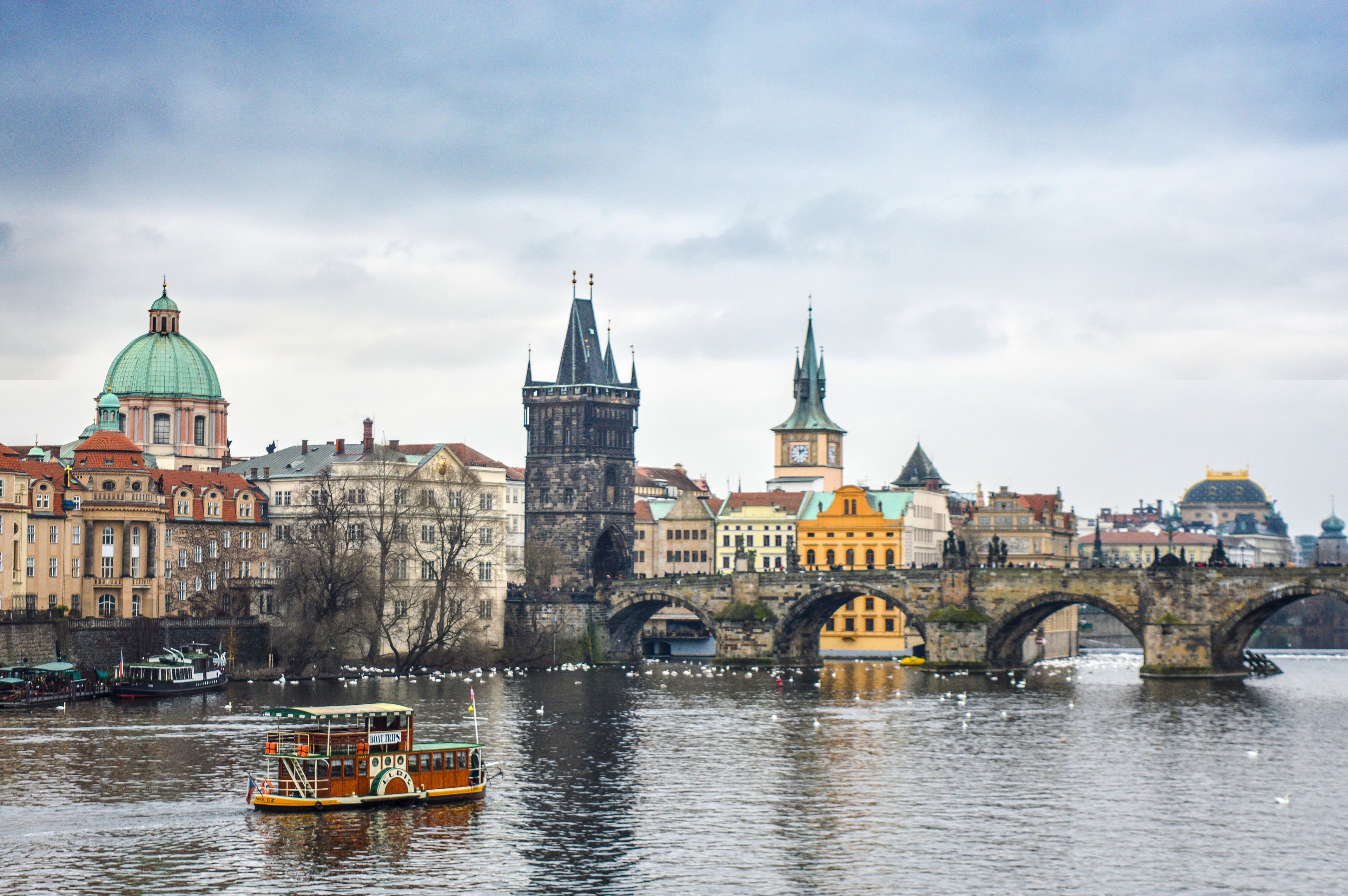
Charles Bridge, Prague Castle and Old Town Square all sit directly on the marathon route itself, seen from the road rather than requiring a separate sightseeing trip either side of the race. Runners chasing photographs at Charles Bridge in particular should pace themselves rather than treating the early crossing as a natural excuse to slow down for the whole field around them.
History
The Prague Marathon is RunCzech’s flagship full-distance event, run each May and organised by Juniorský maratonský klub, z.s. alongside the RunCzech Running League’s wider calendar of half marathons and shorter races across the Czech Republic. First run in 1995, the marathon should be kept clearly distinct from the Prague Half Marathon, also organised by RunCzech but held on a different date.
The race carries a World Athletics Label, and its 2026 edition drew 9,063 finishers, with elite times of 2:05:51 for the men’s winner and 2:24:19 for the women’s winner, a Kenyan podium sweep in the women’s race that year.
The Title Sponsor Changes Each Year
This race has run under different title sponsors in recent years, ORLEN in 2025 and Vodafone in 2026, while the organiser (RunCzech) and the course itself remain constant. Don’t be surprised if the official name on your race pack differs from what you researched the year before.
The course
The marathon starts and finishes at Old Town Square, the historic heart of Prague. From the start, the route runs down Pařížská Street towards the river, passing the Chamber of Deputies and Wallenstein Palace before crossing the Vltava with views of Prague Castle rising above the course. Runners cross the medieval Charles Bridge early in the race, then pass the Rudolfinum concert hall before heading north into the Karlín district, marked by David Černý’s Lilith sculpture, around the 9 km point.
The course returns through Old Town Square at roughly 12.7 km, then follows part of the historic Royal Route past Celetná Street, the Powder Tower and Wenceslas Square, before reaching the National Theatre and the Dancing House. A crossing of Nusle Bridge leads to Vyšehrad fortress around the halfway point, before Legion Bridge brings runners back towards the city centre for a second pass of the National Theatre, Rudolfinum and Karlín, finishing back at Old Town Square. The course is officially described as relatively flat with gentle rolling hills, combining paved roads with some historic cobbled sections.
Km 0-2.8: Old Town Square to Charles Bridge. The race starts at Old Town Square, surrounded by Gothic, Renaissance and Baroque buildings, before running down the elegant Pařížská Street towards the river. Within the first two kilometres the route passes the Chamber of Deputies and the Wallenstein Palace, with Prague Castle itself visible above the course, before crossing the Vltava and reaching Charles Bridge at 2.8 km, a real highlight this early in the race and one worth deliberately not sprinting for the sake of a photo.
Km 2.8-9.3: River corridor to Karlín. Past the bridge, the course runs by the Rudolfinum concert hall at 3.8 km, crosses back over the Vltava and follows the Holešovice embankments east to Libeň Bridge, then returns along Rohanské nábřeží into Karlín, a modern, dynamically developing district reached around 9.3 km and marked by David Černý’s monumental Lilith sculpture, a deliberate contrast with the medieval architecture of the opening kilometres.
Km 9.3-13.6: Return to the historic centre. The route heads back into central Prague, passing through Old Town Square again at 12.7 km, where returning runners are met by the crowd energy built up since the start. From here the course briefly follows part of the historic Royal Route, once used for coronation processions, past Celetná Street and the Gothic Powder Tower at 13.2 km, before reaching Wenceslas Square, the modern civic heart of the city, at 13.6 km.
Km 13.6-21.3: National Theatre to Vyšehrad. The National Theatre at 14.5 km and the Dancing House, one of Prague’s most photographed pieces of modern architecture, at 15.2 km, mark the run south along the river. Nusle Bridge at 18 km carries the course towards the approaching halfway point, and Vyšehrad fortress at 21.3 km offers a quieter, more reflective stretch, a historic hilltop site with a markedly different character from the tourist-dense streets of the opening kilometres.
Km 21.3-31.5: The middle miles. Below Vyšehrad the course runs an out-and-back along the Podolí embankment to a turn at about 22 km, returns to Rašínovo nábřeží, then crosses to the Smíchov bank for a second out-and-back south along Strakonická to a turn at about 28 km, before running north up the Smíchov embankments to Legion Bridge. It is the flattest and quietest stretch of the race, all riverside and all within a few metres of 195 m, a deliberate change of pace from the landmark-dense opening and closing sections.
Km 31.5-38.7: Back towards the centre via Legion Bridge. Legion Bridge at 31.5 km brings runners back over the Vltava towards the city centre, passing the National Theatre again at 31.8 km and the Rudolfinum at 32.5 km, both familiar landmarks from earlier in the race now seen from the return leg. The course reaches Karlín and the Lilith sculpture a second time at 38.7 km, a deliberate structural echo the official course guide itself describes as symbolically closing the contrast between the city’s historic and modern faces.
Km 38.7-42.2: The finish at Old Town Square. The final stretch returns to Old Town Square, where the race began, for a finish among some of the most recognisable architecture in Central Europe and the concentrated crowd support of the historic centre.
Follow the blue tangent line throughout, particularly across Charles Bridge and through the multiple river crossings, where pedestrian and spectator density can push runners off the shortest line. Cobbled sections in the historic centre call for slightly more attention to footing than the modern paved stretches through Karlín.
Course Map
The map shows the loop route from Old Town Square across Charles Bridge, through Holešovice and Karlín, out to Vyšehrad and the Podolí and Smíchov riverbanks, and back via Legion Bridge to the same start/finish location. Tap a marker for details, and scrub the slider or press play to move the orange marker along the course with the elevation profile beneath it.
Runs down Pařížská Street past the Chamber of Deputies and Wallenstein Palace, with Prague Castle visible above the course, to a crossing of the medieval Charles Bridge.
Passes the Rudolfinum, reaches the modern Karlín district and David Černý's Lilith sculpture, then returns through Old Town Square and the historic Royal Route to Wenceslas Square.
Runs south along the river past the National Theatre and Dancing House, passes Nusle Bridge and Vyšehrad near halfway, then out-and-backs along the Podolí and Smíchov riverbanks.
Crosses Legion Bridge, passes the National Theatre, Rudolfinum and Karlín a second time, then finishes at Old Town Square.
Pacers
Free pacers are confirmed via official RunCzech marketing, identified by a lettered group marked on each runner’s own bib. Specific pace-time bands and the start-corral structure had not been published at the time of writing; check the official RunCzech event guide for the current year, typically published closer to race day, for the specific pacer time list.
What to wear
Prague in early May runs mild but changeable, with both sunshine and rain realistic possibilities on race day itself. A throwaway layer for the Old Town Square start is sensible, particularly given the square itself can be crowded and slower to move through than a purpose-built start pen.
Given the course includes real cobbled sections through the historic centre, alongside modern paved roads through Karlín, footwear that handles a mix of surfaces confidently is worth prioritising over shoes optimised purely for a smooth road surface. Runners chasing a specific finish time on this course, officially described as relatively flat with gentle rolling hills rather than pancake flat, should dress for a proper effort rather than treating the course’s flat reputation as a guarantee of an easy pace throughout.
Entry
Entry to the Prague Marathon requires a RunCzech Runner ID account, used across all RunCzech Running League events; registration itself runs first-come through the official online form, with no ballot mechanism. From the 2026 season, RunCzech’s registration fee (a service charge on top of the base entry price) scales with the total value of the runner’s order, from no fee on orders under €3 up to a flat €3 fee on orders over €100, a change RunCzech states was already in effect from 2025 but phased in gradually to avoid a sudden jump for returning runners.
Once a registration is paid, the fee itself is described as final and non-refundable, and cannot be transferred to a different race. Runners unable to take part have two official options: RunCzech’s own cancellation insurance, purchased at the time of registration, or an official registration transfer to another named runner via RunCzech’s own transfer process, distinct from an unofficial private sale, which the organiser explicitly does not facilitate or endorse. There is no general deferral option to a following year’s event described in the official rules.
The minimum age to take part in the Prague Marathon is 18 on race day itself, per RunCzech’s own age-requirement table across its full race calendar. Registrations left unpaid for more than 10 calendar days are automatically cancelled, and any registration created fewer than 12 days before the race must be paid within 6 days of creation.
Fast Runner / GFA Standards
Not applicable. No ordinary fast-runner or GFA-specific route was confirmed for this race beyond its general World Athletics Label status.
Race Weekend
Expo
The Marathon Expo, where all race numbers and any pre-purchased items such as t-shirts are collected, takes place at Výstaviště Holešovice, in the Křižíkovy pavilions, across pavilions C, D and E, with Pavilion E specifically designated for bib numbers and t-shirts.
Runners must bring valid photo identification, an ID card, driving licence or passport, matching the details entered on their registration, to collect their own start pack; RunCzech’s official rules state explicitly that start packs cannot be posted or delivered by any other means, and any pack not collected at the expo itself cannot be claimed later. This is a firmer in-person collection requirement than some other marathons, and overseas entrants in particular should plan their travel to arrive in Prague before the expo closes rather than relying on race-morning collection. Beyond bib collection, the expo also hosts partner exhibition booths and an accompanying programme of events.
Race Morning
The race starts and finishes at Old Town Square, in the historic heart of Prague. Runners should expect Old Town Square itself to be crowded before the start, given it functions as a major tourist site on any ordinary day of the year, not solely a marathon start area, so allow more time to reach the start pen than the square’s small footprint might suggest.
RunCzech’s official rules explicitly prohibit skates, bicycles or other transport devices, hiking poles, prams and running with dogs on the course; start numbers must be worn flat on the chest and are non-transferable to another runner on race day itself. Chips used for individual races are disposable and do not need to be returned, unlike RunCzech’s team relay events, which do require the timing chip’s return.
Since September 2025, RunCzech has changed how the official finishing time itself is calculated: the runner’s own real time, from crossing the start line to the finish, rather than the previous gun time, is now the primary official time for standard participants, with gun time retained only for elite-field verification purposes. This is a useful piece of information for time-conscious runners who may remember the previous system from an earlier Prague race and should not assume gun time still determines their own official result.
Runners are not permitted to have unregistered supporters accompany them onto the course, including the start and finish areas and finishing straight, and doing so risks the runner’s own disqualification.
Nutrition on Course
RunCzech’s general race listings describe refreshment stations positioned at regular intervals along the course, though the exact spacing and what each station specifically offers, water only versus water, sports drink and gel, were not itemised in the sources available. Check the official current-year Event Guide, typically published closer to race day, for the exact aid-station table.
Given the course’s historic-centre setting, runners should expect aid stations to be positioned with an eye to the city’s own street layout and pedestrian access rather than at perfectly even km intervals throughout, a common pattern on city-centre marathons that route through pedestrianised zones.
Spectating
Prague’s course structure favours spectators: because the route passes back through Old Town Square around the 12.7 km mark, and returns close to the centre again via Legion Bridge in the closing stages, supporters based centrally can realistically see a runner multiple times without needing to travel far between sightings, a real advantage over a point-to-point course.
Old Town Square itself, hosting both the start and the eventual finish, is the natural anchor for most spectator plans, and Prague’s dense, well-connected public transport network (trams and metro) makes moving between viewing points along the river crossings practical compared with cities where the equivalent course sections are harder to reach without a car.
Itinerary A, Old Town Square (start, and again at km 12.7): Position around Old Town Square itself for both the start and the runner’s return pass through the historic centre. The most crowded viewing point given the square’s dual role as start and a mid-race landmark.
Itinerary B, Charles Bridge and the river crossings (early miles): A short walk or tram ride from the centre to see runners cross Charles Bridge around 2.8 km.
Itinerary C, Old Town Square finish (recommended for most supporters): Return to Old Town Square ahead of the runner’s expected finish time. The most straightforward single sighting point, avoiding the need to track a runner through the quieter Vyšehrad and middle-mile sections of the course.
Post-Race Food
Lokál Dlouhááá, a well-known Czech pub-style venue in the historic centre serving traditional food and Czech beer, is a plausible post-race option within walking distance of the Old Town Square finish. Pizza Nuova, and Café Louvre, a historic Prague café with a long literary and intellectual association, are further central leads worth checking for current opening hours and Sunday service. Given the finish sits directly at Old Town Square, all three of these central options are realistically walkable rather than requiring onward transport.
Where to Stay
Because the course starts and finishes at the same Old Town Square location, the usual principle of favouring proximity to the finish still points to the same central area as the start, simplifying the choice considerably compared with a point-to-point race.
Old Town
Right around the start and finish itself, Old Town offers the strongest race-day logistics and the most recognisably central Prague base, at the cost of being noisy and among the most expensive parts of the city, particularly during marathon weekend itself.
New Town
Around Wenceslas Square, New Town offers a practical, slightly calmer alternative within easy walking or metro reach of the finish, generally better value than Old Town’s core streets without losing meaningful proximity.
Malá Strana
On the castle side of the river, Malá Strana is scenic and comparatively quiet in the evenings, reached by a walk or tram across the river, though its cobbled, hilly streets are a real consideration for legs recovering from 42 kilometres the day before.
Vinohrady
A short metro or tram ride from the centre, Vinohrady offers a calmer, more local residential feel with its own strong restaurant scene, a reasonable trade of a slightly longer journey for better value and a break from the tourist density of the centre.
Karlín
Also directly on the course route itself (passed twice, at 9.3 km and 38.7 km), Karlín is a modern, food-focused district with good metro and tram access, suited to runners who want value and a proper local dining scene without needing to be immediately on the Old Town Square doorstep.
Given Prague draws a large field (over 9,000 finishers in 2026) into a compact historic centre, and May is peak tourist season for the city independent of the marathon itself, booking accommodation well ahead of the usual city-break timeline is sound practice regardless of which of these areas is chosen.
Recommended hotels
A reliable value option in a well-connected location, though not within the Old Town core itself.
A classic, high-end central base directly suited to race-day logistics, at a real price premium.
Apartment-style accommodation offering more space than a standard hotel room, useful for a longer city-break stay either side of the race.
A practical central base, though positioned in one of the busiest parts of the city on race weekend itself.
A design-focused, value-oriented option, notably also close to the Výstaviště Holešovice expo venue, though further from the Old Town Square start/finish itself.
Booking timeline
Registration runs first-come rather than through a ballot, so there is no single results-announcement date driving a hotel-booking spike in the way a lottery-based race would produce; the more significant pressure on accommodation comes from Prague’s own status as a major European city-break destination in May, independent of the marathon. Book central accommodation as early as realistically possible, since May weekend availability in Old Town and New Town can be tight even without the extra marathon-weekend demand.
Runners flying in are most likely to route through Václav Havel Airport Prague, which sits closer to the city centre than many European airport-to-marathon transfers, with airport bus, metro and taxi connections all realistic options; check current transfer times and options before booking flights.
See & Do
The finish sits at Old Town Square, putting Prague’s densest concentration of major architectural sights within walking distance of the finish line itself.
Charles Bridge
On the course itself, km 2.8. A medieval stone bridge lined with statues of saints, worth revisiting on foot at an early hour to see it without the marathon’s own crowds or the day’s usual tourist density.
Prague Castle
Visible from the course near km 1.8; a longer visit involves a walk and some real climbing. The largest ancient castle complex in the world by area, a major sight but a considerably more demanding visit on legs recovering from a marathon than the flat riverside sections of the course itself.
Jewish Quarter (Josefov)
Within Old Town, a short walk from Old Town Square. A cluster of historic synagogues and the Old Jewish Cemetery, significant sites requiring advance ticket booking for some venues; check current opening hours before planning a visit.
Vyšehrad
On the course itself, km 21.3; a standalone visit involves some climbing. A historic hilltop fortress with real views over the Vltava, quieter and less crowded than the Old Town sites, a good option for a calmer day either side of the race.
Read Before you Run
Prague: A Traveler's Literary Companion
Various (edited anthology)
An anthology approach suited to a city with as dense a literary and cultural history as Prague, offering short pieces tied to specific parts of the city rather than a single continuous narrative; a better thematic fit than a generic country-wide Czech guidebook.
After the Race
The Prague Marathon runs in May. These itineraries range from a same-day walk around the historic centre to a three-night extension to Vienna.
A low-effort day revisiting the historic centre and the river on foot, without the crowds of race morning itself.
A classic, compact medieval-town extension, picturesque in May but correspondingly busy with other visitors.
A spa-town recovery extension built around Karlovy Vary's mineral springs, a good shoulder-season fit for early May.
A full second-city extension reached by direct train, no car required, working well within an early-May travel window.
Frequently asked questions
Should I stay near the start or the finish?
They're the same place: the course starts and finishes at Old Town Square, so a central Old Town or New Town base covers both.
How far in advance should I book a hotel?
As early as realistically possible. Prague is a major European city-break destination in May independent of the marathon, so central accommodation availability is tighter than the race’s own field size alone would suggest.
Is public transport free on race day?
Not confirmed from an accessible source.
What is the best neighbourhood to stay in?
Old Town or New Town for the simplest race-day logistics; Vinohrady or Karlín for better value and a more local feel, at the cost of a short tram or metro journey.
When does the expo open, and what do I need to bring?
The Marathon Expo runs at Výstaviště Holešovice, Křižíkovy pavilions, with Pavilion E for bib numbers and t-shirts. Bring valid photo ID matching your registration details; race packs cannot be posted or collected at any other time.
What is the weather typically like on race day?
Mild but changeable early-May Central European weather, with both sun and rain realistic possibilities.
How do I get from the airport to the city centre?
Václav Havel Airport Prague connects to the centre by airport bus, metro or taxi, a shorter transfer than many European marathon airports.
Is there a bag drop at the race?
Not confirmed from an accessible official source; check the current-year Event Guide.
Should I bring a throwaway layer to the start?
Yes, particularly given Old Town Square itself can be slow to move through before the start, extending the pre-race wait.
How do I get back to my hotel after finishing?
The finish is at Old Town Square; central Old Town and New Town hotels are within walking distance, while Vinohrady or Karlín-based runners will need a short tram or metro journey.