The Race
You have to bring your own cup
There are no disposable cups anywhere on this course. Liquid aid comes from water fountains, and every 2026 marathoner is required to carry their own reusable cup, bottle, flask or hydration vessel. This is a race rule, not a suggestion, and it changes how you drink for 42 km. Practise with whatever you intend to use, because filling a soft flask at a fountain while your heart rate is at 160 is a skill, and race day is a poor place to learn it.
| Next Race Date | Sunday 26 September 2027 (provisional; the organiser has not yet published the 2027 date) |
|---|---|
| Course Type | Two loops, mixed road and coastal path |
| Registration | Open, direct entry, capped at 3,000 |
| Ballot Opens | No ballot |
| Total Finishers | Field capped at 3,000; no single course record, the route has changed too often |
| Average Race Day Temperature | 11 to 22°C in September, with wind the bigger variable |
| Cutoff Time | 5 hours 45 minutes, with barriers at 16.87 km, halfway and 34.5 km |
| Free Race Day Transport | Not confirmed; the town is compact enough to walk |
| Course Certification | FFA-affiliated and officially measured; no AIMS or World Athletics label |
History
The Marathon de Vannes was created in 2000 by officials from the athletics section of the Municipaux de Vannes working with the sports association of the Centre Hospitalier Bretagne Atlantique. Co-presidents Patrick Le Ray and Pierre Tessier oversaw an inaugural race on 19 November 2000 that drew 1,700 runners against an initial cap of 1,500, and Jogging International named it a “coup de cœur” marathon in its first year.
From the start the course was defined by the Golfe du Morbihan and not by city streets alone. Older event material describes a two-loop structure, and that repeated-sector character survives: the 2026 aid plan lists the same stations at two separate kilometre points, for the first and second passages. The race grew into a weekend that now includes the Duo de l’Hermine, a 20 km, the Gwened Nocturne 10 km, a 5 km and corporate events, passing 5,000 runners across the programme by 2022 and exceeding 10,000 at the 25th edition in 2025.
It has built an environmental identity alongside that growth. Liquid aid has come from water fountains instead of disposable cups since 2021, and a €2 entry contribution goes directly to the Conservatoire du Littoral, tying the cost of entry to protecting the coast the race runs along. The most recent change is the finish itself, now at Parc des Expositions du Chorus, which moves finish-line services and the marathon village into the Parc du Golfe while the start stays at the ramparts.
For 2026, the 26th edition, the field is capped at 3,000. The route and the finish have changed enough across 26 years that a single current course record cannot responsibly be published: Olivier Frémy won in 2025 in 2:30:01 and Mélissa Fretaud in 3:07:47, and those are recent results rather than all-time marks, since archived results from earlier configurations include faster times.
The course
The race starts at 09:30 from the Vannes ramparts on Rue Francis Decker and finishes at Parc des Expositions du Chorus in the Parc du Golfe, 2.5 km away on the other side of the city. It is not a conventional single-loop city marathon: it crosses the historic centre and makes repeated passages along the coastal paths of the Golfe du Morbihan, anchored by Larmor-Gwened, the Isthme de Conleau, central Vannes and the port, structured across two loops.
The organiser gives approximately 150 m of elevation gain, and the terrain bears that out: the whole course sits inside about 24 m, it never climbs more than 20 m at a time, and it never goes further than 3.7 km from the start. None of which makes it fast. The cost here is surface and shape, not gradient: mixed paved road and coastal path, narrow sectors where a field cannot spread out, repeated directional changes, and real exposure to wind coming off the water. All of it is met twice. No kilometre-by-kilometre surface breakdown has been published, so wait for the organiser’s final runner guide before assuming gravel, mud or cobbles at any particular point.
Kilometre by kilometre
Km 0 to 1.5: the ramparts start. The race begins beside the walls of Vannes, which is one of the better start settings among French regional marathons. The 09:30 gun is later than most city races, which makes race morning easy and raises the chance of finishing in warmer conditions than you started in. The fastest runners and the 3:00 to 3:45 pace groups use SAS 1, with slower groups filling SAS 2 through 4. Pen placement matters more than usual because the course narrows quickly once it leaves the broad central streets.
Km 1.5 to 13.7: central Vannes to Larmor-Gwened. The route runs through Place des Lices, Racker and the Parking ARS sector before reaching Larmor-Gwened, the first major outer anchor, at about 13.7 km. This stretch mixes town streets with the first of the coastal path, and the organiser’s own language is “sentiers côtiers” rather than any promise of continuous broad road. Expect narrowing and surface variation.
Km 13.7 to 21.8: Conleau and the halfway turn. The course reaches the Isthme de Conleau around 21 km, the most distinctive sector on the route: a narrow peninsula with water on both sides and far less shelter than the town centre. Wind and rain change the character of this section more than the elevation figure ever suggests. The halfway cutoff is 3 hours, so slower runners have to manage the narrow stretches here without losing time they cannot recover.
Km 21.8 to 39: the second passage. The route turns back towards Larmor-Gwened and Vannes and repeats several of the sectors covered on the way out. Runner accounts consistently describe this second pass as the harder one, and not because of any single hill: short rises, irregular path surface and repeated changes of direction accumulate more noticeably past 25 to 30 km. Aid reappears at the same named points, Place des Lices, Racker, Parking ARS, Bois de Conleau, Isthme de Conleau, Capitainerie, Kermain and Larmor-Gwened, which is how you can read the two-loop structure straight off the aid table.
Km 39 to 42.195: into the Parc du Golfe. The closing kilometres return through central and harbour Vannes towards the Parc du Golfe finish, which replaces the stadium finish the race used for years. It puts runners straight into the marathon village and close to the Parc du Golfe hotels. Showers are not here: they are a further kilometre away at the Stade de Kercado.
Intermediate barriers apply at km 16.87 (2h25), halfway (3h00) and km 34.5 (4h56), with an overall cutoff of 5h45. Runners outside those limits can be removed from the organised framework as roads reopen. No official blue line has been confirmed, so follow the shortest sensible line through corners.
Course Map
Two loops from the ramparts down to the Gulf shoreline and back, inside a 3.7 km radius of the start. Tap a marker for the start, the finish, the Marathon Village and the exposed Gulf sector, and scrub the slider or press play to move the orange marker along the course with the elevation profile beneath it.
Pacers
Everyone starts at 09:30, seeded across four pens. SAS 1 carries 3:00 (red), 3:15 (yellow), 3:30 (blue) and 3:45 (violet); SAS 2 has 4:00 (green), SAS 3 has 4:15 (orange) and SAS 4 has 4:30 (pink). That runs from 4:16 to 6:25 per kilometre. The organiser also offers preferential bib placement, which is seeding and not a separate entry route, to runners with proof of sub-2:45 for men or sub-3:15 for women.
What to wear
September normals at Vannes-Séné put the average minimum around 11.5°C and the maximum around 21.9°C, with roughly 56 mm of rain across about seven wet days in a typical month. Those numbers matter less here than the wind. A meaningful part of this course is exposed coastal path, and September averages around 3 m/s with stronger gusts entirely possible, which can make a cool, wet day feel considerably harder than the temperature alone suggests.
The 09:30 start removes the risk of a freezing wait and adds the opposite problem: later finishers can meet a warmer, sunnier second half than the one they started in. A packable or disposable layer for the start is sensible on a cool or wet forecast, though no clothing-donation scheme has been published, so discard kit only where staff permit it. Plan for a day that changes character partway through instead of dressing for one expected condition, and remember you are carrying a vessel of your own regardless.
Entry
Entry is direct online registration with no ballot, priced in two bands: €65 for the first 500 entries or anyone registering by 28 February, rising to €75 for the remaining 2,500 places from 1 March. FFA-licensed runners get €5 off. Additional charges apply on top: a €2 eco-participation paid to the Conservatoire du Littoral, around €2.10 in processing fees, an optional €10 cancellation guarantee and an optional €9 home bib delivery.
The marathon is capped at 3,000. Registration and Pass Prévention Santé documentation can be completed until 1 September 2026 according to the live FAQ, though the regulations PDF carries a stale prior-year date that should not be relied on. Runners without a licence need a PPS completed after 15 January 2026 under the current one-year validity, and runners from outside France are not exempt. There is no Good For Age route; preferential start-position seeding is available instead for evidence of sub-2:45 (men) or sub-3:15 (women). No charity allocation or overseas tour-operator programme has been published.
Fast Runner / GFA Standards
There is no guaranteed-entry standard. Sub-2:45 for men and sub-3:15 for women earns preferential bib placement, which moves you forward in the pens and nothing more. Every place is bought through the two open bands above.
Race Weekend
Expo
The Marathon Village and bib collection are at Parc des Expositions du Chorus, Parc du Golfe, 8 rue Daniel Gilard. Live 2026 race pages give Friday 25 September from 15:00 to 19:00 and Saturday 26 September from 10:00 to 19:00, though the FAQ and the regulations PDF disagree on the Friday opening, one of them giving 14:00. Check the live site shortly before travelling. There is no Sunday collection.
Bring photo identification, your collection voucher or QR code, and any outstanding PPS or licence evidence. A proxy can collect with the runner’s identification and collection documentation. One unusual detail worth planning around: the organiser’s clothing and bag-storage service asks runners to hand belongings over at bib collection itself, the day before, for return at the Chorus finish on Sunday. Confirm that in the final runner guide before relying on it, because it changes what you can carry on race morning.
Getting to the Start
The marathon starts at 09:30 from the ramparts on Rue Francis Decker. Central Vannes is the easiest base for race morning because it avoids any vehicle transfer into a city with extensive closures: the organiser states plainly that traffic around the marathon route is prohibited on race Sunday, with only limited access to some Parc du Golfe businesses via the Racker roundabout.
No free network entitlement for runners has been published, and the town is compact enough that it hardly matters: a central hotel makes the walk to the start realistic without any transit at all. Given the 09:30 gun, the weather can shift meaningfully between the start and the finish, so a packable layer for the wait is sensible on a cool or wet forecast.
Belongings handled through the organiser’s clothing service come back at Hall B at Chorus after you finish. Showers are not available inside the finish complex: they are roughly a kilometre away at the Stade de Kercado, which is worth knowing before planning a long drive home. Intermediate cutoffs apply at km 16.87 (2h25), halfway (3h00) and km 34.5 (4h56), with the overall limit at 5h45.
Nutrition on Course
Aid stations carry water, energy drink and a mix of salty and sweet food, and the station list is the clearest evidence of the two-loop structure: Place des Lices at 1.5 and 16 km, Racker at 4.4 and 23.5 km, Parking ARS at 7.2 and 26.2 km, Bois de Conleau at 10.7 and 29.6 km, Isthme de Conleau at 11.8 and 30.8 km, a festive point at the Halle aux Poissons at 15.5 km, Capitainerie at 17.3 and 34.5 km, and Kermain at 20.8 and 38 km.
All liquid comes from water fountains instead of disposable cups, so every runner must carry their own reusable cup, bottle, flask or hydration vessel. This is a compulsory race requirement and it is worth practising with in training, because refilling at a fountain costs time in a way that taking a cup off a table does not. Overstim.s is the official nutrition partner with a dedicated zone, though the exact gel format on course has not been confirmed, so carry your own if you rely on something specific.
Spectating
The two-loop structure is this race’s real strength for supporters: you can see a runner more than once without covering the course yourself, and the organiser’s own aid table tells you exactly where.
Itinerary A, the central option. Watch the start at the ramparts, walk into the centre around Place des Lices, which the aid table lists at both 1.5 km and again around 16 km, then move to Parc du Golfe for the finish. Three sightings, all on foot.
Itinerary B, the outer anchor. Position around Larmor-Gwened, a repeated relay and course anchor where the official material places runners more than once, then walk or use local transport towards Chorus for the finish.
Itinerary C, the Gulf option. Take the Bois de Conleau and Isthme de Conleau sector, which the race passes at 10.7 and 11.8 km and again at 29.6 and 30.8 km. Leave before the second passage if you need the time to reach the Chorus finish.
Race-day traffic is heavily restricted across the whole course corridor, so walking, cycling or local transit is more reliable than following a runner by car. The best single location is the port and central Vannes sector, where runners pass more than once and the finish is still reachable afterwards. Official live-tracking details were not clearly published when this page was written.
Post-Race Food
Mercure Vannes Le Port in the Parc du Golfe is an official marathon partner directly beside the Chorus finish district, which makes it the lowest-walking sit-down option; confirm Sunday restaurant opening ahead of race day. Golfe Hôtel Vannes on rue Winston Churchill is another partner in the same area and works for anyone who wants to stay close to the finish.
For anything beyond the partner hotels, the port and the streets inside the ramparts hold the town’s restaurants, which is a walk or a short ride from the finish. Sunday opening in a Breton town of this size varies enough that a group should reserve ahead instead of hoping.
Where to Stay
This is one of the few races on this site where the usual advice does not simply apply. The start at the ramparts and the finish at Chorus sit on opposite sides of the city, 2.5 km apart, so choosing a base is a real trade-off. Weigh removing race-morning transport risk against a shorter walk at the end, and note that road closures make driving between them on Sunday a poor plan either way.
Historic centre and the ramparts
The historic centre works best for the runner. The start is on your doorstep, and Saturday sightseeing and restaurants are a few minutes away. You will need to walk or find local transport back from Chorus after finishing, and removing race-morning risk is usually worth that.
Port and Place Gambetta
The port is the strongest compromise: close to the start, sitting directly on a repeated course sector so you see the race from the door, and roughly midway between the old town and the Parc du Golfe. It also has the best concentration of waterfront restaurants in the town.
Parc du Golfe and Chorus
Parc du Golfe suits anyone putting finish and expo logistics first. The Mercure, the Golfe Hôtel and the other partner properties sit beside the marathon village and the finish, which makes bib collection and the post-race hour trivial. The cost is a walk or transfer to the ramparts on race morning.
The station district
The station sits north of the historic centre, which suits rail travellers arriving on a Saturday. The start is walkable but not immediate, and the return from Chorus is longer than from anywhere more central.
Centre, Jean-Monnet and Libération
The band between the station and the historic core is the practical middle ground, with partner options including Escale Oceania and Kyriad Prestige. Useful when the most central properties have already sold out, which on a 3,000-runner weekend in a town this size happens early.
Ploeren
Ploeren is a budget partner location outside the centre. It may be cheaper and it is car-dependent, which is the wrong dependency for a race that closes the roads around its entire course. It is not the recommendation for a visiting runner without a car.
Recommended hotels
An official marathon partner directly beside the finish district, and the lowest-walking sit-down meal available afterwards. Confirm Sunday restaurant opening before race day. The trade is a walk or transfer into the ramparts on race morning.
Another official partner in the Parc du Golfe area, close to the marathon village and the expo. Same logic as the Mercure: excellent for the finish and the Saturday, less so for the 09:30 start across town.
A partner property in the middle ground between the station and the historic core, which makes it a practical fallback when the most central rooms have gone.
The other partner option in the same middle band. Walkable to the start without being right on it, and a manageable return from the finish.
Booking timeline
There is no ballot, and entering early pays twice: the marathon’s 3,000 places move from €65 to €75 after the first 500, and the hotels go the same way. Book central or Parc du Golfe rooms as soon as your entry is secured, since the Gulf of Morbihan stays an active tourism destination through late September regardless of the race.
Rail is the most convenient long-distance option for most visitors: the organiser advertises Vannes at roughly 2 hours 30 minutes from Paris by TGV. Book peak Friday and Sunday services as soon as fares open. The organiser’s own partner packages start around €95 and can include breakfast from 06:00 and late checkout for post-race showering, which is worth comparing given that the finish has no showers of its own.
See & Do
Vannes is small enough that everything below is within walking distance of either the ramparts start or the port, and most of it is on ground the race covers twice.
The ramparts and the Jardins des Remparts
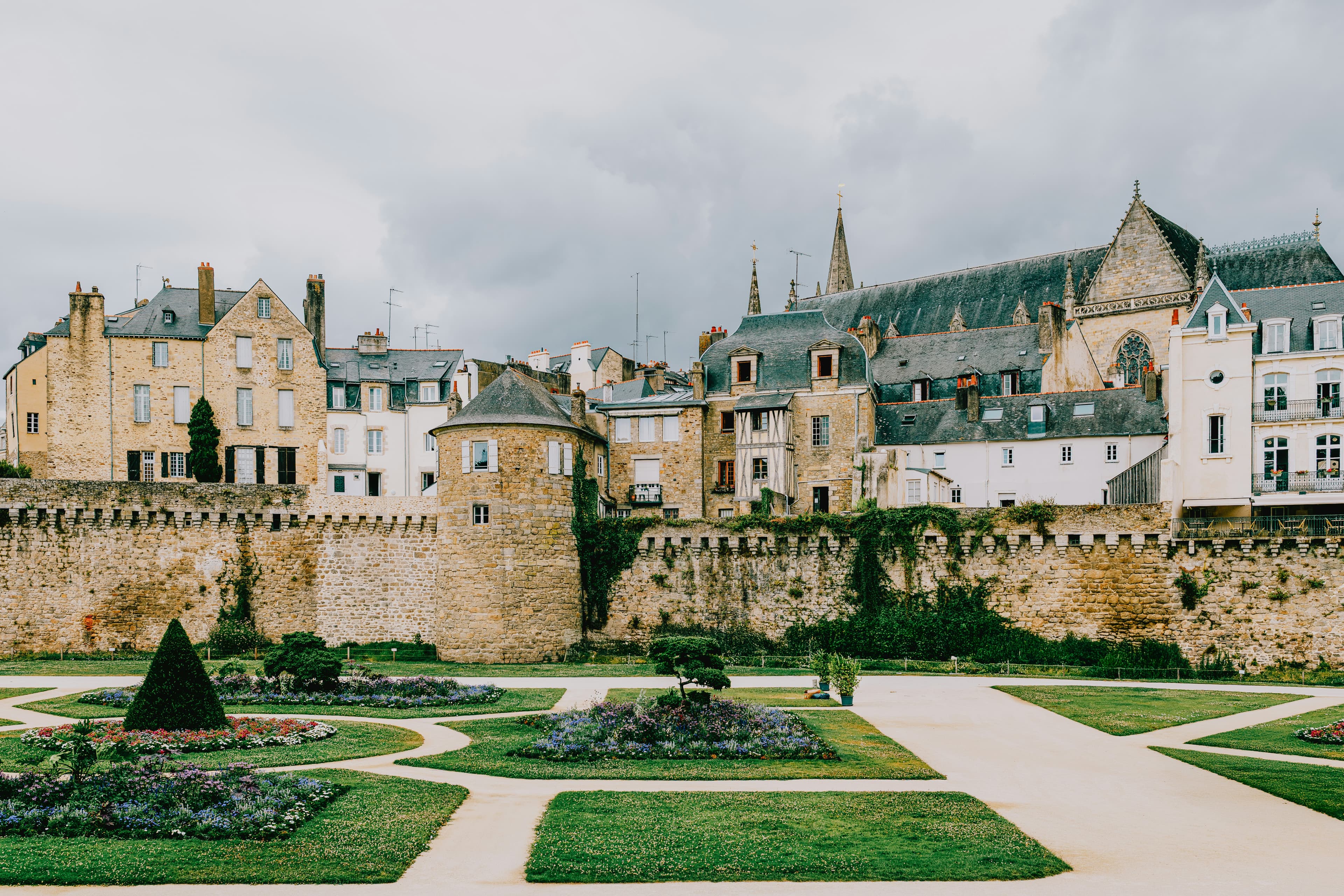
On the start line. Vannes keeps one of the most complete medieval wall circuits in Brittany, with formal gardens laid out in the moat beneath them and the old wash-houses on the Marle below. Free, open, and a ten-minute walk that takes in the best of the town.
The old town and Cathédrale Saint-Pierre
About 0.3 km (0.2 miles) inside the walls from the start. Half-timbered houses leaning over the lanes around Place Henri IV, and a cathedral begun in the thirteenth century and finished over the following five hundred years. The course runs through Place des Lices alongside it, twice.
The port
About 0.5 km (0.3 miles) from the start and on the course. A narrow channel running right up to the walls, with the restaurants along both quays. It is the single best place in the town to watch the race and the obvious place to eat afterwards.
Presqu’île de Conleau
About 3 km (1.9 miles) south of the centre, and the most distinctive sector of the course. A narrow isthmus out to a small peninsula with a seawater bathing pool, woodland and views across the Gulf. Flat, and a gentler thing to walk on the Monday than it was to run on the Sunday.
The Golfe du Morbihan
Boats leave from the Vannes port, about 0.5 km (0.3 miles) from the start. The Gulf holds dozens of islands inside an almost enclosed sea, and a circuit by boat is the least demanding possible way to spend the afternoon after a marathon. Book ahead in September; the sailings thin out as the season ends.
After the Race
Late September in southern Brittany is the end of the season: the ferries and the island crossings are still running, the coast is quiet, and the weather is the only variable. Everything below is chosen for legs that have just covered two loops of coastal path, which in practice means short journeys and flat ground first. The Île aux Moines day trip is the gentlest, and it puts you on the water the race spent all morning beside.
The largest island in the Gulf of Morbihan, and the shortest crossing to it. Flat lanes, hedged paths and a handful of beaches, walkable in small sections rather than as a circuit. The most direct way to see the water the race has just run beside.
More than three thousand standing stones in rows across several fields, raised before the pyramids. The alignments are viewed from the roadside or on a guided walk, which keeps the effort low on tired legs.
A narrow peninsula out to a ferry port, and the largest of the Breton islands beyond it. Belle-Île rewards a car or a bike more than walking, so plan it for day two or three when the legs can take the coast path.
The mechanical elephant on the Île de Nantes, a ducal château in the city centre and a serious food scene. Flat and urban, which makes it the gentlest of these extensions.
Brittany’s capital and its walled corsair port on the same line. Saint-Malo’s ramparts walk is short and flat, and it pairs neatly with a race that started on the walls of Vannes.
Frequently asked questions
Do I need to carry my own cup?
Yes, and it is compulsory. Liquid aid comes from water fountains, not disposable cups, and every marathoner must carry a reusable cup, bottle, flask or hydration vessel. Practise with it: filling at a fountain mid-race is a different skill from grabbing a cup.
Should I stay near the start or the finish?
A real trade-off here. The ramparts start and the Chorus finish are 2.5 km apart on opposite sides of the city. The historic centre removes race-morning risk; Parc du Golfe favours the finish and expo. The port and Place Gambetta sit between them.
How far in advance should I book a hotel?
Once your entry is secured. The price rises from €65 to €75 after the first 500 of 3,000 places, so early entry pays twice. The Gulf of Morbihan is an active destination in late September regardless of the race.
Is there free transport to the start on race day?
No runner entitlement has been published, and it matters little: Vannes is compact enough to walk to the start from a central hotel. Traffic around the marathon route is prohibited on race Sunday, so driving in is the thing to avoid.
When does the expo open?
At Chorus, 8 rue Daniel Gilard, on Friday 25 and Saturday 26 September. Live pages give Friday 15:00 to 19:00 and Saturday 10:00 to 19:00, though the FAQ and the regulations PDF disagree on the Friday opening, one saying 14:00. There is no Sunday collection.
What are the cutoff times?
Overall 5 hours 45 minutes, with barriers at km 16.87 (2h25), halfway (3h00) and km 34.5 (4h56). Check the halfway barrier against your realistic pace before entering, since it is the tightest of the three.
What is the weather typically like on race day?
September normals at Vannes-Séné give about 11.5°C minimum and 21.9°C maximum, with roughly 56 mm of rain across seven wet days. Wind matters more than those numbers: a good part of the course is exposed coastal path.
Are there showers at the finish?
No. Showers are about a kilometre away at the Stade de Kercado, which is worth knowing before planning a long drive home. Belongings from the organiser clothing service come back at Hall B at Chorus.
Is the course flat?
Flat in elevation and not easy. The whole course sits inside about 24 m and the organiser gives roughly 150 m of gain with no real climb. What costs time is narrow coastal path, repeated turns and wind off the Gulf, all met twice on a two-loop route.
Can spectators see runners more than once?
Yes, and it is the race’s best feature for supporters. The aid table lists Place des Lices at both 1.5 km and 16 km, and the Conleau sectors at 10 to 12 km and again at 29 to 31 km. Walk or use local transit: race-day traffic is heavily restricted.