The Race
| Next Race Date | Sunday 18 October 2026 |
|---|---|
| Course type | Loop: start and finish both at the University of York |
| Registration | Open, direct entry through Run For All, no ballot found. Minimum age 18. UK race numbers are posted approximately two weeks before race day; overseas runners collect from the Race Office during event weekend. |
| Ballot Opens | Not applicable: open entry, no ballot found |
| Total finishers | Not confirmed |
| Avg race-day temp | Not confirmed. Reports describe cool autumn conditions as often excellent for racing, consistent with the mid-October date. |
| Cutoff time | Not published by the organiser |
| Free race-day transport | Yes. A dedicated Park & Ride operates from Elvington Airfield, and a city-centre shuttle runs from York Railway Station Stand J direct to the Event Village from 7:00am, with runner priority before 8:30am; bus service 66 also connects the city centre and University. |
| Course certification | Not stated for a specific certificate number. The race has featured on the World Marathon Majors directory in recent years; 2026 qualifier status should be verified annually. |
| Sleeper Train | Not accessible |
York Minster in Mile Eight, Then Truly Open Countryside
The Yorkshire Marathon’s defining moment comes early: the course passes directly by York Minster in the well-supported opening miles through the city centre, a landmark that older race reports single out repeatedly. What follows is where the race asks more than its “flat and fast” marketing suggests. Once the course leaves the city for open Yorkshire countryside east of York, race reports consistently describe real undulation, notably around miles 8 to 9 in older editions, alongside wind exposure that can turn a promising early pace into a real test of discipline. This is a well-organised, festival-scale event, with sponsored pacers, dedicated Park & Ride transport, and a strong national rail connection via York’s East Coast Main Line station. Runners chasing a PB should treat the early city miles with restraint and resist banking time on the downhill start, saving something for the exposed rural stretch that decides most people’s race.
History
The Yorkshire Marathon has grown into one of the UK’s most established autumn city and regional marathons, organised by Run For All and starting and finishing at the University of York. It combines a controlled event-village start with an early pass through York’s historic city centre and a long rural section through villages east of the city. The event now forms a broader festival weekend, with a Yorkshire 10 Mile race and relay options run alongside the marathon, and the official page’s commercial infrastructure, official pacers, a nutrition partner, event village, baggage store, shuttle buses, partner charities and sustainability points, is closer to a large UK city race than a small club marathon. Current title sponsor Altra joins partner infrastructure including Arla Protein pacers, Applied Nutrition fuelling and Shokz headphone guidance. The race has featured on the World Marathon Majors directory in recent years, though current 2026 qualifier status should be verified annually, never assumed. No confirmed founding year or finisher count has been sourced for this guide.
The course
The Yorkshire Marathon starts and finishes at the University of York, initially heading toward the city centre via Green Dykes Lane, Hull Road and Lawrence Street, passing Walmgate Bar, then using St Deny’s Road, Piccadilly, High Ousegate, Spurriergate, Coney Street, St Helen’s Square, Blake Street and Duncombe Place, past York Minster, before leaving the dense city support for open country roads and villages east of York.
The early city miles are consistently described in older race reports as enjoyable and well supported, with York Minster acting as the race’s emotional landmark; the early downhill and flat feel can tempt runners to bank time. Once the course leaves the city, it settles into a quieter rural rhythm, where pacing discipline really matters: wind, gentle rises and long open stretches can make the course feel harder than the official “flat and fast” positioning suggests. The race is still fast and PB-friendly relative to most UK marathons, and the profile is genuinely gentle: the whole course sits inside a 26 m band, from 13 m at km 1.6 to 39 m at km 15, and no gradient on it reaches 1%. What makes it feel harder is length, not steepness. The two long shapes are a 24 m rise spread across 7.3 km from km 7.7 and a 22 m fall across 7 km after km 15, both at 0.3%.
The late miles are about returning to York and the University after extended countryside running, with the final approach restoring support and structure, though tired runners should be ready for continued open sections and gradual undulations before then. No confirmed official kilometre-by-kilometre elevation figure exists. A roughly 143 m/469 ft figure appears in older race-report material and does not sit easily with a course whose total spread is 26 m.
330ml bottled water is available at course water stations; Applied Nutrition electrolyte tablets, isotonic drinks and energy gels are provided at energy stations. Exact kilometre markers for these stations appear on the official route map but were not extracted for this guide.
Course Map
The map shows the loop route from the University of York through the city centre and York Minster, then out into open Yorkshire countryside before returning to the same start/finish. Tap a marker for details, and scrub the slider or press play to move the orange marker along the course with the elevation profile beneath it.
A controlled event-village start with full festival infrastructure.
Well-supported streets via Walmgate Bar, past York Minster, the race's emotional landmark.
Real undulation and wind exposure east of York, where pacing discipline matters most.
A return to full support and structure after the rural stretch.
Pacers
Official pace groups are confirmed for this race, sponsored by Arla Protein, carrying flags with finish times. Check the final event guide for the exact pace bands closer to race day.
What to wear
Reports consistently describe cool autumn conditions as often excellent for racing, consistent with the mid-October date, though no race-day-specific temperature record has been sourced for this guide. Given the exposed, open countryside sections of the course, layers suited to real wind exposure are worth planning for beyond the general cool-autumn expectation. Bone-conduction headphones are permitted, provided volume is kept low enough to hear marshal and emergency instructions; other headphone types should be checked against current race rules.
Entry
Entry is direct through Run For All, with a minimum age of 18. UK race numbers are posted approximately two weeks before race day; overseas runners do not have numbers posted internationally and instead collect from the Race Office during event weekend. Address changes are only possible until six weeks before the race. No specific entry pricing, closing date, or refund/transfer policy was located in official materials reviewed for this guide.
Fast Runner / GFA Standards
Not applicable. No fast-runner qualification table was found for this race.
Race Weekend
Expo
Race numbers are posted to UK entrants approximately two weeks before race day, with no expo collection. Overseas runners collect their numbers at the Race Office during event weekend, since international postage is not offered.
Race Morning
The race starts and finishes at the University of York, home to the Event Village. Blue Badge parking is available at the University; general race-day parking uses a dedicated Park & Ride, including a Pullman Park & Ride service from Elvington Airfield. A city-centre shuttle operates from York Railway Station Stand J direct to the Event Village from 7:00am, with runner priority before 8:30am. Regular bus service 66 also connects the city centre and University.
York sits on the East Coast Main Line, with direct rail links from London, Edinburgh, Liverpool, Manchester, Birmingham and the South West, giving this race strong national rail access. Allocated toilets are positioned around the start/finish area, with a zero-tolerance policy on urinating outside facilities. Clothing discarded at the start is collected and donated, never returned; runners should not expect to retrieve it. Old trainers can be dropped at JogOn stations near the Race Office.
Nutrition on Course
330ml bottled water is provided at course water stations, with Applied Nutrition electrolyte tablets, isotonic drinks and energy gels at energy stations. Fixed first aid is positioned near water stations, with additional first aid and recovery support near the start/finish and roaming first aiders in the Event Village. Bins and recycling bins are provided after water stations. Exact kilometre markers for water and energy stations appear on the official route map but were not extracted for this guide.
Spectating
Spectators can realistically see the early city section around York Minster and the city centre, then return toward the University for the finish; multiple rural sightings are harder without a bike or car, given road closures along the countryside sections. The best single-location points are York Minster/city centre for crowd energy, or the University finish for finish-line certainty. Spectators should use rail, bus or walking; driving across the course will not work, given the road closures in effect.
Itinerary A: Base at York Minster/city centre for the early, well-supported city miles, then travel to the University of York for the finish using bus service 66 or the city-centre shuttle from York Railway Station Stand J, with no driving across the course.
Post-Race Food
York city centre, with its strong independent food scene around the Shambles, offers the best-established restaurant options within reach of the finish. No specific named restaurant has been sourced with confidence for this guide; the Shambles and York’s wider city-centre dining scene are the practical area to check closer to race week.
Where to Stay
The Yorkshire Marathon’s start and finish are the same location, the University of York, so accommodation choice is judged on the trade-off between city-centre character and race-morning simplicity, with no start-versus-finish decision to make.
York city centre
The best base for character, offering restaurants, the railway station, sightseeing and early-course access, requiring a shuttle, bus or taxi to reach the University start.
Heslington / University area
Race-morning convenient given its proximity to the start and finish, quieter and more limited in accommodation and restaurant supply.
Layerthorpe / Foss Islands
A compromise between city access and route proximity.
Bootham / Museum Gardens side
A good option for quieter, historic accommodation within the city.
South Bank / Bishopthorpe Road
Better for food but involves a longer transfer to the University.
Out-of-town Park & Ride hotels
May be cheaper but add real race-morning stress and should be weighed against that trade-off.
Recommended areas
The best base for character, restaurants, the railway station and early-course access, at the cost of needing transport to the start. No specific property has been sourced with confidence for this guide.
Race-morning convenient given proximity to the University, though quieter and more limited in accommodation supply. No specific property has been sourced with confidence for this guide.
A good option for quieter, historic accommodation within York itself. No specific property has been sourced with confidence for this guide.
Booking timeline
Book accommodation once entry is confirmed and re-check race-weekend prices closer to the date, consistent with standard practice for a well-established city race; York’s own strong year-round tourism draw means booking earlier than for a purely off-peak weekend is sensible regardless of the marathon itself. No specific race-weekend price premium has been sourced for York accommodation around this event.
See & Do
The start and finish sit at the University of York, so these attractions are all within central York, not tied to a single distance from the venue.
York Minster
On the course itself. The race’s own landmark, passed directly on the route, worth a slower, properly paced visit either side of race day.
York city walls
A historic walkable circuit around the city centre. The walls have steps and can be tiring after a marathon, so treat as optional, never mandatory.
National Railway Museum
Central York. A largely indoor museum, a good wet-weather or low-effort option regardless of race-day conditions.
JORVIK Viking Centre
Central York. An immersive Viking-history experience in York’s city centre, a low-effort indoor option suited to legs recovering from the marathon.
The Shambles
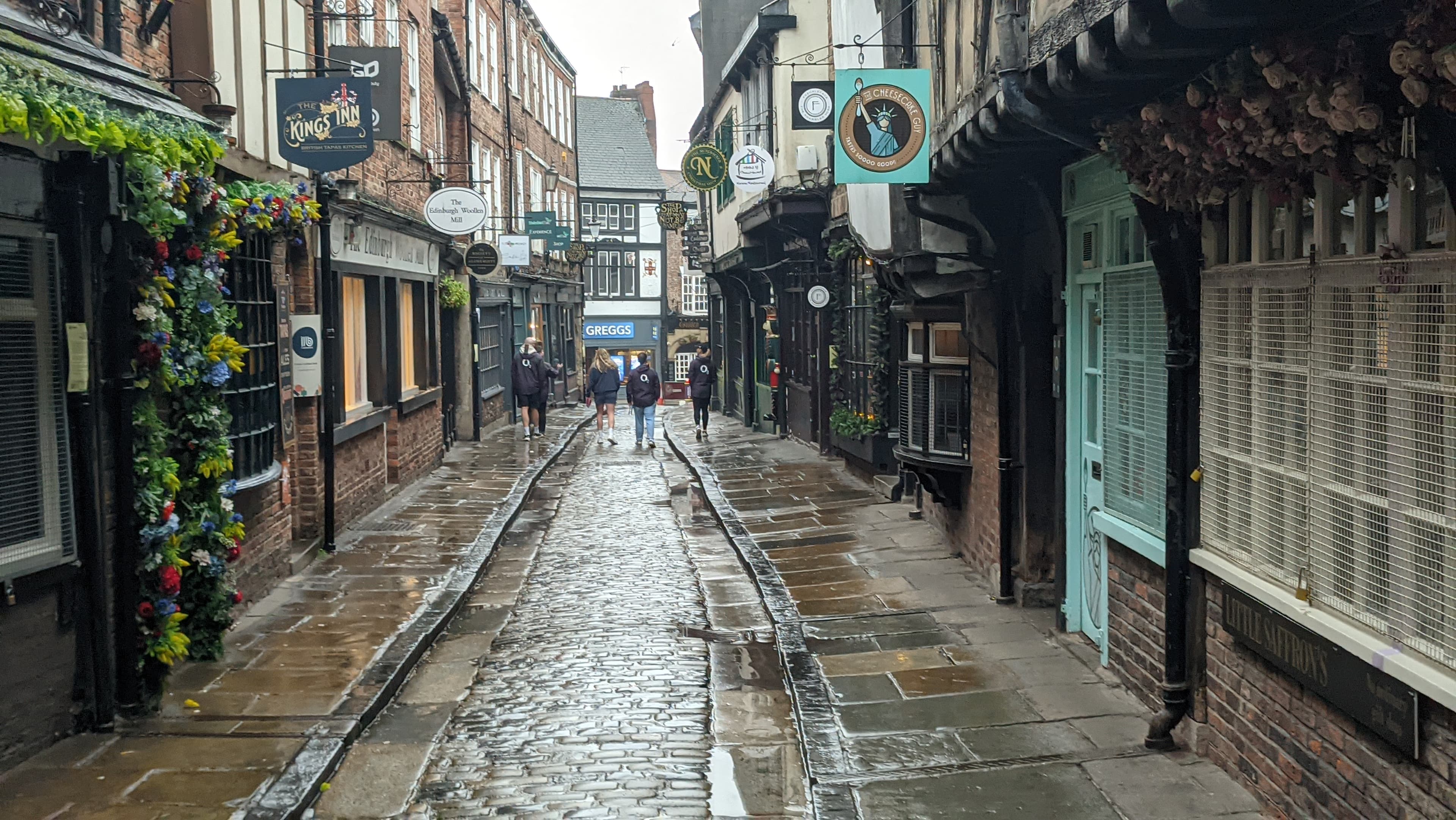
Central York. York’s best-known historic street, now home to a strong independent food and shopping scene, an easy post-race wander.
Read Before you Run
York: The Making of a City, 1068-1350
Sarah Rees Jones
Rees Jones's history of medieval York gives runners real context for the streets the marathon's own course passes through, from Walmgate Bar to the Minster itself, tracing how the city took the shape still visible on race day.
After the Race
The Yorkshire Marathon runs in October. These itineraries stay within York itself or take a short train ride to a nearby city.
A slower, properly paced return to the race's own emotional landmark, plus a walk along the historic city walls.
Two of York's best indoor attractions, a low-effort day suited to legs recovering from the marathon.
A straightforward rail day trip to either Harrogate's spa-town character or Leeds's larger city scene.
Frequently asked questions
Should I stay near the start or the finish?
They are the same place. The Yorkshire Marathon starts and finishes at the University of York, so the real decision is between staying in York city centre for character or near the University for race-morning simplicity.
How far in advance should I book a hotel?
Once entry is confirmed, then re-check race-weekend prices; York's own strong year-round tourism draw means booking earlier than for a purely off-peak weekend is sensible.
Is there free transport to the start?
Yes. A dedicated Park & Ride operates from Elvington Airfield, and a city-centre shuttle runs from York Railway Station Stand J direct to the Event Village from 7:00am, with runner priority before 8:30am; regular bus service 66 also connects the city centre and University.
What is the best area to stay?
York city centre for character, restaurants and sightseeing, using a shuttle or bus to reach the University start, or Heslington for direct race-morning convenience.
When does the expo open?
There is no conventional expo. UK race numbers are posted approximately two weeks before race day; overseas runners collect at the Race Office during event weekend.
What is the weather typically like?
No confirmed race-day-specific average has been sourced for this race. Reports describe cool autumn conditions as often excellent for racing, though the open countryside sections can be notably wind-exposed.
How do I get from the airport?
No specific airport transfer route has been confirmed. York sits on the East Coast Main Line, with direct rail links from London, Edinburgh, Liverpool, Manchester, Birmingham and the South West, making rail the practical general route from most UK airports.
Is there a bag drop?
Yes, a baggage store is available using the tear-off strip on the race number.
Should I bring a throwaway layer?
Sensible, given the course's open countryside sections and real wind exposure. Discarded clothing at the start is collected and donated, never returned, so runners should not expect to retrieve it.
How do I get back to my hotel after finishing?
Runners staying near the University can walk back directly. Those staying in York city centre should use bus service 66 or the city-centre shuttle back to York Railway Station.