The Race
| Next Race Date | 8 November 2026 |
| Course Type | Point-to-point, hilly. Flat to km 8, climbing to km 16, a 51 m drop to km 18, then 13.5 km of climbing to the 247 m high point at km 31 and a descent into Athens. |
| Start | Town of Marathon, Attica |
| Finish | Panathenaic Stadium, Athens |
| Race Start | 08:30, first block (15 blocks start in waves) |
| Registration | Open entry |
| Field Limit | 25,000 marathon · 78,000 across all weekend races |
| Avg Race Day Temp | 10-21°C range; typically 16-20°C at race start |
| Cutoff Time | Official checkpoints: 21.1 km by 13:45, 30 km by 15:25, 40 km by 17:25; final time limit 18:15 |
| Free Race Day Transport | Official buses from 9 Athens metro stops (included with entry) |
| Course Certification | AIMS / World Athletics certified |
History
Athens is the only marathon where the distance itself is the destination. Every other race borrows the format; this one invented it. The 2,500-year-old story is unavoidable - the soldier Pheidippides running from the battlefield at Marathon to Athens in 490 BC to announce a Greek victory over the Persians, then collapsing once he had delivered his news - and the organisers have been sensible enough not to embellish it. The race is called The Authentic, and it means what it says.
The modern race was first run in 1896 as the centrepiece event of the inaugural modern Olympic Games, won by a Greek water-carrier named Spyridon Louis in 2 hours, 58 minutes and 50 seconds. The current men's course record stands at 2:10:34, set by Edwin Kiptoo in 2023. The annual mass-participation race dates to 1972. The race is capped at 25,000 marathon entrants, with a further 53,000 participants across the other distances run over the weekend.
Athens suits runners who are running for reasons beyond the clock. It is not a personal best course. It is a hard course with a finish that justifies every difficult kilometre.
The course
Athens is a point-to-point course running 42.195 km from the town of Marathon to the Panathenaic Stadium in central Athens, following as closely as the modern road network permits the path Pheidippides is said to have run. The first 8 km along Marathonos Avenue are flat or gently downhill. Between km 4 and km 6 the course leaves the avenue and loops round the Marathon Tomb, the burial mound of the 192 Athenians who died in the battle, and the day's low point of 7 m comes on that loop. Nea Makri follows from km 6 to km 10.
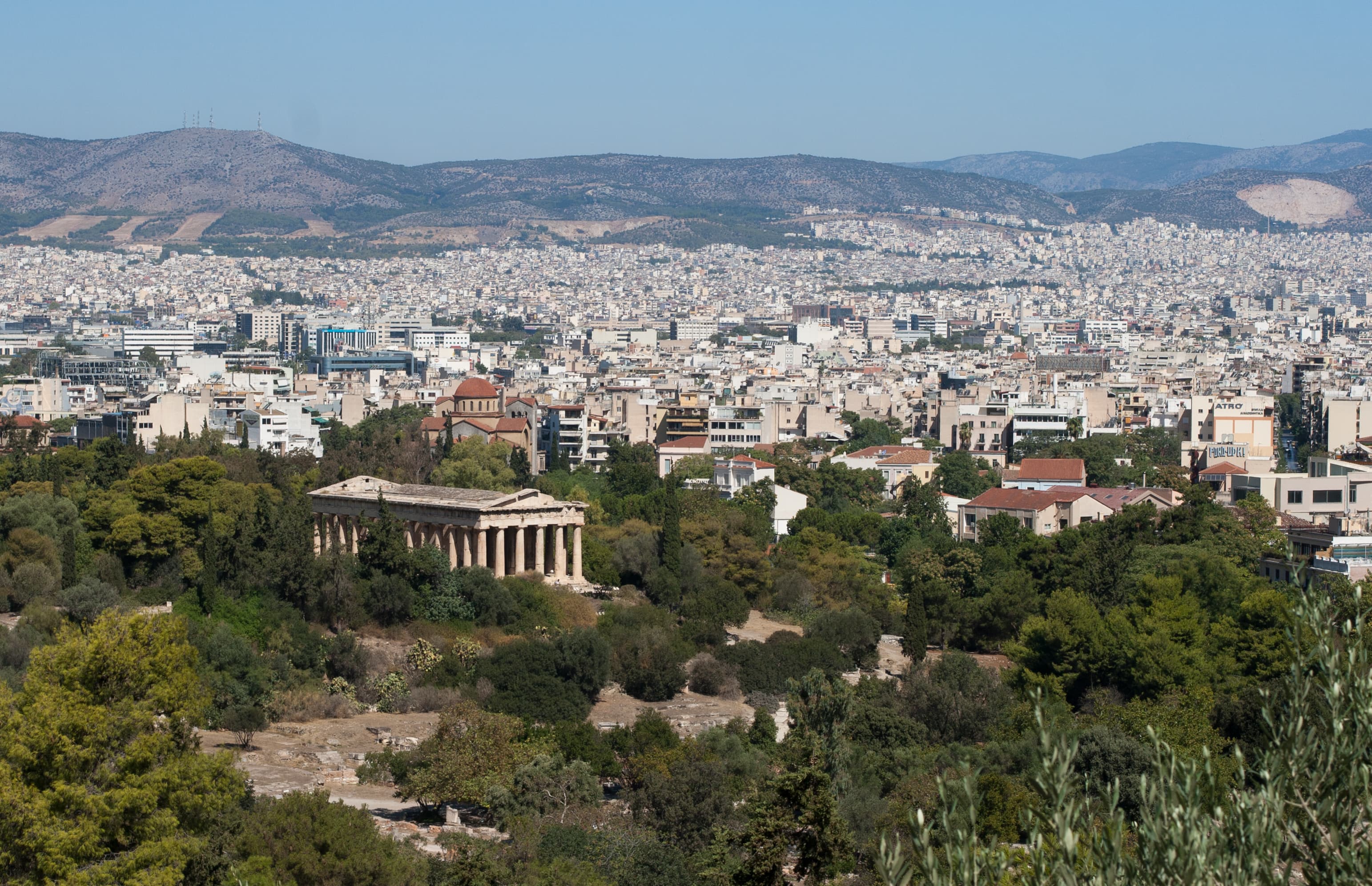
The climbing starts at km 8, and the first part of it is not one continuous hill. The road rises about 54 m to km 13.6 and another 30 m to km 16, then drops 51 m in under 2 km, at about 3 per cent, to just before the Rafina junction at km 17.8. From there it climbs for 13.5 km with no real break: 207 m to the high point of 247 m near the Stavros junction at km 31.3, averaging 1.5 per cent. The steepest kilometres are km 24 to 25 in Pallini and km 30 to 31 on the approach to Stavros, each gaining about 28 m. Two short flat stretches, at km 26.5 to 27.5 and from km 28 to 29.4 where the Attiki Odos motorway crosses, are the only pauses.
From the high point the road runs downhill or flat to the finish, losing about 150 m over the last 11 km. It reaches Agia Paraskevi at km 32 and follows Mesogeion Avenue through Chalandri and Cholargos. From the Ministry of National Defence at km 36.3 the road drops 20 m in a kilometre to the Katechaki junction, where runners pass under the bridge at km 37.5. After Henry Dunant Hospital the route takes Michalakopoulou Avenue and Feidippidou Street, rejoins Vasilissis Sofias Avenue at km 39, and falls another 21 m to the American Embassy and the Athens Concert Hall at km 40, where the last aid station stands. Crowds, sparse through the rural middle of the course, build from about km 35. A 9 m rise past Evangelismos Hospital at km 41 is the last uphill; then Irodou Attikou Street drops 28 m in 700 m, the steepest ground of the day, past the Presidential Palace and the National Garden, and the last 170 m are on tartan inside the Panathenaic Stadium.
Course Map
Marathon to Athens, point to point. The map also shows all nine race-bus boarding points, coloured by wave, and the expo at Faliro where bibs are collected and clothing bags handed in. Four of the stops sit on the course itself, on Mesogeion Avenue between km 34 and km 37.5. Tap a marker for details, and scrub the slider or press play to move the orange marker along the course with the elevation profile beneath it.
Flat or slightly downhill along Marathonos Avenue, with the loop round the Marathon Tomb at km 4 to 6. Adrenaline and flat terrain make it easy to run too fast. Hold back: time banked here is repaid with interest on the hill.
Two rises to km 16, a 51 m drop to the Rafina junction, then 13.5 km of climbing to 247 m. Run 10-15 seconds per km slower than goal pace. Treat the downhill at km 16-18 and the flat at km 28-29 as recovery.
Gravity assists - but quads that have climbed for two hours will cramp if you surge too hard too soon. Give it half a kilometre after the top before accelerating. The crowd from km 35 carries you into the stadium.
What the course actually looks like
The Marathon Tomb comes between km 4 and km 6, where the course turns off Marathonos Avenue onto Marathonomachon Street and runs an almost circular loop round it: a low, grass-covered mound marking where the Athenian dead were buried in 490 BC.
Between km 6 and km 23 the course runs through Nea Makri, Mati and Pikermi, small towns where the race effectively takes over the main street. Children hand out olive branches at the roadside. Whole villages stand outside. In the rural sections between those villages there is essentially nobody: just the painted blue line on the road, the sound of breathing, and the hill continuing ahead.
The city starts around km 35 on Mesogeion Avenue. The noise level jumps, spectators stand three and four deep, and the streets narrow. Runners who kept something in reserve describe this section as one of the best experiences in marathon racing. The descent on Irodou Attikou Street, past the Maximou Mansion, the Presidential Palace and the National Garden in the final kilometre, is the steepest of the day. At the Discobolus statue the route turns for the stadium, and the last few metres of its forecourt lead onto the track.
The hill: what runners need to know
Athens has one characteristic that determines almost everything about how to prepare for and run it. Runners who understand this from the start often have a race that surprises them positively. Runners who underestimate it frequently have the hardest race of their lives.
Between km 8 and km 31 the course climbs about 290 m and gives back about 50 m of it. Two rises take the road to 88 m at km 16, it falls 51 m to the Rafina junction, and then it climbs for 13.5 km with no real break to 247 m near Stavros. No single kilometre is steep: the hardest, km 24 to 25 and km 30 to 31, gain about 28 m each, under 3 per cent. The difficulty is duration. By km 25, legs that managed each individual rise without trouble have been climbing for well over an hour.
Generic marathon training is not enough here. Several runners who had completed multiple marathons before Athens, and arrived in good shape, found the middle section destroyed their plans entirely. The hill rewards runners who have done specific work: long runs with sustained climbing, back-to-back long run days to simulate fatigue on the ascent, trail running on rolling terrain. Useful benchmark: 18 km at marathon effort over gently rolling ground, followed immediately by 13 km at the same effort uphill. That is the shape of Athens from the Rafina junction to Stavros.
The most common race-ending mistake happens on the descent, not the climb. Runners who crest the hill on target feel the downhill like a release valve and instinctively accelerate. Quads that have been climbing for over two hours respond by cramping. The pattern is specific and repeated: cresting km 31 on schedule, surging downhill, grinding to a halt at km 33 or 34 with severe leg cramps. Give the descent half a kilometre before picking up pace.
A frank note on the cutoff: one reviewer is direct about what the race feels like for runners approaching the 8-hour limit - aid station energy thins, road support becomes intermittent, and the experience changes character significantly after the six-hour mark. Runners targeting a finish beyond 6 hours should consider whether building up to Athens with a flatter race first would serve them better.
What to wear
November in Athens sits in a meteorological gap that catches runners out in both directions. Race day temperatures over the past five years have ranged from 10°C to 21°C, with most recent editions landing between 16°C and 20°C at race time. Dress for 15°C and sun.
The sun becomes a real factor after two hours of running, particularly on the exposed uphill middle section where shade is minimal. Many runners pour water over themselves at every aid station from km 25 onwards - not because the temperature is extreme, but because sun exposure compounds fatigue in ways that are easy to underestimate at the start. A cap is genuinely useful for the middle miles in a way it rarely is at autumn marathons in northern Europe. If carbon-plate super shoes are part of your kit plan, what the research says about shoes on hilly terrain is worth reading before finalising.
All runners receive a disposable thermal waterproof jacket with hood in their expo pack - wear this for the wait at the start village. Mornings in Marathon before sunrise can be cool, and the jacket is designed to be discarded at the gun.
Entry
| Registration Type | Open entry - no ballot |
| Entry Fee | €75 EU residents (advanced registration) · €165 all runners (full registration) |
| 2026 Registration | Opened 24 April 2026, 12:00 Greek time. Advanced tier sold out in approximately 6 hours; full registration sold out the same day. |
The Athens Marathon runs two registration tiers. Advanced registration is available to EU residents only, at €75. Full registration is open to all runners at €165.
For the 2026 race, registration opened on 24 April at 12:00 Greek time. The booking system suffered a server failure within minutes of opening. Despite that, the advanced registration tier sold out in approximately six hours; full registration sold out the same day. No ballot, no lottery - first-come, first-served, and it moves fast.
Full registration includes: a backpack, an OASA Public Transportation Card, a microfibre sports towel, an official AMA commemorative cap and keychain, and priority access to full registration for the 2027 marathon. These are in addition to the Adidas technical T-shirt, a disposable thermal waterproof jacket, and free entry to the Benaki Museum and Acropolis Museum that all marathon entrants receive.
The OASA card is a four-day travel pass valid on all OASA-operated public transport in Athens - buses, trolleybuses, trams, the electric railway, and the metro to Koropi station. It activates from first use and is valid exclusively Monday 2 November to Monday 9 November 2026. It is not valid for airport connections: not the X80 express bus, and not the metro between Koropi and the airport. Plan your airport transfer separately.
Minimum age is 20 in the race year, counted by year of birth rather than race date. There is no Good for Age or time-qualifying entry pathway for the general public - starting blocks are seeded by submitted recent performance, which affects where you start, not whether you get in. Groups of 30 or more qualify for a small per-runner discount.
If general registration closes before you act, charity places and tour-operator packages are the realistic alternative routes to a bib. Sports Tours International and Apostolos Greek Tours both specialise in this race.
Race Weekend
Expo and Number Collection
The Allwyn Marathon EXPO is held at the Faliro Indoor Hall and Exhibition Centre - the former Taekwondo venue on the Olympic coastal zone south of central Athens. Open Wednesday 12:00-21:00, Thursday-Friday 10:00-21:00, Saturday 10:00-20:00. Collection is not available on race morning.
Allow 45 minutes minimum, including travel. The centre is not walkable from central Athens in any practical sense: major roads and active construction separate it from the pedestrian network. Take the tram or metro. Runners who attempt the walk regularly report ending up on the wrong side of a motorway.
Collect on Wednesday or Thursday to avoid the longest queues. Bib collection requires a confirmation email and photographic ID. Wave reassignment is possible at the expo if needed. Your pack includes your bib, timing chip, technical T-shirt, and clothing bag with bib sticker. All runners also receive a disposable thermal waterproof jacket with hood. The official merchandise stall runs low on small and medium sizes early in the weekend.
Getting to the Start: Race Buses
The start is in the town of Marathon, 42 km from Athens. Official free buses transport all registered runners from nine Athens boarding points split across two waves, direct to the start with no intermediate stops. The journey takes 45-60 minutes. Buses leave as they fill; do not wait for the last departure. Wave 1 runners should aim to be at their stop by 05:45 to avoid the longest queues. The organisers ask runners to spread across all the boarding points. Every stop is marked on the Course Map in The Race section.
The race operates in two waves. Your wave determines which bus schedule applies. Check your bib number: blocks 1-10 are Wave 1, blocks 11-15 are Wave 2.
| Boarding Stop | Metro | Wave 1 (Blocks 1-10) | Wave 2 (Blocks 11-15) |
|---|---|---|---|
Syntagma Two boarding streets: Vasilissis Amalias Ave on the Parliament side, and Vasileos Georgiou A’ Ave in front of the Grande Bretagne | Lines 2 & 3 | 05:00-06:45 | — |
Panepistimio Panepistimiou Ave, University side | Line 2 | 05:00-06:45 | — |
Omonia Panepistimiou Ave and 3is Septemvriou St, Omonia Square | Lines 1 & 2 | 05:00-06:45 | — |
Evangelismos Vasilissis Sofias Ave, outbound (ascending) side | Line 3 | 05:00-06:45 | — |
Syngrou-Fix ⚠️ Syngrou Ave, outbound (ascending) side, exit Syngrou | Line 2 | 05:00-06:15 (last bus 06:15) | — |
Katechaki Mesogeion Ave, carriageway towards Agia Paraskevi | Line 3 | 05:00-06:45 | 06:30-07:45 |
Ethniki Amyna Mesogeion Ave, carriageway towards Agia Paraskevi | Line 3 | — | 06:30-07:45 |
Cholargos Mesogeion Ave, carriageway towards Agia Paraskevi | Line 3 | — | 06:30-07:45 |
Nomismatokopio Mesogeion Ave, carriageway towards Agia Paraskevi | Line 3 | — | 06:30-07:45 |
Syngrou-Fix final departure is 06:15, half an hour before the other Wave 1 stops close. Katechaki is the only stop serving both waves. All four Wave 2 stops are on Mesogeion Avenue (Metro Line 3), in order heading out of the city: Katechaki, Ethniki Amyna, Cholargos, Nomismatokopio. Buses board on the carriageway towards Agia Paraskevi.
The organisers advise against driving to the start. If you do, be at the start area in Marathon by 07:30, allow for a walk of about 800 m from the drop-off parking, and note that Marathonos Avenue closes to traffic in both directions from 08:00.
Clothing Bag and Bag Drop
There is no bag drop at the Marathon start. For the marathon, the clothing bag must be dropped at the Allwyn Marathon EXPO at the Faliro Indoor Hall before race day. Drop hours: Wednesday 12:00 to 21:00, Thursday and Friday 10:00 to 21:00, Saturday 10:00 to 20:00. The race instructions give later drop-off times (22:00, and 21:00 on Saturday), but those run past the expo’s published closing hours, so plan on the earlier ones. The clothing bag is collected with your bib at the expo - attach the bib sticker visibly on the bag before handing it in. The bag drop is organised by bib number range. Only the official clothing bag is accepted; no backpacks or personal bags.
Do not put travel documents, money, valuables, or medicines in the clothing bag. SEGAS and the organising committee bear no responsibility for loss of valuables. After the finish, bags are collected from the Alea of Zappeion by showing your bib number. Uncollected bags are stored for 15 days at the SEGAS Marathon Office and then discarded.
All runners receive a disposable thermal waterproof jacket with hood - collected at the expo with your bib. Wear this for the wait at the start in Marathon. Early November mornings can be cool and breezy before the sun comes up.
The Course
The course runs point-to-point from Marathon to Athens. The first 8 km are flat, with the loop round the Marathon Tomb at km 4 to 6. The road then climbs to km 16, drops 51 m to the Rafina junction, and climbs again for 13.5 km to its 247 m high point near the Stavros junction at km 31; the gradient is rarely steep, but its length depletes runners who went out too fast. From there the route descends along Mesogeion and Vasilissis Sofias Avenues and down Irodou Attikou Street to the stadium. Elevation gain is approximately 333 metres. This is not a PB course, and racing it as one is a mistake the hills correct fairly decisively.
Aid Stations and Course Support
Carry all the nutrition you intend to use. Aid station fuelling at Athens is adequate for hydration; runners who rely on race-course gels frequently report it as insufficient. Personal drinks are reserved for elite and national-championship athletes - everyone else uses the official stations. This is not a London or Berlin aid station setup. On pre-race fuelling strategy, the carb-loading piece is relevant here.
MarathonPassport
Build a pacing plan for the Marathon-to-Athens climb
This is a point-to-point course, so mid-course spectating is thin. Enter a start time and goal finish to see the stadium arrival window, grade-adjusted for the climbing between km 8 and km 31.
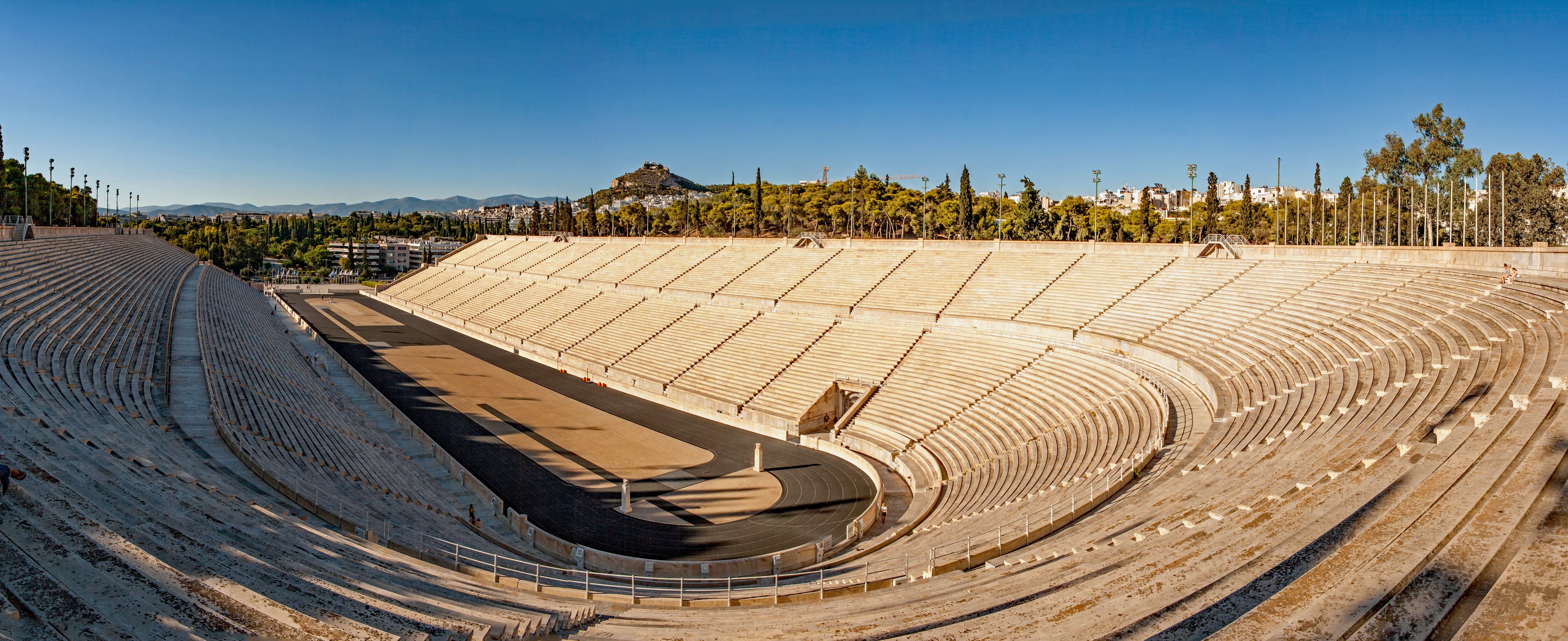
The Finish at the Panathenaic Stadium
The finish is inside the Panathenaic Stadium - the marble horseshoe completed in 1896 for the first modern Olympic Games, on the site of the ancient stadium. The last 170 m are on the tartan inside, to the cheers of spectators filling the stone tiers. After crossing the line, keep walking: you receive your finisher medal, then leave by the ramp to the stadium forecourt for water, isotonic drinks, juice and bananas, and follow signs to the Alea of Zappeion, where bags are returned by bib number.
From the stadium, Pangrati, Mets and Syntagma are all a short walk away on tired legs. Mavro Provato in Pangrati, about 500m from the stadium, does proper sit-down Greek food if you can manage a table and a chair. For something faster, the souvlaki stalls around Syntagma and Monastiraki, including Bairaktaris, serve gyro and kebab pita within minutes: salty and carb-heavy in exactly the way a marathon finish demands. Pace yourself on what you order - souvlaki first, moussaka later once your stomach settles, and loukoumades with honey when you are ready to celebrate properly.
For spectators
Athens is a difficult spectator race. The course follows a closed point-to-point road for 42 km, much of it through rural Attica where there is no public transport and access without a car is effectively impossible; official race rules also keep spectators out of the road corridor itself. Supporters who set out to track a runner through the middle of the course will have a frustrating and largely unsuccessful morning. Rural support along the route is real but patchy: strong through village centres like Nea Makri and Pikermi, thin on the open stretches between them.
The practical approach is to do the opposite: stay in Athens, have a long breakfast, and let the city work for you. By the time your runner reaches the city streets at km 35, you should already be in position. Vassilissis Sofias Avenue between km 39 and km 40 is the recommended spot - runners are still moving at pace, crowd noise is high, and you can see them clearly as the route passes the American Embassy and the Athens Concert Hall. From that point, the Panathenaic Stadium is a 10-minute walk. Move promptly after your runner passes and you will reach the stadium before the finishers start arriving.
The finish inside the Panathenaic Stadium is worth every effort to see. The noise when runners enter the marble horseshoe, bouncing off tiers of stone seating on three sides, has no equivalent in marathon running.
Access to the track is restricted to finishing runners and credentialled Organising Committee staff. Friends, family, and coaches must use the designated spectators' area in the stands and must not attempt to enter the track - this causes congestion for runners exiting the stadium and for the staff directing them. No vehicles of any kind (bicycles, skateboards, or similar) are permitted inside the stadium. Make sure your supporters know these rules before race day.
Where to Stay
Stay near the finish. This is true of every marathon, but Athens makes this point more forcefully than most: the start is 42 km away, official buses run reliably in the morning when you have two working legs, and after the race you will not want to walk 400 metres, let alone navigate a connecting metro.
Pangrati, immediately east of the Panathenaic Stadium, is the primary recommendation. Hotels here are within 10 minutes' walk of the finish line, the streets are quiet enough for sleep before the race, and the tavernas on Plastira Square make a straightforward pre-race pasta dinner. This is the neighbourhood for runners who want to keep things simple.
Kolonaki, slightly north of the stadium, is a workable second choice: a little more expensive, a little more convenient for sightseeing if you have a day before the race. 15 minutes' walk from the finish.
Monastiraki and Plaka are the central tourist areas and see significant late-night activity on weekends. They are reasonable for a sightseeing trip; for the night before a marathon they require earplugs and advance planning.
Syntagma is where the Wave 1 race morning buses depart, which simplifies logistics considerably, but add 20 minutes of walking to the finish and adjust your post-race plans accordingly. Book four to six months in advance; November is low season in Athens but marathon weekend fills central hotels and prices rise sharply in October.
Athens's grand hotel, on Syntagma Square since 1874. Rooftop pool and restaurant with Acropolis views.
Roof terrace with Acropolis views directly above the Plaka neighbourhood. Central and well-positioned.
Rooftop infinity pool overlooking the Acropolis. Design hotel in the historic Monastiraki area.
Quiet hotel on the south slope of the Acropolis hill, very close to the Panathenaic Stadium. Good value.
Simple, clean hotel in the heart of the Plaka. Roof terrace with Acropolis view. Reliable mid-range option.
See & Do
The finish at the Panathenaic Stadium puts you in the Mets neighbourhood, 10 minutes from Syntagma and 15 minutes from the Acropolis. The main sites are compact; most are within flat walking distance of the hotels listed above, though the Acropolis involves a hill climb better managed on day two.
The Acropolis and Parthenon
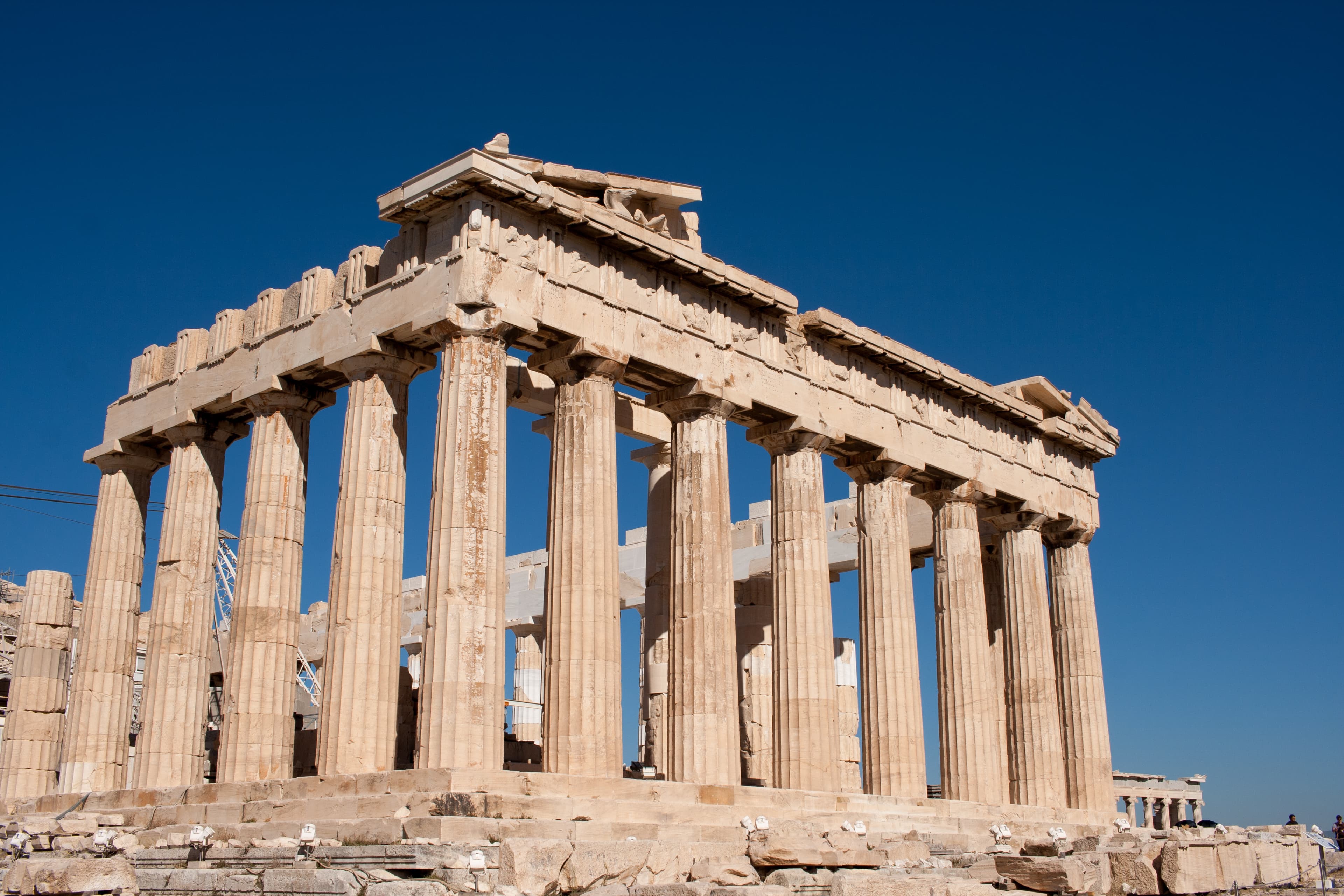
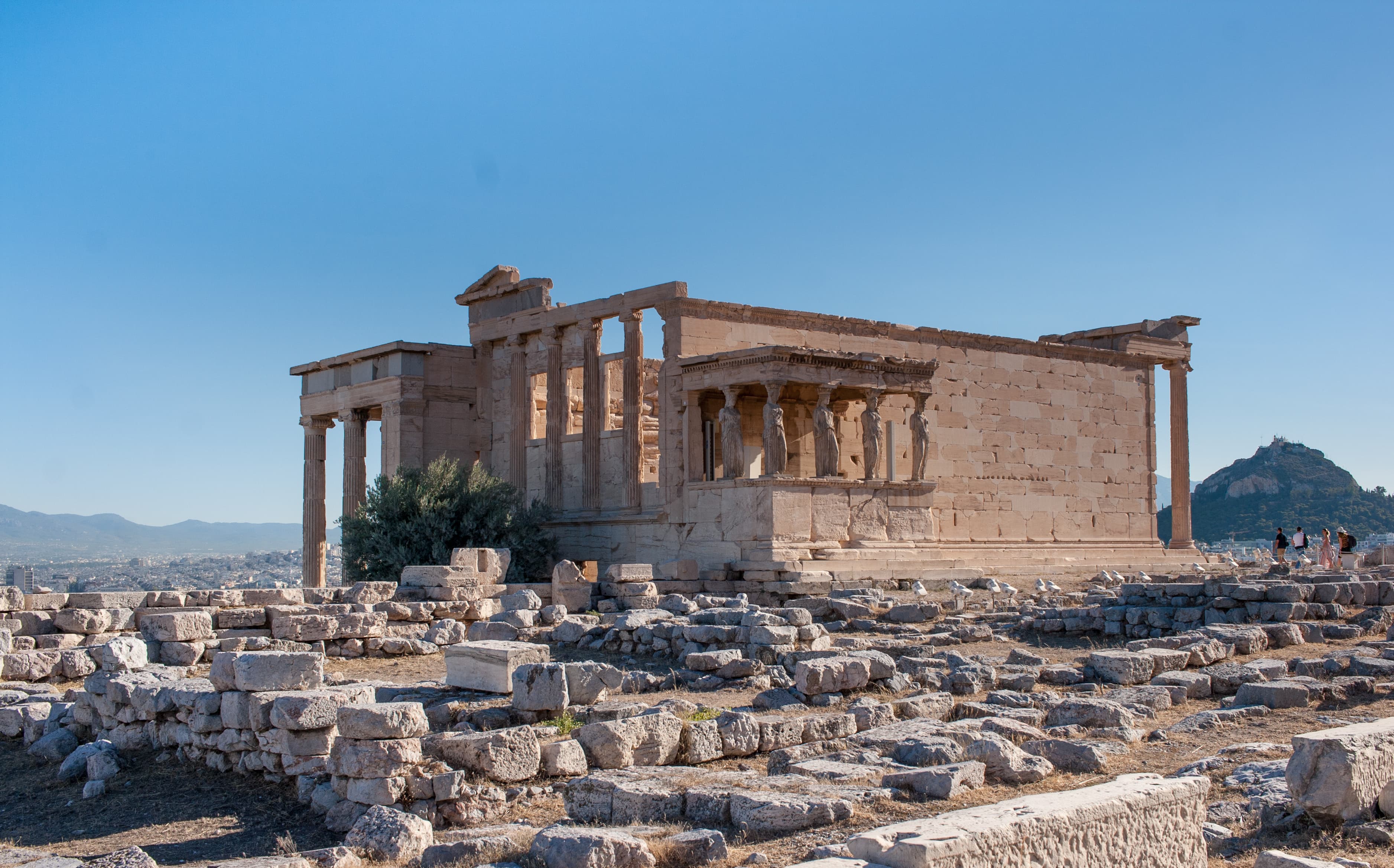
1.5km (0.9 miles) from the finish, up a moderate hill. The Parthenon (447-432 BC) is the centrepiece; the Erechtheion - with the caryatid porch whose originals are now inside the museum - and the Propylaea are on the same site. Do not attempt this on the day after the race. On day two, with recovered legs, it earns its reputation. The Acropolis Museum at the base displays the original sculptures in proper light and is included in your race entry - collect the free pass with your bib at the expo.
The Plaka
The oldest continuously inhabited neighbourhood in Athens: narrow flat lanes below the Acropolis, neoclassical houses, tavernas. Tourist-oriented but genuinely old. Adrianou Street and Mnisikleous Street are the main pedestrian routes; the Byzantine church on Mnisikleous dates from the 12th century.
Benaki Museum
1.3km (0.8 miles) from the finish on Vasilissis Sofias Avenue - the marathon course runs past the entrance at km 39-40. The main building covers 5,000 years of Greek culture across several floors: prehistoric finds, Byzantine icons, Ottoman-era objects, and an extensive collection of Greek jewellery, textiles, and decorative arts. Entry is included in your race entry - collect the free pass with your bib at the expo. Closed Tuesdays.
National Archaeological Museum
2.0km (1.2 miles) from the finish on Patission Street. The largest collection of ancient Greek artefacts in the world: the Mask of Agamemnon, the Antikythera Mechanism, the Artemision Bronze, the Thira frescoes. Flat throughout. Allow three hours. Book online.
Cape Sounion
70km south of Athens by KTEL bus from Areos Park (approximately 90 minutes). The Temple of Poseidon on a cliff directly above the Saronic Gulf - Byron scratched his name into a column here in 1810; it is still visible. The coastal road and cliff-top site are flat enough for the day after a marathon.
After the Race
The Athens Authentic Marathon runs in the first week of November. The sites are open, the summer crowds are gone, and hotel prices at Delphi, Meteora, and the Saronic islands run 30-40% below July rates. The low winter sun illuminates the Oracle sanctuary at Delphi and the rock faces at Meteora with a quality that mid-summer overhead light does not produce. The excursions below are specifically calibrated for post-marathon legs: flat harbours, ferry crossings, and thermal water before the harder walking of the archaeological sites on days four and five, when legs are substantially recovered.
The Athenians' island. Metro Line 1 to Piraeus, fast ferry to a working harbour town with 24 of the Temple of Aphaia's 34 original columns still standing and views across to the Acropolis on a clear day. Flat harbour promenade. The pistachio gelato at Gelato Follia on the harbour is specifically worth mentioning. The easiest possible day trip on post-marathon legs.
Hellenic Train from Larissa Station to Korinthos, then a short taxi to the archaeological site. Seven Doric columns of the Temple of Apollo from 560 BC survive above the Roman Agora. The Bema of Saint Paul - where the New Testament places the Apostle before the Roman proconsul Gallio in 51 AD - sits unremarked at ground level. Almost no other visitors in November. The site is largely flat.
The Sacred Way climbs through treasury buildings to the Temple of Apollo and the ancient theatre with views down to the Gulf of Corinth. The museum at road level has the Charioteer of Delphi, one of the best-preserved large bronzes from antiquity. In November the site is almost empty. Take the 08:30 bus from Liosion Terminal; back in Athens by 21:00.
Hydra has had a 300-year ban on motor vehicles. The entire island runs on foot, donkey, or water taxi. The harbour front is smooth marble - flat, quiet, and oddly restorative. Coastal path to Kamini in 15 minutes. The harbour in the evening after the day-trippers have gone is the version worth seeing. Hotel Hydra on the quayside or the Bratsera in a converted sponge factory in the upper town.
Tram T5/T6 from Syntagma along the Saronic Gulf coast to Glyfada's flat seafront esplanade. Day two: a local bus south to Vouliagmeni and Lake Vouliagmeni - a brackish geothermal lake at 22-29°C year-round, used for therapeutic bathing since antiquity. The X96 airport bus departs from Vouliagmeni directly to ATH in 35 minutes. The correct post-marathon prescription.
Monday: flat recovery in Athens - the National Archaeological Museum is enormous, well-organised, and entirely flat. Tuesday: Aegina by ferry. Wednesday: KTEL Fokidas 08:30 bus to Delphi, afternoon at the Oracle site. Thursday: private transfer to Kalambaka; dinner under the Meteora rocks. Friday morning: Megalo Meteoron and Varlaam monasteries, back to Athens by afternoon. The two greatest archaeological sites in mainland Greece, routed for recovering legs.
Read Before you Run
The Road to Sparta: Running in the Footsteps of the Original Ultramarathon Man
Dean Karnazes
Karnazes retraces the legendary 246km route from Athens to Sparta that gave birth to the ultramarathon. Part history, part physical ordeal, it puts the Athens Marathon course in a context most runners never consider: the city at the start line is where the whole story began.
Buy on Amazon ↗Lonely Planet Pocket Athens
Lonely Planet
Compact and practical, this covers the essentials for a short trip - the Acropolis, Monastiraki, Plaka, and the areas within reach of the finish line at the Panathenaic Stadium. Useful for the non-running days either side of race weekend.
Buy on Amazon ↗The First Marathon
Stephen Figg
Figg examines the documented evidence behind the Pheidippides legend and the Battle of Marathon the modern race commemorates, separating the historical record from the story most runners already know. Read it before race week and the Tomb of Marathon loop at km 4 to 6 stops being just a name on the course map.
Frequently asked questions
Should I stay near the start or the finish for the Athens Marathon?
Stay near the finish in central Athens. The start is in the town of Marathon; buses transport runners to the start on race morning. Syntagma Square or Plaka are the most convenient neighbourhoods.
How far in advance should I book a hotel for the Athens Marathon?
Book four to six months in advance. November is quiet season in Athens but the marathon weekend fills central hotels. Prices rise significantly in October.
Is there free transport to the Athens Marathon start?
Yes. Official buses run from nine Athens metro stops to Marathon, included with entry. Wave 1 (blocks 1-10): Syntagma, Panepistimio, Omonia, Evangelismos, Syngrou-Fix, Katechaki - buses 05:00-06:45 (Syngrou-Fix last bus 06:15). Wave 2 (blocks 11-15), all on Mesogeion Avenue: Katechaki, Ethniki Amyna, Cholargos, Nomismatokopio - buses 06:30-07:45.
What is the best neighbourhood to stay in for the Athens Marathon?
Syntagma Square and the Plaka. Both within 1 kilometre of the Panathenaic Stadium finish. Kolonaki is attractive and 15 minutes walk from the stadium.
When does the Athens Marathon expo open?
The Allwyn Marathon EXPO is at the Faliro Indoor Hall and Exhibition Centre. Open Wednesday 12:00-21:00, Thursday and Friday 10:00-21:00, Saturday 10:00-20:00. Collect your bib on Wednesday or Thursday. Your clothing bag for bag drop is also collected here - must be dropped at the expo by Saturday 20:00. No bag drop at the start on race day. All entrants also collect their Adidas T-shirt, disposable jacket, and free entry passes for the Benaki Museum and Acropolis Museum at the expo.
What is the weather like at the Athens Marathon?
Early November: 14 to 20°C at race start, low humidity. The course climbs significantly; the combination of hills and warm conditions makes this a difficult PB course.
How do I get from the airport to Athens?
Metro Line 3 (Blue line) from ATH to Syntagma: approximately 40 minutes, €9 single. Taxis: 30-45 minutes, approximately €35-45.
Is there a bag drop at the Athens Marathon?
For the marathon, bag drop is at the Allwyn Marathon EXPO only - not at the start on race day. Drop the official clothing bag during expo hours (Wednesday to Saturday, last drop Saturday 20:00). After the finish, collect from the Alea of Zappeion by showing your bib number. Uncollected bags are stored 15 days at the SEGAS Marathon Office.
What do I wear to the Athens Marathon start?
All marathon entrants receive an Adidas technical T-shirt, a disposable thermal waterproof jacket with hood, and free entry passes for the Benaki Museum and Acropolis Museum - all collected with your bib at the expo. Wear the jacket for the wait at the start in Marathon; early November mornings can be cool and breezy. The first block starts at 08:30; allow 45-60 minutes for the bus.
How do I get back after the Athens Marathon?
The Panathenaic Stadium finish is 1 kilometre from Syntagma Metro station. Metro Line 3 from Syntagma to Athens Airport takes approximately 40 minutes.