The Race
| Next Race Date | 4 April 2027 |
|---|---|
| Course Type | Loop: start and finish at PW1, Castray Esplanade |
| Registration | Open entry, prices rising through five releases |
| Ballot Opens | Not applicable. There is no ballot |
| Total Finishers | Not published |
| Average Race Day Temperature | 9 to 18°C, the April mean low and high |
| Cutoff Time | 6 hours, to noon |
| Free Race Day Transport | No |
| Course Certification | AIMS |
History
The Hobart Marathon Festival is an Atlas Events race built around the River Derwent waterfront, with the PW1 building on Castray Esplanade as its start, finish and race village. The organiser’s results archive begins in 2022 and runs without a break to 2026, which makes 2022 the earliest confirmed edition. For its first years it carried the Hobart Airport Marathon Festival name.
It is a different event from the Cadbury Marathon, the older race in the Hobart area that still fills search results for “Hobart marathon”. The two have different organisers, dates and courses.
The route has changed more than once. A 2023 competitor guide set out a three-lap course; later editions settled on one climb through the Queens Domain and the Royal Tasmanian Botanical Gardens followed by three legs south through Battery Point to Sandy Bay. The organiser has never sold it as flat: its own description is “the kind of course that tests your legs and rewards your patience”.
The race now sits in early April, the start of the Tasmanian autumn; the 2026 edition ran on 12 April. The weekend also carries a half marathon, a 10 km, 5 km run and walk events and a 2 km children’s race, with more than 4,000 runners across the distances. The course records on the official results page are Dillon Goss’s 2:27:25 from 2026 and Milly Clark’s 2:40:40 from 2025. The race is AIMS certified and holds no World Athletics label.
The Atlas Majors medal
Hobart is one of four marathons run by Atlas Events, with Brisbane, Cairns and the Sunshine Coast. Finish the marathon at all four and Atlas sends a separate Atlas Majors medal. There is no time limit and no required order: after the fourth finish, runners submit a link to each official result through the application form on the Atlas Events website, and Atlas verifies them and posts the medal. Only the 42.2 km counts.
Hobart is the odd one out. It is the only one of the four outside Queensland and the only one run in autumn cool, where the other three are winter races in subtropical or tropical warmth. In 2027 it comes first, nine weeks before Brisbane.
Long Read
The Running Circuits: Your Guide to Marathon and Half Marathon Series
The Atlas Majors alongside the World Marathon Majors, the European Marathon Classics and three other series: how each works, and the 2027 spacing for anyone running all four Atlas races in one year.
The course
The race starts at 06:00 at PW1 on Castray Esplanade and finishes in the same waterfront precinct. The first ten kilometres are a loop north into the Queens Domain and back; the remaining 32 km are three out-and-back legs from the waterfront through Battery Point and along Sandy Bay Road to a turn near Wrest Point. Runners are back on Franklin Wharf at km 10.4, km 21, km 31.5 and km 41.5.
The SRTM profile below runs from 4 m on the wharf to 98 m on Upper Domain Road. The big climb comes first: 89 m over 3.8 km from the docks to the top of the Domain at km 4, an average of 2.4 per cent, steepening to 4 per cent between km 3 and km 4. After that the course never goes above 36 m, but it never stays flat for long either. Each Sandy Bay leg crosses the Battery Point ridge twice, climbing about 30 m at 1.5 to 1.7 per cent on the way out and again on the way back. That is six climbs of roughly the same size between km 10 and km 40, the last topping out at km 39.8 with 2.4 km to run.
The surface is road throughout. The Sandy Bay legs face the Derwent and are exposed to its wind, and the three turnarounds break rhythm each time. The organiser has not published an official elevation total.
Km 0 to 4: up into the Domain. The gun goes in half light, with marathon and half marathon runners starting together. The first kilometre runs north along the docks past Franklin Wharf, flat and crowded, and then the road rises. From km 1 the course climbs almost without a break into the Queens Domain, gaining 20 m, then 29 m, then 41 m in successive kilometres. The first drinks are at 3.6 km on Upper Domain Road. Run this on effort and accept a slow split: pace forced here is paid back later.
Km 4 to 10.4: down past the Gardens. From the high point at km 4 the course loops round the top of the Domain and drops 63 m over the next three kilometres to Lower Domain Road, with drinks at 6.9 km and 7.75 km beside the Royal Tasmanian Botanical Gardens. A further 32 m of gentle descent brings the race back to sea level and Franklin Wharf at 10.4 km. Let the descent return time without chasing it.
Km 10.4 to 21: the first Sandy Bay leg. The pattern for the rest of the day starts here. The course climbs 32 m through Battery Point to Hampden Road at km 12, drops to Sandy Bay Road and runs south along the river, nearly level, to the turnaround at km 15.75 near Short Beach and Wrest Point. The return climbs 29 m back over the ridge by St Georges Terrace at km 19 and falls to the waterfront. Aid is at the Marieville Esplanade junction (13.65 km and 17.65 km, the second with the first special-needs table) and at 518 Sandy Bay Road (16 km). Franklin Wharf at 20.85 km and 20.95 km marks halfway and the biggest crowd since the start.
Km 21 to 31.5: the second leg. The same road, the same two climbs of about 30 m and the same turn at km 26.2. Knowing the ground helps: the flat 5 km along Sandy Bay Road between the climbs is where to settle into rhythm, and the descent back to the wharf is where to resist a surge. Drinks at 24.15 km, 26.55 km and 28.1 km (special needs again), then Franklin Wharf at 31.4 km and 31.5 km.
Km 31.5 to 41.5: the third leg. Hobart’s difficulty is the repetition. The fifth Battery Point climb arrives at km 31.4 and the sixth at km 37.9, and Sandy Bay Road is quieter on this last pass, with the half marathon long finished. The turn is at km 36.5. Aid is at 34.7 km, 37.1 km and 38.65 km, the last special-needs point. Hold effort on the climbs and let the pace drop.
Km 41.5 to 42.2: the docks. Final drinks stand at 41.5 km and 41.6 km on Franklin Wharf, and the finish is a flat run along the docks to Castray Esplanade, where the crowd is thickest.
Chip timing starts and finishes on mats at PW1. No painted shortest-route line or list of intermediate timing mats has been published.
Course Map
The map shows the 2026 route, which the 2027 aid-station table follows kilometre for kilometre, with the start and finish at PW1, the Domain high point, the Sandy Bay turnaround, Franklin Wharf and the airport bus stop. Tap a marker for details, and scrub the slider or press play to move the orange marker along the course with the elevation profile beneath it.
Pacers
The organiser’s 2027 marathon page lists pacers for 3:00, 3:15, 3:30, 3:45, 4:00, 4:15, 4:30, 4:45 and 5:00, plus a sweeper at the back. Marathon and half marathon go off together in a single start at 06:00, with start zones organised by goal time. In past editions pacers have worn yellow singlets and carried balloons marked with their finish time. The organiser also takes applications from runners who want to pace; The People Carrying the Balloon explains what the job involves on the day.
What to wear
The start sits close to Hobart’s April mean minimum of about 9°C, and a 06:00 gun means standing on the waterfront before sunrise. Bag drop opens at 05:00 and the organiser asks runners to arrive 30 to 60 minutes early, so that is up to an hour outside beside the Derwent.
Wind is the variable to plan for. Hobart’s weather turns quickly, and the Sandy Bay legs, run three times, face the river. A cool, breezy morning can make the second half feel colder than the temperature says, especially for slower runners whose pace drops late. Most people race in a singlet or T-shirt and shorts, with arm sleeves or light gloves on a cold day, and wear an old top to the start. No clothing donation scheme has been published, and littering outside aid-station zones can lead to disqualification, so check the athlete guide before discarding anything.
The mean April maximum is about 18°C, so the morning warms up. Anyone out beyond four hours should wear sunscreen: late-morning sun on the open Sandy Bay road can be strong even in autumn.
One more thing for travellers: race morning falls on the first Sunday in April, the day Tasmania’s daylight saving ends. Clocks go back an hour at 03:00. Phones update themselves; a watch or travel alarm set by hand will not.
Entry
Entry is open: there is no ballot and no qualifying time. Places are sold in five price releases, each dearer than the last, and online entry stays open until the Friday before the race if the distance has not filled. The minimum age is 17 on race day.
| 2027 release | On sale | Price | Approx. GBP |
|---|---|---|---|
| Early Access | 5 to 8 July 2026 (closed) | A$194 | £103 |
| 1st Release | 9 July to 15 September 2026 (sold out) | A$199 | £106 |
| 2nd Release | 16 September to 30 November 2026 | A$220 | £117 |
| 3rd Release | 1 December 2026 to 1 February 2027 | A$240 | £127 |
| Final Release | 2 February to 30 March 2027 | A$260 | £138 |
Sterling figures use A$1 = £0.53 and are a guide only. Entry includes a chip-timed bib, a 2027 race shirt, a finisher’s medal and access to the competitor finish area.
Transfers are clearly set out. A runner can pass an entry to someone else in the same distance for A$20, online until 17:00 on the Friday nine days before the race, then in person at registration on the Saturday, where the original confirmation email is required and screenshots are not accepted. Distance changes follow the same deadline: moving up costs the difference, moving down earns no refund. Refunds run on a sliding scale, 50 per cent until late January and 25 per cent until late February, then nothing. Cancelled entries cannot be deferred or moved to another Atlas event.
The official charity is Variety Tasmania, supported through fundraising pages set up on the event platform; there is no separate charity entry allocation.
Fast Runner / GFA Standards
There is no good-for-age route. Atlas runs an elite support programme instead, open to Australian athletes with a qualifying result from the previous 18 months, linked to official results. International elite athletes are considered case by case. Elite waivers and pacing are two of the routes to a free place set out in How to Race Without Paying the Entry Fee.
| Tier | Men | Women | Support |
|---|---|---|---|
| Elite | Under 2:20 | Under 2:45 | Free entry, up to A$500 travel if more than 150 km from Hobart, elite lounge |
| Sub-elite | Under 2:25 | Under 2:50 | Free entry, up to A$300 travel |
Race Weekend
Expo
Bib collection is at PW1, Castray Esplanade, the same building as the start, finish and race village, on Saturday 3 April 2027 from 09:00 to 16:00. There is no race-day collection, so anyone flying in has to reach Hobart by Saturday afternoon. Bring the registration QR code or photo ID. The expo reopens on race morning at 06:30 for merchandise, not bibs.
Australian residents can pay A$15 to have the bib posted, with a February deadline; it covers the bib only, so merchandise still has to be collected at PW1, and overseas addresses are not eligible. Marathon runners receive a FIXX Gel X Pro at collection, and special-needs drinks go into the marked tubs at registration by 14:00 on the Saturday.
PW1 is a short walk from Salamanca, Battery Point and Sullivans Cove and 10 to 20 minutes on foot from most CBD hotels. Salamanca Market runs on Saturdays alongside it, which makes the precinct busy; collect early to keep time on your feet down.
Getting to the Start
| Sunday 4 April 2027 | Time |
|---|---|
| Bag drop opens, PW1 | 05:00 |
| Marathon and half marathon start | 06:00 |
| Expo reopens | 06:30 |
| 10 km start | 07:30 |
| 5 km run and walk start | 09:30 |
| Marathon presentation | 10:05 |
Hobart’s compact centre makes race morning simple. From Salamanca and Battery Point, PW1 is 5 to 15 minutes along the waterfront; from the CBD the walk runs downhill to the docks in 10 to 20 minutes. No free race-day transport has been announced, and road closures affect some bus services and stops. Rideshare and taxi drop-off points operate near the precinct. Parking and traffic maps are published closer to race day.
With the Domain climb starting inside the first kilometre, a long warm-up adds little. A few minutes of easy jogging along Castray Esplanade is enough. Bag drop is at PW1 and the finish returns to the same precinct, so the bag is a short walk from the line; size and security rules appear in the athlete guide.
A 06:00 gun means breakfast at about 03:00 to 04:00, hours before any hotel buffet opens, so bring your own. Race Morning Fuel covers what to eat and how to manage it from a hotel room.
After the finish come the medal and finish-area refreshments. Anyone staying in Salamanca, Battery Point or the CBD can walk back. For anywhere further out, wait for the closures to lift or follow signs to the rideshare and taxi area, which may not be where the morning drop-off was.
Nutrition on Course
There are 19 aid points on the marathon course, all with water and twelve with FIXX Tropical electrolyte. No gels are listed on course, so carry your own. Special-needs drinks are for marathon runners only: sealed, leak-proof bottles no taller than 21 cm, labelled with name, race number and station, handed in at registration by 14:00 on the Saturday.
| Km | Location | Water | Electrolyte | Special needs |
|---|---|---|---|---|
| 3.6 | Upper Domain Road, opposite the playing fields | Yes | No | No |
| 6.9 | Lower Domain Road, Botanical Gardens | Yes | Yes | No |
| 7.75 | Lower Domain Road, Botanical Gardens | Yes | No | No |
| 10.4 | Franklin Wharf | Yes | Yes | No |
| 13.65 | Marieville Esplanade and Sandy Bay Road | Yes | No | No |
| 16.0 | 518 Sandy Bay Road | Yes | Yes | No |
| 17.65 | Marieville Esplanade and Sandy Bay Road | Yes | Yes | Yes |
| 20.85 | Franklin Wharf | Yes | No | No |
| 20.95 | Franklin Wharf | Yes | Yes | No |
| 24.15 | Marieville Esplanade and Sandy Bay Road | Yes | No | No |
| 26.55 | 518 Sandy Bay Road | Yes | Yes | No |
| 28.1 | Marieville Esplanade and Sandy Bay Road | Yes | Yes | Yes |
| 31.4 | Franklin Wharf | Yes | No | No |
| 31.5 | Franklin Wharf | Yes | Yes | No |
| 34.7 | Marieville Esplanade and Sandy Bay Road | Yes | No | No |
| 37.1 | 518 Sandy Bay Road | Yes | Yes | No |
| 38.65 | Marieville Esplanade and Sandy Bay Road | Yes | Yes | Yes |
| 41.5 | Franklin Wharf | Yes | No | No |
| 41.6 | Franklin Wharf | Yes | Yes | No |
After the first 10 km, drinks are never more than 3.5 km apart. The long gap is at the start: the first station is at 3.6 km, and the course climbs almost all the way to it.
Spectating
Franklin Wharf is the best single spot. Marathon runners pass it at 10.4 km, 21 km, 31.5 km and 41.5 km, all a 10 to 15 minute walk from the start, so a spectator who stays on the waterfront sees a runner four times plus the start and finish without any transport.
Sandy Bay Road works as a two-for-one position, because each leg passes in both directions. A spectator at the Marieville Esplanade junction sees a runner at 13.65 km and 17.65 km, again at 24.15 km and 28.1 km, and a third time at 34.7 km and 38.65 km. The organiser’s list of vantage points also takes in Hampden Road in Battery Point, Short Beach and the Wrest Point foreshore, Long Beach, Lower Domain Road and Davies Avenue, and the Botanical Gardens.
Itinerary A: the waterfront only
Watch the 06:00 start on Castray Esplanade, walk 10 to 15 minutes to Franklin Wharf for km 10.4, km 21, km 31.5 and km 41.5, then walk back for the finish.
Itinerary B: the Domain, then the waterfront
After the start, walk about 25 minutes uphill (or take a taxi before the closures) to Lower Domain Road by the Botanical Gardens for km 6.9 to 7.75. Walk back down to Franklin Wharf for km 21, km 31.5 and km 41.5.
Itinerary C: Sandy Bay Road
Walk about 30 minutes through Battery Point, or take a taxi before the closures, to the Marieville Esplanade junction for all six passes between 13.65 km and 38.65 km. Allow 30 minutes to walk back to Castray Esplanade for the finish.
Post-Race Food
A sub-four-hour runner finishes before 10:00, when some kitchens are only just opening, so start with the finish-line refreshments. Gigi’s Diner at 17A Castray Esplanade is in the finish precinct itself and serves on Sunday from morning into mid-afternoon: eggs, toast and coffee at a seated table with almost no walking. Farzi, in the same building, opens for Sunday brunch and lunch.
Mures at Victoria Dock, the naming partner of the race-weekend 10 km, is a flat 10-minute walk away, and its fish and chips are the obvious later order once appetite comes back. Salamanca Place, a few hundred metres from the finish, has cafés and pubs in its sandstone warehouses for anyone who would sooner shower first.
Where to Stay
The race starts and finishes at the same place, PW1 on Castray Esplanade, so there is no choice to make between the two. Stay within walking distance of the waterfront and race morning and the walk back are both solved.
Salamanca
Salamanca is the closest base, directly beside Castray Esplanade, with many rooms 5 to 10 minutes from the start and bib collection. The sandstone warehouses along Salamanca Place hold bars and restaurants, so Saturday nights are busy; ask for a room away from the street. Race-weekend prices are upper-middle to high.
Battery Point
Battery Point rises directly behind Salamanca, a residential district of 19th-century cottages and narrow streets. Most addresses are 10 to 20 minutes from PW1, downhill on race morning. The walk home after 42 km climbs, and the course itself crosses the Battery Point ridge six times. Choose it for a quiet Saturday night.
Hobart CBD
The CBD has the widest range of hotels and apartments, most 10 to 20 minutes on foot from the waterfront. The walk to the start runs downhill; the walk back climbs gently. The airport SkyBus stops here, which makes arrival and departure easy. Saturday-night noise varies by street.
Sullivans Cove and Hunter Street
Sullivans Cove, around Hunter Street and Constitution Dock, sits beside the course: runners pass Franklin Wharf four times. PW1 is 5 to 10 minutes away. The converted warehouses here hold the most expensive waterfront hotels.
Sandy Bay
Sandy Bay lies further south on the route, with apartments, motels, supermarkets and cafés that suit a longer self-catering stay. PW1 is 20 to 40 minutes on foot depending on the address, and because Sandy Bay Road is part of the course, a race-morning taxi is less predictable.
North Hobart
North Hobart, on Elizabeth Street, has a strong restaurant strip and often better-value rooms, but it is the furthest of these from the waterfront, with a longer walk or a taxi on a morning of closures. It suits a week-long stay more than a 06:00 start.
Recommended hotels
Apartment-style rooms with kitchens a few minutes’ walk from PW1, useful for breakfast before a 06:00 start. Salamanca Place can be loud on a Saturday night, so ask for a room on the quiet side.
A heritage hotel on Runnymede Street at the foot of Battery Point, downhill to the start in minutes. The short walk back after the race climbs.
On Macquarie Wharf at the end of Hunter Street, beside the stretch of waterfront the course passes four times. A flat walk to the start and back.
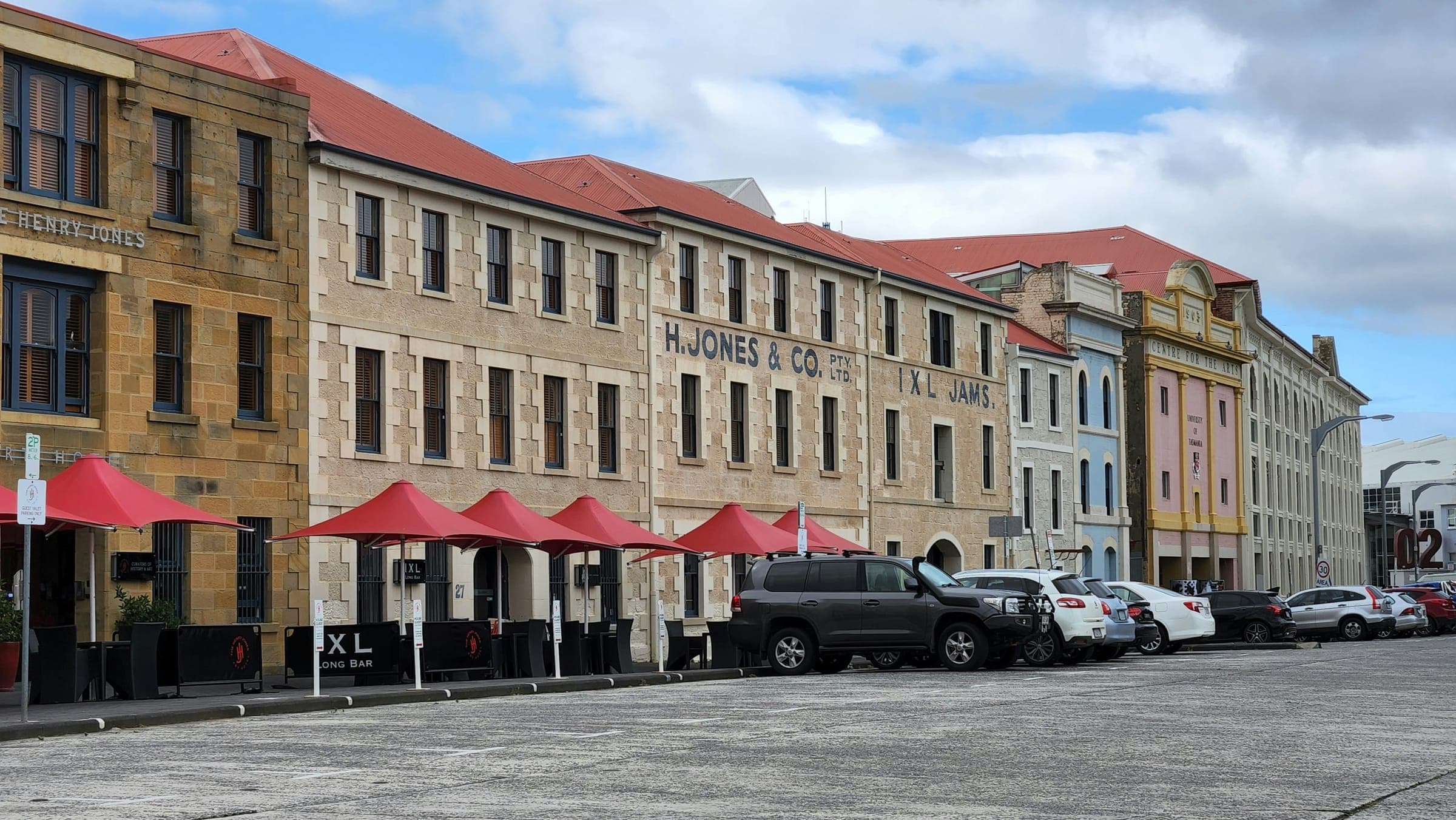
The converted IXL jam-factory warehouses on Hunter Street, pictured at the top of this page, a flat walk from PW1. Priced as one of Hobart’s premium stays.
A large full-service hotel in the centre and the naming partner of the race-weekend 5 km. The walk to the start is downhill; the walk back climbs gently.
Booking timeline
Entry is open, so there is no results date to wait for: book a refundable room in Salamanca, Battery Point, Sullivans Cove or the CBD when you enter. Two 2027 price releases had closed by September 2026, and the festival brings more than 4,000 runners into a compact waterfront hotel market that also serves ordinary weekend visitors. No official room block has been announced.
Flights from mainland Australia to Hobart are short, but international visitors connect through Melbourne, Sydney or Brisbane. Book the domestic leg on the same ticket as the long-haul flight so the connection is protected, and plan to land by Saturday lunchtime: there is no race-day bib collection. Hobart is nine hours ahead of the UK on race weekend, a difficult eastward shift; Beating Jet Lag for Marathon Tourists sets out how to start adjusting before you fly. A hire car is unnecessary for race weekend, though most trips around southern Tasmania afterwards work best with one; the race partners with SIXT, which offered runners a 15 per cent discount for 2027 entries.
See & Do
The first two are a flat walk from the finish and the hotels above; the Botanical Gardens and Mona need a little more, and the mountain needs a car.
Salamanca Place and Salamanca Market
0.3 km (0.2 miles) from finish. A row of sandstone warehouses beside the finish precinct, now cafés, galleries and shops. The Saturday market runs alongside bib collection, which makes it easy to see and hard on the legs the day before a marathon; the street itself is flat and makes a gentle walk after the race.
Tasmanian Museum and Art Gallery
0.7 km (0.4 miles) from finish. Tasmania’s state museum stands beside Constitution Dock, a flat walk from the finish. Most of the visit is indoors with seating along the way, which suits the day after the race.
Mona (Museum of Old and New Art)
12 km (7.5 miles) from finish by ferry. The ferry leaves Brooke Street Pier, beside the course at Franklin Wharf, and takes about 30 minutes up the Derwent, seated. The museum is cut down into the riverside sandstone and involves stairs and a lot of standing. It opens Thursday to Monday, so the Monday after the race works.
Royal Tasmanian Botanical Gardens
2 km (1.2 miles) from finish. The course passes the gardens on Lower Domain Road inside the first 8 km. Coming back later gives time to see what went past at race pace, though the grounds slope and cover more ground than the map suggests. April is autumn, so expect autumn colour, not spring flowering.
kunanyi / Mount Wellington
22 km (14 miles) by road from finish. The mountain behind the city, 1,271 m high, is reached by car or tour, not on post-marathon legs. The summit can be far colder and windier than the waterfront in April and the road can close in bad weather, so check conditions on the day.
Reading
Robert Hughes’s The Fatal Shore is the standard popular history of convict transportation to Australia, with Van Diemen’s Land and Port Arthur at its centre. It gives the sandstone of Salamanca and Battery Point its context, and it is the book to have read before the Tasman Peninsula trip many runners take after the race.
After the Race
April is autumn in southern Tasmania: shorter days, cool evenings and the summer crowds gone. Many of the best trips from Hobart are by ferry or a short drive. The two day trips below need no car; Bruny Island, the Tasman Peninsula and the east coast are easiest with one.
A seated river crossing from beside the course to Tasmania’s best-known museum, cut into the sandstone on the Derwent’s western bank. Mona opens Thursday to Monday, so the day after the race works.
A Georgian village on the Coal River with Australia’s oldest stone bridge still in use, built by convicts from 1823. Flat riverside paths and short distances.
A car ferry from Kettering to an island of oyster farms, cheese and a convict-built lighthouse. April is well past the summer crowds.
The penal settlement at Port Arthur, with a harbour cruise included in entry, and two nights on the peninsula’s bays. Mostly flat grass and gravel paths through the site.
Coles Bay, the granite Hazards and Great Oyster Bay, with a road route up the east coast and a flight home from Launceston. The steep Wineglass Bay lookout is optional.
Frequently asked questions
Should I stay near the start or the finish?
They are the same place: PW1 on Castray Esplanade. A hotel in Salamanca, Battery Point, Sullivans Cove or the CBD puts both within a short walk, with no buses or taxis to rely on before a 06:00 start.
How far in advance should I book a hotel?
When you enter. There is no ballot to wait for, two 2027 price releases had closed by September 2026, and more than 4,000 runners share a compact waterfront hotel market with ordinary weekend visitors.
Is there free transport to the start on race day?
No free race-day transport has been announced. Most central hotels are 5 to 20 minutes on foot from PW1, and road closures affect some bus services on race morning.
What is the best area to stay?
Salamanca, beside the start and finish. Battery Point is quieter but the walk home climbs. The CBD has the widest choice and the airport bus. Sullivans Cove sits on the course and costs the most.
When does the expo open?
Saturday 3 April 2027, 09:00 to 16:00, at PW1. There is no race-day collection, so arrive in Hobart by Saturday afternoon. Bring your registration QR code or photo ID.
What is the weather typically like on race day?
Cool: April in Hobart averages about 9°C at dawn and 18°C at its warmest. Wind off the Derwent on the three Sandy Bay legs usually counts for more than the temperature.
How do I get from the airport?
SkyBus meets flights at Hobart Airport and reaches the waterfront at Brooke Street Pier in about 30 minutes, with no booking needed. Taxis and hire cars are the alternatives.
Is there a bag drop?
Yes, at PW1 from 05:00 on race morning, in the same precinct as the start and finish. Bag size and security rules are in the athlete guide.
Should I bring a throwaway layer?
Yes. Dawn in April is often around 9°C and breezy, and you may wait up to an hour. No clothing donation scheme has been published, so discard only where the organiser says you can.
How do I get back to my hotel after finishing?
Walk. Salamanca, Battery Point, Sullivans Cove and the CBD are 5 to 20 minutes from the finish, and cars are slow around the closed waterfront. Battery Point is uphill.