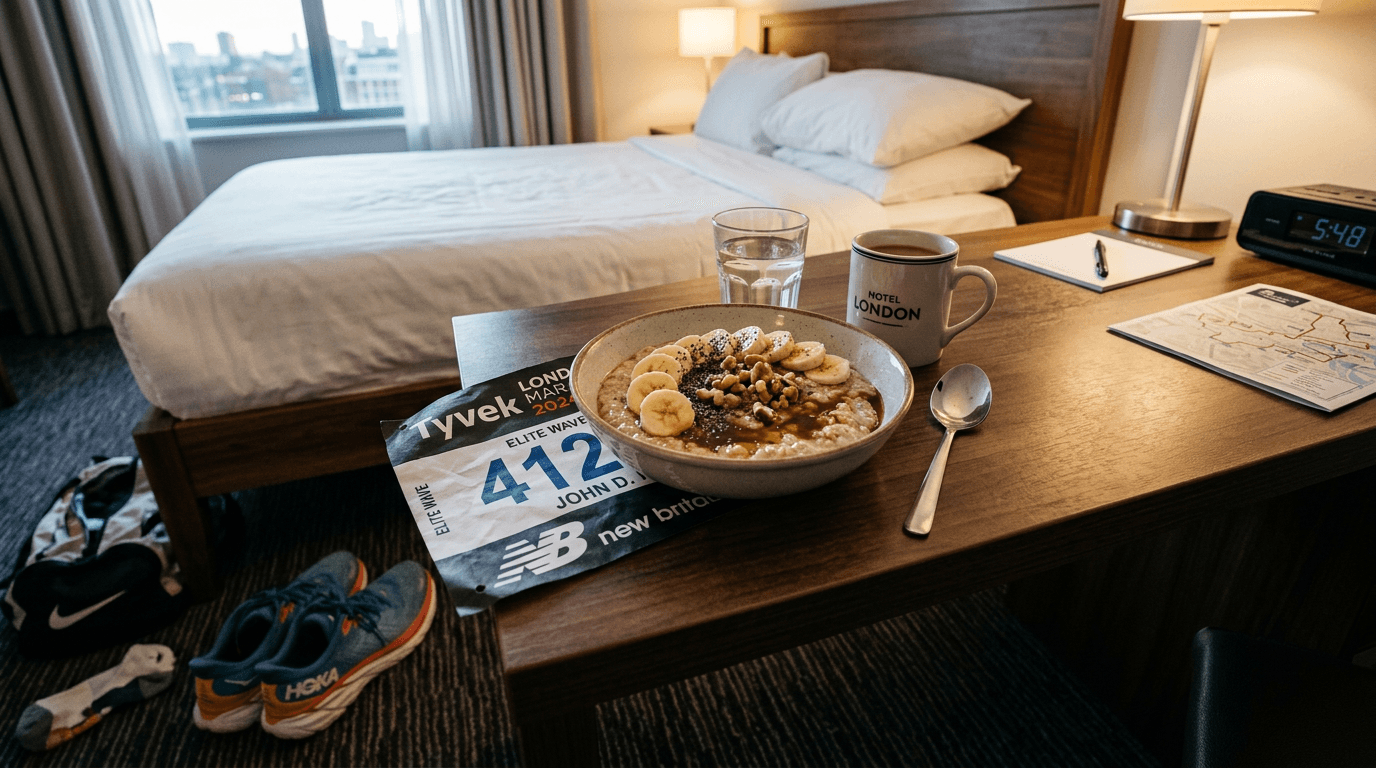
For any distance runner, the breakfast on race morning is a targeted attempt to top up a specific fuel reserve that has been running down all night: liver glycogen.
Your muscle glycogen stores are largely set by the carbohydrate loading you did in the 36 to 48 hours before the race. But your liver glycogen has been steadily used up overnight to keep your central nervous system ticking over while you slept. Start a 26.2-mile race with that tank depleted and you will find it harder to regulate blood sugar in the later miles, which is one of the more reliable routes to the wall.
The Short Cut
- The pre-marathon breakfast is specifically about restoring liver glycogen lost overnight, not topping up muscle stores (that window has passed).
- Aim for 1 to 4 grams of carbohydrate per kilogram of body weight in the two to four hours before the start.
- Keep fat and fibre low. Both slow gastric emptying, which means food still sitting heavily in your stomach when the gun goes.
- Never try anything new on race morning. Test whatever you plan to eat during long training runs months before the event.
What the Science Says
Major sports nutrition bodies, including the American College of Sports Medicine, have established a consistent framework for the morning of an endurance event. The ideal pre-marathon meal is heavily weighted towards easily digestible carbohydrates. Protein at a moderate level is fine. Fat and fibre need to be kept low. Both slow the stomach and increase the risk of gut problems at race pace.
For hydration, aim for 5 to 7ml of water or electrolyte fluid per kilogram of body weight at least four hours before the start. In practice, if your race starts at 7am, you are working with limited time. Do what you can. The core principle is simple: do not start hungry, dehydrated, or with a gut full of heavy food.
What to Eat, What to Leave
Good choices
Plain white toast or bagels digest quickly without taxing your intestines. Ripe bananas give easily accessible simple sugars alongside potassium. White rice or rice pudding is gentle on nervous stomachs. Honey and jam provide fast carbohydrate. Rice Krispies are basic carbohydrates and nothing more complicated.
Things to avoid
Wholemeal bread and bran flakes are high in insoluble fibre, which accelerates gut transit, which is the last thing you want when you are about to run for several hours. Avocado, bacon, and eggs are heavy on fat and protein, which slow gastric emptying and leave you feeling sluggish at the start line. Croissants and pastries are high in butter fat, which delays digestion and provides poor immediate fuel.
A Personal Favourite: Porridge, Chia, and Honey
The breakfast I keep coming back to is porridge with chia seeds and honey. The science explains why it works.
Oats release energy gradually rather than dumping sugar into your system all at once, which prevents the blood sugar spike and subsequent crash you can get from purely high-glycaemic foods. Honey contains both glucose and fructose. Having two types of carbohydrate available simultaneously improves intestinal absorption rates and optimises liver glycogen storage more effectively than glucose alone. Chia seeds add useful nutrients and help with hydration. I have been using them since reading Christopher McDougall's Born to Run, though the portion matters: too many will slow gut clearance, so use them in moderate amounts.
I came to this combination through trial and error over many long training runs, which is exactly how you should arrive at yours.
The Hotel Problem
One of the more practical challenges of marathon tourism is that hotel breakfast schedules rarely align with race start times. If the buffet does not open until 7:30am and your race starts at 9:00am, you do not have the digestion window you need.
The simplest solution is to pack instant porridge pots and a compact travel kettle. You control the timing, you eat exactly what you have tested, and you are not dependent on whatever the hotel happens to be serving. A dual-voltage travel kettle that packs flat takes up minimal luggage space and removes the problem entirely.
Related reading: Race morning nutrition is the final piece of a multi-day fuelling plan. The Golden Rules of Glycogen covers the 48-hour carbohydrate loading protocol that sets muscle glycogen before race day. For travelling runners dealing with jet lag and unusual meal timing, Beating Jet Lag for Marathon Tourists covers how to adjust eating schedules across time zones. The race morning logistics for individual events, including expo closure times, bag drop locations, and hotel proximity to the start, are covered in the race pages for London, Berlin, Tokyo, and Chicago.
The Extra Mile
- Kanter, M. (2023). Carbohydrates and Endurance Exercise: A Narrative Review of a Food-First Approach. Nutrients, 15(6), 1460. MDPI.
- Thomas, D. T., Erdman, K. A., & Burke, L. M. (2016). American College of Sports Medicine Joint Position Statement: Nutrition and Athletic Performance. Medicine & Science in Sports & Exercise, 48(3), 543–568.
- Burke, L. M., et al. (2011). Carbohydrates for training and competition. Journal of Sports Sciences, 29(Suppl 1), S17–27.
- Jeukendrup, A. E. (2014). A step towards personalised sports nutrition: carbohydrate intake during exercise. Sports Medicine, 44(Suppl 1), 25–33.
The information in this article is for educational purposes only and does not constitute nutritional or medical advice. Always consult a qualified healthcare professional before changing your dietary or training protocols.