| Next Race Date | 7 February 2027 |
|---|---|
| Course Type | Two loops (start and finish ~0.2km apart) |
| Registration | Open |
| Ballot Opens | Not applicable |
| Total Finishers | To be Confirmed |
| Average Race Day Temperature | To be Confirmed |
| Cutoff Time | To be Confirmed |
| Free Race Day Transport | To be Confirmed |
| Course Certification | To be Confirmed |
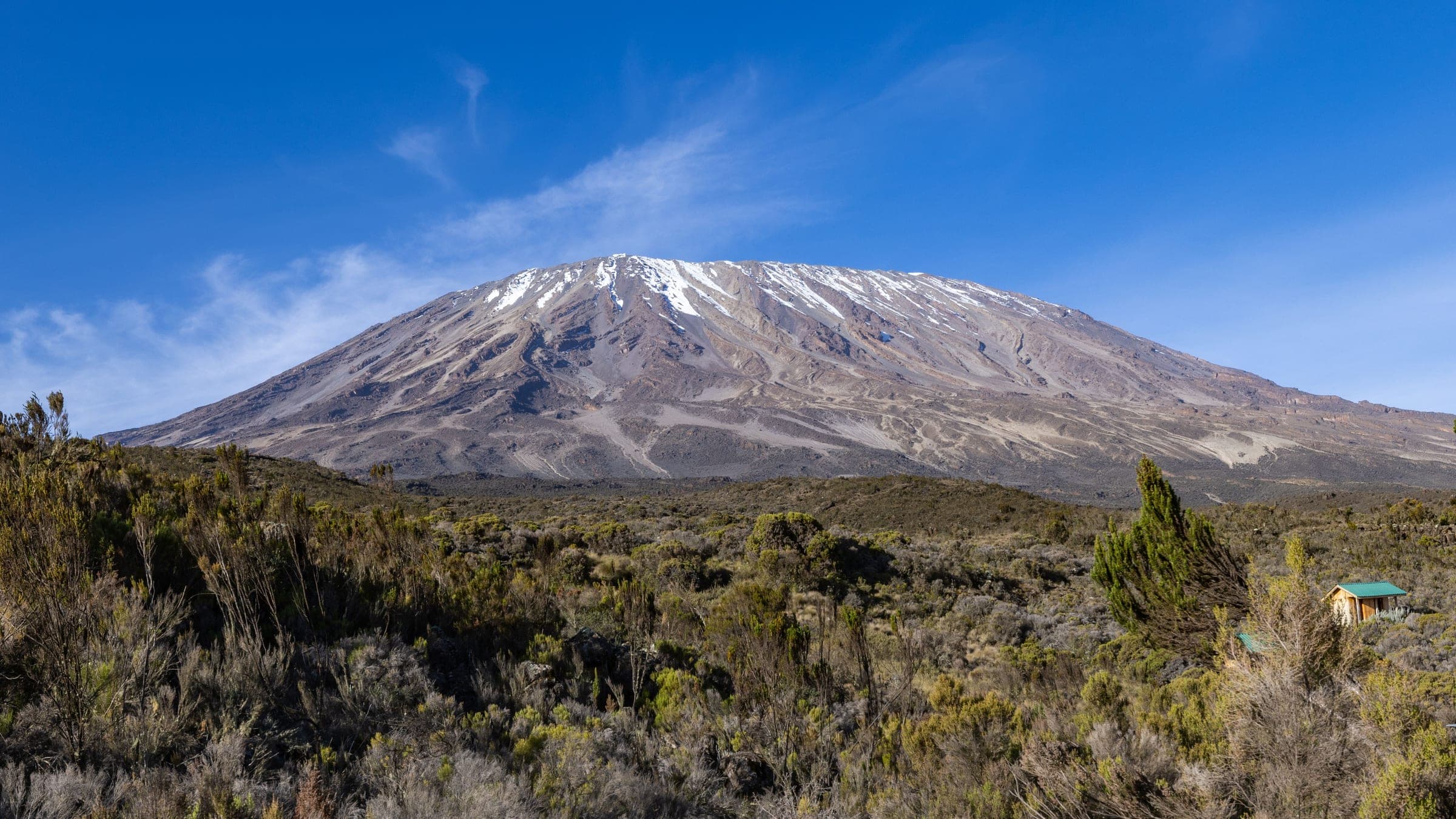
This is a road race, not a climb
The marathon is run on roads around Moshi. A bib does not include park access or a guide for the mountain, and a climb is a separate guided trip with its own permits.
Before you go
Entry, accommodation and travel: what to sort out before you book.
Entry
Entries opened on 19 October 2026. Marathon fees are reported as USD 80 for international runners, USD 55 for Tanzania residents, East African work-permit holders and SADC citizens, and TZS 55,000 for Tanzanian and East African citizens, with a midnight deadline on 15 December 2026, earlier closure at capacity, card payment settled in South African rand and no refunds. The organiser’s fee document did not load, so treat these as unconfirmed until you see them at checkout. No sterling conversion is given.
Wild Frontiers, the official travel partner, offers packages with guaranteed entry, airport transfers, race-weekend accommodation and event transport. A package is optional. The minimum marathon age is reported as 20. No ballot, qualifying-time or deferral policy has been found.
For UK passport holders, the FCDO requires a visa (an e-visa or single-entry visa on arrival), six months’ validity and a blank page. It also requires government-provided inbound insurance for most visitors, and a private policy does not replace it. Yellow-fever rules depend on where you travel from. The FCDO highlights malaria and dengue and limited medical facilities outside Dar es Salaam, and advises against all but essential travel to the Mozambique border area only.
Fast Runner / GFA Standards
No ballot, qualifying time or guaranteed-entry route has been found.
Where to Stay
Choose a Moshi base. The start and finish share the university grounds, so Arusha and Dar es Salaam are too far for race morning. Uru Road and Sokoine Road lie near the university approaches but may be closed on race morning.
Moshi town
Riadha Street puts you in the town centre, and Lema Road suits a self-contained stay with a transfer. Mailisita is quieter and needs a vehicle. Do not confuse Kibo Palace Hotel Moshi with its Arusha branch, or Keys Hotel’s main site with the Mbokomu one.
Recommended hotels
Race supplier near the university approach. Confirm the main hotel, not the Mbokomu branch.
Race supplier with on-site meals. Needs a vehicle plan.
Pool and airport pickup. Breakfast and 10:00 checkout clash with racing.
Town-centre option. Not the Arusha hotel.
Quiet boutique stay with luggage storage. Needs a private transfer.
Booking timeline
Entries are open, so you can compare flexible rooms now. Confirm entry and a transfer before you accept restrictive terms, and check that no package still quotes the superseded March date. Plan to reach your collection city before its desk closes. No sell-out pattern or hotel premium has been found.
Race weekend
The expo, number collection and the days either side of the start.
Race Weekend
Expo
Kit collection is listed in Dar es Salaam on 29 to 31 January, in Arusha on 2 and 3 February and in Moshi at the university on 4 to 6 February. Collecting in Dar es Salaam or Arusha does not move the race, so you still need to reach Moshi. No race-day collection has been reported. Confirm the venues, hours and any proxy rules with the organiser.
Getting to the Start
The start is reported at 06:30 at the university grounds, so prepare for a pre-dawn departure. The 2026 traffic notice described parking via Uru Road and restrictions on Sokoine Road, so a taxi may not reach the usual drop-off. Ask your hotel or travel partner for the approved approach and a named return pickup.
Primeland’s normal breakfast starts at 06:30, which is too late for a runner, so arrange an early meal. Start-area toilets, a bag drop and a security process are unconfirmed. Leave valuables at the hotel, and keep the finish plan flexible.
What to wear
No race-hour February temperature normal has been found. The 2026 race, in March, started in rain, which says little about February. Check the forecast close to the date, and decide how you will keep any spare layer, because no bag drop is confirmed.
Race day
The course, the clock, getting to the start and what to carry.
The Race
The course
The marathon starts and finishes at the Moshi Co-operative University grounds. It is a foothill road race on a loop of about 21 km, run twice, and not a climb of the mountain. Written descriptions of the route differ, and a recent guide mentions a gravel section, so check the final map before you choose shoes or plan supporters.
Each loop climbs 284 m in 9.8 km, from 887 m at the start to 1,173 m at the northern turn, then descends 292 m in 10.7 km to 878 m at km 20.5. The pattern repeats from km 21: 292 m up to 1,173 m at km 30.7, and 277 m down to the finish. These figures are estimates.
The loop climbs one road and descends another, so no part of the lap is run in both directions. On the 2026 line the course passes the university grounds at km 21, which puts a supporter at the start in position to see the halfway pass and the finish.
Km 0 to 10: up the northern road. The line leaves the university area and runs north on Sokoine Avenue through Moshi from km 1 to 5, rising from 887 m to 1,038 m. It passes Kirima Kati at km 6 to 8 and reaches Kibosho Road at Kirima by km 10, where the lap peaks at 1,173 m at km 9.8, 8.7 km in a straight line from the start. The climb averages 2.9% and the steepest 200 m is about 7%.
Km 10 to 21: down the western road.The turn is on Kibosho Road at Kirima, and the descent takes the westerly return: Kibosho Road past km 14, Longuo ’A’ at km 15 and 16, Lema Avenue at km 17 and 18 and Kilimanjaro Road at km 19 and 20. The road falls 292 m, 2.7% on average, to 878 m at km 20.5, the lowest point of the course.
Km 21: the halfway pass. The line passes the university area at km 21 within 190 m of the start, at 886 m, and turns north again onto Sokoine Avenue.
Km 21 to 31: the second climb. The second lap repeats the first. Sokoine Avenue runs from km 21 to 26, Kirima Kati from km 27 to 28, Sungu at km 29, and the road reaches Kibosho Road at Kirima for the high point of 1,173 m at km 30.7. The climb is 292 m in 10.2 km, 2.9% on average.
Km 31 to 42.2: the second descent.The descent runs Kibosho Road through Kirima, past Kncu at km 35 and Longuo ’A’ at km 36 and 37, then Lema Avenue and Kilimanjaro Road. The last 11 km fall 277 m, 2.7% on average, to 893 m at km 41.1. The finish is on Sokoine Avenue, about 0.2 km from the start.
Course Map
The map shows both loops from the university grounds up to Kirima and back, with the start, the finish and the northern turn. Tap a marker for details, and scrub the slider or press play to move the orange marker along the course with the elevation profile beneath it.
Nutrition on Course
Water cups are reported roughly every 4 km, with cola at some stations and advice to bring your own gels. The organiser’s aid schedule has not been published, so carry the fuel you have trained with.
Spectating
The simplest plan is to stay at the university grounds, where the start and finish share one complex, once you have the public-access map. On the 2026 line the course passes the grounds again at km 21, so a supporter there sees the start, the halfway pass and the finish. Seeing a runner in town depends on closures that change through the morning, and no official tracking has been verified. Agree a meeting point and a backup if phones fail. A 06:30 gun gives arithmetic windows of about 10:30 for a four-hour finish and 11:30 for five hours, before delays.
After the race
Where to eat, what to see and how to spend the days after the finish.
See & Do
Four options around Moshi, in the order they suit tired legs.
Post-Race Food
Salinero Kilimanjaro, off Lema Road, serves wood-fired pizza and à-la-carte lunch indoors and outdoors. Primeland Hotel on Sokoine Road publishes lunch from 12:30 to 15:00. Keys Hotel on Uru Road has a restaurant, bar and coffee lounge. None is shown to be walkable from the finish, and Sunday kitchen hours are unconfirmed, so book a table. No official finish meal has been found.
Materuni coffee experience
A farm, roasting and lunch visit. The normal tour includes a waterfall hike, so ask for a coffee-only version.
Materuni Waterfall
About one hour of hiking on moderate slopes, so it is not an easy recovery walk.
Chemka (Kikuletwa) hot springs
About 35 km (22 miles) from Moshi by the tourism authority’s figure. Check road access and swim only if you want to.
Lake Chala
A crater lake on the Kenyan border. Check transfers, rim access and operators.
Read Before you Run
Kilimanjaro: The Trekking Guide to Africa’s Highest Mountain
Henry Stedman
Trailblazer’s sixth edition, covering Moshi and Marangu alongside the mountain routes. It is a trekking guide, not a marathon handbook, so check permits and health guidance separately.
After the Race
The race is on a Sunday in February, so the excursions start on Monday with legs that have climbed about 290 m twice. Each option here is vehicle-based, with walking kept short.
A coffee-farm visit with a driver, with the waterfall hike optional.
A crater-lake night arranged through an operator.
Two quiet nights in Moshi with a coffee visit and the hot springs.
A safari extension arranged through Wild Frontiers.
Background
History
The race dates its beginning to 2003 and has been held in Moshi since. The opening field was about 400 runners, and recent editions have drawn more than 45 nationalities across all distances, figures that describe the whole event and not the marathon alone. The sponsor partnership with Kilimanjaro Premium Lager is long-standing, and the 2027 race is promoted as the 25th edition.
The latest race ran on 22 March 2026 in early rain. Kenya’s William Morwabe won the men’s marathon in 2:18:52 and Alice Kamunya the women’s in 2:50:33. These are edition results, not course records. February was the race month from 2022 to 2025, 2026 moved to March, and 2027 returns to February.
Frequently asked questions
Should I stay near the start or the finish?
Both are at the university grounds in Moshi. Choose a Moshi hotel with a written transfer plan.
How far in advance should I book a hotel?
Entries are open, so compare flexible rooms now. No sell-out deadline has been found.
Is public transport free on race day?
No general entitlement has been found. Travel packages include specified transfers.
What is the best neighbourhood to stay in?
Moshi. Uru Road, Sokoine Road, Riadha Street and Lema Road each have verified hotels; none has a measured walk.
When does the expo open?
Kit collection is listed in Dar es Salaam, Arusha and Moshi between 29 January and 6 February. Confirm hours with the organiser.
What is the weather typically like?
No February race-hour normal has been found. Check a forecast near the date.
How do I get from the airport?
Fly to Kilimanjaro International (JRO) and book a hotel or partner transfer.
Is there a bag drop?
Unconfirmed. Leave valuables at your hotel.
Should I bring a throwaway layer?
No disposal scheme has been found, so plan how to carry or hand over a layer.
How do I get back to my hotel after finishing?
Arrange a pickup outside the controlled area and a flexible time.