| Next Race Date | 4 September 2027 |
|---|---|
| Course Type | Point to point |
| Registration | To be Confirmed |
| Ballot Opens | Not applicable |
| Total Finishers | To be Confirmed |
| Average Race Day Temperature | To be Confirmed |
| Cutoff Time | 6 hours |
| Free Race Day Transport | To be Confirmed |
| Course Certification | To be Confirmed |
The start is a long way from the finish
The marathon starts at the Equator in Kikorongo and finishes in Kasese. A hotel near the arena does not put you at the start, so plan the shuttle and the return before you book.
Plan your pace for the Mt. Rwenzori Marathon for you and your supporters
Turn a goal time into grade-adjusted splits, and see when your supporters should be where.
Build your pace planBefore you go
Entry, accommodation and travel: what to sort out before you book.
Entry
Registration for 2027 had not reopened when checked. The registration page showed carried-over bands: before 1 July, UGX 50,000 for the regional category and USD 50 for international runners; from 1 July, UGX 60,000 and USD 60. At 0.7504 pounds to the dollar on 29 October 2026 the international fees are about £37.52 and £45.02 before charges. These are not 2027 prices. The regional category covers Uganda, Kenya, Tanzania, Burundi and Rwanda, with residency proof.
In 2026 entry was online with a confirmation email needed at collection. The entry terms prohibit refunds and transfers, and the minimum age is 18. No ballot, qualifying time, charity allocation or guaranteed tour place was found.
For UK passport holders, FCDO requires six months’ validity and an online visa application, with the barcode authorisation printed. An East African tourist visa is listed at USD 100 (about £75.04) for travel across Uganda, Kenya and Rwanda over 90 days, which may not suit a Uganda-only trip. Uganda’s immigration authority announced on 2 October 2026 that a yellow-fever certificate is no longer mandatory for entry, though TravelHealthPro still lists transmission risk. It rates malaria risk as high. FCDO reported the Ugandan Ebola outbreak over on 27 August 2026 while transmission continues across the border, so check current advice.
Fast Runner / GFA Standards
No ballot, qualifying time or guaranteed-entry route has been found.
Where to Stay
Central Kasese is the first area to look at, because collection and the finish are there. Kikorongo is the choice for runners who want a short walk to the start, at the price of a longer trip back.
Kasese and Kamaiba
Central Kasese, around Rwenzori Road, holds the arena shuttle point and the finish. Kamaiba is a quieter hotel base on the edge of town. No pedestrian routes were measured.
Kikorongo and the escarpment
Kikorongo suits runners who want the short walk to the start but means a longer trip back. Safari lodges on the escarpment suit a combined trip and need a driver at both ends.
Recommended hotels
Central base for the arena shuttle. Ask about an early breakfast.
The municipal listing confirms the address. Check restaurant hours.
About 1 km from the start per the organiser. Hillside cottages; needs a return from Kasese.
Budget rooms and camping, described as within 2 km of the start. Check facilities.
Luxury safari base. Needs private transport at both ends.
Booking timeline
The date is confirmed, so compare flexible rooms now. Entry opening and fees are not yet known. Allow for a long journey from Entebbe, which the organiser puts at about eight hours by road, or a domestic flight to Kasese. See a travel clinic at least eight weeks ahead. No sell-out pattern was found, and the move to September is not a guarantee of cheaper rooms.
Race weekend
The expo, number collection and the days either side of the start.
Race Weekend
Expo
In 2026 kit was collected in Kampala on 14 to 16 August and at the Kasese arena on 19 to 21 August, with the confirmation email shown on paper or a phone. The kit held a shirt, a bib with timing chip and four pins. Collection for 2027 has not been announced, and Kampala is a long road journey from Kasese, so keep the arrival, collection and transfer as separate plans.
Getting to the Start
The start is at the Equator in Kikorongo, a long way from the finish in Kasese. In 2026 full-marathon runners staying in town took a shuttle from the arena between 03:45 and 04:15, assembled at 05:30 and started at 06:00, with the highway closed from 04:00 to midday. Ask whether 2027 repeats this. Boarding rules and companion places were not published, so do not assume a supporter can come.
If you stay near Kikorongo, ask the lodge for its race-day transfer and a return from Kasese, because the closure affects vehicles. Arrange an early breakfast in writing. No bag transport from the start to the finish was found, so leave valuables at your accommodation.
What to wear
September falls inside Kasese’s August to November rainy period, and altitude changes the weather quickly. No race-hour September normal was found, so check the forecast near the date and carry a light waterproof.
Race day
The course, the clock, getting to the start and what to carry.
The Race
The course
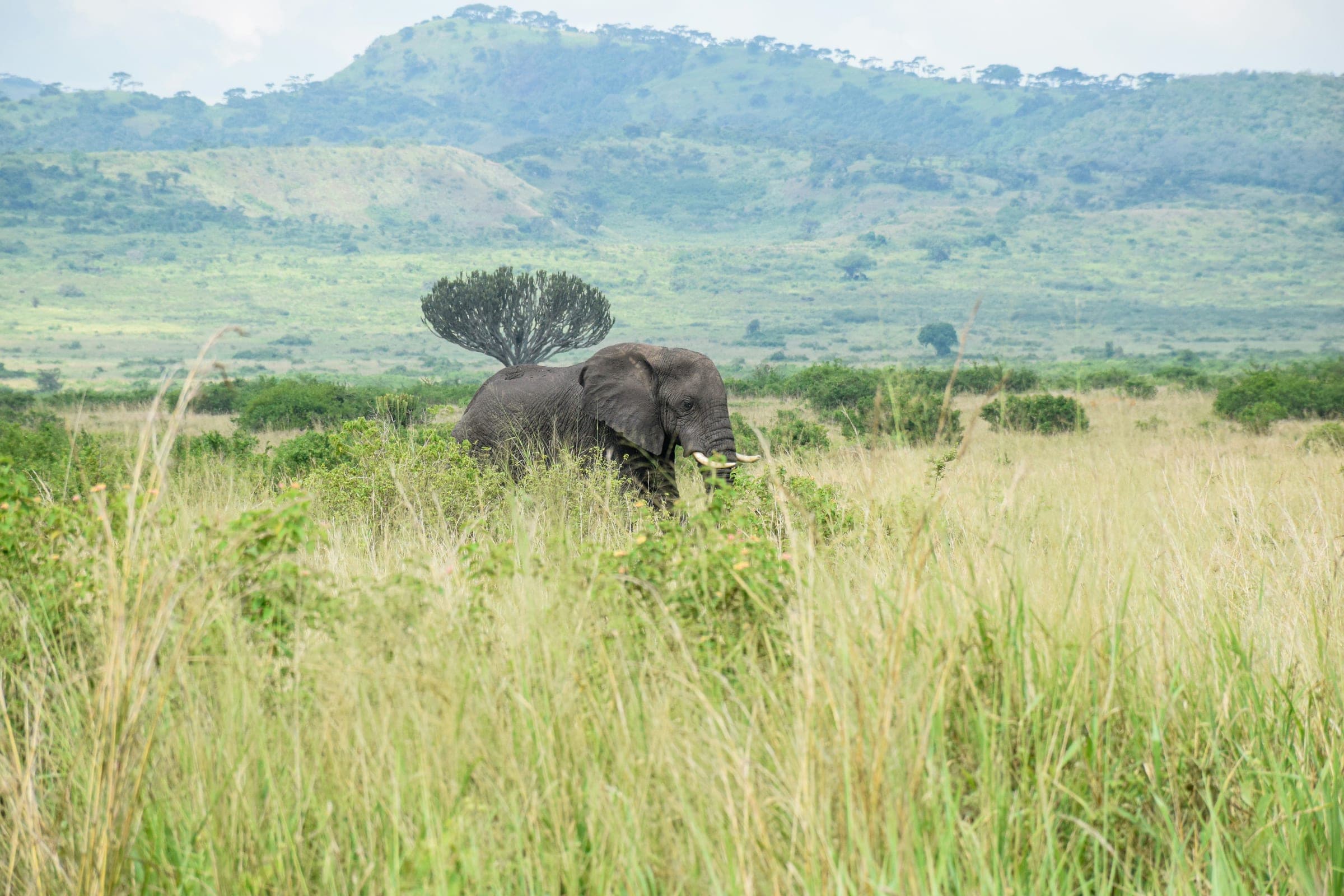
The 2026 marathon started at the Equator in Kikorongo, on the Kasese to Mbarara highway, and finished at the Arena on Stanley Street in Kasese. The organiser describes about 20 km of main road with Lake George on the right and the Rwenzori foothills on the left, then a run through Kasese and out alongside the Nyamwamba River towards Kilembe Mines before the return to the arena. The 2027 route has not been confirmed.
On the 2026 line the first 21 km are almost flat. The road stays between 930 m and 976 m from the Equator at 946 m, with the course low of 930 m at km 5. The climb starts at km 21 and takes 262 m over 12.2 km, 2.1% on average, to the course high of 1,225 m at km 33.4, where the line turns. The return falls 248 m in 8.8 km, 2.8% on average, to the finish at 977 m. The organiser’s published figure for the whole course is 410 m of ascent.
Km 0 to 10: the Equator and the highway. The line leaves the Equator at Katunguru and runs north-east on the A5 through Kikorongo from km 1 to 9, rising from 946 m to 951 m, dipping to 931 m at km 5 and returning to 966 m at km 9. Lake George is on the right and the foothills on the left.
Km 10 to 23: Muhokya and Kamaiba. The A5 passes Muhokya at km 10 to 12 and Kamaiba at km 13 to 19, between 945 m and 975 m, then follows the Fort Portal to Mpondwe road through Kirembe from km 20 to 23. The ground is almost flat, with no climb above 32 m.
Km 24 to 33: out along the Kilembe road. The line reaches its easternmost point near Kasese at km 24, 23 km in a straight line from the start, then turns back west and north-west through Nyakasanga Lower and Kasanga to the Kilembe road at km 27. From there it climbs to 1,046 m at km 27 and 1,212 m at km 33, with the steepest 200 m, 7.1%, at km 26.8.
Km 33 to 42.2: the turn and the return. The turn is at km 33.4 at 1,225 m, 21 km from the start. The return runs back down the Kilembe road, with a 7.1% fall over 200 m at km 40.2 on the way to the finish at the arena in Kasese, at 977 m.
Course Map
The map shows the 2026 line from the Equator up the highway to Kasese and out along the Kilembe road, with the start, the finish and the turn. Tap a marker for details, and scrub the slider or press play to move the orange marker along the course with the elevation profile beneath it.
MarathonPassport
Pace plan and spectator planner for the Mt. Rwenzori Marathon
Enter a start time and goal finish, then tap the course map. Each point you pick shows the window of time your runner is expected to pass it.
Nutrition on Course
In 2026 water in bottles and cups was offered every 3 to 5 km, with soft drinks, and the organiser told runners to bring their own gels. Red Cross teams and two ambulances covered the route, and light massage was offered at the finish.
Spectating
The finish arena in Kasese is the simplest place for a supporter, because the start is a shuttle ride away. A 06:00 start gives arithmetic windows of about 10:00 for a four-hour finish and 11:00 for five hours, before delays. A sighting in town before the finish may be possible, but wait for the 2027 map. No live tracking was verified. FCDO reports terrorism risk and concerns in western Uganda, so check its advice before travelling.
After the race
Where to eat, what to see and how to spend the days after the finish.
See & Do
Four options within reach of Kasese, all vehicle-based or seated.
Post-Race Food
No finish-food menu was found. Sandton Hotel on Rwenzori Road has a restaurant and room service. Rwenzori International Hotel in Kamaiba has a restaurant whose hours were not confirmed, so ask before relying on them. Lodges outside town may suit a meal after a confirmed return transfer. FCDO advises bottled or boiled water.
Equator monuments, Queen Elizabeth National Park
A short stop outside the race closure, confirmed by the Uganda Wildlife Authority.
Kazinga Channel
A boat trip between Lakes Edward and George. Check boarding steps.
Rwenzori foothills and Bakonzo cultural visit
Guided nature and community visits. A summit climb is a separate expedition.
Kibale chimpanzee tracking
Advance booking and a minimum age of 16. Two to five hours of walking.
Read Before you Run
Guide to the Rwenzori
Henry Osmaston and David Pasteur
A regional guide to the Rwenzori Mountains, relevant to the mountains beside the race. It is not a race manual, and permits and security need checking separately.
After the Race
The race is on a Saturday in September, so the excursions start on Sunday with legs that have climbed 262 m and descended it again. Each option here is vehicle-based or seated.
A seated boat trip with a driver.
A lodge night and one guided park activity.
A rest day then chimpanzee tracking.
A rest day, a guided foothill visit and a nature stay.
Background
History
The Mt. Rwenzori Marathon began on 3 September 2022, and a UNDP account links it to tourism recovery and local employment after the pandemic. The second edition on 2 September 2023 drew up to 2,000 participants from 14 countries across all distances. By 2025 the organiser reported 6,000 registrations from 36 countries, again across the whole festival.
In 2026 the race held a World Athletics Label listing and a re-measured course with a larger finish arena. On 22 August 2026 Uganda’s Leonard Chemonges won in 2:13:25 and Kenya’s Margaret Jepchumba in 2:39:15. Those are edition results, not course records. The sixth edition has moved to 4 September 2027, partly to ease pressure on accommodation. The organiser says it hopes to pursue an Elite Label, which is an aim and not an award.
Frequently asked questions
Should I stay near the start or the finish?
Central Kasese suits collection and the finish. Kikorongo suits the start but needs a confirmed return.
How far in advance should I book a hotel?
The date is confirmed, so compare flexible rooms now. No sell-out deadline was found.
Is public transport free on race day?
No general entitlement. A 2026 shuttle ran from the arena to the start, with no published fare.
What is the best neighbourhood to stay in?
Central Kasese first. Sandton Hotel and Rwenzori International Hotel are verified options.
When does the expo open?
2027 dates are unannounced. In 2026 kit was collected in Kampala and at the Kasese arena.
What is the weather typically like?
September is in the rainy period. No race-hour normal was found.
How do I get from the airport?
Fly to Entebbe. The organiser estimates about eight hours by road to Kasese, or a domestic flight.
Is there a bag drop?
Not confirmed. Leave valuables at your accommodation.
Should I bring a throwaway layer?
No disposal scheme was found, so plan how to keep a layer.
How do I get back to my hotel after finishing?
Central hotels may be walkable once the exit is checked. Lodges need a pre-agreed pickup.