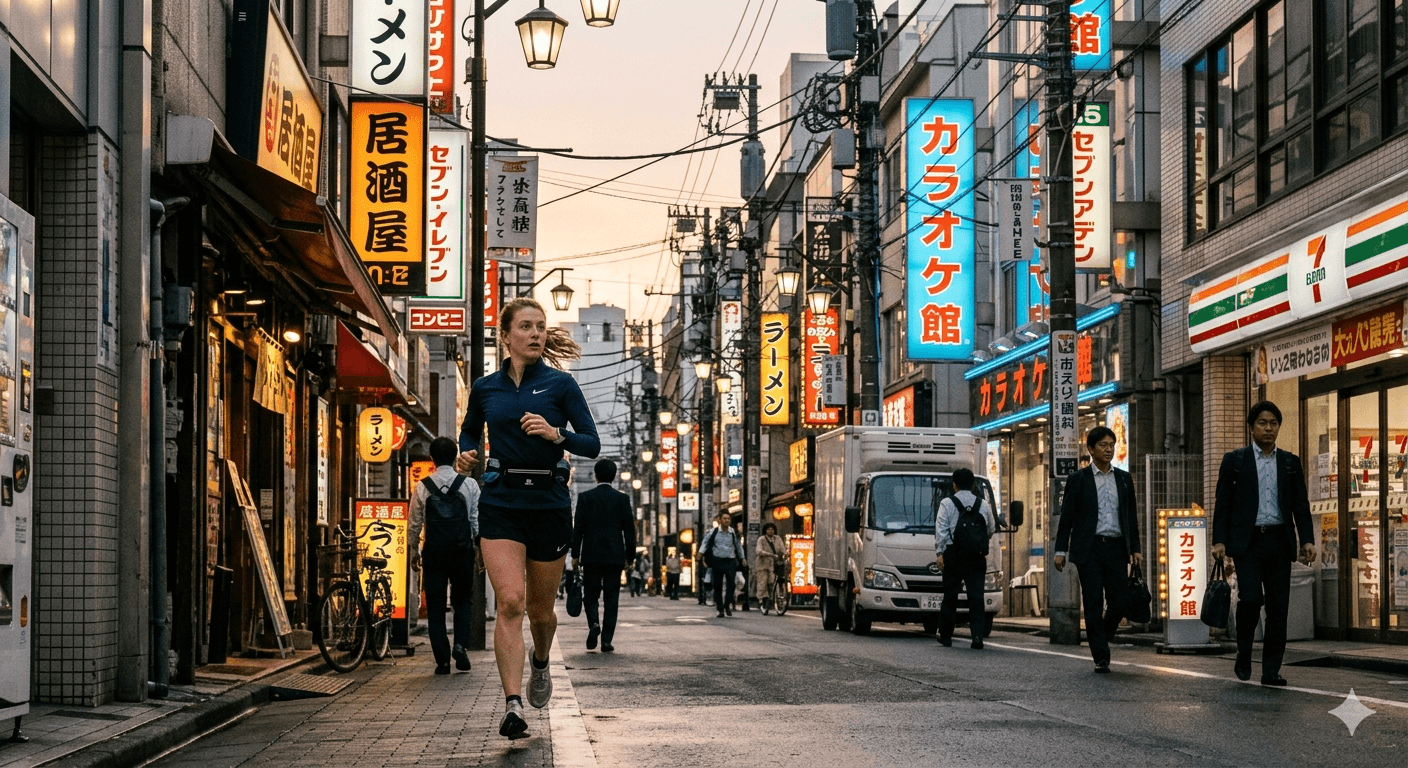
The Short Cut
- Arrive two days before race day at minimum. For long-haul flights, three days is the practical floor; four is better.
- Everything race-critical travels in the cabin. Race shoes, timing chip, gels, race outfit: none of these can be sourced at the expo the night before.
- A throwaway layer for the start is not optional. You will stand in a holding area for 45 to 90 minutes in conditions that vary from cold and grey to genuinely freezing.
- The race ends at the finish line. The two hours after finishing often determine whether the rest of the trip is enjoyable or miserable. Plan for them.
Arrive Early Enough to Mean It
The standard advice is to arrive two days before race day. The better advice is three, and for long-haul flights, four. One day to recover from travel is not enough if you have crossed multiple time zones, especially eastward where jet lag tends to hit harder. By arriving earlier, you give yourself a full day to collect your bib and race pack in a calm state, walk part of the course if it is accessible, eat familiar food, and simply sleep in the hotel before race morning.
Do not use the extra days for intensive sightseeing. The temptation is real: you are in a new city and the running shoes can wait. But 20,000 steps around a museum the day before a marathon has ended many well-prepared runners' races before they started.
The Kit Problem
Everything race-critical travels with you in the cabin. This means bib wallet, racing shoes, timing chip, energy gels, your race-day outfit, and whatever you run with on your wrist. This is the category of item you cannot replace at the race expo at 7pm the night before because the expo closes at 6pm or has sold out.
Super shoes in particular need careful packing. The foam stack and carbon geometry deform under compression. Pack them in a rigid case or box with structure around them, not squashed into the sides of a bag. Some runners pack them as carry-on in a shoe box and check a pair of trainers instead.
At the race expo, buy nothing you have not tested before. A new vest, a different gel brand, a pair of compression socks you have never run in: race morning is not the time to discover what your body thinks of any of these.
The Throwaway Layer Problem
Start lines in April in London, March in Tokyo, October in New York all involve standing in a holding area for 45 to 90 minutes in cool to cold conditions. If you wear your race kit from the hotel to the start, you will be cold and damp before the gun goes. If you bring a jacket you want to keep, you face a long queue at bag drop or an expensive decision.
The solution is a throwaway layer: a cheap fleece, an old hooded sweatshirt, a charity shop find. Wear it to the start, keep warm through the wait, drop it at the last moment before your wave goes. Organisers collect everything discarded and donate it. Budget for it and do not wear anything to the start line you want to see again.
Food and Water
Three days out, do not experiment with local cuisine in unfamiliar combinations. Eat broadly what you eat at home for carbohydrate loading: rice, pasta, bread, whatever your body knows and trusts. This is not the trip for the fermented fish market, the extremely spicy street food, or the third glass of wine.
Tap water quality varies. If you have any doubt about the local water supply, drink bottled water throughout your stay and, critically, on race morning. Gut problems on race day are usually traceable to something eaten or drunk in the 48 hours before.
The Course Reconnaissance
Most major international races publish detailed course maps and elevation profiles online. Read them. Not for general inspiration but for tactical purposes: where are the climbs, where is the wind likely to come from on the main exposed sections, where does the course narrow at bottleneck points early in the race.
If you can run or walk even the first 5km of the course the day before, do it. You will know exactly where the first kilometre of congestion is, where the footing is uneven, and whether the route feels like what you imagined. That preview pays dividends when you are in wave three at 7am and your brain is too tired to process maps.
Time Zones and Race Morning
For long-haul eastward trips in particular, your body's internal race time will be different from the local race start. If you normally run at 7am and the race starts at 9am local time but you have flown in from the US, your body may well think it is 3am. Adjust sleep and meal timing in the days before. Go to bed earlier, not later, expose yourself to morning light, and be deliberate about when you eat your pre-race meal.
Race morning is typically very early: 5:30am hotel departures near major urban start lines are common. This is not the morning to discover that breakfast service starts at 7am. Bring your own pre-race food from home or from a supermarket the day before: whatever you train on, in the quantity you train on.
The Post-Race Reality
You will finish the race in a different physical state than you started it. Bag drops at major international marathons involve queues, sometimes very long ones, in immediate post-race conditions. You may be walking very slowly in a thin foil blanket in October drizzle for 25 minutes before your warm clothes. Plan for this physically and logistically: book accommodation close to the finish rather than the start, have warm dry clothes including socks at the top of your bag drop bag, and have a simple plan for food within an hour of finishing.
The race ends at the finish line. The trip continues, and the decisions you make in the first two hours after finishing often determine whether the next 48 hours are enjoyable or miserable.
The Short Checklist
Before you fly: race shoes broken in, kit tested, gels confirmed, jet lag strategy in place, throwaway layer packed, hotel confirmed within 2km of finish.
Race morning: pre-race food from home or supermarket, kit laid out the night before, phone charged, course first 5km memorised.
Post-race: warm layer at top of bag drop, plan for hot food within 60 minutes, nothing booked requiring you to be on your feet for the rest of the day.
Related reading: Jet lag management for long-haul race travel is covered in full in Beating Jet Lag for Marathon Tourists. For carbohydrate loading in the days before, The Golden Rules of Glycogen and Race Morning Fuel cover the nutrition planning. Race-specific logistics for the most popular destination marathons: Tokyo, Boston, London, Berlin, Chicago, New York City, and Sydney.
The Extra Mile
For the science behind jet lag and race preparation, Beating Jet Lag for Marathon Tourists covers the mechanisms and the practical strategies in full. Lonely Planet's city guides for Tokyo, London, Berlin, and New York all include useful neighbourhood-level logistics that complement what is on the race pages. For kit packing, the relevant race expo hours are always published on the official race website in the weeks before the event.